Health appraisal form
A health appraisal form is a record a licensed provider signs to document someon...

2
Last Updated: Oct 13, 2026
The best patient experience software for most private practices is Pabau, our all-in-one practice management platform. It keeps booking, charting, payments and feedback on one patient record. We compared seven platforms that private practices, med spas and multi-location groups shortlist in 2026. Weave, NexHealth, Solutionreach, Doctible, Klara and Phreesia each win a narrower lane.
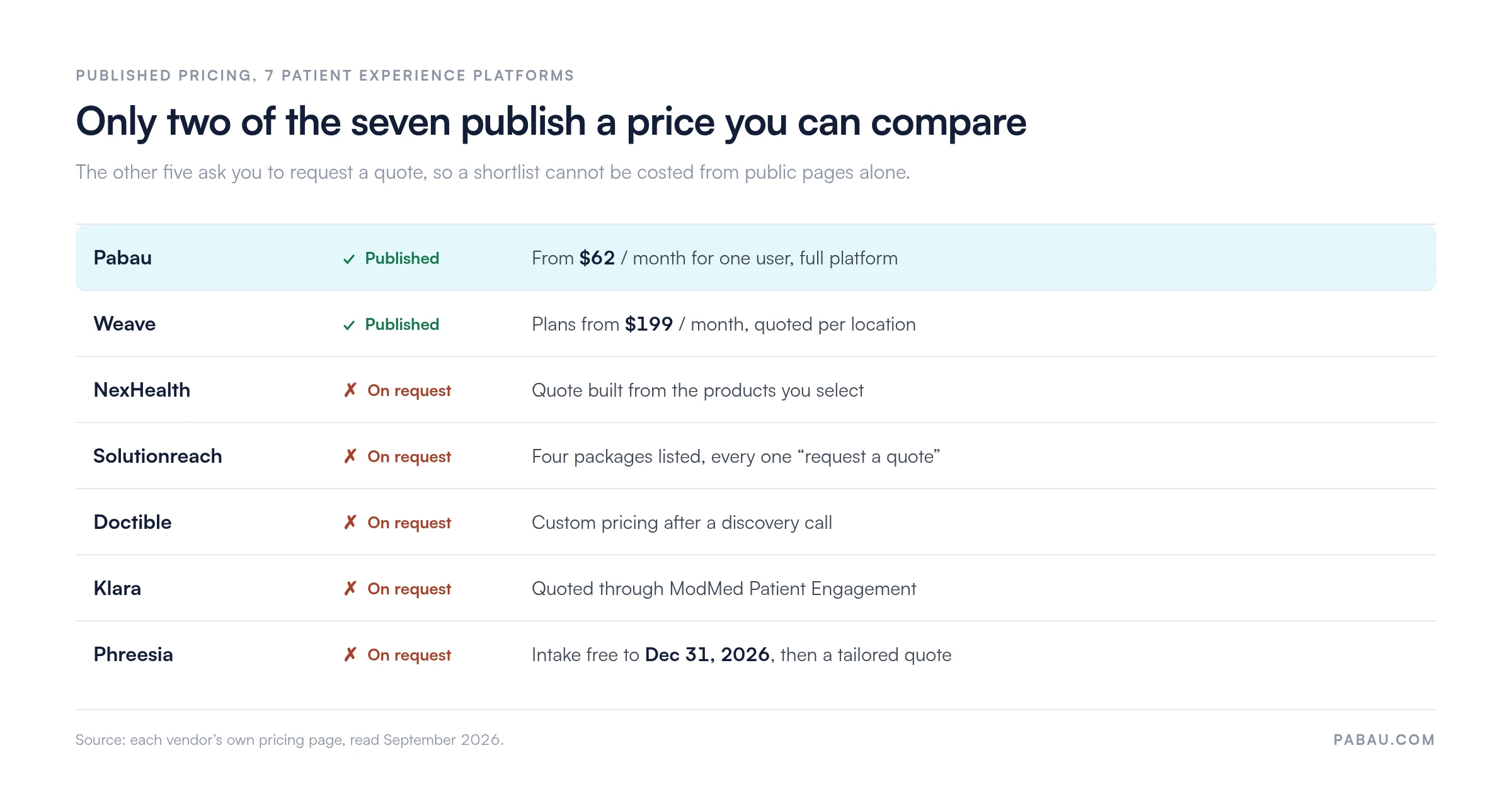
One finding shaped the whole comparison. Only two of the seven publish a price at all. Pabau lists $104 per month for one user, and Weave lists plans from $199 per month. The other five quote on request, so any figure you read elsewhere came from a customer rather than the vendor.
Each profile below covers what the product is built for, what the vendor publishes on price, where it wins and where it falls short. Ratings come from Capterra and G2, checked in September 2026. If you want the concept settled before the shortlist, start with what patient experience means for a practice.

1. Pabau — best all-in-one pick for practices that want booking, charting, payments and feedback on one record.
2. Weave — strongest fit for practices whose front desk is buried in phone calls.
3. NexHealth — best modern booking and intake layer over an EHR you plan to keep.
4. Solutionreach — the workhorse for recall and reactivation campaigns run at volume.
5. Doctible — the focused choice when Google reviews bring in most of your new patients.
6. Klara — best for specialty teams whose patient contact happens mostly by message.
7. Phreesia — enterprise-grade self-service intake, built and priced for groups of 25+ providers.
The matrix below summarizes each platform by primary fit, headline feature, published price and review score. Pabau leads the table because it is the only one of the seven that covers the full clinical and non-clinical journey from one record.
We read all seven pricing pages in September 2026. Only Pabau and Weave show a number a buyer can compare. The other five ask you to request a quote, which means this shortlist cannot be costed from public pages alone.
That changes how you run the evaluation. Ask every quoted vendor for the same three figures. Those are monthly cost per provider, the included SMS or message allowance, and the one-off implementation fee. The chart below shows where each vendor stands today. It is worth asking whether those channels share a single patient inbox or sit in separate tools.
Quoted vendors are not automatically more expensive. They price per location, per seat or per visit, so the figure moves with your size. Insist on a written quote normalized to monthly cost per provider before you put two vendors side by side.
Pabau keeps booking, notes, payments and feedback on the one patient record, so nothing has to be synced.
Pabau is an all-in-one practice management platform that pairs a full EMR with the front-of-house workflows that shape how patients feel about your practice. It is used by aesthetic practices, wellness teams, primary care offices and fertility groups. Physical therapy chains and mental health teams run on it too, wherever clinical and operational data belong on one record.
Where most vendors on this list bolt onto an existing EHR, Pabau is the system of record. Booking, intake forms, consents, photos, SOAP notes, payments, reminders, recall and feedback all sit on one patient timeline, with no integration latency in between. A thyroidology patient note, for instance, holds paired symptom and history fields for thyroid, adrenal and glucose alongside a review of outside records.
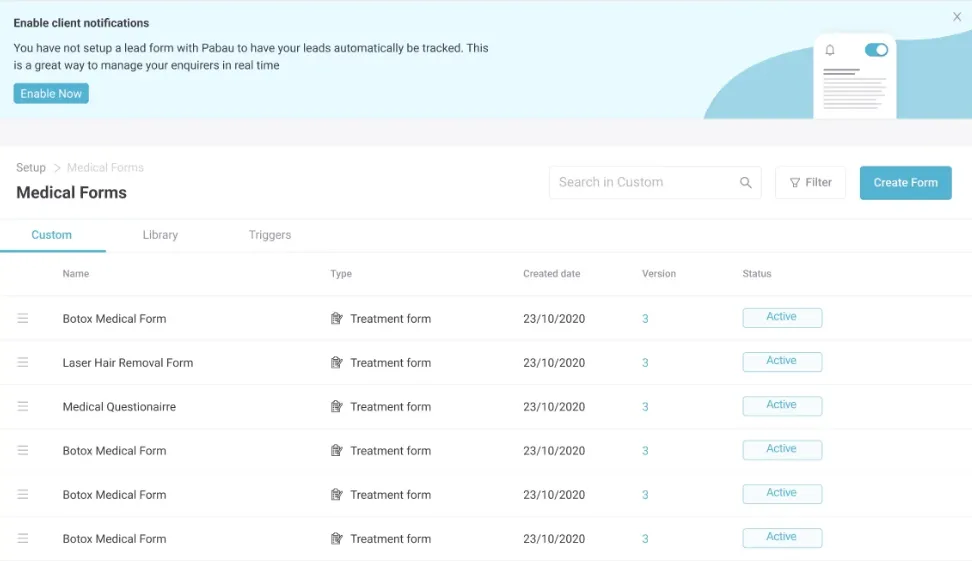
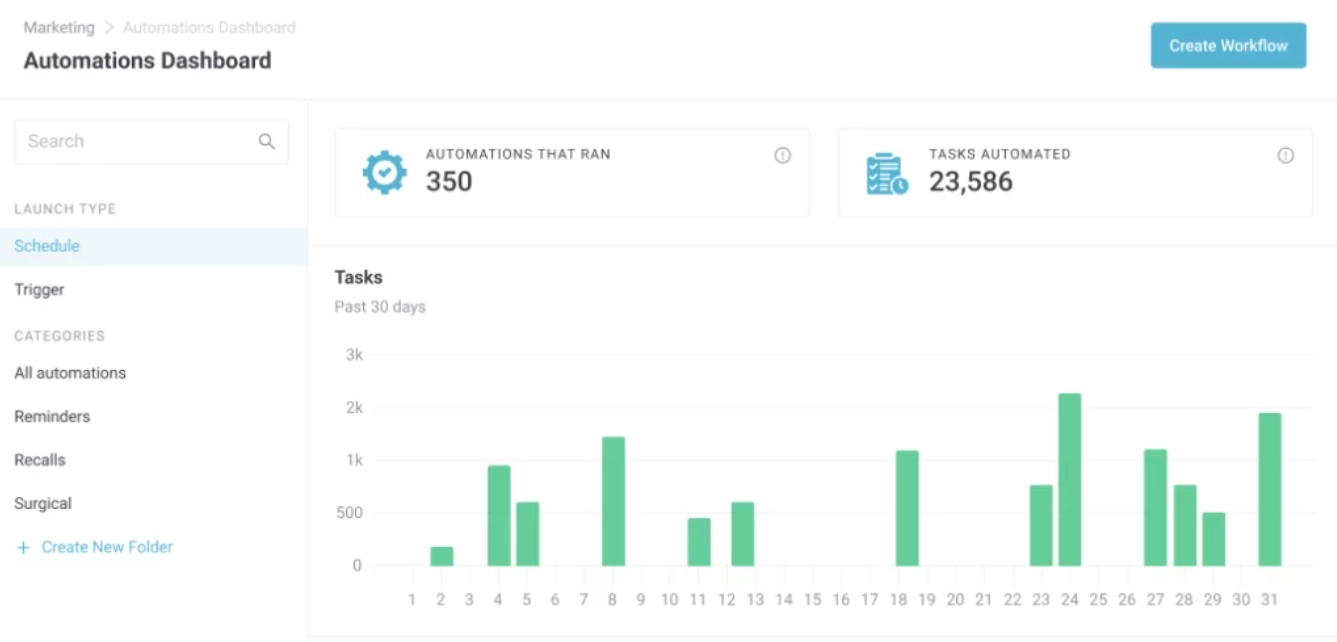
“Pabau has streamlined the entire patient journey: booking, consultations, treatment notes, payments, marketing, and reporting are all in one place. The automation features have been a game changer for client retention.” (Verified Capterra reviewer). Pabau holds 4.7/5 across 600+ verified reviews on Capterra and 4.7/5 on G2.
| Plan | Price | Who it’s for | Key inclusions |
|---|---|---|---|
| Starter / Solo | From $62 / month | Single-user practices | Full platform, monthly or annual billing |
| Team / Medium / Group | Quoted by team size | Practices with 2 to 15 users | Full platform, per-user pricing by band |
| Enterprise | Custom quote | Groups with 16 or more users | Full platform plus dedicated onboarding |
Pabau prices per user, and every plan carries the full platform with no features held back. Annual billing saves up to 20%. Figures come from Pabau’s published pricing, read in September 2026.
Weave answers the phone problem first, then layers texting, reviews and payments on top of it.
Weave began as a VoIP phone system for dental practices and now bundles two-way text, payments and review collection. It is a practical pick for practices whose biggest leak is the phone line.
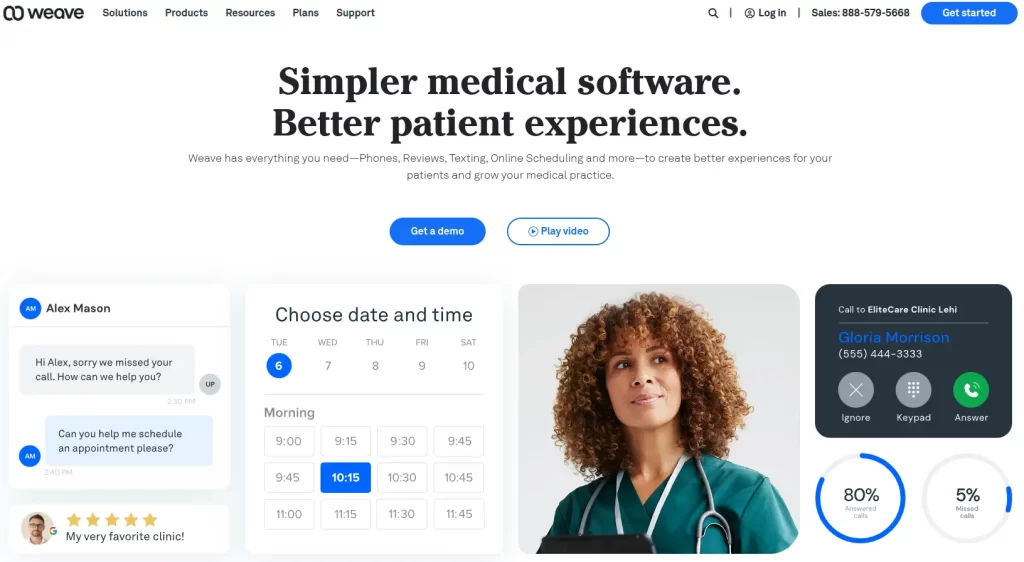
“Weave changed how we answer the phone. Patient context shows up automatically, and review requests run themselves.” (Verified reviewer on Capterra). Weave holds 4.2/5 across 500+ reviews.
| Plan | Price | Who it’s for | Key inclusions |
|---|---|---|---|
| Pro | From $199 / month, quoted | Small practices adding text and reviews | Phones, reminders, two-way text, 1,500 bulk messages |
| Elite | Quoted per location | Practices adding payments and reviews | Adds reviews, payments and 3,000 bulk messages |
| Ultimate | Quoted per location | Multi-provider practices wanting analytics | Up to 15 phones, premium analytics, 15,000 bulk messages |
Weave publishes an entry point of $199 per month and quotes each plan per location. The bulk message allowance is the clearest difference between the three tiers, so size it against your patient list before you choose.
Audit your booking-to-visit pipeline before you shortlist. Time how long it takes from booking to a completed registration packet. Count the touchpoints a patient navigates, and measure no-show rate by acquisition channel. If three or more tools are involved, an all-in-one platform like Pabau pays back faster than a point tool. If only one step is broken, a focused vendor like Weave or Doctible is usually cheaper.
NexHealth is the modern front door for a practice that wants to keep its EHR behind it.
NexHealth sits on top of an existing EHR and surfaces real-time scheduling, intake and recall through its own API and patient-facing interface. It is a strong pick for practices that have invested in a clinical platform but want a modern front door.
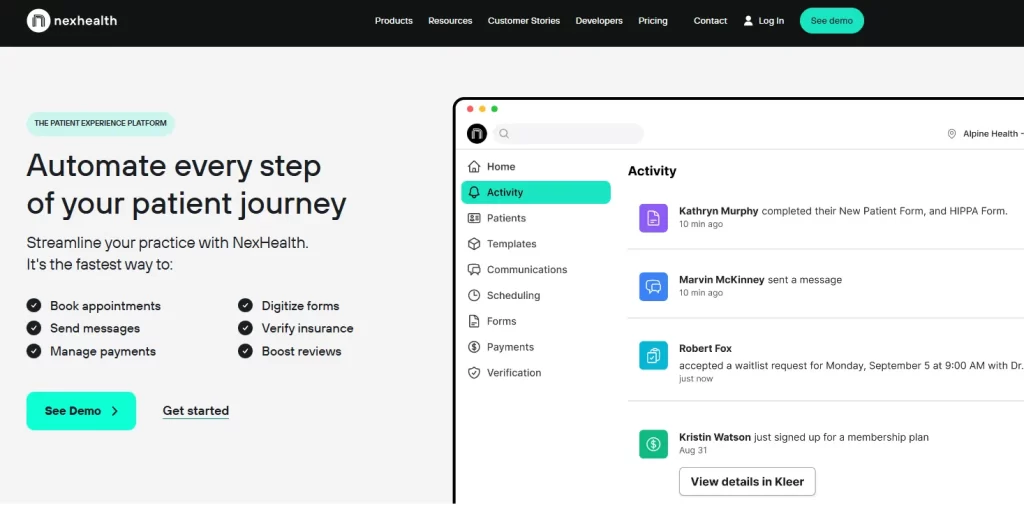
NexHealth holds 4.6/5 across 220+ reviews on Capterra. Reviewers rate it highly for ease of use, and a recurring comment is that the API stack is unusually mature for this segment.
| Plan | Price | Who it’s for | Key inclusions |
|---|---|---|---|
| Custom package | Not published, quoted | DSO groups, multi-location dental, primary care | Scheduling, forms, communications, payments, API access |
NexHealth builds a quote around the products you select, so no entry price appears on its site. Expect the figure to move with your location count and the size of your product mix.
Solutionreach is the recall workhorse, built around campaigns rather than clinical triggers.
Solutionreach is one of the longest-running patient engagement platforms in the US, focused on recall, reactivation and bulk messaging campaigns. It is a workhorse for practices that run structured recare lists. If retention is your deciding factor, our patient retention software comparison weighs it against an all-in-one alternative.
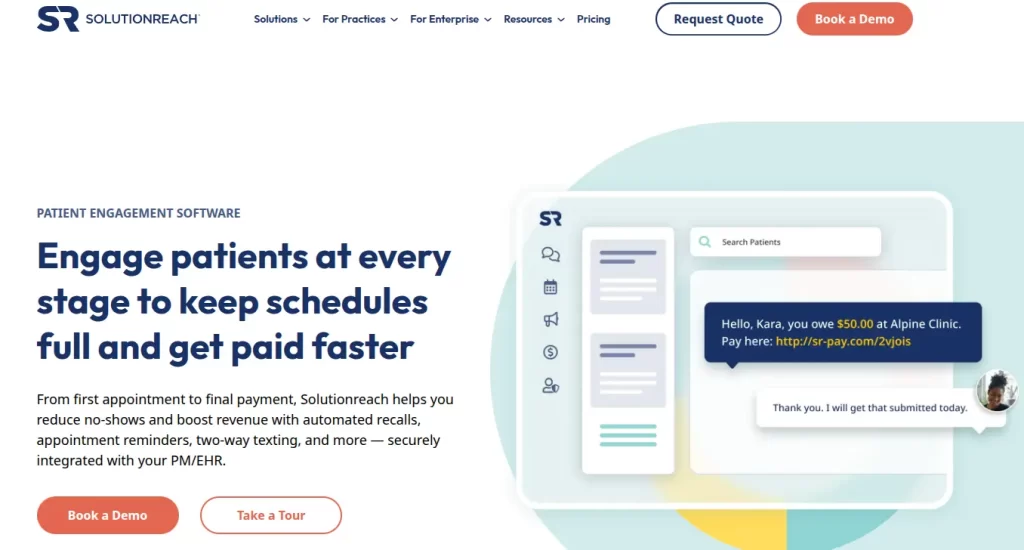
Solutionreach holds 4.3/5 across 167 reviews on G2, with admin teams praising recare reach and clinicians flagging the age of the interface.
| Plan | Price | Who it’s for | Key inclusions |
|---|---|---|---|
| Patient Connect | Not published, request a quote | Practices focused on reminders and follow-through | Two-way texting, appointment reminders, recall |
| Practice Efficiency | Not published, request a quote | Front desks cutting call volume | Adds online scheduling, digital intake, check-in |
| Practice Growth | Not published, request a quote | Practices chasing fuller schedules and production | Adds reputation management, surveys, advanced outreach |
| Enterprise | Not published, get in touch | Groups with six or more locations | Full platform plus organization-wide reporting |
Solutionreach publishes four packages and no prices, so every tier starts with a quote request. Feature depth rather than seat count is what separates them, which makes the package choice the expensive decision.
Doctible does one job properly: turning completed visits into Google reviews.
Doctible is built around the idea that patients increasingly choose providers from Google search results. The platform focuses on review collection, review response and reputation analytics.
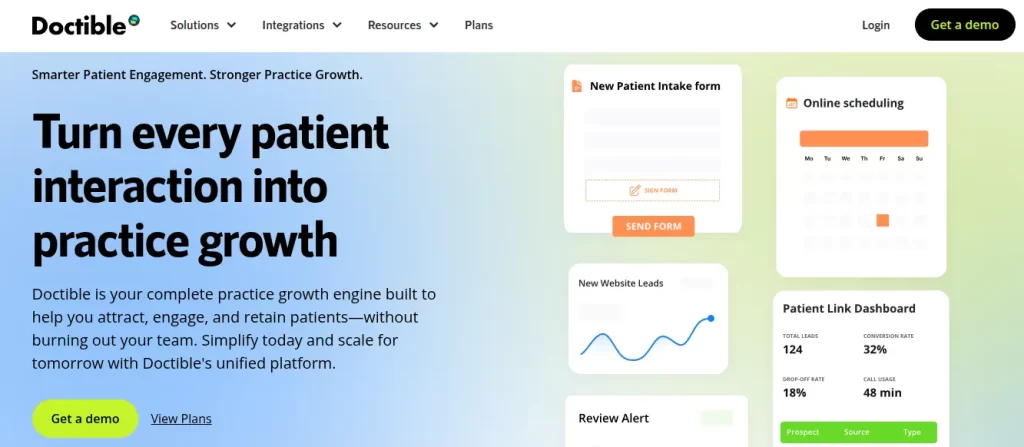
Doctible holds 4.8/5 across 260+ reviews on Capterra, the highest score in this comparison, with consistent praise for review automation and support responsiveness.
| Plan | Price | Who it’s for | Key inclusions |
|---|---|---|---|
| Custom plan | Not published, custom quote | Dental, primary care and specialty practices | Reviews, surveys, two-way text, reputation analytics |
Doctible quotes each practice after a discovery call and bills most customers monthly under an annual agreement. Onboarding, staff training and data migration are priced inside that agreement rather than listed separately.
Klara handles the messages between visits, and now sells as part of ModMed's engagement suite.
Klara focuses on HIPAA-compliant patient and team messaging, and now ships as ModMed Patient Engagement. It suits specialty practices where most of the patient experience happens between visits rather than in the waiting room.

Klara holds 4.3/5 across 211 reviews on Capterra, with reviewers praising message routing and secure delivery for dermatology and primary care teams.
| Plan | Price | Who it’s for | Key inclusions |
|---|---|---|---|
| ModMed Patient Engagement | Not published, quoted through ModMed | Specialty practices on ModMed or a compatible EHR | Secure messaging, routing, automated outreach, EHR integration |
ModMed publishes no price for the Klara product, so every figure comes from a quote. Ask whether messaging is already bundled into your ModMed contract before you price it as a separate line.
Phreesia is enterprise intake, and its current free period is the cheapest way to test that at scale.
Phreesia specializes in patient intake at scale, with tablets in waiting rooms and pre-visit registration links sent by SMS. It is the closest the category has to an enterprise default, built for groups running thousands of registrations a day.
It sits last here for one reason. Its cost profile and implementation are aimed at groups of 25 or more providers. That is a poor match for the private practices and med spas this guide is written for. Larger readers should move it up the list.
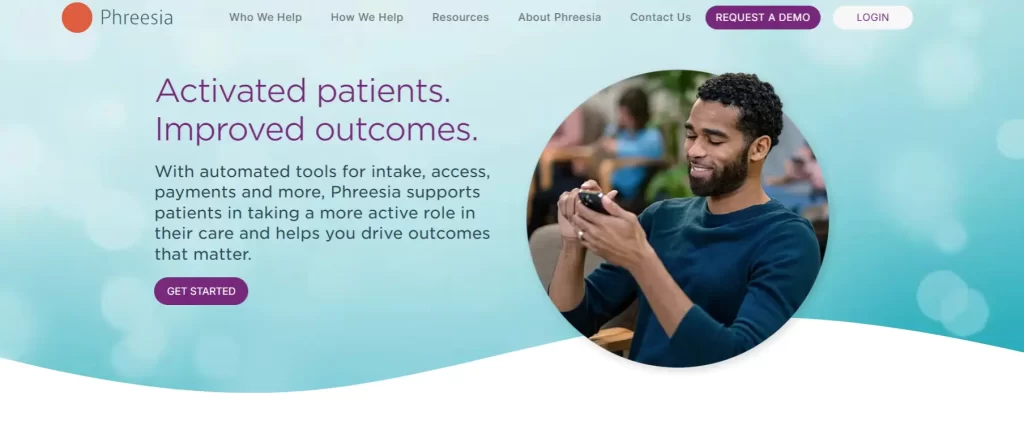
Phreesia holds 4.5/5 across 210+ reviews on G2. Reviewers consistently praise intake speed, and just as consistently flag setup time as the tradeoff for smaller teams.
| Plan | Price | Who it’s for | Key inclusions |
|---|---|---|---|
| Phreesia Intake | Free through Dec 31, 2026 | Practices trialing self-service intake at scale | Full access to every Intake product, at no cost |
| Standard subscription | Not published, tailored quote | Mid-size to enterprise health systems | Intake, payments, PROs, insurance verification, EHR integration |
Phreesia is giving full Intake access at no cost until December 31, 2026, with standard pricing starting January 1, 2027. After that the quote is built around your size, workflows and product mix, with no per-message charges.
Track three benchmarks before you change vendors. Measure first-response time on patient messages, the share of intake forms returned before the visit, and the post-visit review rate. A first-response time over four hours during opening hours points at the messaging tool. An intake return rate under 70% points at the form tool. A review rate under 5% of completed visits points at the feedback loop. Fix the worst-performing metric first.
The seven platforms cover overlapping ground, so the choice comes down to five criteria: scope, specialty fit, integration cost, pricing model and compliance posture.
If your goal is to remove handoffs, an all-in-one platform like Pabau ends most of the integration math. If you want to keep your EHR, a focused layer is usually the cleaner pick: NexHealth for booking, Klara for messaging, Doctible for reviews.
Whichever route you take, test the feedback step before you sign. A post-visit feedback form sent within 24 hours of the appointment tells you how many patients reply today.
Most practices reach a comparison like this because the journey is split across four or five systems. The booking tool holds the appointment, the form tool holds the consent, the messaging tool holds the conversation and the review tool holds the feedback. Every handoff is a point where patient context stops travelling.
Pabau keeps all of it on one patient timeline. The record that carries the appointment also carries the consent, the SOAP note, the payment and the survey response. Patients pick their own slot through Pabau’s online booking software, so deposits, waitlists and multi-location rules apply from the first click.
The outcome is fewer systems to reconcile and a shorter path from a missed message to a booked visit. Automations fire from clinical data rather than a marketing list. A recall goes out because of the last treatment, not because of a date in a spreadsheet. Every subscription includes every feature, so the workflow does not change as the practice grows.

Watch how Pabau connects booking, intake, reminders, payments and feedback in 30 minutes with a Pabau specialist who knows your specialty.

The right patient experience software is the one that fixes your worst bottleneck without opening another. Pabau is the broadest fit for private practices that want the whole journey on one record. Weave, NexHealth, Solutionreach, Doctible, Klara and Phreesia each win a narrower lane, and none of them replaces the record underneath.
Because five of the seven quote privately, the decision rests on what you ask for. Get every quote normalized to monthly cost per provider, with SMS allowances and implementation fees written in. The measuring patient engagement guide covers the metrics each platform should move once it is live.
Shortlist one all-in-one and one focused layer, then price both against the same journey map. Book a demo to see how Pabau handles booking, intake, reminders and feedback for your specialty.

Want the benchmarks your shortlist should move? Patient engagement statistics for clinics in 2026 tracks the metrics each platform should improve.
Need to defend the business case internally? Improving patient experience: 7 strategies that work lays out the operational levers behind each tool.
Want to score patient satisfaction directly? Patient satisfaction survey template covers quality of care, facility, communication, cost, and likelihood to recommend.
Need to survey the parents you serve? Parent survey template covers demographics, communication, appointment experience, staff quality, and facilities on a 5-point scale.
Patient experience software is the set of tools that manage how patients book, prepare for, interact with, and follow up after care. It typically includes online scheduling, digital intake and consent forms, automated reminders, a patient portal, feedback surveys, and review automation. Those tools may sit in a single platform like Pabau, or as a layer over an existing EHR.
Patient engagement software focuses on getting patients to act, whether that is booking, messaging, refilling or attending. Patient experience software covers the full journey, including the clinical and operational steps in between. In practice, the categories overlap heavily, and platforms like Pabau cover both because the same record powers engagement and experience.
The terms are used interchangeably. Patient experience management software describes the same category from the vendor’s side. It covers how a practice measures and improves each step of the journey, from booking through follow-up and feedback. Whether a tool calls itself an experience platform or a management platform, judge it on scope, specialty fit, and integration cost.
Only two of the seven platforms we compared publish a price. Pabau starts at $104 per month for one user with the full platform, and Weave publishes plans from $199 per month. NexHealth, Solutionreach, Doctible, Klara and Phreesia all quote on request, and Phreesia’s Intake platform is free through December 31, 2026. Confirm SMS volume costs and implementation fees in writing before you sign.
Yes. Any platform handling patient identifiers, appointment data, or messages must comply with the HIPAA Privacy and Security Rules in the US. It must also provide a Business Associate Agreement. The HHS Office for Civil Rights publishes current guidance, and reputable vendors document their HIPAA Security Rule controls in a public trust center.
For most private practices under 25 providers, Pabau is the strongest pick. It covers booking, clinical notes, payments, automations, and feedback on one record, without the overhead of stacking three or more tools. Single-site dental or optometry practices that keep their existing PMS often start with Weave for phones, text, and reviews, then add NexHealth or Doctible later.
The core four are Net Promoter Score (NPS), no-show rate, first-response time to patient messages, and post-visit review rate. The AHRQ CAHPS family of surveys is the US benchmark for structured measurement. Track these monthly before and after switching platforms to validate the upgrade.