Head to toe assessment cheat sheet: Printable nursing guide
A head to toe assessment cheat sheet gives you one fixed order at the bedside, s...

5
Last Updated: Oct 23, 2026
Blog / Filler face mapping: Guide and template for med spas
Filler face mapping plans injection points and dosage by facial zone, using facial thirds and bony landmarks to keep results balanced rather than overfilled in one area.
Work through each zone in order: forehead and temples, cheeks and mid-face, tear troughs, nasolabial folds and marionette lines, lips and chin, and the jawline, since each carries its own placement risks.
The tear trough and nasolabial fold sit closest to major vessels, so mapping a safe entry point matters more in these zones than anywhere else on the face.
A free, customizable filler face mapping template further down this page helps you document the consultation, treatment plan, and before-and-after results for every patient.
Storing mapped photos and treatment notes in practice management software like Pabau keeps everything tied to the client record, making it easier to track results and stay compliant.
Want the filler face mapping template? Grab it right here!
It’s easy to spot the difference between well-placed fillers…
…and those that miss the mark.
The best results have that natural, balanced look, and there’s a simple reason behind it. A big part of achieving those smooth, natural results comes down to the strategic placement of dermal fillers in key areas of the face. Recording those placements is the job of injection charting, a feature reviewed in our ranking of software for med spas.
Precisely identifying areas of the face that would benefit the most from filler injections isn’t always easy, as everyone’s facial anatomy is different. This is where filler face mapping comes into play. Mapping can create a personalized plan for each client, helping you claim more and more successful stories.
And once you’re documenting those results consistently, your medical aesthetics marketing becomes much easier because you’ve got clearer proof, stronger messaging, and more confident consultations.
In this blog, we’ll explain why filler face mapping is so important. Plus, we’ve included a FREE facial filler template to document your patient care
In essence, filler facial mapping guides injection placement on the face and at the right dosage.
Since everyone’s facial structure differs, customized facial maps are essential, as what works for one person might not be suitable for another.
Including filler face mapping as a step in your consultations can help you and your injectors to know exactly where to place face fillers for optimal results, lessening the chances of your clients looking overdone or experiencing side effects. That consultation still has to capture medical history, allergies, and contraindications, which is what a consultation form template is for.
Let’s now look at the main areas to focus on…
Before you map a single injection point, read the whole face. Dermal filler for facial balancing treats the face as one connected structure, so restoring a cheek also softens the shadow beneath it and supports the brow above.
Map across the facial thirds and check symmetry from side to side. Most balancing work uses hyaluronic acid filler because it can be layered gradually and dissolved if a proportion looks off. Collagen stimulators such as PLLA work differently and carry their own aftercare. The Olidia PLLA aftercare handout sets out the five-day massage routine patients need to follow.
Planning for balance first is what stops a face from looking overfilled in one area and flat in another.
Volume restoration in the forehead and temples adds harmony to the upper face. Hollow temples pull the brow down, so filling them subtly lifts the lateral brow and opens up the eyes.
Facial aging can’t be reversed, but the right injection plotting techniques soften fine lines and restore support. Keep injections away from the temporal vessels, and map both temples so the two sides stay even.
Once you identify the areas that need a boost, you can create a more youthful, refreshed look or better symmetry, depending on the client.
The cheeks and mid-face set the structure of the whole face, so this is where cheek filler mapping earns its keep. Plot your points against the bony landmarks: the zygomatic arch, the malar fat pads, and the deep medial cheek where volume sits closest to bone.
Most injectors work three to five points per side, placing deep filler on the periosteum for lift and a softer product higher up for contour. A cannula through a single entry point keeps you clear of the infraorbital artery, while a needle gives precision on bone.
Mapping these areas restores the volume lost with age and lifts the mid-face without the recovery of surgery. Marking the submalar and lateral cheek before you inject keeps both sides even and the result looking natural.
When the mid-face has descended rather than deflated, PDO threads can do the lifting instead. Those sessions need their own paperwork, and a NovaThreads consent form covers what to record before and after.
The tear trough is one of the trickiest zones on any filler face map, which is why it belongs in your plan from the start. Hollowing here casts a shadow that reads as tiredness, but the area sits over the infraorbital vessels and takes very little product.
Map under eye filler conservatively, and check whether restoring the cheek first lifts the trough enough on its own. A soft hyaluronic acid filler placed deep and in small amounts gives a smoother correction than overfilling a shallow hollow.
Marionette lines are among the first lines to appear, often before a client turns 30. Paired with the nasolabial folds, they can add years to a face.
Nasolabial fold filler softens these creases, but the area runs close to the facial artery, so mark a safe entry point and inject slowly to avoid vascular occlusion. Mapping the folds and marionette lines together keeps the lower face symmetrical rather than correcting one side at a time.
Bonus: grab our Botox face mapping template too.
Lip and chin fillers are among the most popular face fillers on the market. A VICE UK poll, reported by Save Face, surveyed 47,000 people and found that 68% had someone in their close circle who had had a cosmetic procedure like lip filler. US practices log over three million lip procedures a year, placing them high in the most popular cosmetic procedures.
Demand for lip filler has climbed sharply over the past decade, so even small placement errors stand out. Map the lips and chin together to keep proportions balanced, and mark the injection points carefully to avoid vascular occlusion, a blockage in the blood vessels.
Whether it’s fuller lips or a more defined chin, accurate filler placement makes all the difference.
A defined jawline shapes the whole lower face, and it is one of the most requested areas in the practice. Clients often walk in asking to sharpen a soft jaw or reduce the look of jowls.
Map filler along the mandibular border and angle to sculpt and define, adding more projection at the angle for male clients who want a squarer contour. Accurate jawline mapping gives the lower face structure and keeps both sides balanced.
Filler sculpts the jawline, but when the softness under the chin is submental fat rather than lost volume, a fat-dissolving injectable like Kybella targets it directly. Document those sessions with a Kybella consent template so the injection plan, risks, and aftercare sit alongside your mapping notes.
Loose skin is a different problem from lost volume, and no amount of filler tightens it. If radiofrequency is the better answer, the Thermage aftercare instructions cover the 48 hours off heat and exercise.
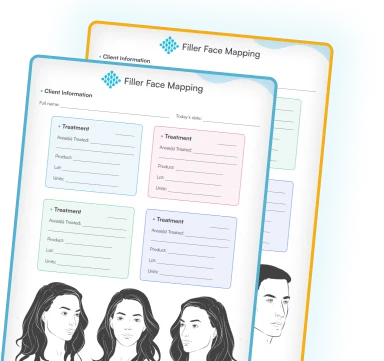
Fill in your details to get your free template
Now that you understand the key areas to focus on, let’s talk about how you can best use a filler face mapping template — whether you run a med spa or a skin clinic offering injectables.
Every face is unique, so your filler mapping template should be, too.
Customize it to reflect each patient’s facial structure, aesthetic goals, and specific treatment plan.
It’s also great when following the latest Botox and filler trends, ensuring you stay ahead in the industry, offering the most up-to-date and customized results for your clients.
Precise filler placement can help get the best possible results. And this is how you make sure clients trust you and your business for whatever procedure they’re after.
Face mapping is an excellent way to monitor progress, providing a clear visual record of improvements over time – even if they’re subtle. Photo consent belongs in that same record, and an e-consent form can be signed before the first set of images.
Documenting before-and-after photos becomes far more effective when done inside a plastic surgery software, where images stay linked to treatment notes, consent forms, and follow-up care. You can track the impact of treatments, and even share them with clients via secure url. It’s also better for compliance purposes.
With practice management software like Pabau, you can take photos and mark up the image with the product used and the areas injected, and all of it is stored safely in the client record.
Plus, instead of manually searching through folders to find patient information – with just a few simple clicks or taps, you can check their progress quickly.
Integrating face mapping templates into your daily routine is simple.
Whether you prefer digital or paper-based records, this template can be used as part of your consultations and follow-ups, ultimately making the customer journey smoother for you and your patients.
However, digitizing your face mapping with practice management software like Pabau makes managing these documents even easier. Everything is stored in one place, so you can securely track and manage patient treatments from anywhere.
Going paperless might seem like a massive change, but it has the potential to simplify work life and improve workflows massively.
Follow-ups only work if the patient hears from you at the right moment. Botox reminder emails map out the send dates, from 48 hours before treatment to the month-three check-in.
Filler is rarely the only treatment on a med spa’s menu, and every device session leaves a record of its own. The habits that make a face map useful carry straight over. Log the settings you used, the consent you took, and the aftercare the patient went home with.
An Excel V treatment record has fields for wavelength, fluence, and Fitzpatrick type. The ResurFX documentation templates cover the non-ablative fractional laser from Lumenis and the aftercare that follows it.
For radiofrequency, the TempSure Envi aftercare handout runs to a single page and covers wrinkles, tissue heating, and cellulite.
Right now, many practices track filler face mapping on paper or in loose photos, separate from the treatment note. When a patient comes back for a touch-up months later, someone has to track down the original map to check dosage and placement.
Practice management software like Pabau keeps each patient’s face map, before-and-after photos, and treatment notes in the same record, tagged to that visit and the product used. Injection plotting lets you mark up a photo directly, so the placement and dosage are documented at the point of care instead of copied over afterward.
That single record speeds up follow-up consultations, since the previous plan is right there, and it gives you the documentation trail you need if a client raises a question about a past treatment.
See how practice management software like Pabau ties injection plotting, before-and-after photos, and treatment notes to one patient record.
Book a demo
A filler face map is only as useful as the record it leaves behind. The zone-by-zone approach in this guide keeps placement decisions consistent from one appointment to the next, but that consistency only holds if the plan from today’s visit is easy to find at the next one.
Treat the map as part of the patient’s permanent record rather than a sketch you reference once and file away. The practices that get the most out of face mapping are the ones that can pull up last visit’s plan in seconds, not the ones with the most detailed map on the day.
Book a demo to see how Pabau keeps every face map, photo, and treatment note tied to the same patient record.
Need a signed consent record before you inject? Dermal filler consent template gives you a ready-to-use form to capture consent alongside your face map.
Treating with Bellast instead of a standard HA filler? Bellast consent template covers the product-specific consent and aftercare points to document.
Want a standard structure for every consultation? Aesthetic consultation notes template gives you a repeatable format to capture history and goals before you map a single point.
Still relying on your camera roll for progress photos? Med spa before-and-after photos explains how to tie images to the client record instead.
Storing mapped photos and notes long-term? HIPAA compliance checklist covers what that record-keeping needs to satisfy.
Running the first consultation by video? Telehealth consent form sets out the eight elements state law expects you to cover.
Welcoming a first-time patient to the practice? Spa welcome letter gives you email, print, and HIPAA-aware versions to customize.
Adding Dermaheal to the treatment plan? Dermaheal consent form covers screening, contraindications, and the session notes to keep.
Offering bio microneedling alongside filler? SQT bio microneedling forms cover consent, intake, and aftercare for spicule treatments.
Tracking more than treatment notes? Spa tracker template sets out the daily, weekly, and monthly logs plus five KPIs.
Yes. Mapping the face before treatment lets you plan placement around each client's anatomy instead of chasing a trend, so results look more balanced and natural with fewer complications. It doesn't change the filler itself, it changes how precisely it's placed.
The zones around major blood vessels carry the most risk, especially the glabella between the brows, the nose, and the under-eye area. Tear trough filler sits over the infraorbital vessels, so accidental injection into a vessel here can cause vascular occlusion. This is why you map injection points and inject slowly in these areas.
Facial contouring uses dermal filler to define and reshape features, such as sharpening the jawline, lifting the cheeks, or balancing the profile, rather than just filling individual lines. It goes hand in hand with dermal filler for facial balancing, where the whole face is mapped so each area supports the others.
Cheek filler is usually placed on or near the bone across three to five points per side, along the zygomatic arch, the malar fat pads, and the deep medial cheek, with a softer product higher up for contour. Cheek filler mapping marks these points first so both sides stay even.
It depends. Many people with autoimmune conditions can have filler safely, but it should be assessed case by case with their treating physician, since some conditions and medications affect healing and inflammation. Always record the full medical history before treatment.
A good template captures the facial zones treated, the product and volume used per area, the injection points, and before-and-after photos, all tied to the client record. Keeping it in practice management software like Pabau stores the mapping notes, consent, and images in one place for follow-ups and compliance.