Healthcare workforce planning: a practical guide for practice leaders
Healthcare workforce planning is the structured process of matching clinical cap...

Last Updated: Oct 13, 2026

Private practice gives UK doctors control the NHS rarely offers: their own schedule, appointment lengths, fees, and the services they provide.
Full-time private GPs typically earn £90,000 to £105,000 a year, though income tracks your patient volume and fees rather than a fixed NHS pay band.
Longer appointments mean better continuity and stronger patient relationships, plus the freedom to build niche or specialist services the NHS often can’t.
The trade-offs are real: financial risk, no NHS safety net (pension, sick pay, indemnity), and running a business on top of clinical work.
Private practice suits doctors who want independence and can handle uncertainty; the NHS still wins on stability and guaranteed income.
Leaving the NHS isn’t a decision clinicians take lightly. For some, it’s about escaping the administrative burden and burnout that erode both clinical time and mental health. For others, it’s the pull of greater autonomy, flexibility, and fair reward for their work.
Private practice offers genuine rewards, but it also brings financial risk, business responsibility, and operational complexity that NHS employment absorbs invisibly.
A private practice is a medical business that a doctor owns and runs outside the NHS, funded by patient fees or private insurance rather than public money. The model shows up across specialties, from a solo GP to a consultant-led practice, and the benefits of private practice tend to draw in doctors leaving the NHS wherever they specialize.
People use “clinic” and “practice” interchangeably, however, the practice is the business you own, while the clinic is the premises you treat in.
Physicians in private practice don’t all work the same way, and the route you take shapes the risk you carry:
The picture reaches well past well past GPs. Independent and larger consolidated practices sit side by side, and starting a private practice looks similar whether you’re a surgeon or a a surgeon or a therapist.
Source: Pabau
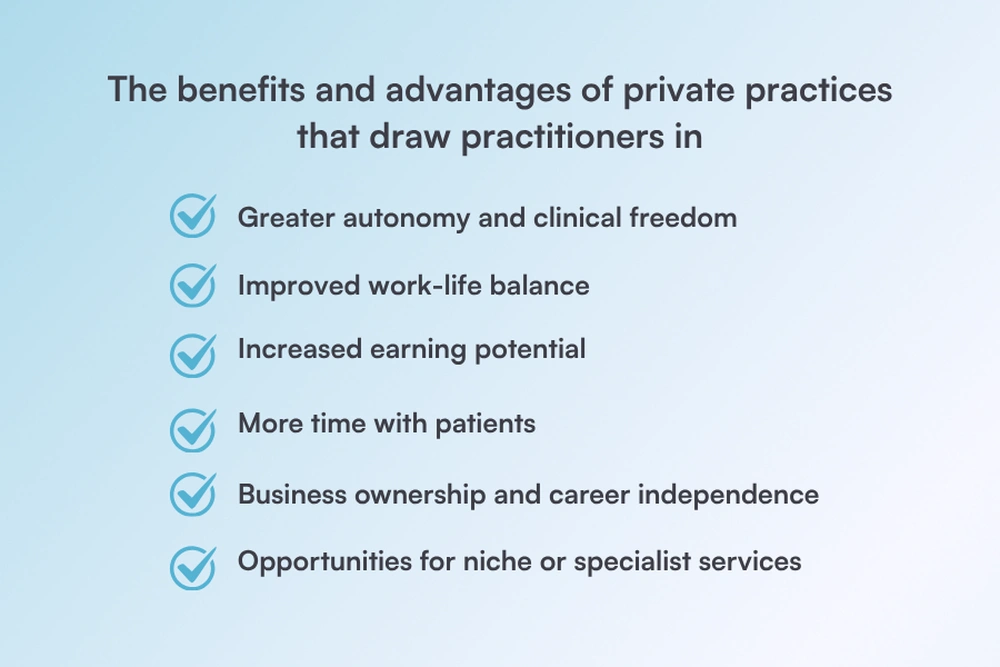
Private practice gives doctors control the NHS rarely offers. Whether it’s setting your schedule, shaping patient care, or growing your own business, this route offers a more flexible and personally rewarding way to practice medicine.
Here are the biggest benefits that draw practitioners in.
Doctors get full autonomy over decisions like:
A private GP in London, for example, might offer 30–45-minute appointments so patients never feel rushed. That improves patient satisfaction and gives the doctor time to practice medicine the way they envisioned when they trained.
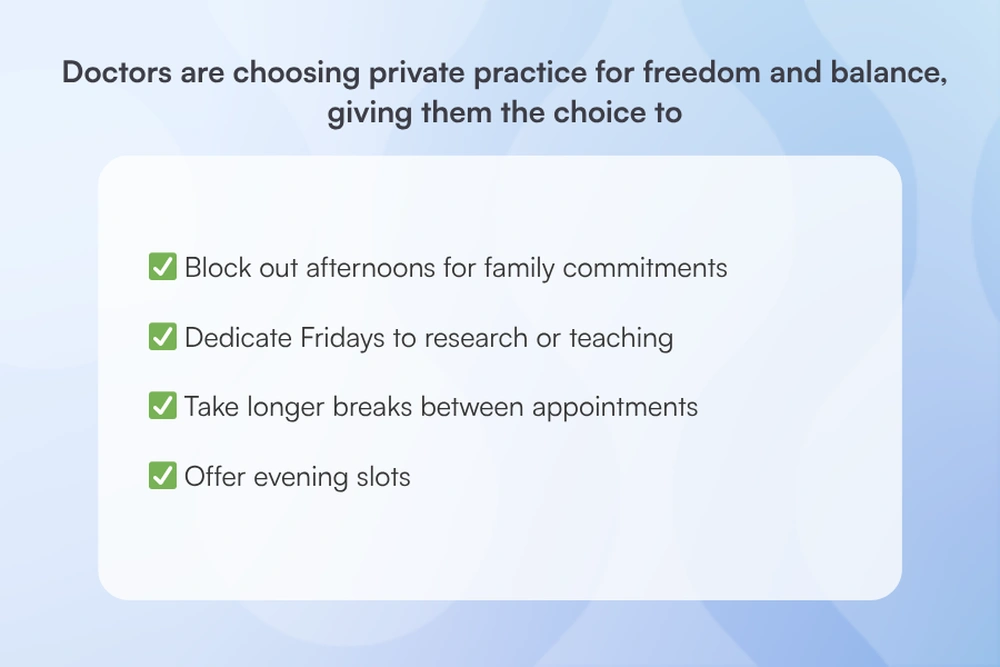
Private practitioners set their own hours, which makes balancing clinical work and personal time significantly more manageable.
Source: Pabau
The administrative load is lighter too, with fewer mandatory forms, fewer reporting requirements, and no waiting on institutional sign-off. That frees up mental energy for the work that matters.
The most common question doctors ask before leaving the NHS is a simple one: how much does a private GP earn?
It varies, because earning potential depends on several factors:
According to Menlo Park Recruitment, full-time private GPs typically earn between £90,000 and £105,000 a year.
That range is only a starting point. A private practice physician’s salary tracks how much you bill and how full your books are, so earnings for private practice doctors vary far more widely than a fixed NHS pay band.
You can spend 30, 45, or even 60 minutes with patients if you need to, without worrying about the queue outside your door. That extra time improves diagnostic accuracy and gives patients room to feel genuinely heard.
That extra time is enough to work through a full respiratory exam using the IPPA steps, rather than rushing a chest listen between other tasks.
That often translates into better outcomes and stronger patient retention.
Another plus is the continuity of care. You’re more likely to see the same patients repeatedly, allowing you to track their progress and genuinely impact their long-term health.
Running an independent practice means running a business. A physician-owned practice puts the big calls (brand, hires, pricing, technology) in your hands.
For many doctors, this shift from employee to entrepreneur is a big part of why they leave the NHS for private practice. Owning the business also means they can:
Owning the practice also means independence from NHS bureaucracy. Instead of waiting months for sign-off on a new service, you can often introduce it within weeks.
That same freedom applies to choosing a primary care EHR. An owner can switch systems the moment one stops fitting the practice, without waiting on procurement sign-off.
Maybe you’re passionate about dermatology, women’s health, or mental wellbeing. Or perhaps you’ve noticed unmet demand in your local area, such as pediatric nutrition or aesthetic medicine, which are often limited in the NHS.
That freedom pulls in specialists of every kind. A private practice therapist offering psychotherapy in private practice shapes their caseload the same way a private GP does (around the work they do best). A CBT practitioner, for instance, can build sessions around tools like the cognitive triangle without institutional protocols dictating the approach.
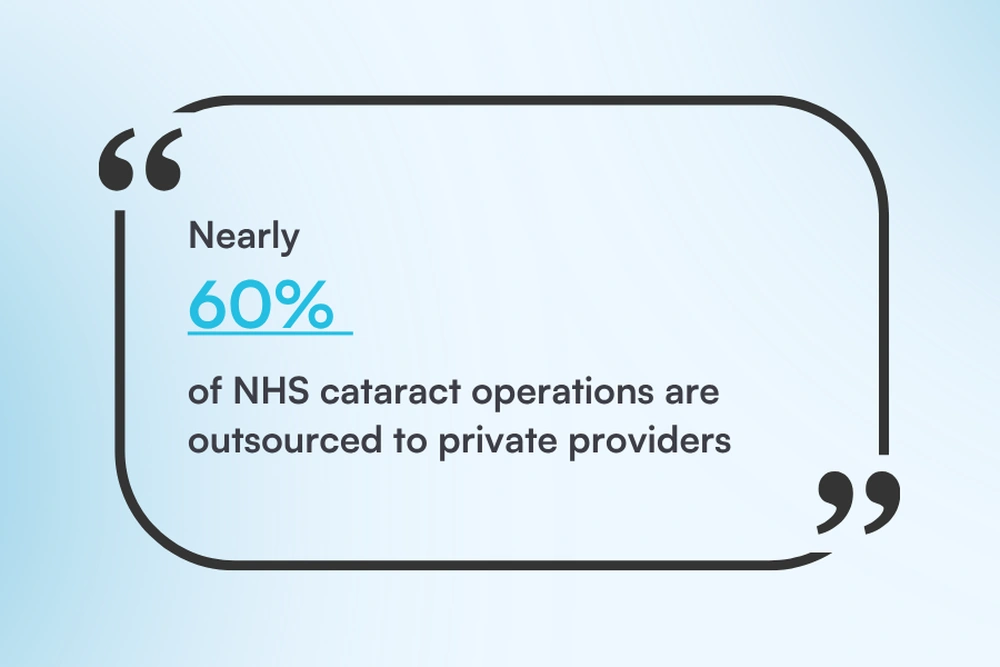
Illustration: Pabau /Data: The Guardian
According to the Guardian, nearly 60% of NHS cataract operations are outsourced to private providers, creating opportunities for private referrals in high-demand niches.
By focusing on an underserved niche, you can build a reputation in high-demand services and attract a patient base willing to pay for specialist care.
Private practice comes with trade-offs worth understanding before you commit.
Starting a private medical practice in the UK comes with significant financial commitments.
Initial setup costs vary depending on the scale and location of the practice, but typically include medical indemnity insurance, practice management software, office equipment, and staff salaries.
Practitioners are also responsible for arranging their own benefits, such as:
Unlike NHS employment, these aren’t provided automatically, so effective cash flow management is crucial, since income can be unpredictable in the early months.
Weigh these financial responsibilities carefully, since the risks can sometimes outweigh the rewards.
When you move into your own private practice, you gain autonomy, but you also lose the NHS infrastructure. Staffing, payroll, billing, compliance, and tax, and tax all land on your shoulders, and they can quickly eat into the time you hoped to reclaim.
Comparing the EHR for private practice options early pays off, since switching systems later means migrating records, billing history, and compliance data mid-practice.
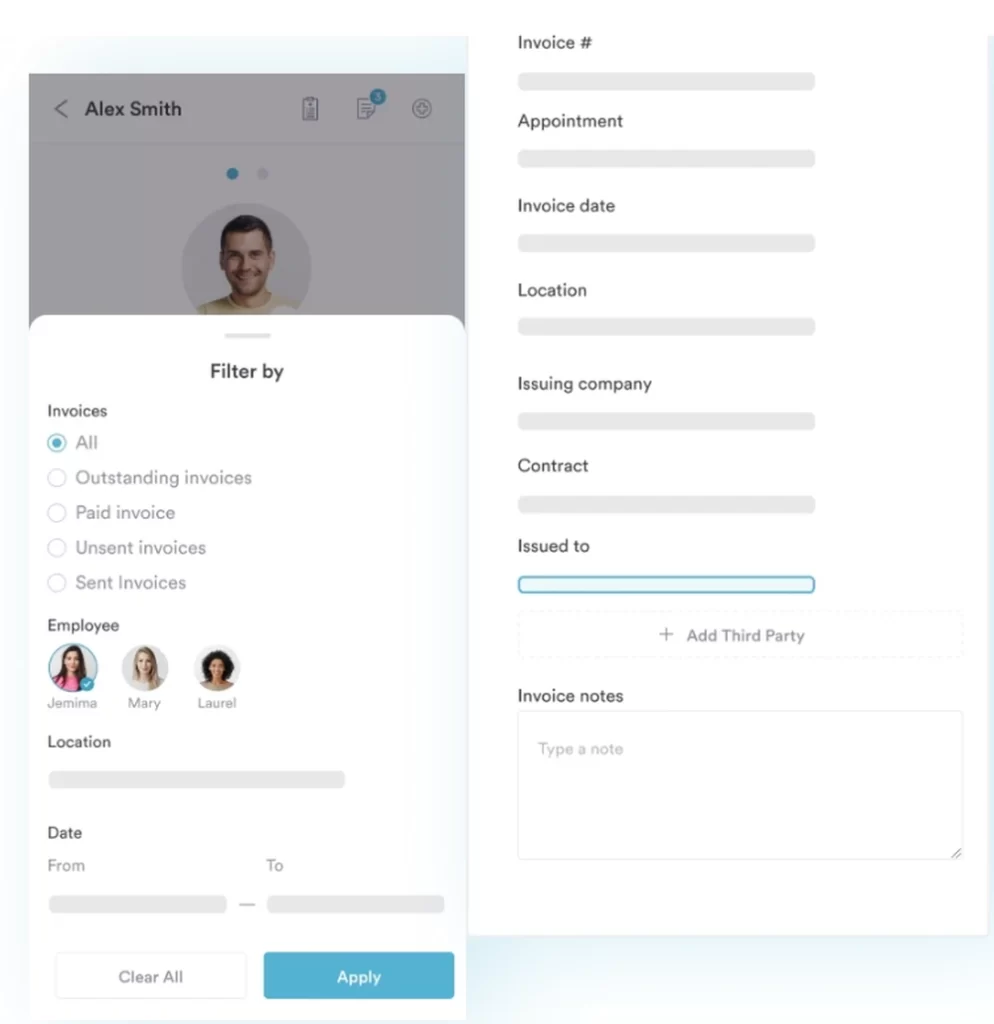
With the right practice management software, most of that load becomes manageable. Rather than juggling a booking tool, a spreadsheet, and a card terminal that don’t talk to each other, a system like Pabau pulls booking, records, billing, and compliance into one place, so the business side doesn’t swallow your clinical time.
Source: Pabau
Patient records, treatment notes, and forms are stored centrally and accessible instantly, so you’re not searching for a document while a patient is waiting or chasing payments by hand.
Unlike the NHS, private practices don’t have a guaranteed patient pipeline, and building one takes deliberate effort. In the early days, and in competitive areas, word of mouth is your strongest marketing tool.
Most private patients start with a search like “private medical practices near me”, so showing up there is half the battle. You’ll also need:
Collecting reviews is only half the job; managing your online reputation means monitoring them across platforms and responding to critical ones before they cost you bookings.
And once patients do come, retention depends on delivering consistently excellent care.
Working privately doesn’t free you from meeting regulatory and legal obligations. Even though you’re working solo, you’ll still be responsible for:
Private GPs also need clear NHS referral pathways for cases that fall outside primary care. Going private doesn’t sever that route for patients who need it.
Many practices use integrated digital platforms to secure patient data, manage consent forms, and maintain audit trails in one centralized location.
For most UK doctors, the choice between private practice and hospital work inside the NHS comes down to trade-offs rather than a clear winner. Control, time, and income potential draw doctors toward private practice, but hospital employment keeps the security that private practice gives up.
A salaried hospital role hands you a guaranteed pay band, a pension, indemnity cover, and a team around you. Private practice hands you the upside and the risk:
Framed that way, the decision comes down to one question: how much control do you want, and how much risk will you take for it?
Private practice can be rewarding, but it’s not for everyone. The decision comes down to your goals, your tolerance for financial uncertainty, and how much of the business side you’re willing to take on.
If you crave independence, want to shape your career on your own terms, and don’t mind rolling up your sleeves for the business side, private practice could be a great fit. If you prefer stability, guaranteed income, and focusing purely on clinical care, the NHS may be a better match.
Take time to reflect, talk to colleagues who’ve made the switch, and model your finances before you commit.
Going private comes with operational complexity that’s easy to underestimate.
Most of that complexity is administrative: booking appointments, managing patient records, billing, compliance, and patient communications.
Pabau handles the operational layer, so you can focus on clinical work. It covers everything a private practice needs to run day to day, including:
All of it lives in one system, which means less time stitching tools together and more time with patients.

See how Pabau helps UK doctors launch and grow a private practice, with booking, records, billing, and compliance handled in one place.

The doctors who make private practice work treat the business side with the same seriousness as the clinical side. A full diary means nothing if billing is chasing invoices for weeks, and a loyal patient base can erode fast if booking is a hassle or records are scattered across three different systems.
That is where Pabau earns its keep, not by replacing clinical judgement, but by keeping the admin side running quietly in the background, so the practice you end up with is closer to the one you pictured when you decided to go private. If you are weighing the move, book a demo and see what that looks like week to week.

Already decided to make the move? Leaving the NHS walks through the transition step by step.
Starting completely from scratch? Starting a medical practice covers the setup work before you see your first patient.
Wondering what CQC inspectors actually check? compliance, and tax breaks down the regulatory side in detail.
Practice up and running, now what? Growing a medical practice covers building the patient base from there.
Not inherently. The setup simply lets them practice differently. A private doctor usually has longer appointments and more continuity than a packed NHS list, so patients often feel more heard. The difference comes down to time and autonomy: the same clinician just has more room to tailor care.
They can, but it isn’t guaranteed. A private practice physician salary rises and falls with patient volume, fees, and overheads rather than a fixed NHS band, so full-time private GPs in the UK commonly earn in the region of £90,000 to £105,000, with income slower to build and less predictable in the early months.
There isn’t one reliable figure, partly because many UK doctors take on private work alongside their NHS role rather than leaving entirely. The clearer trend is growth: as NHS waiting lists have risen, so has private demand, and nearly 60% of NHS cataract operations are now delivered by private providers, for example.