Healthcare workforce planning: a practical guide for practice leaders
Healthcare workforce planning is the structured process of matching clinical cap...

Last Updated: Oct 13, 2026
Improving patient experience means removing friction at the five points a patient actually notices. Those are booking, preparation, the consultation itself, care coordination, and follow-up. The Agency for Healthcare Research and Quality (AHRQ) scores those same five domains in its CAHPS surveys. Each one is measured separately, rather than judged by feel.
Timing is what turns those five domains into work a team can put in a calendar. Almost every fix below is a message that has to land at a particular hour. Some fire 48 hours before the appointment, others 24 hours after it, others six months later.
This guide sets out seven strategies for practice owners, practice managers, and lead clinicians, and names the hour each one belongs to. Where practice management software like Pabau removes a specific friction point, it is named.

Improving patient experience spans every touchpoint from online booking through post-visit follow-up, not just the consultation itself.
Communication outranks technology, with 96% of patients rating providers who listen as a top factor.
Each touchpoint has a specific hour, from a reminder 48 hours before the visit to a recall six months after.
Automated reminders, intake forms, and recall sequences remove friction at the moments patients drop out, without adding staff workload.
Pabau’s Client Portal, digital forms, and automated recalls run the operational layer, so clinicians can focus on the patient.
The experience begins when someone searches for your practice, long before they reach reception. A booking workflow that needs a phone call during office hours creates the first drop-out point. So does a booking system that never confirms by SMS. AHRQ’s CAHPS guide treats access to care as one of its five measured domains.
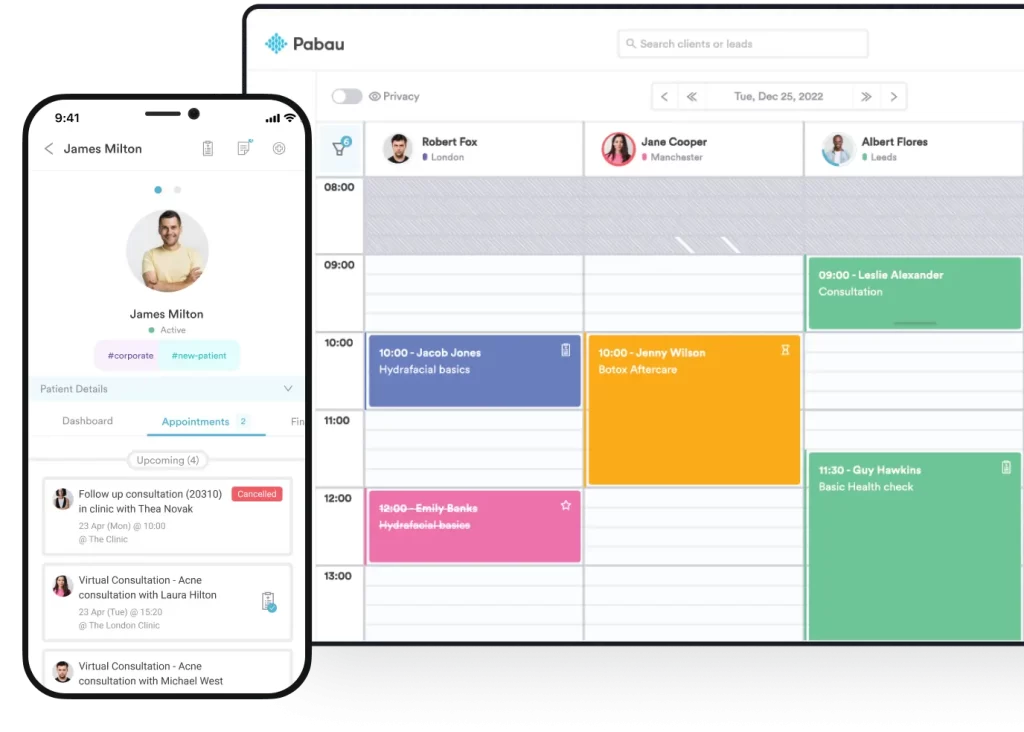
Letting patients book themselves in solves the access problem for the large share who prefer digital self-service. A confirmation by SMS and email at booking, then a reminder 48 hours out, clears most “forgot about it” no-shows with no staff effort. Those confirmations invite replies, so two-way patient texting decides whether a question gets answered before the visit.
Pabau’s online booking software runs 24/7 on any device. Patients pick their preferred clinician and get an automatic confirmation, which cuts the call volume your front desk handles each day.
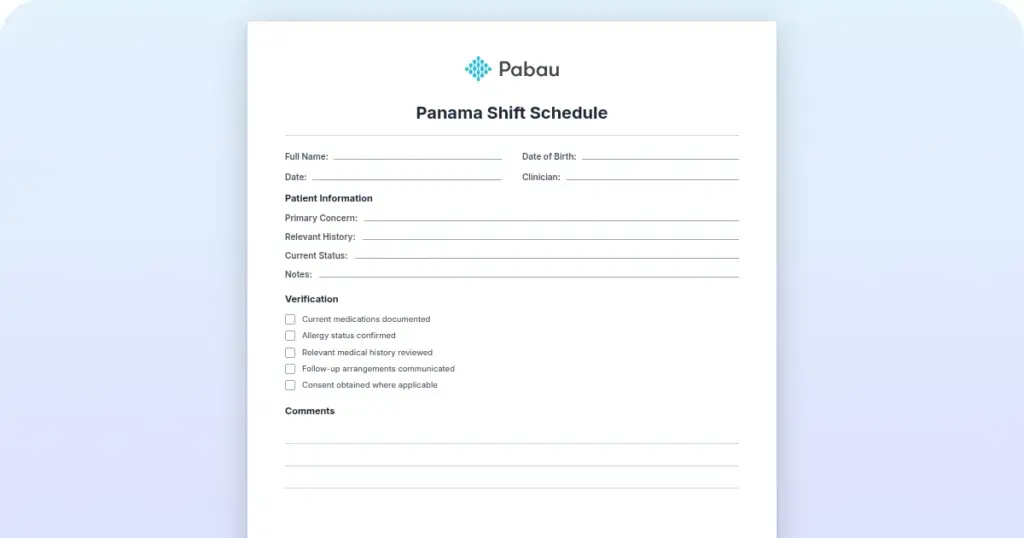
Pre-appointment intake is the second friction point. A clipboard handed over in the waiting room wastes the patient’s time and produces paper someone has to key in later.
Digital intake forms sent 24 hours ahead let patients answer at home, flow straight into the record, and brief the clinician before the consultation starts. That one change usually saves 5 to 10 minutes of admin per appointment.
A no-show costs the practice a slot and costs the patient the relationship. Someone who misses an appointment without hearing from anyone often feels too embarrassed to rebook, particularly in aesthetic and elective care.
A reminder sequence with a rescheduling link gives them an easy way to say so and move the booking. Pabau’s automated reminders carry that link, which protects both the calendar and the relationship.
A 2024 study cited by West Coast University found that 96% of patients rate providers who listen as a top factor in their care. Another 96% say the same about clear communication.
The Beryl Institute research behind those figures puts a clear plan of care at 95%. All three outrank technical skill, facility quality, and wait times in patient feedback. Communication is trainable, which is what makes it the cheapest lever on this list.
For clinicians, that means structuring consultations around three behaviors:
For practice managers, communication quality is measurable. A systematic review of quality improvement strategies found staff education among the most effective approaches for patient experience. Twenty of the 21 studies it included reported measurable improvement, and 14 reached statistical significance.
Administrative friction degrades the interaction on either side of the consultation, and that is the problem technology is for. The tools that move the needle in a private or specialist practice run quietly in the background. They automate the routine so the clinical team can look up.
A practice running its patient communication through one platform can automate most of the operational journey without adding headcount. Our roundup of the best patient management software compares how leading platforms handle each of these touchpoints.
| Patient journey stage | Friction point | Digital solution | Pabau feature |
|---|---|---|---|
| Pre-booking | Phone-only booking, long hold times | 24/7 online booking | Online booking |
| Pre-appointment | Paper intake forms in the waiting room | Digital forms sent by SMS or email | Digital forms |
| Day of appointment | No reminder, patient forgets | Automated SMS or email reminder | Automated workflows |
| In consultation | Clinician typing notes, poor eye contact | AI-assisted note dictation | Pabau Scribe |
| Post-visit | No aftercare instructions, no follow-up | Automated aftercare emails | Pre- and aftercare |
| Recall | Patient lost to follow-up | Automated recall sequences | Automated workflows |
The benefits of patient portals go well past booking. A patient-facing portal hands patients their own records, upcoming appointments, consent forms, and aftercare instructions without a phone call.
Practices using Pabau’s Client Portal report that routine queries, confirmations, and document requests get self-served, which frees reception for work that needs a person.
What the table above does not show is when each message goes out. That is the part a practice decides once and then automates.
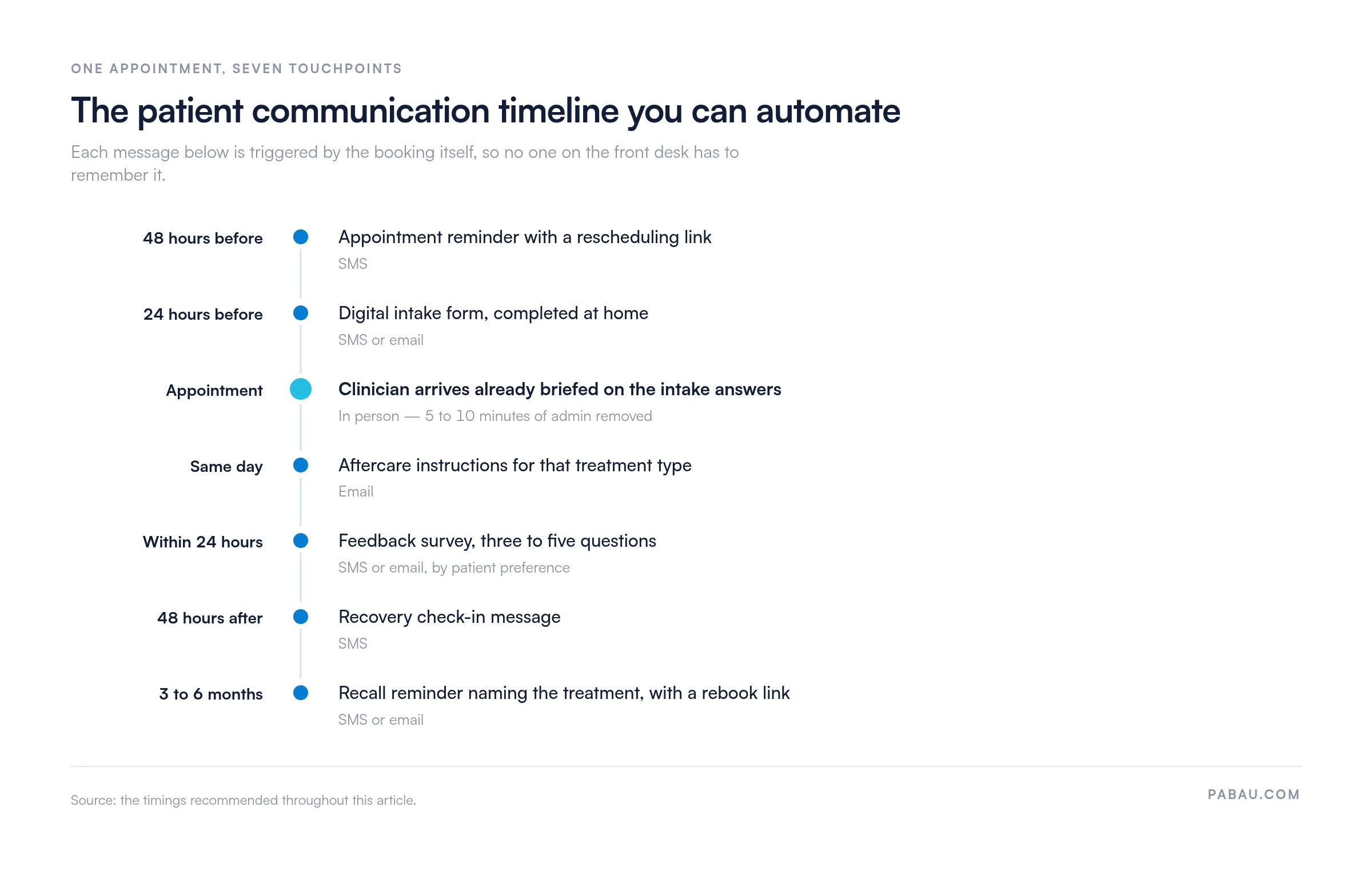
Audit your appointment confirmation sequence. If the only message before an appointment is the confirmation sent at booking, two high-impact moments are going unused. One is a 48-hour SMS reminder with a rescheduling link. The other is a 24-hour form completion prompt for new patients. Those two messages alone cover most no-show and incomplete-intake problems in outpatient settings.
Weak care coordination does more damage in a multi-clinician practice than anywhere else. A patient who sees a different provider each visit and re-explains their history has hit a process problem rather than a clinical one.
A UK study of primary care contracting found that continuity of care deteriorated sharply after structural changes, and patient experience scores fell with it. Patients were less likely to report a positive visit when no available provider knew their history.
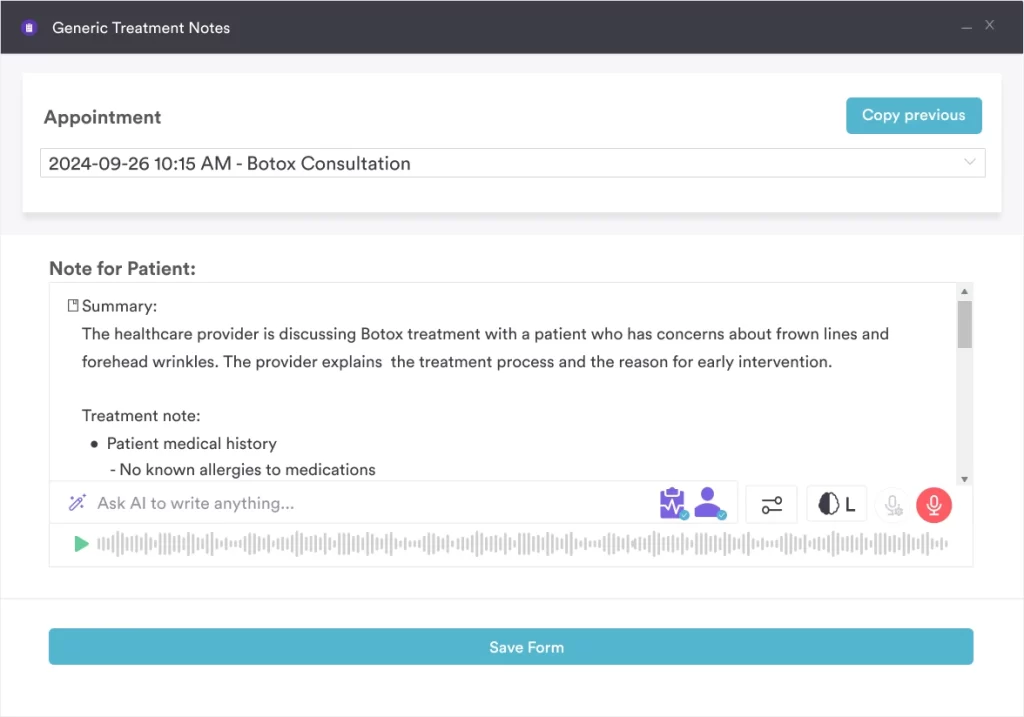
For private and specialist practices, patient care management tools centralize records, treatment notes, and communication history. That makes continuity workable even when different clinicians cover different sessions. Open one record and every prior treatment, consent form, and clinical note is there.
AHRQ’s CAHPS framework counts care coordination as a measured domain because it predicts both satisfaction scores and clinical outcomes. Practices that score well share three habits. They have shared record access, structured handover protocols, and a defined process for chasing outstanding referrals and test results.
Feedback without a response process is data collection. The practices that move their scores route each comment to a named person, acknowledge it inside a defined window, and check whether the change worked.
A review of patient feedback programs identified six post-collection activities that separate the organizations that improve from the ones that do not. Three of them are making sense of the data, sharing findings internally, and planning structured improvement actions.
How to capture patient feedback comes down to timing and format. A survey sent within 24 hours of the appointment gets a far better response rate. A follow-up call or a paper form left in reception does much worse.
Send it through the channel the patient prefers, which is SMS for most under-50s and email for most over-50s. Keep it to three to five questions. One open text field beats ten Likert scales.
AHRQ’s CAHPS surveys give a validated framework for measuring experience across the five domains. A practice that wants benchmark data, rather than only its own trend line, can use CAHPS-aligned questions and compare against national or regional averages. That turns a dashboard number into something that informs staffing, training, and workflow decisions.
Reviews bring in new patients, and the ask lands better right after a good interaction than as a blanket post-appointment message. Pabau’s review automation sends the request by SMS on configurable rules, at the point when sentiment is still high. Practices that manage that pipeline deliberately outperform the ones that leave reputation to chance.
Front-desk staff set the emotional tone of a visit before the clinician walks in. A warm greeting, a name used correctly, and a brief word about the wait all register strongly in patient feedback.
AdventHealth’s patient experience program, covered by the American Hospital Association, built its training around staff engagement for that reason. Frontline behavior is the part of the experience practice leadership controls most directly.
Practical staff training priorities for improving patient experience include:
The AMA’s STEPS Forward toolkit gives structured resources for building a patient experience program that embeds team engagement and feedback into routine operations. Automated workflows extend that into the operational layer, so post-visit touchpoints fire consistently no matter how busy the day is.
Run a quarterly patient journey audit. Book an appointment under a colleague’s name and go through the whole process as a patient would. Document every friction point, from the booking confirmation to the follow-up email. A patient who quietly stops rebooking rarely files a complaint first, so this audit is where those problems surface.
The visit ends when the patient leaves. The experience runs for another 72 hours. Three touchpoints carry both satisfaction and retention in that window and beyond it.
Aftercare instructions arrive before the patient gets home, a check-in follows at 48 hours, and a recall lands at the clinically appropriate interval. Pabau’s automated pre- and aftercare emails can be set per treatment type.
A patient who had a chemical peel gets skincare instructions for that procedure, while a physical therapy patient gets their home exercise protocol. Neither one depends on a clinician remembering to send it.
AI earns its place here by handling the repetitive communication layer rather than the clinical judgment. Pabau Scribe drafts the note, automated workflows send the aftercare, and clinicians spend the saved attention on the patient.
A recall sequence flags a patient for re-engagement after a defined period. That is three months for a Botox patient, six months for a routine skin check.
A well-timed recall naming the treatment, with a rebook link, converts far better than a generic marketing email. The timing and the treatment reference are what drive the response.
Most practices deliver a good patient experience by effort. Someone remembers to send the reminder, someone prints the aftercare sheet, someone notices that a patient has not been back in nine months. The quality of the experience then tracks how busy that week was.
Pabau runs the same sequence from the booking record instead. Online booking takes the appointment, and the intake form goes out 24 hours ahead. Patients complete forms, consents, and photo prompts through the care pathway in Pabau GO, our iOS app for practitioners.
Their answers land in the patient record before the consultation starts. Pabau Scribe drafts the note in the room, aftercare fires the same day, and the recall is already scheduled against the treatment.
Every Pabau subscription includes every feature, so none of that sits behind a higher tier. Setup runs as structured onboarding with a dedicated coordinator, because the sequence has to match the way your practice already works.

Pabau connects booking, intake, reminders, clinical notes, and post-visit follow-up in one system. See how practices deliver the same patient experience every week without adding admin hours.

Patient experience improves when the sequence stops depending on who is on shift. Decide once what goes out and when, then let the system send it. The clinical conversation is the only part that should need a person’s full attention.
The trade-off worth remembering is that automation makes a weak sequence consistent too. Walk your own patient journey before you automate it, then read the feedback that comes back. Book a demo to see how Pabau maps these touchpoints onto your own patient journey.

Unsure whether to call them clients or patients? Client vs patient terminology guide explains how the choice affects documentation and compliance.
Need to measure where your practice currently stands? Measuring patient satisfaction explains which metrics matter, how to collect them reliably, and how to benchmark them.
Want a structured engagement plan to work from? Patient engagement strategies sets out the tactics that keep a care plan visible between visits.
Losing patients between visits, not during them? Digital patient engagement covers the strategies and tools that keep patients coming back.
AHRQ names five domains: access to care, provider-patient communication, care coordination, customer service, and health promotion. For private and specialist practices, the fastest wins are digital intake forms, automated appointment reminders, and a structured post-visit follow-up sequence. Each one removes a measurable drop-out point without adding staff.
Patient satisfaction measures whether expectations were met. Patient experience measures what happened: whether a clinician listened, whether care was coordinated, whether follow-up arrived. Satisfaction is a subjective rating, and experience is an account of events. CAHPS is built around experience because a satisfaction score alone does not tell you which operational change to make.
An automated post-appointment SMS survey sent within 24 hours needs no staff effort once configured. Three to five questions is the right length for response rates in outpatient settings. Platforms like Pabau trigger the survey after each appointment, route responses to a dashboard, and flag low scores for follow-up.
A peer-reviewed PMC systematic review found staff education among the most consistently effective quality improvement strategies for patient experience. Twenty of its 21 studies showed measurable improvement. Practical priorities are communication scripts for delays and complaints, cultural responsiveness training, and brief monthly sessions reviewing patient comments with the whole team.
Technology handles the work that consumes clinical time without adding clinical value: reminders, intake forms, aftercare instructions, and recall messages. When those run automatically, clinicians spend less of the consultation on administration. AI scribe tools like Pabau Scribe cut in-room documentation time, which lets a clinician hold eye contact and listen.