Healthcare workforce planning: a practical guide for practice leaders
Healthcare workforce planning is the structured process of matching clinical cap...

Last Updated: Oct 13, 2026
Patient experience in healthcare is the sum of every interaction a patient has with your practice, from booking to final invoice. It covers the wait times, the intake paperwork, the unanswered calls, and the follow-up that never arrived.
Those moments decide whether patients rebook, refer a friend, and stick to their treatment plans. This guide defines patient experience, separates it from satisfaction, and shows how to measure and improve it in a private practice.

Patient experience covers every interaction a patient has with a practice, from booking to billing to follow-up.
Experience records what happened during care, while satisfaction records whether the visit met expectations.
Poor patient experience is linked to lower treatment adherence, higher readmission rates, and weaker retention.
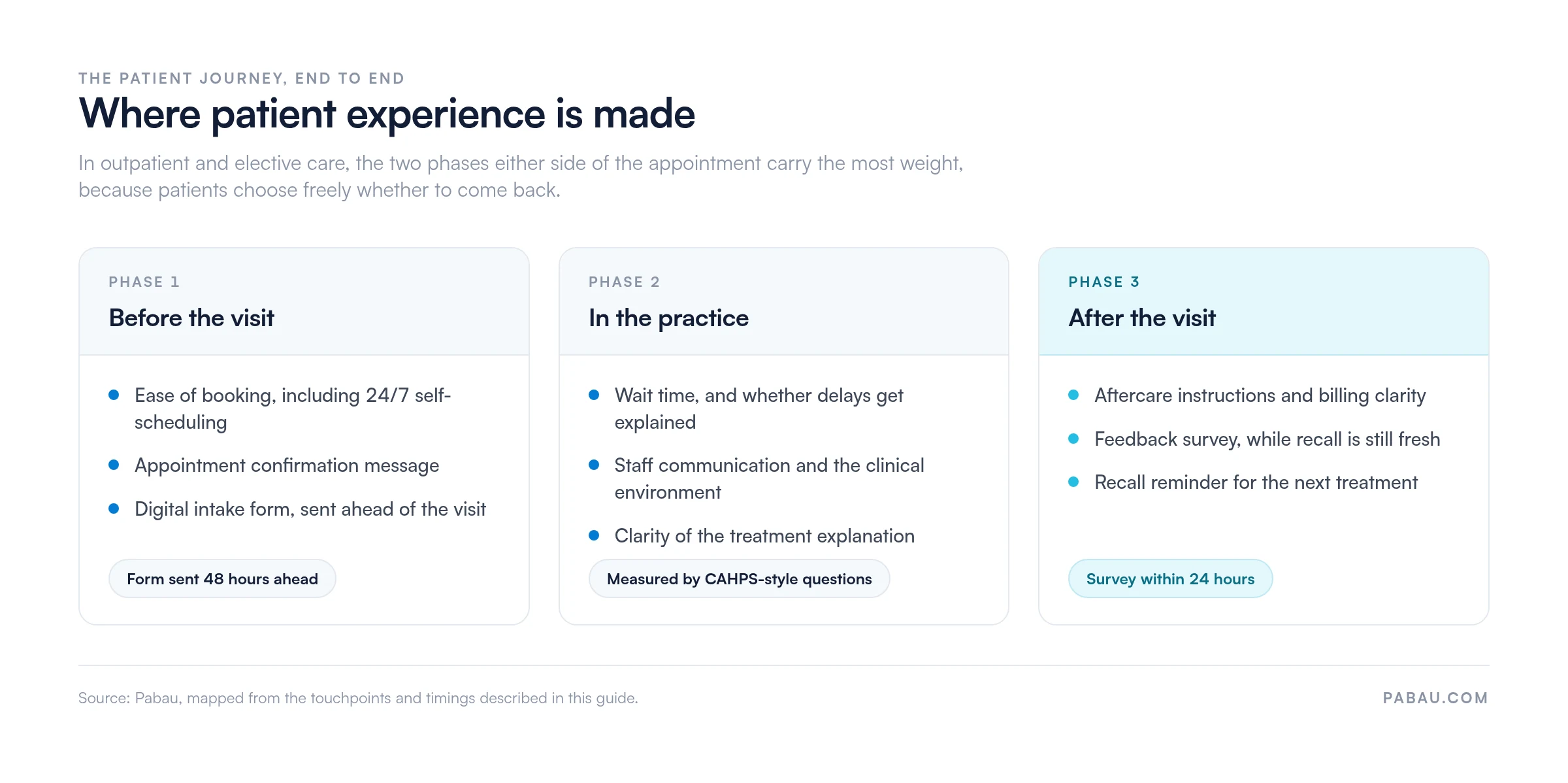
In outpatient and elective care, the phases either side of the appointment carry more weight than the appointment itself.
Pabau’s automated workflows, digital forms, and recall tools help practices improve experience at every touchpoint.
According to the Agency for Healthcare Research and Quality (AHRQ), patient experience covers the range of interactions patients have with the healthcare system. That includes care from health plans, and from the doctors, nurses, and staff who work in hospitals, physician practices, and other facilities.
The Beryl Institute is the leading independent body advancing this field. It defines patient experience as “the sum of all interactions, shaped by an organization’s culture, that influence patient perceptions across the continuum of care.”
That second definition is the more useful one to run a practice by. Culture shapes the experience before any single interaction happens, and the continuum counts as much as any one appointment. It also explains why membership models such as concierge medicine compete almost entirely on experience.
Hospital-focused definitions tend to reduce patient experience to inpatient stay metrics. Outpatient and elective care works differently. Patients choose freely whether to come back, so the pre-visit and post-visit phases carry more relative weight than the appointment in the middle.
The practical first step is mapping where each interaction happens and naming who owns it. Dedicated patient experience software can then track those touchpoints for you, instead of a spreadsheet nobody updates.
The Society of Hospital Medicine defines it as “everything we say and do that affects our patients’ thoughts, feelings and well-being.” For a practice team, that works as a daily operating principle. Every message, every process delay, and every unexplained fee shapes what patients carry away from their visit.
Intake is often a patient’s first substantive interaction with a practice. Paper forms handed over in a waiting room signal disorganization. A digital form sent 48 hours before the appointment signals preparation and respect for the patient’s time.
Practices using digital intake forms routinely report shorter wait times and better-prepared consultations, because clinical staff have reviewed the relevant history before the patient arrives.
These two terms get used interchangeably in most practice conversations. They measure different things, and conflating them produces misleading performance data.
| Dimension | Patient experience | Patient satisfaction |
|---|---|---|
| What it measures | What happened during care interactions | Whether expectations were met |
| Example question | “Did staff explain your medication clearly?” | “Were you satisfied with your visit today?” |
| Bias risk | Lower, because it is anchored to observable events | Higher, because it is shaped by prior expectations |
| Actionability | High, because it names the step that failed | Medium, because it reports the outcome but not the cause |
| Survey instrument | CAHPS, HCAHPS | NPS, custom satisfaction scales |
A patient with very low expectations who receives mediocre care may report high satisfaction. A patient who expected prompt communication, then waited three days for results, may report low satisfaction despite clinically excellent care.
Neither answer tells the practice which step in the visit failed. Measuring patient satisfaction is still worth doing for overall sentiment, but it needs experience data beside it before anyone can act on it.
The CAHPS (Consumer Assessment of Healthcare Providers and Systems) framework, developed by the AHRQ, was designed to standardize experience measurement. Its questions ask about concrete events: whether care was explained, whether staff were respectful, whether appointments started on time. Those observable benchmarks beat generic satisfaction scores for operational improvement.
Johns Hopkins Medicine states that a positive patient and family experience in hospital often results in better overall health outcomes. Clear communication from providers helps patients and families understand how to manage their health, and lowers the likelihood of readmission.
The same pattern shows up in the evidence on patient engagement. Higher patient activation scores track with better adherence to medication and follow-up care.
The mechanism is straightforward. Patients who understand their care instructions follow them, and patients who feel heard report concerns earlier. For practice owners, the business case runs parallel to the clinical one:
Cleveland Clinic was the first major academic medical center to appoint a Chief Experience Officer and open a formal Office of Patient Experience. The signal there is that experience needs dedicated operational ownership, not a survey sent at discharge.
A private practice cannot hire for that role, so the equivalent has to come from its systems. Solid patient care management routines cover the work a dedicated team would otherwise own.
Review your last 25 patient journey touchpoints. Identify which three generated the most friction (missed communications, long waits, unclear billing). Fix those three before adding new experience initiatives. Concentrated improvements outperform broad but shallow changes.
Measurement frameworks vary by setting, country, and practice size. These are the instruments and methods most relevant to a private practice:
The HCAHPS (Hospital Consumer Assessment of Healthcare Providers and Systems) survey is the standardized CMS instrument for measuring patients’ perceptions of hospital care. It covers communication with doctors and nurses, staff responsiveness, communication about pain, discharge information, and the overall hospital rating.
CMS replaced the older pain management questions with the Communication About Pain composite in January 2018. Results are published publicly, which creates direct reputational and financial accountability.
CAHPS surveys extend the same methodology to outpatient, dental, surgical, and other settings. The AHRQ runs the CAHPS program and publishes validated instruments that a private practice can adapt. Where reporting is not mandatory, CAHPS-style questions still beat generic five-star reviews, because they are standardized and comparable across settings.
NPS asks one question: “How likely are you to recommend this practice to a friend or colleague?” Patients answer on a scale of 0 to 10. Promoters score 9 or 10, passives score 7 or 8, and detractors score 6 or below.
Subtract the share of detractors from the share of promoters and you have the score. NPS is fast to deploy and comparable across industries, but it captures sentiment rather than the specific step that went wrong. Use it as a directional indicator beside more granular feedback, not on its own.
Automated post-visit surveys sent within 24 hours of an appointment capture experience data at peak recall. Response rates drop sharply beyond 48 hours.
Practices that capture patient feedback systematically can route happy patients toward public review platforms. Unhappy ones get flagged for a call before the review gets written.
Improvement gets concrete once each phase of the journey is tied to a specific workflow decision. The map below shows where those decisions sit, and the five touchpoints that follow are where operational changes produce measurable gains.
Friction at booking predicts cancellation rates. A practice whose patients have to call during business hours loses to the competitor down the road with 24/7 self-scheduling. Good online booking software pays for itself quickly.
Confirmation messages, preparation instructions, and digital intake forms sent in advance reduce anxiety and no-shows at the same time. Automated confirmation and reminder sequences handle all three without manual staff effort. For a first appointment, a new patient welcome letter sent within a day of booking covers arrival time, parking, and what to bring.
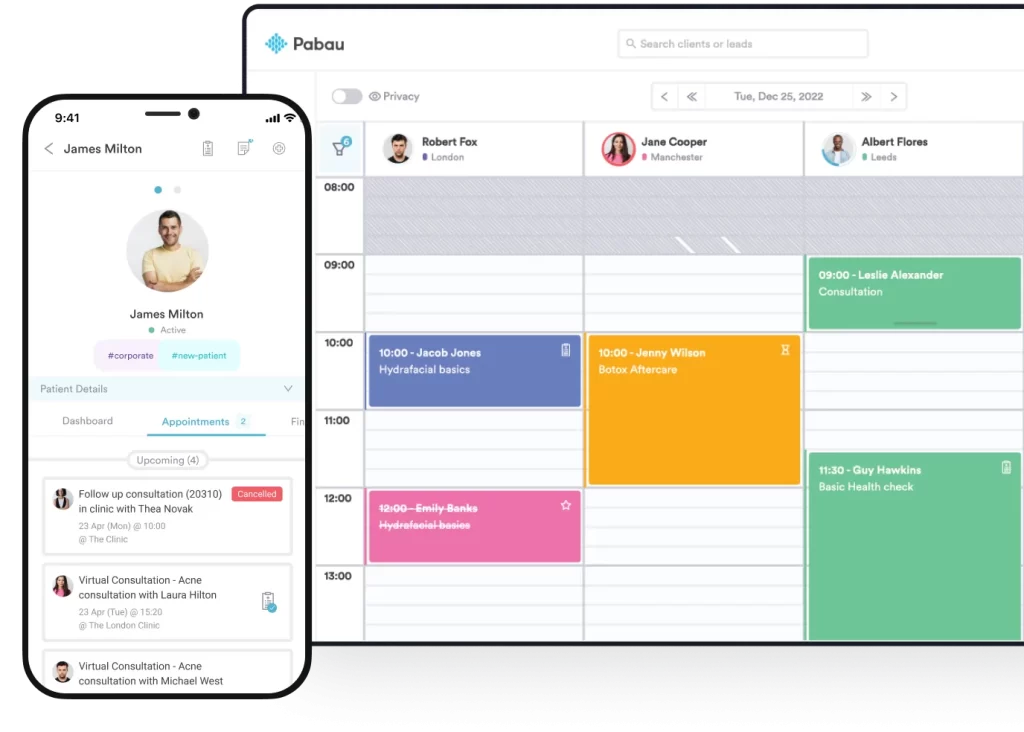
Wait time perception is partly psychological. Patients who are given a reason for the delay report less frustration than patients who wait the same length of time in silence.
Staff who greet patients by name, explain what happens next, and check understanding are the biggest single driver of positive experience ratings. Training protocols matter here as much as any technology investment.
Retention is decided after the appointment ends. A patient who gets clear aftercare instructions, a follow-up check-in, and a timely recall reminder feels managed rather than forgotten.
Sending those three messages automatically through practice management software keeps them consistent without adding to anyone’s workload. Patients who receive systematic follow-up are measurably more likely to rebook.
Manual processes create inconsistency. When a staff member forgets to send a recall message or a post-visit survey, that patient’s experience degrades quietly. Nobody notices until the patient fails to rebook.
Automated workflows replace those manual decisions with triggered sequences. A confirmation fires at booking, and a reminder fires 48 hours before the visit. Aftercare fires the same day, and a feedback survey fires 24 hours later.
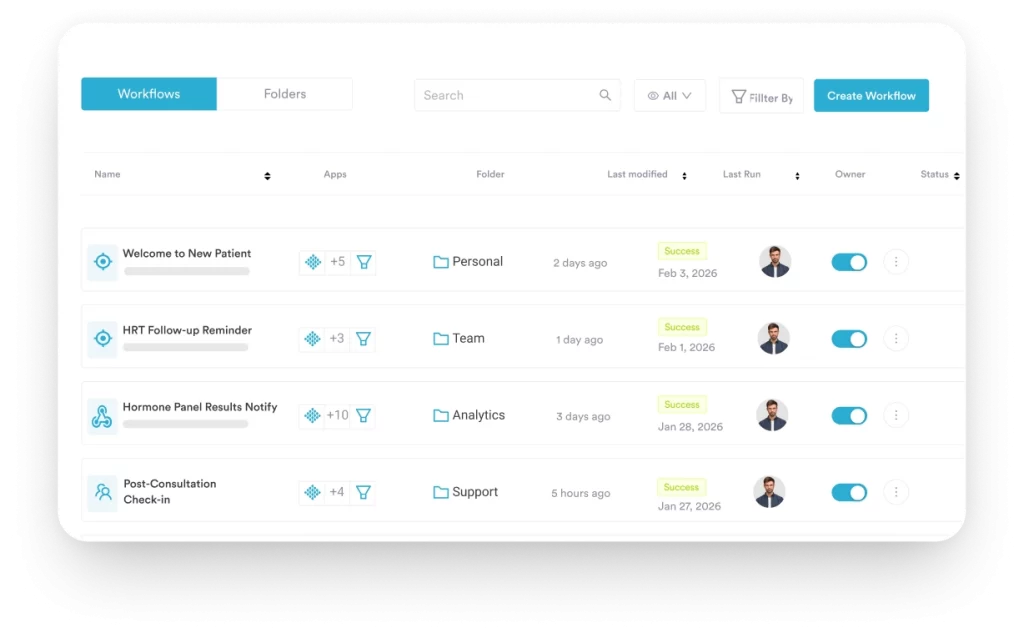
Consistency is itself an experience signal. A patient who gets the right message at the right time reads the practice as organized and attentive. It makes no difference to them whether a person or a system sent it.
Surprise billing is one of the most reliable drivers of negative experience reviews. Patients who get a clear fee explanation before treatment, an itemized invoice, and flexible payment options report higher experience scores. That holds even when the cost lands above what they hoped.
Billing transparency is a communication problem before it is a finance problem. Pre-treatment cost summaries, digital consent forms that carry the fee acknowledgment, and invoices delivered straight after the visit all help. Together they remove most of the uncertainty that generates complaints.
Most practices run the patient journey across separate tools. Bookings sit in one system, forms in another, and the recall list lives in a staff member’s head. Every handover is a chance for a message to go out late, or not at all.
Practice management software like Pabau keeps the whole journey against one patient record. Online booking, digital intake forms, appointment reminders, aftercare messages, and post-visit surveys all fire from the same timeline. Your team can see what was sent and what came back without opening a second system.
The outcome is a journey that reads the same for every patient, whoever is on the front desk that day. Staff stop chasing the admin, and patients stop noticing the seams between one stage and the next.

Digital intake forms, automated reminders, post-visit follow-up, and review capture all run from one patient record. Book a demo to see the whole sequence working on your own calendar.

Patient experience is the operational output of every system, process, and message a practice puts in front of a patient. Treat it as a structural concern and retention, treatment compliance, and referrals all move with it.
Start with the three touchpoints that generate the most friction today, then automate them so they survive a busy week. To see how Pabau handles the journey from booking to post-visit follow-up, book a demo.

Want a framework for capturing patient feedback systematically? How to Capture Patient Feedback covers the tools, timing, and question frameworks that generate actionable data from patients.
Wondering how satisfaction differs from experience? Patient satisfaction vs experience clarifies the difference so feedback programs measure care outcomes, not just feelings.
Want the bigger picture beyond scheduling? Patient relationship management guide explains how missed follow-ups and recalls quietly cost practices their patients.
Looking for ways to keep patients coming back? Patient retention strategies sets out the recall and follow-up habits that turn a first visit into a course of treatment.
Patient experience records what happened during care interactions, such as whether a nurse explained the medication clearly or whether wait times were communicated. Patient satisfaction records whether those events met the patient’s prior expectations. A patient with low expectations can report high satisfaction after mediocre care, which makes satisfaction scores weaker at pinpointing the step that failed.
Better patient experience is associated with higher treatment adherence, lower readmission rates, and stronger retention. Patients who feel heard and well-informed follow care instructions more consistently. In competitive markets, experience quality also shapes online reviews and referrals. In US hospital settings it affects Medicare reimbursement through HCAHPS-linked payment adjustments.
Private practices typically use post-visit surveys sent within 24 hours, Net Promoter Score questions, and public review platforms. CAHPS-style instruments from the AHRQ provide standardized, validated questions that capture observable events rather than general sentiment. Automated survey dispatch through practice management software lifts response rates well above manual outreach.
It covers the first booking attempt, whether online, by phone, or by referral, then pre-visit communications and intake. It then covers the clinical encounter, aftercare instructions, follow-up and recall messaging, and finally billing clarity. Each touchpoint either reinforces or erodes the overall perception. In elective and private practice settings, the pre-visit and post-visit phases often carry more weight than the encounter itself.
A positive patient experience means the patient felt informed, respected, and well-managed throughout their contact with a practice. Their appointment started close to schedule, staff communicated clearly, and they understood the treatment plan and the cost before agreeing to proceed. Follow-up communications arrived as expected, and they had a clear way to contact the practice with questions. Missing any one of these reduces the overall experience.