









Skin peel treatment notes: Free template and example
Download your free skin peel treatment notes template A ready-to-use peel sessio...

2
Last Updated: Sep 4, 2026


Written informed consent is legally required before administering anti-wrinkle treatments including botulinum toxin, dermal fillers, chemical peels, and laser procedures — obtain it on every patient, every time.
Consent forms must document patient capacity, understanding of risks and alternatives, medical history including contraindications, aftercare acknowledgment, and signature — vague or incomplete forms expose practices to regulatory and liability risk.
Botulinum toxin is an FDA-approved prescription drug in the US and a prescription-only medicine (POM) in the UK; prescriber details must appear on all consent forms.
Automated pre-appointment digital consent dispatch via practice management software like Pabau reduces no-shows, ensures completion before arrival, and creates audit-ready records for HIPAA and CQC compliance.
A free, printable anti-wrinkle treatment consent form (PDF) covering patient details, medical history, treatment description, contraindication screening, risk disclosure, aftercare obligations, before-and-after photo consent, and signature blocks for Botox, dermal filler, chemical peel, and laser procedures.
Download templateMost aesthetic practitioners know that facial consultation best practices start with gathering clinical information. But a consultation form isn’t enough on its own. Before administering any anti-wrinkle treatment — botulinum toxin injection, dermal filler, chemical peel, laser resurfacing, or microneedling — you need written informed consent.
This guide and template cover what your consent form must include, whether you need a Botox consent form, a dermal filler consent form, or a single combined document, so you protect both your patients and your practice.
An anti-wrinkle treatment consent form — such as a Botox consent form or dermal filler consent form — is a legal document that records a patient’s informed agreement to undergo an aesthetic procedure. It confirms the patient understands the risks, benefits, alternatives, and aftercare obligations before treatment starts.
In clinical practice, consent forms serve three functions:
In the US, the FDA classifies botulinum toxin as a prescription biologic, and a licensed prescriber must be involved in its supply. In the UK, it’s a prescription-only medicine (POM), and the Human Medicines Regulations 2012 require a qualified prescriber’s involvement too.
Either way, your consent form must name the prescriber and confirm their role in the treatment plan.
Beyond regulatory classification, informed consent standards require that consent forms disclose material risks, alternatives to the proposed treatment, and the patient’s right to withdraw.
In the US, this follows from state-level informed consent law. In the UK, it follows GMC guidance and the Montgomery ruling — a UK case law precedent, not a US standard — which set the current test for what risks must be disclosed.
See our aesthetic practice compliance checklist for the fuller picture. A consent form that omits any of these elements leaves your practice exposed.
Three reasons drive the requirement for written consent before anti-wrinkle treatments:
A comprehensive anti-wrinkle treatment consent form must contain these mandatory sections (if you just need the identification fields on their own, our client information template covers those):
Not every section need be a separate page. Many practitioners use a single-page form with checkbox sections for efficiency. The key is completeness and clarity. A form that’s too long or dense may not get read carefully by patients.
Different anti-wrinkle procedures carry different risk profiles. A Botox consent form, a dermal filler consent form, a chemical peel consent form, a microneedling consent form, and a laser treatment consent form each need to emphasize different risks and aftercare. Other cosmetic procedures, such as microblading, need a dedicated microblading consent form to cover their own specific risks.
Your consent form should either be specific to each procedure or include a comparative section so the patient understands their chosen treatment. Use this table as a reference for what to emphasize in each.
Use this table to tailor your consent form to each procedure. Patients appreciate understanding how their specific treatment differs in recovery time and risk profile.
Digital forms sit at the center of practice management software, feeding records, billing, and follow-ups from one entry.
Your anti-wrinkle treatment consent form must include a detailed medical history section. This is where you identify patients who should not proceed. Essential screening questions include:
Document all responses on the form. If a patient answers “yes” to any absolute contraindication, do not proceed without medical clearance and updated consent reflecting the increased risk.
Your consent form must categorize risks by likelihood and severity. Use realistic language. Don’t understate risks or overwhelm the patient with fear. Common and expected side effects (bruising, swelling, injection-site reactions) should be clearly distinguished from rare but serious complications (nerve injury, vascular occlusion).
After documenting risks, provide written aftercare instructions that the patient must sign acknowledging they understand. Common mistake: handing the patient aftercare instructions verbally and assuming they will remember. Written instructions reduce post-treatment complaints and complications. Include:
Clinical photography for anti-wrinkle treatment documentation serves two purposes. Medically, it creates a record of pre- and post-treatment appearance for clinical audit and follow-up comparison. It can also support marketing, using before-and-after images on the practice website or social media to showcase results. These require separate consents.
Your consent form must include a dedicated section for photography consent that covers:
Never assume verbal permission is sufficient. A signed photography consent clause protects your practice if a patient later objects to their image being used.
Instead of printing a paper form, emailing it, and hoping the patient completes it before arrival, Pabau automates the entire process. Step-by-step workflow:

Solo practitioners see this in practice:
This digital workflow also reduces no-shows through automated consent reminders that keep the treatment front-of-mind. Patients who receive a reminder to complete their consent form are more likely to remember their appointment and show up on time.
This creates a comprehensive audit trail.
If you’re standardizing note formats across the team, pair this with a structured template like our APSO note template so consent status and treatment notes follow the same structure.
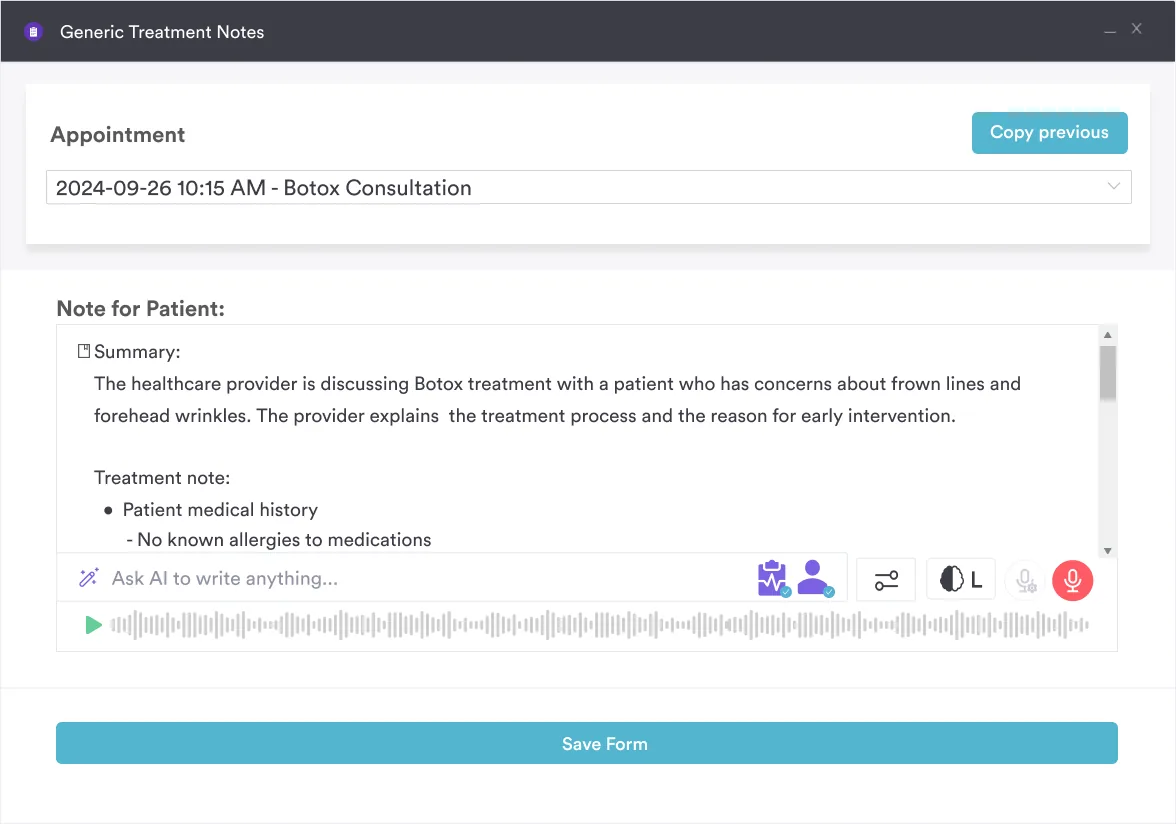
Capturing the consent conversation and the treatment note on the same record means the signed form and the clinical detail stay together, not scattered across separate systems.

Eliminate paper forms, ensure compliance, and let your team focus on patient care.

This template and guidance applies to any healthcare professional administering anti-wrinkle treatments:
Compliance and legal protection. A well-designed consent form demonstrates to state licensing boards and HIPAA auditors (US), and CQC inspectors (UK), that your practice takes informed consent seriously. In the event of a patient complaint or regulatory investigation, the form becomes evidence that you disclosed risks and the patient agreed.
Patient safety and shared decision-making. Patients who complete a thorough consent form understand what to expect, realistic outcomes, and their role in post-treatment success (following aftercare). This alignment reduces disputes, improves satisfaction, and encourages follow-up treatments.
Operational efficiency. A standardized form saves time for each patient and ensures no critical elements are missed. Combined with digital dispatch via Pabau, the form is completed before the appointment, freeing clinical time for the treatment itself.
Staff training and consistency. A documented consent template becomes a training tool for new estheticians and nurses, embedding your practice’s standards into every team member’s practice.
Written informed consent is clinical best practice as much as it’s legal protection. An anti-wrinkle treatment consent form documents that your patient understands the procedure, its risks, realistic outcomes, and aftercare obligations. It protects your practice during HIPAA and CQC audits, reduces post-treatment disputes, and reinforces shared decision-making with patients.
Download the template above and review it with your medical director and legal counsel before rolling it out. Then integrate it into your practice workflows, ideally through digital dispatch and digital form capture in your practice management system.
Automating consent through Pabau means every patient completes their form before arrival, your team has time to address questions, and your practice keeps a secure, audit-ready record.
Ready to streamline your consent workflow and stay compliant across every anti-wrinkle treatment? Book a demo today.

Need a consent form for a different procedure? Cheekbone reduction consent template follows a similar procedure-specific structure for surgical consultations.
Need to know California’s licensing rules? California cosmetology license requirements covers required training hours, the state exams, and application steps for California practitioners.
Ready to grow your aesthetic business? 7 customer journey steps walks through the 7 essential customer journey steps for growing an aesthetic business.
Obtain fresh written consent before each new course of treatment. Annual consent is not sufficient if more than 12 months have passed between treatments, as risks and clinical context may have changed (new contraindications, new procedures, updated prescriber). Many practices re-consent every 6-12 months as standard practice for repeat patients.
Yes. Digital signatures are legally valid under the US ESIGN Act (Electronic Signatures in Global and National Commerce Act) and the UK Electronic Communications Act 2000. A digital signature on a tablet or via email is equivalent to a handwritten signature. Ensure your practice management software encrypts the form and maintains an audit trail of when it was signed.
A generic form covering all procedures can work if it clearly specifies which treatments the patient is consenting to (e.g. checkbox: “Botox”, “Filler”, “Chemical peel”). However, procedure-specific forms are preferable because they allow you to tailor risks, downtime, and aftercare instructions. Pabau allows you to create multiple form templates and link each to specific services.
If a patient is unable to understand or retain information about the treatment (cognitive impairment, mental health crisis, medication-induced sedation), do not proceed. For a parent consenting on behalf of a minor, use a separate “Parental Consent for Minors” form that documents the parent’s understanding and authority. Capacity assessment is the practitioner’s responsibility and must be documented on the form.
In the US, HIPAA requires covered practices to keep HIPAA compliance documentation (like authorizations and policies) for 6 years — but HIPAA itself doesn’t set a retention period for the medical record. How long you must keep medical and consent records is set by state law, and it varies, so check your state’s requirement and keep records for the longest period that applies to your practice. In the UK, GDPR requires you to keep personal data no longer than necessary (the storage-limitation principle) but doesn’t specify a number of years. Many UK private and aesthetic practices follow the NHS Records Management Code of Practice, which recommends retaining adult patient records for around 8 years after the last treatment as a benchmark, not a legal mandate. Cloud storage with Pabau makes it easy to apply whichever retention period applies to your practice.
Online templates are a starting point but should be reviewed by your practice’s legal counsel and medical director before use. Consent forms must be jurisdiction-specific (US state law differs from UK law) and procedure-specific. A generic template that doesn’t account for your practice’s scope of practice may leave your practice exposed. Pabau’s pre-built aesthetic consent templates are designed for UK and US compliance and can be customized for your practice.
Yes. You can download the free anti-wrinkle treatment consent form (PDF) at the top of this page and use it as a printable Botox consent form or adapt it for fillers, peels, and laser. Review it with your medical director before use so the wording matches your scope of practice and local regulations.
No. There is no requirement to use the manufacturer’s version. Many practices prefer a single anti-wrinkle treatment consent form that covers every injectable and energy-based procedure they offer, as long as it names the product administered and captures risks, contraindications, and aftercare.