Healthcare workforce planning: a practical guide for practice leaders
Healthcare workforce planning is the structured process of matching clinical cap...

Last Updated: Oct 13, 2026

Patient experience measures whether specific care events occurred; patient satisfaction measures whether those events met patient expectations.
CAHPS surveys use frequency scales (always/never); traditional satisfaction surveys use rating scales (very good/very poor).
Non-clinical touchpoints like online booking, wait times, and automated reminders directly shape experience scores.
Pabau’s automated workflows, digital forms, and recall tools help clinics improve both metrics simultaneously.
Most clinic owners treat patient satisfaction vs patient experience as interchangeable terms. They are not. Conflating them leads to measurement gaps, misallocated improvement budgets, and feedback programs that tell you how patients felt rather than what actually happened during their care. According to the Agency for Healthcare Research and Quality (AHRQ), patient satisfaction assesses whether expectations were met, while patient experience measures whether specific, evidence-based aspects of care actually occurred. Getting that distinction wrong costs practices both retention and referrals.
Consider a cosmetic dermatology clinic that maintained a 4.8/5 satisfaction score for two consecutive years while its no-show rate climbed to 34%. Patients liked the results when they showed up, but the booking process was broken: confirmation messages arrived late, intake forms required printing, and the average wait time between check-in and consultation was 22 minutes. Satisfaction measured the outcome; experience measured the process. Fixing one without the other left revenue on the table.
Patient experience is objective. It asks whether something happened: Did the clinician explain the medication? Was the appointment on time? Did someone follow up after the procedure? These are verifiable events, not opinions. The AHRQ frames experience as an inventory of care interactions the patient values: timely appointments, information access, provider communication, and care coordination.
Patient satisfaction, by contrast, is entirely subjective. It asks how the patient felt about what happened, filtered through whatever expectations they brought into the encounter. A patient who expected a 10-minute wait and waited 12 minutes may report lower satisfaction than one who expected 30 minutes and waited 20. The clinical interaction itself was identical. The satisfaction score was not.
| Dimension | Patient Experience | Patient Satisfaction |
|---|---|---|
| What it measures | Whether specific care events occurred | Whether expectations were met |
| Nature | Objective / event-based | Subjective / expectation-based |
| Survey scale | Always / Never (frequency) | Very Good / Very Poor (rating) |
| Primary tool | CAHPS, HCAHPS | Custom satisfaction surveys, NPS |
| Best used for | Process improvement | Gauging patient loyalty, referral intent |
A 2019 peer-reviewed analysis published in PMC defines patient satisfaction as “an outcome measure of a patient’s experiences of care, along with health outcomes and confidence in the health system.” That framing is important: satisfaction is a downstream result, shaped by experience but also by personal expectations that have nothing to do with your clinic’s actual performance.
Understanding patient satisfaction vs patient experience at the measurement level changes how clinics interpret their data. The two most widely used instruments are designed for fundamentally different purposes.
The Consumer Assessment of Healthcare Providers and Systems (CAHPS), developed and maintained by the AHRQ, uses frequency-based response scales: always, usually, sometimes, never. These questions do not ask patients how they felt; they ask what happened. “Did your provider explain things in a way you could understand?” yields an actionable clinical process finding. If the answer skews toward “sometimes” or “never,” you have a communication workflow problem, not a perception problem.
HCAHPS (Hospital Consumer Assessment of Healthcare Providers and Systems) is the hospital-setting adaptation mandated by the Centers for Medicare and Medicaid Services (CMS) for value-based purchasing calculations. Private clinics and med spas are not subject to HCAHPS reporting requirements, but the instrument’s domain structure (communication, responsiveness, environment, care transitions) is a useful framework for any practice designing its own measurement program.
Traditional patient satisfaction surveys use rating scales from “very poor” to “very good.” Net Promoter Score (NPS) asks one question: how likely are you to recommend this practice? Both tools measure perception and loyalty intent. They are useful for benchmarking referral sentiment and identifying outlier visits, but they cannot tell you which specific process failed or which staff behavior drove the result.
Most private practices that run only satisfaction surveys are flying partially blind. They know whether patients are happy; they do not know what made them happy or unhappy. Combining both instrument types gives you the complete picture.
Clinicians often assume experience scores are driven entirely by clinical interactions. The data disagrees. Non-clinical touchpoints shape experience before a patient sets foot in your building, and they continue to shape it after they leave.
Scheduling friction: A patient who tried three times to book online before giving up has already formed a negative experience impression. Online booking availability, confirmation emails, and reminder timing all register as experience events under CAHPS-style frameworks.
Wait time management: Wait time is the most frequently cited non-clinical driver of both experience and satisfaction scores. A clinic running 20 minutes behind without communicating that to waiting patients is generating a measurable experience gap, regardless of how good the clinical encounter is.
Post-visit follow-up: Whether a patient received post-care instructions, whether someone checked in after a procedure, and whether their next appointment was easy to schedule all appear in experience surveys. These touchpoints are entirely within the clinic’s operational control.
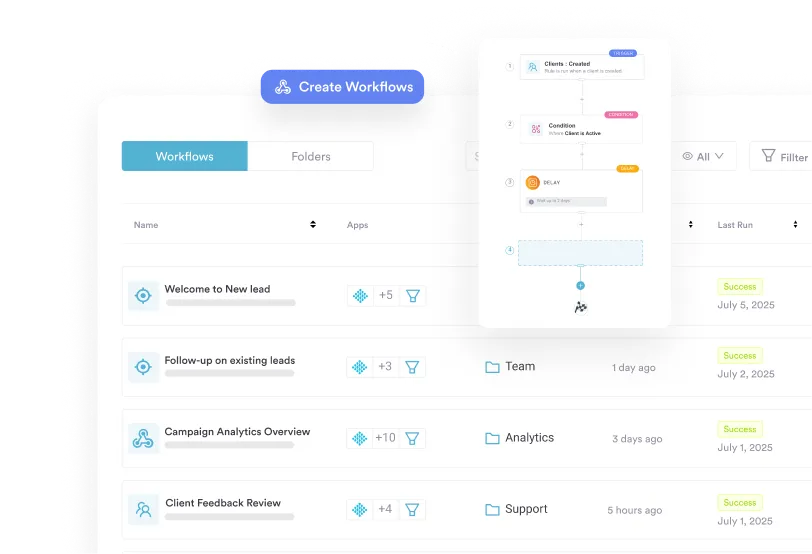
Clinics using automated workflows can systematically address every stage of this touchpoint map. The automation does not replace clinical care; it ensures the surrounding operational context consistently supports it. Similarly, pre and post-care automation ensures patients receive standardized follow-up that directly maps to experience measurement criteria.

From digital intake forms to automated recall reminders, Pabau handles the non-clinical touchpoints that drive patient experience scores. Book a demo to see the full workflow.

Running only one type of survey creates a blind spot. The operational value emerges when both datasets are layered: experience surveys reveal which touchpoints are failing, while satisfaction scores reveal whether those failures actually damage loyalty. Together, they form a diagnostic-and-prognostic pair – one tells you what broke, the other tells you how much it cost you.
Research published in PMC (2021) on relationships between patient experience and primary care quality found that satisfied patients are more likely to adhere to recommended treatments and attend follow-up visits. That correlation has real revenue implications: a one-percentage-point improvement in follow-up attendance compounds across a full patient panel. The mechanism behind it, however, is the experience, not the satisfaction score. Improving the experience drives the adherence; the satisfaction score reflects it afterward.
For practices operating in value-based or outcomes-linked payment models, this distinction carries regulatory weight. CMS value-based purchasing calculations incorporate HCAHPS scores for hospital providers. Private clinics and medical spa operators are not directly subject to those calculations, but the underlying logic applies: demonstrable care quality captured in experience data is increasingly the standard that payers, regulators, and accreditors use to evaluate practices.
Most improvement programs fail because they treat satisfaction and experience as the same problem. They are not. Each requires a different intervention type.
Experience gaps are process gaps. When CAHPS-style data shows patients rarely receive clear post-visit instructions, the solution is a standardized post-care communication workflow, not a staff pep talk. When experience scores show booking is difficult, the solution is online booking that removes friction from appointment scheduling. Every experience gap maps to a specific operational touchpoint that can be systematically addressed — the core discipline covered in our practice management guide.
Systematizing a touchpoint starts with documenting it correctly, which is where knowing the difference between protocols versus procedures pays off: one sets the decision rules, the other the exact steps.
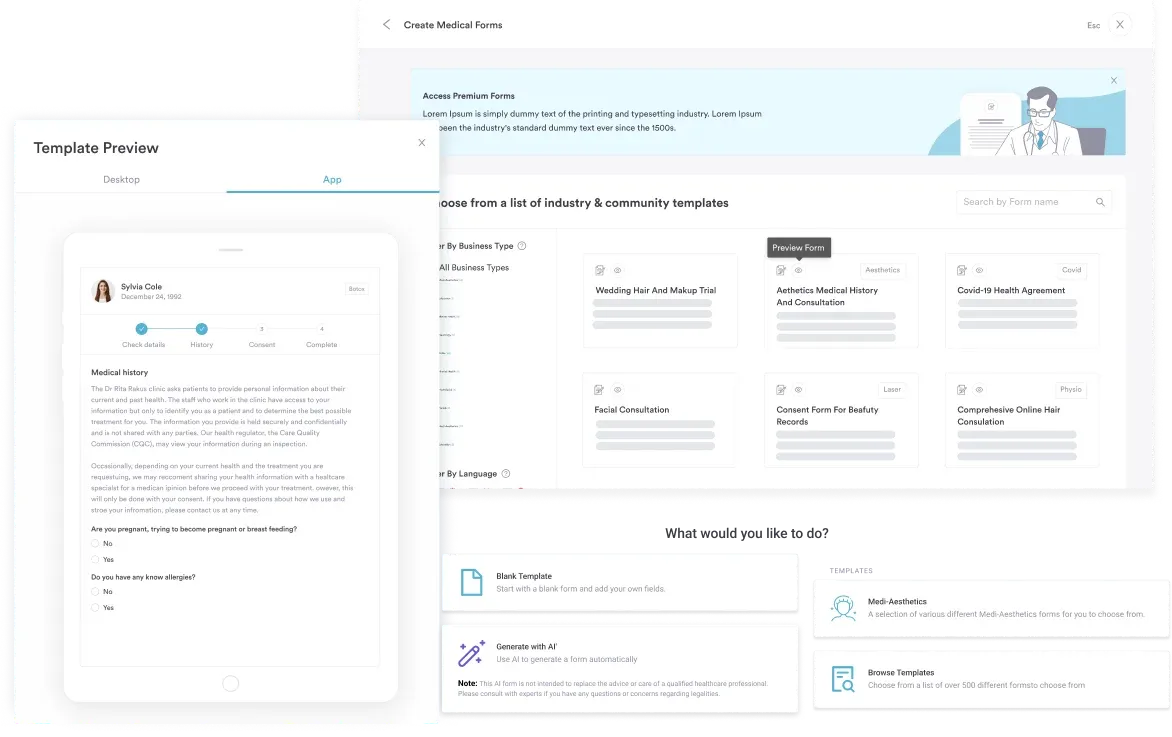
Digital intake forms eliminate paper-based delays at check-in. Digital forms sent before the appointment mean patients arrive with consent and medical history already completed. That single change compresses the pre-clinical experience from friction to efficiency, and it appears in experience surveys as “the clinic was organized and my time was respected.”
Because satisfaction is expectation-based, the most powerful lever is expectation management before the visit. A patient who receives a clear confirmation email explaining what to expect, how long the appointment will take, and what preparation is required arrives with calibrated expectations. When reality matches those expectations, satisfaction scores rise, even if the clinical interaction was identical to a visit where no such communication occurred.
Appointment reminders, pre-visit instructions, and confirmation messaging are expectation-setting tools. Clinics using email and SMS campaigns can automate this communication at scale across their entire patient panel. The client portal gives patients self-service access to their records, upcoming appointments, and post-visit summaries, reducing the information asymmetry that generates dissatisfaction. Those messages generate replies, so a shared patient inbox decides whether anyone answers them.
The most common mistake private clinics make is collecting feedback reactively, only when something goes wrong. A systematic post-visit survey program captures both experience events and satisfaction impressions at scale. Pabau’s review management tools automate post-visit review requests, channeling positive responses to public platforms and flagging negative responses for internal follow-up before they become public complaints.
For practices that want to build a structured feedback program, the patient feedback capture guide covers the specific survey design, timing, and follow-up workflow that yields actionable data rather than vanity scores.
Run two separate feedback touchpoints: send an experience-focused survey (3-4 frequency-scale questions about communication, wait time, and follow-up) within 24 hours of the visit, and a satisfaction NPS question at 7 days post-visit. The gap between experience scores and NPS reveals expectation management opportunities you cannot see from either metric alone.
The concern practitioners most often raise is whether experience scores actually correlate with clinical quality, or whether they simply reward warm bedside manner regardless of clinical rigor. The New England Journal of Medicine addressed this directly: patient experience surveys designed and administered appropriately provide robust measures of healthcare quality, not just customer service impressions.
The operational translation for private practices is this: experience data collected around communication, care coordination, and responsiveness predicts clinical process quality. Practices that score well on these dimensions tend to have lower complication rates, better follow-through on treatment plans, and stronger long-term patient relationships. The mechanism is not mysterious. Patients who receive clear explanations understand their treatment. Patients who receive timely follow-up catch complications early. Good experience design and good clinical design reinforce each other.
For clinics running patient experience management programs, the key is connecting feedback data to operational dashboards rather than treating it as a standalone metric. When a drop in communication scores triggers a review of appointment pacing and consultation time, the feedback loop closes. When it sits in a spreadsheet, nothing changes.
Practices that also track patient engagement (see our guide on how to improve patient engagement) alongside experience and satisfaction metrics have three interlocking data points: what happened, how it felt, and how actively patients are participating in their own care. Together these indicators give clinic owners a complete operational picture that no single survey instrument can provide.

Want a structured framework for collecting patient feedback? How to Capture Patient Feedback covers survey design, timing, and follow-up workflows for private clinics.
Looking to reduce patient drop-off? patient engagement strategies guide covers the follow-up habits that stop quiet patient drift after a single good visit.
Most patient experience literature focuses on hospital and primary care settings. But the satisfaction-vs-experience gap plays out differently in aesthetic, cosmetic, and elective medicine, and this distinction matters for private clinic operators running med spas, dermatology, or wellness practices.
In elective medicine, patients are consumers making a discretionary purchase. Their expectations are shaped by consumer experiences (Amazon, Uber, restaurant bookings), not by healthcare benchmarks. A patient booking Botox expects the same frictionless digital experience they get from a hotel reservation: instant confirmation, no paperwork on arrival, transparent pricing, and a follow-up that feels personalized rather than automated. When the experience falls short of consumer-grade expectations, satisfaction drops disproportionately, even if the clinical outcome is excellent.
This creates a specific measurement challenge. Standard CAHPS-style experience questions (“How often did your provider explain things in a way you could understand?”) miss the touchpoints that elective patients care about: booking ease, wait time transparency, before-and-after photo handling, payment flexibility, and post-treatment communication speed. Clinics in this space need experience surveys calibrated to consumer-service expectations, not hospital-derived frameworks.
Pabau was built for this exact operational profile. The platform’s automated workflow engine handles the entire patient journey – from online booking with instant confirmation, through digital intake forms completed on the patient’s phone before arrival, to before-and-after photo management tied to the clinical record, and automated post-treatment follow-ups sent at clinically appropriate intervals. Each of these touchpoints is an experience data point that standard healthcare survey tools do not capture. Pabau’s automated review collection then measures satisfaction at the moment it matters most – immediately after the patient has experienced the full service cycle.
The clinics that consistently grow are the ones that stopped treating feedback as a single score. They measure experience to find operational failures and measure satisfaction to track whether fixes actually changed patient behavior. The ROI is concrete: lower no-show rates, higher rebooking, and organic referrals that cost nothing to acquire.
Pabau’s automated workflows, digital intake forms, post-care messaging, and review collection tools address both sides of this equation. They systematically improve the non-clinical touchpoints that drive experience scores and the expectation-setting communications that shape satisfaction. If you want to see how that plays out across a live clinic workflow, book a demo and we’ll walk through the specific automation touchpoints relevant to your practice type.
Patient experience measures whether specific care events occurred (such as clear communication, timely appointments, and care coordination), using frequency-based scales like always/never. Patient satisfaction measures whether those events met the patient’s prior expectations, using rating scales. Experience is objective and process-focused; satisfaction is subjective and expectation-focused.
Patient experience data identifies specific process failures in care delivery that satisfaction scores cannot pinpoint. Research shows that patients with better experiences are more likely to follow treatment recommendations, attend follow-up visits, and maintain long-term relationships with their providers, which has direct clinical and revenue implications for practices.
CAHPS (Consumer Assessment of Healthcare Providers and Systems) measures patient experience using frequency scales. HCAHPS is the hospital inpatient version used in CMS value-based purchasing. Custom post-visit surveys and Net Promoter Score (NPS) measure patient satisfaction. Private clinics typically need both instrument types to capture the full picture.
Non-clinical factors including online booking ease, wait time management, appointment reminder timing, check-in processes, and post-visit follow-up all appear in CAHPS-style experience surveys. These operational touchpoints are entirely within a clinic’s control and often have a larger impact on experience scores than the clinical interaction itself.
Practice management software addresses the operational touchpoints that drive experience scores (booking, reminders, intake, post-care follow-up) and the expectation-setting communications that shape satisfaction (confirmation emails, pre-visit instructions, client portals). No software guarantees higher satisfaction scores, but systematically addressing these touchpoints removes the most common drivers of poor scores in private clinics.