Fertility clinic marketing: Strategies that attract & convert patients
Fertility clinic marketing is how a fertility practice attracts, educates, and c...

Last Updated: Oct 14, 2026
How to collect patient feedback comes down to five channels. Practices use a post-visit survey, an on-site feedback form, a feedback landing page, social media, and phone calls.
The right one depends on whether you want ratings at volume or a handful of detailed answers. So pick one channel as your always-on backbone, then add a second for depth.
Collecting the responses is the easy half. Feedback only earns its keep when a low score reaches a named owner with a deadline attached. Each method below comes with the questions to ask, and a protocol for the scores you would rather not see.

Always-on surveys sent by text or email right after each appointment capture feedback while the visit is still fresh.
On-site feedback forms, paper or digital, catch reactions to one specific visit before the patient walks out.
A feedback landing page returns fewer responses, but longer ones, and it lets patients stay anonymous.
Social media polls reach patients who skip formal surveys, and a phone call gets the detail neither of those can.
Route every low score to a named owner with a callback target of one business day.
Use a post-visit survey for volume, a feedback landing page for depth, and a phone call when you need the reason behind a low score.
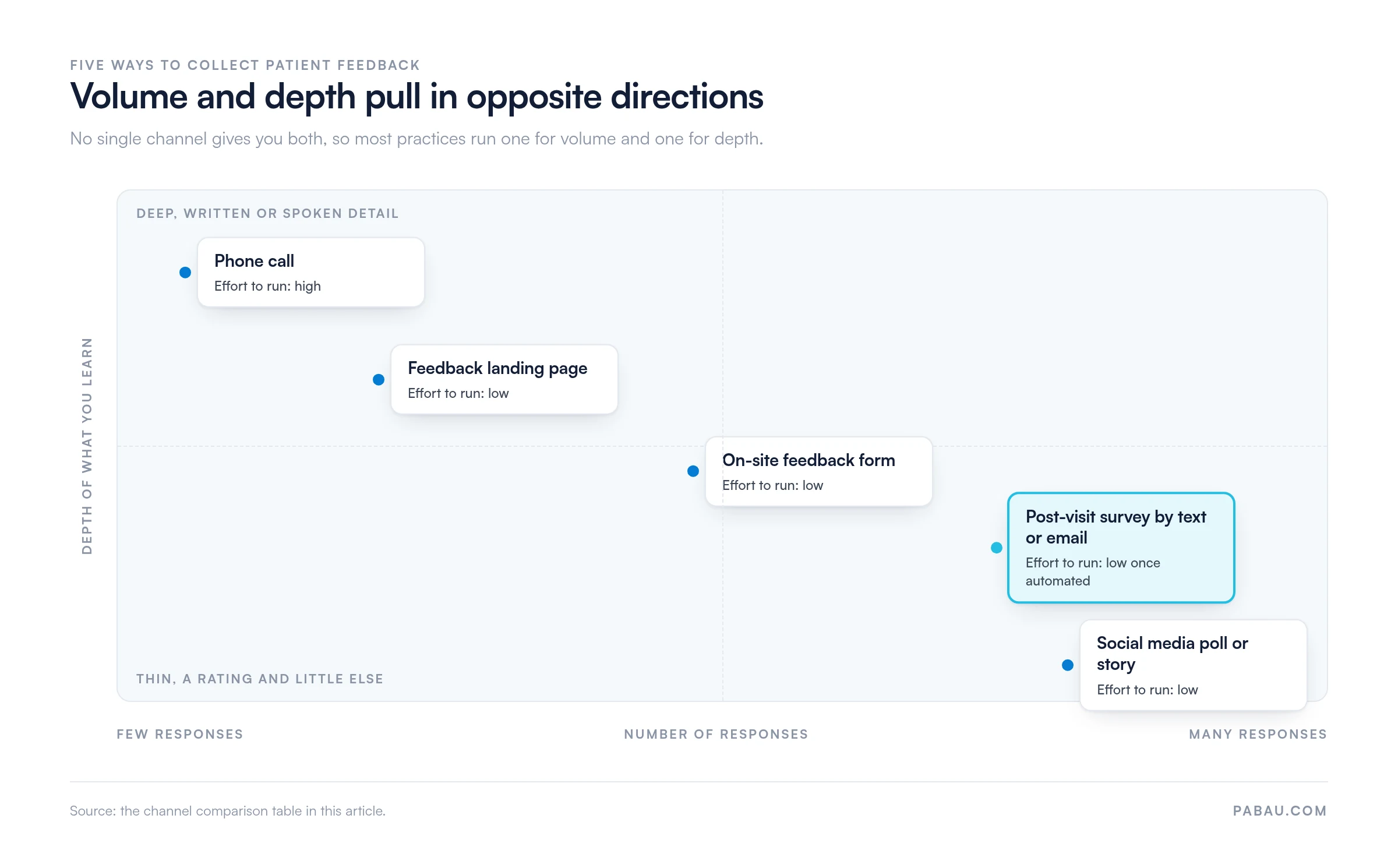
Most practices run two or three together. Here’s how the five channels compare, sorted by volume, depth, effort to run, and whether the patient can stay anonymous.
Plotted against each other, the five split cleanly. The channels that bring volume rarely bring detail, which is why pairing two beats perfecting one.
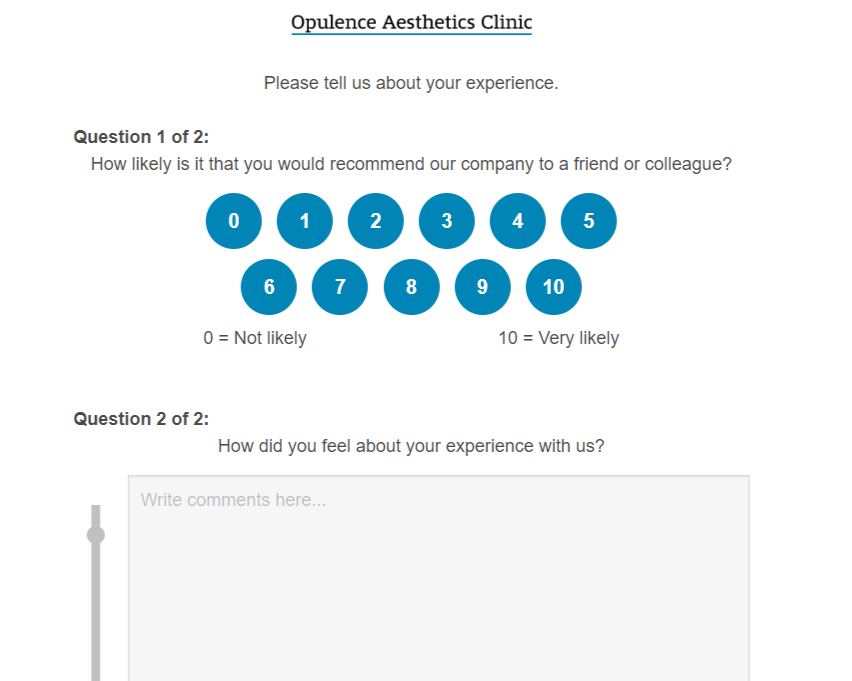
Send a short survey by text or email within an hour of checkout, then repeat it after every appointment rather than quarterly.
A patient feedback survey run once a quarter tells you how the practice felt three months ago. Building the request into your checkout routine gives you a running read of the same week. A slipping wait time then shows up before it costs you a patient.
Two channels carry the request, and they suit different questions:
Timing decides how to get patient feedback that is worth reading. Send within the hour for front-desk and service questions. Delay the send for treatments whose results take time to appear, and say in the message why you waited.
If you want your scores to mean something outside your own four walls, borrow from a standardized instrument.
CAHPS, short for Consumer Assessment of Healthcare Providers and Systems, is the US standard set of patient experience surveys. Its Clinician and Group question set transfers well to a short post-visit survey. The wording has already been tested on thousands of patients.
Four- and five-star responses are worth a second ask. Prompt those patients to repost the same words on Google. The survey then doubles as a feed into your healthcare reputation management.
Ten minutes of setup saves a month of unread responses. Run through these four first:
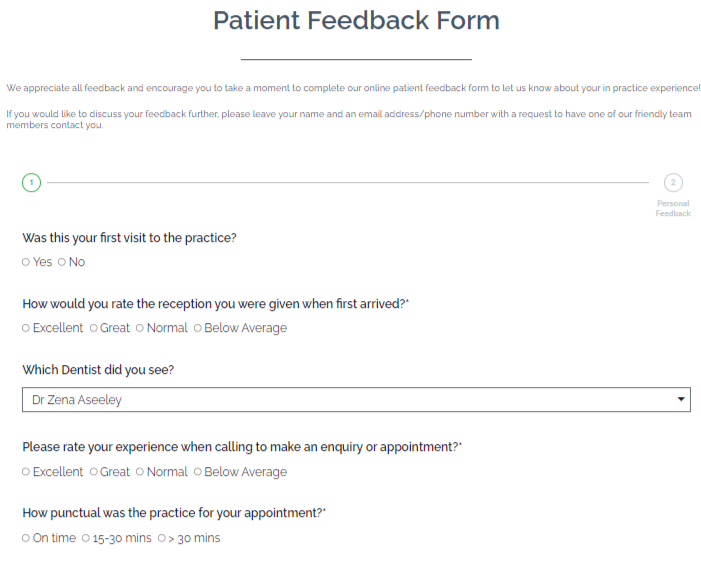
Hand patients a short feedback form before they leave, on paper or a tablet, so you capture the visit while it is still happening.
Surveys and forms answer different questions. A survey is comprehensive and completed remotely, usually hours or days later. A patient feedback form is filled out on-site. That is why it catches the small irritations a patient forgets by the evening.
Keep the form to the parts of the visit the patient could see. Four areas cover most of it:
Questions they cannot answer from one appointment come back blank.
Paper and digital both work, so offer both. If you print them, leave a stack in a tray at reception with a sealed box for completed forms. The box matters more than the form. A patient who has to hand it back to the receptionist will soften what they wrote.
Mix the question formats inside the form. Rating scales give you a number you can track month to month. One or two open prompts then explain the number.
A feedback page on your own site is the only channel here that keeps the patient anonymous. It is also the one that brings back long, written answers. That combination is what makes it worth building.
Patients who would never say something awkward to a receptionist will type it into a form at home. Responses tend to be longer and more considered, because nobody is waiting for them to finish.
Mix the question types on the page. Use a yes or no, a rating scale, and an open text box. Then add three sorting questions. Ask which treatment they had, which practitioner they saw, and roughly when they visited.
Those three fields turn a pile of comments into something you can act on. They let you start measuring patient satisfaction by practitioner and by treatment. One blended number never moves, so it never tells you where to look.
Link the page from your booking confirmation, your aftercare email, and your Google Business profile. A page nobody can find gets no answers.
Social media reaches the patients who ignore every formal channel. A poll in a story takes one tap, which is a far lower ask than a survey link.
The trade-off is depth. A poll shows you the split, and never the reason behind it. So use it to test one specific question, such as whether patients would book evening appointments.
Many patients check a provider’s profile and reviews before they book. A visible question in your feed therefore does double duty. It collects an answer, and it shows prospective patients that you ask.
A poll question can be as short as this:
📊 How did you rate your last booking experience with us? Excellent, good, average, or poor.
Phone two groups. Call the patients who scored you low, and the ones who never answered at all. A five-minute call explains what a rating never will.
A call is the only channel here that lets you ask a follow-up. When a patient says the wait was too long, you can ask where they were waiting and for how long. That answer is what tells you whether to fix the schedule or the waiting room.
Calling is also how to get feedback from patients who ignore every other prompt. Working the silent list is the cheapest way to lift your response volume. It doubles as a rebooking conversation.
Keep the list short and deliberate. Ten calls a week, made by the same person, will teach you more than a thousand unread survey responses.
Closing the loop means routing each theme to one owner, making one change, and telling the patients who raised it what changed.
Skipping the last step is what makes feedback programs quietly die. Patients stop answering when no visible change follows, and staff stop reading when nobody acts. Accenture research found that 34% of patients who had a negative healthcare experience switched provider afterward.
Three themes come up often enough to plan for.
Read the comments for the moments where a patient did not know what was happening. Those moments cluster at the handovers, such as booking to confirmation, or treatment to aftercare.
Each one is fixable with a template rather than a training day. Name the practitioner, the room, and what to bring in your confirmation message. That alone removes most of the confusion patients report.
Patients describe process complaints precisely, which makes them the easiest to act on. Long waits, an unanswered phone, and a booking process that takes three messages come up in the same words every time.
TechTarget reports that 80% of patients want self-service online scheduling. Booking friction is a common theme in feedback, so online booking for practices is often the first fix worth making.
Using patient feedback for quality improvement works best when you read it next to your clinical outcomes, in the same review meeting. A treatment with good results and poor feedback usually has a consent or expectation-setting problem, not a clinical one.
Ask what patients say about the consultation itself. A patient who felt rushed will judge an average result harshly. Someone who felt heard will forgive the same result.
Treat any score below your threshold as a task with a named owner, and call the patient back within one business day.
The survey is the easy part to set up. What happens next decides whether a low score changes the practice. Five steps cover it:
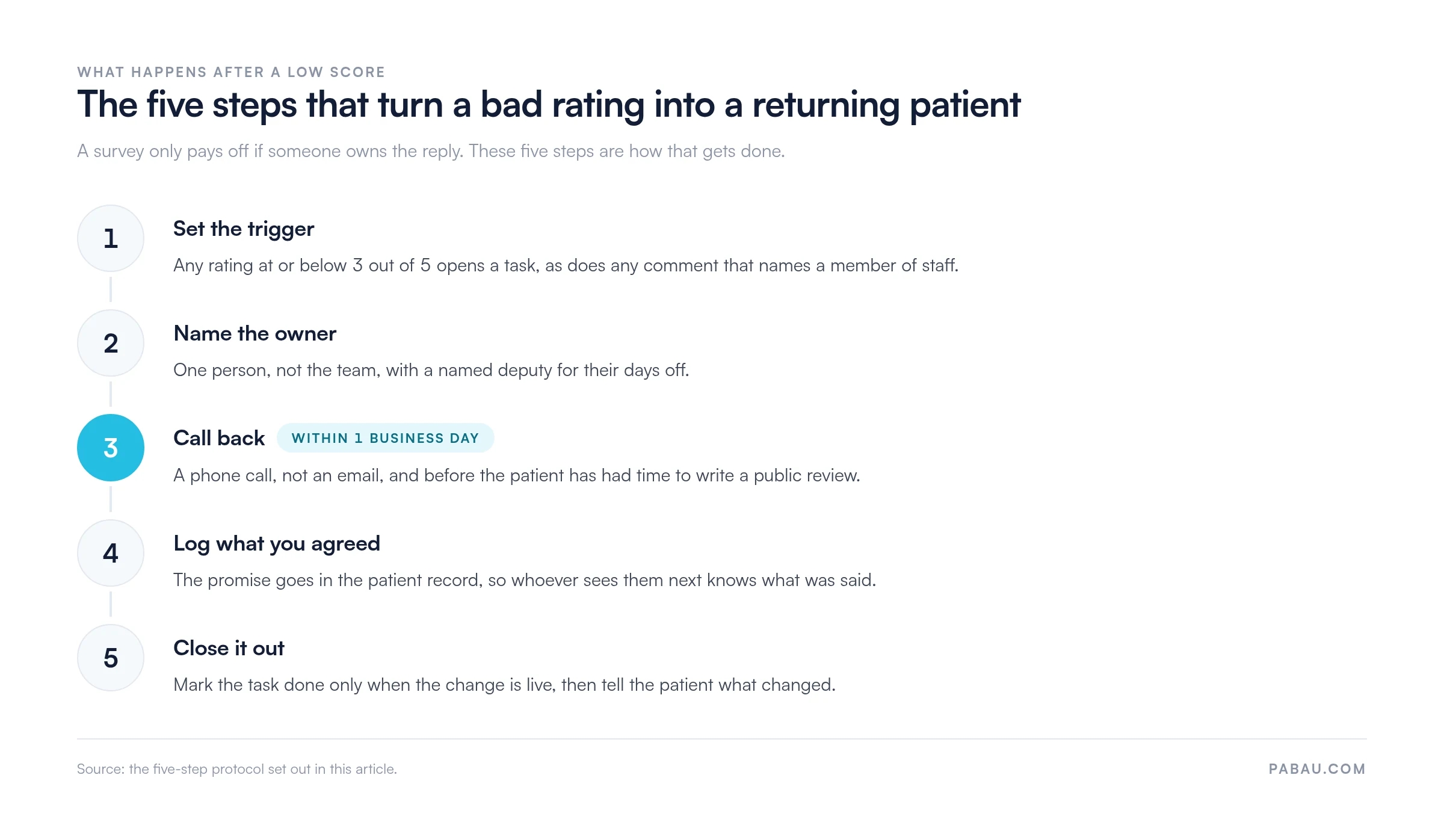
In the practices we onboard, the survey is rarely the sticking point. The reply is where it breaks down. A task with nobody’s name on it gets read, then forgotten.
The same protocol covers a public review. Reply in the open within a day, and keep clinical detail out of it. Move the specifics to a phone call. A short, unbothered reply reads better to the next reader than a detailed defense.
Track the average score by month rather than by response. One bad week reads like a crisis. A three-month slide is what deserves a response. A month-by-month trend is also the only way to tell whether your fix worked.
The five channels above still need someone to send the request, read the answers, and act on them. Practice management software like Pabau, our all-in-one system for practices, takes the sending and the sorting off the front desk.
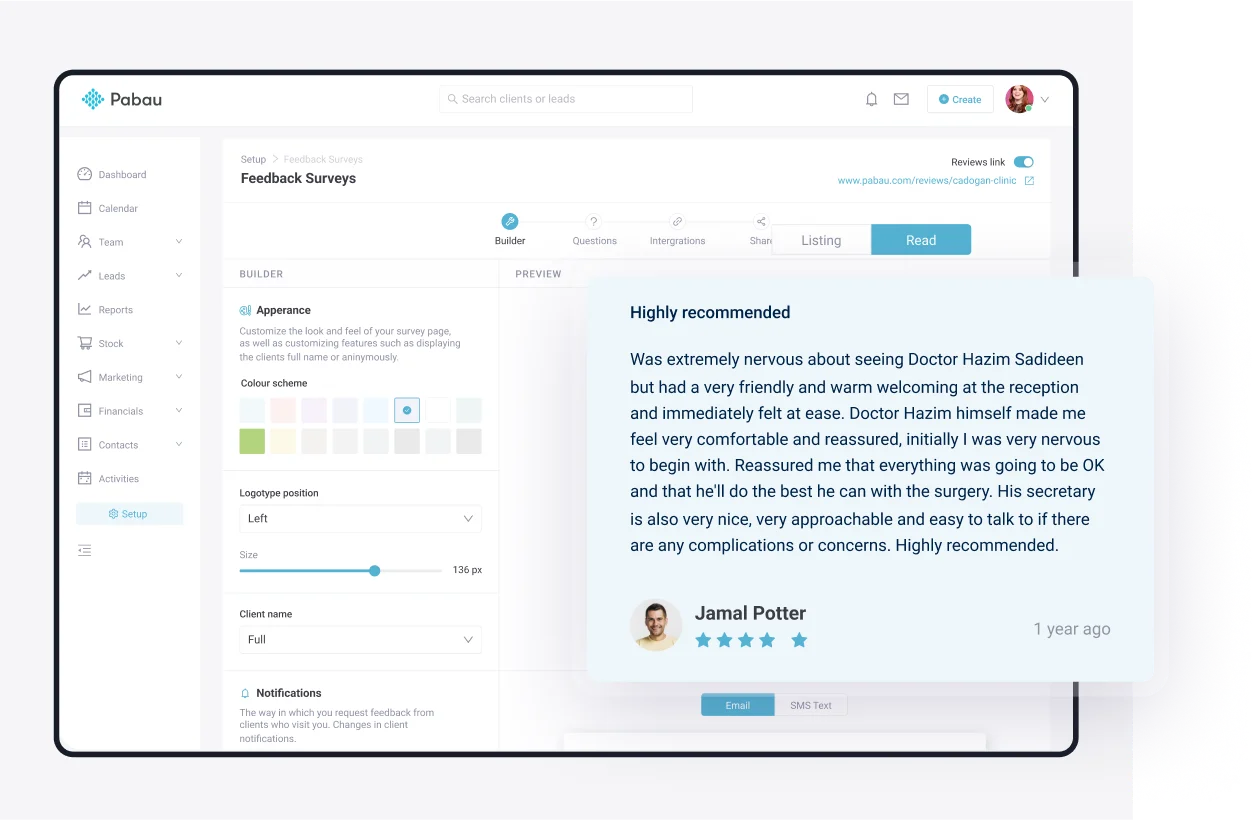
Pabau’s feedback surveys go out on a rule you set per service. Someone in for filler can get the request an hour after checkout. For a laser course, the request waits until the third session, when the result is finally visible. You build the questions once from a question bank, then reuse them across services.
Praise and criticism then take different routes. Lower scores stay internal, on a reviews page Pabau hosts for the practice. With Marketing Plus, our paid marketing add-on, four- and five-star responses also get a prompt to repost on Google. So praise reaches the people choosing a provider, and criticism reaches you first.
Responses land in Pabau’s reporting instead of a spreadsheet, next to the appointment and the practitioner who ran it. Low scores are visible the same day, so the callback in the protocol above happens while the patient still remembers the visit.
If you are still choosing a tool, our roundup of patient satisfaction survey software compares what each one sends, stores, and reports.

Pabau sends post-visit surveys by text or email on a rule you set per service. Every score lands next to the appointment it came from, so a low rating reaches the right person the same day.

Two decisions carry most of the value here. Pick one channel for volume and one for depth, then stop adding channels and start reading what comes back.
The second decision is what happens on a bad score. Call the patient back within a day, and a would-be one-star review becomes a returning patient. File the score away, and you learn the same lesson twice.
None of this needs new software if your front desk has spare hours each week. Few do. Pabau sends the requests, collects the scores, and puts every low rating in front of the person who can fix it. Book a demo to see it running in your own practice.

Getting more bad reviews than you can answer? Medical practice reputation management sets out how to reply, when to escalate, and what to leave alone.
Worried about what patients find when they search your name? Online reputation management for doctors covers the profiles and listings that decide that first impression.
Want to act on what the feedback tells you? Improving patient experience walks through the changes that move scores rather than just recording them.
Losing patients after one visit? Patient retention strategies explains the follow-up sequence that brings people back for a second appointment.
Still messaging patients from three different inboxes? 7 best patient communication software compares the tools that keep every message on the patient record.
Judge it against your own trend, because no single number works across every specialty. On a 0 to 10 recommendation question, patients answering 9 or 10 count as promoters and 0 to 6 as detractors. Net Promoter Score subtracts the detractor share from the promoter share, so it runs from -100 to +100. Above zero means you have more promoters than detractors.
Feedback is something you asked for, and a complaint is something the patient raised on their own. That difference matters day to day. A complaint usually starts a formal process with its own record, response deadline, and escalation route. Feedback has no such route unless you build one, which is why a low survey score needs a named owner.
No. Google’s review policy bans offering money, discounts, or gifts in exchange for a review, and reviews collected that way can be removed. Your own internal survey is a different case, since it is private and never becomes a public rating. Even there, keep any incentive small and never tie it to the score a patient gives.
Positive feedback usually names a staff member, a short wait, or an explanation the patient understood. Common wording includes “the nurse talked me through every step” and “I was seen five minutes after my appointment time”. Keep those comments verbatim, because they make better review copy and better training material than a five-star rating.