HCPCS Code E0272: Foam rubber mattress billing guide
HCPCS Code E0272: official descriptor and code overview HCPCS Code E0272 is the ...

Last Updated: Nov 6, 2026
K0849 is the HCPCS Level II code for power wheelchair, group 3 standard, captains chair, patient weight capacity up to and including 300 pounds.
Unlike the adjacent K0848, which uses a sling or solid seat and back, K0849 requires the captain's chair configuration. Medicare covers it under LCD L33789 once prior authorization is affirmed before delivery. Common denials come from a missing prior authorization, an order dated after delivery, or records that skip the patient's mobility limitation at home.
Let Pabau's smart automation suggest the right codes, reduce claim denials, and keep your practice compliant—effortlessly.
Automate repetitive tasks and focus on what matters most—your patients.
Reduce coding errors and ensure compliance with the latest regulations.
Clean claims, fewer denials, and faster reimbursements.
Powerful insights and reporting to help your practice thrive.
HIPAA compliant SOC 2 certified GDPR-compliant Trusted by 4,000+ clinics worldwide

HCPCS Code K0849 covers a group 3 standard power wheelchair with a captain’s chair for patients up to and including 300 pounds.
Prior authorization must be affirmed before delivery under Medicare’s prior authorization program for power mobility devices.
LCD L33789 governs coverage and requires a mobility limitation in the home that a cane, walker or manual wheelchair can’t safely resolve.
Rental claims use RR with KH in month 1, RR with KI in months 2-3 and RR with KJ in months 4-13.
Pabau, the practice management platform we build, keeps the order, exam notes and signed forms on one patient record for prior authorization and billing.
HCPCS Code K0849 is the HCPCS Level II code for a group 3 standard power wheelchair with a captain’s chair.
It covers patients who weigh up to and including 300 pounds. CMS lists its full descriptor as Power wheelchair, group 3 standard, captains chair, patient weight capacity up to and including 300 pounds. The code sits in the K0848-K0864 range of group 3 power wheelchairs.
K0849 covers a group 3 power wheelchair fitted with a captain’s chair. A captain’s chair is a one-piece, contoured seat with armrests and usually a headrest. K0848 uses a sling or solid seat and back instead.
Covered configurations: A K0849 chair meets the CMS group 3 speed, range and obstacle-climbing minimums. It carries a patient weight capacity of 300 lbs or less and has no power seating options.
Excluded from K0849:
CMS sorts power wheelchairs into groups 1 to 5, and group 3 sits above group 2 on performance. A group 3 base has to clear higher minimums for speed, range, obstacle climbing and stability.
These thresholds follow the PDAC performance testing criteria, so confirm the current version before relying on them. Coverage also adds a clinical condition on top of the group 2 criteria. The mobility limitation must result from a neurological condition, a myopathy or a congenital skeletal deformity.
The treating physician or non-physician practitioner documents why the patient’s condition requires a group 3 base. A note that only names the diagnosis doesn’t meet that bar.
K0848, K0850 and K0851 are the codes most often confused with K0849. All four are group 3 power wheelchairs without power options, and they split on seat type and weight capacity.
The choice comes down to two questions. At 300 lbs or under, a captain’s chair is K0849 and a sling or solid seat and back is K0848. From 301 to 450 lbs, a captain’s chair is K0851 and a sling or solid seat is K0850.
Billing K0849 for a sling-seat chair is a coding error. It draws a technical denial when PDAC product verification doesn’t match the captain’s chair descriptor.
LCD L33789, titled “Power Mobility Devices,” governs K08xx power wheelchair claims across all four DME MAC jurisdictions (A through D). Coverage requires the beneficiary to meet every one of the following conditions.
LCD L33789 also lists situations that are not covered. These include patients who can ambulate with assistive devices, chairs not needed primarily in the home, and patients whose needs a lower-group device would meet.
Since April 17, 2023, CMS has required a face-to-face encounter and a written order before delivery for K0849, under its Master List of DMEPOS items. Review the full LCD text in the CMS coverage database before billing any K08xx claim.
Incomplete documentation is the leading cause of K0849 claim denials, and power wheelchairs are on CMS’s list of items subject to prepayment review. Every document below must be on file before the claim is submitted.
The order of those documents matters as much as their content. The sequence below runs from the first exam to the final rental month.
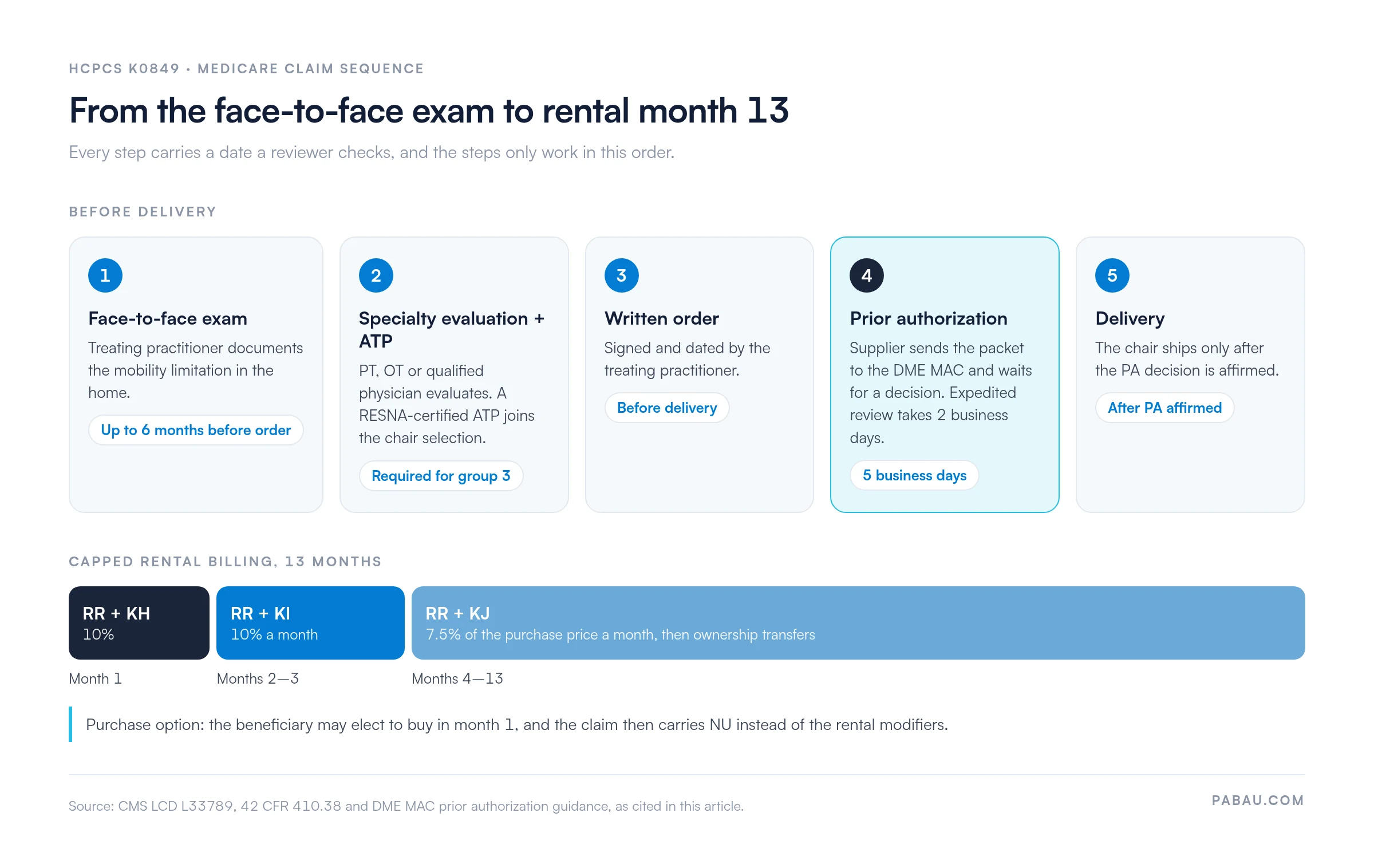
K0849 requires prior authorization before delivery under the Medicare Prior Authorization Program for Power Mobility Devices. If the chair is delivered before an affirmed PA decision, the DME MAC won’t pay the claim, however complete the documentation is.
The prior authorization process starts when the supplier sends the request to the DME MAC. The packet carries the face-to-face exam report, the written order, the specialty evaluation and the medical records. An affirmed decision doesn’t guarantee payment, but it confirms the documentation met coverage criteria at review. A non-affirmed decision lists the deficiencies to fix before resubmission.
A standard PA decision takes 5 business days. Expedited review takes 2 business days when a delay could seriously jeopardize the patient’s health. Build that window into delivery scheduling, and confirm current PA requirements at CMS.gov before submitting.
Submit the PA request as soon as the face-to-face exam, written order and specialty evaluation are complete. Don’t wait until the chair is ready for delivery. With a 5-business-day standard review, a request sent on delivery day pushes delivery back by at least a week.
K0849 is billed on the CMS-1500 claim form or its 837P electronic equivalent. The claim carries the DMEPOS supplier’s National Provider Identifier, and the place of service is usually 12, the patient’s home.
Medicare lets the beneficiary elect to buy a K0849 chair in month 1, and the supplier must offer that option. Without a purchase election on file, bill the rental modifiers and keep NU for a documented purchase. Verify modifier requirements against current HCPCS Level II coding guidance each plan year.
The 2026 Medicare allowed amount for HCPCS Code K0849 is published in the CMS DMEPOS fee schedule file. Rental payments run for up to 13 months, after which ownership transfers to the beneficiary. Each monthly rental payment is a set percentage of the purchase price in the fee schedule.
Medicare pays 80% of the allowed amount after the Part B deductible is met. The beneficiary owes 20% coinsurance, which secondary insurance or a Medicare Supplement plan may cover. Fee schedule amounts are set by state, with separate rural rates, so the payment varies by location.
For the current lookup, download the CMS DMEPOS fee schedule file for the current quarter and find K0849 under your state. Don’t apply prior-year rates to 2026 claims without checking, because the annual update may change the allowed amount.
K0849 denials tend to repeat the same few patterns, so fixing the pattern once beats appealing each claim. Each denial arrives with a remittance code, and a guide to denial codes helps match the code to its cause.
The denial management process for power wheelchair claims follows the five Medicare appeal levels. They are redetermination, reconsideration, an ALJ hearing, Medicare Appeals Council review and federal court. Appeals that only need a missing document supplied are usually settled at redetermination or reconsideration.
Every group 3 claim, K0849 included, needs a specialty evaluation and a RESNA-certified ATP with direct involvement in choosing the chair. A licensed PT or OT, or a physician with training in rehabilitation wheelchair evaluations, performs the evaluation. That professional must have no financial relationship with the supplier.
The evaluation documents why a captain’s chair suits the patient’s postural support needs, trunk stability, pressure relief and functional reach. It adds clinical detail that a physician’s office note rarely includes. That gives the DME MAC reviewer the rationale without a separate development request.
The ATP holds a current credential from RESNA (Rehabilitation Engineering and Assistive Technology Society of North America) and works for the supplier. Include the evaluation and the ATP records in the PA request, and keep both in the claim file for audits. For PT and OT practices that already run DME evaluations, this fits the existing workflow.
Medicare pays for K0849 on a capped rental basis unless the beneficiary elects purchase in month 1. Rental runs for up to 13 months of continuous use. Month 1 is billed RR with KH and months 2 and 3 RR with KI, each paying 10% of the purchase price.
Months 4 through 13 use RR with KJ and pay 7.5% of the purchase price each month. After month 13, ownership transfers to the beneficiary and rental payments stop.
During the rental period, the supplier maintains and services the chair at no additional charge to Medicare or the beneficiary. After ownership transfers, repairs are billed separately using the appropriate HCPCS repair codes.
The purchase option is a beneficiary choice that the supplier must offer in month 1, and the claim then carries NU. Other payers set their own purchase and rental rules. Teams handling medical billing across several payers should map the modifier set by payer and rental month.
Many suppliers and therapy practices track a K0849 order across email, paper forms and a billing spreadsheet. The exam date, the order date and the PA decision end up in different places. That is how a chair gets delivered a day before approval.
Pabau, the practice management platform we build, holds the patient record, signed digital forms and treatment notes in one file. Its claims management software bills from that same record, so staff can check every date against its document before a claim goes out.
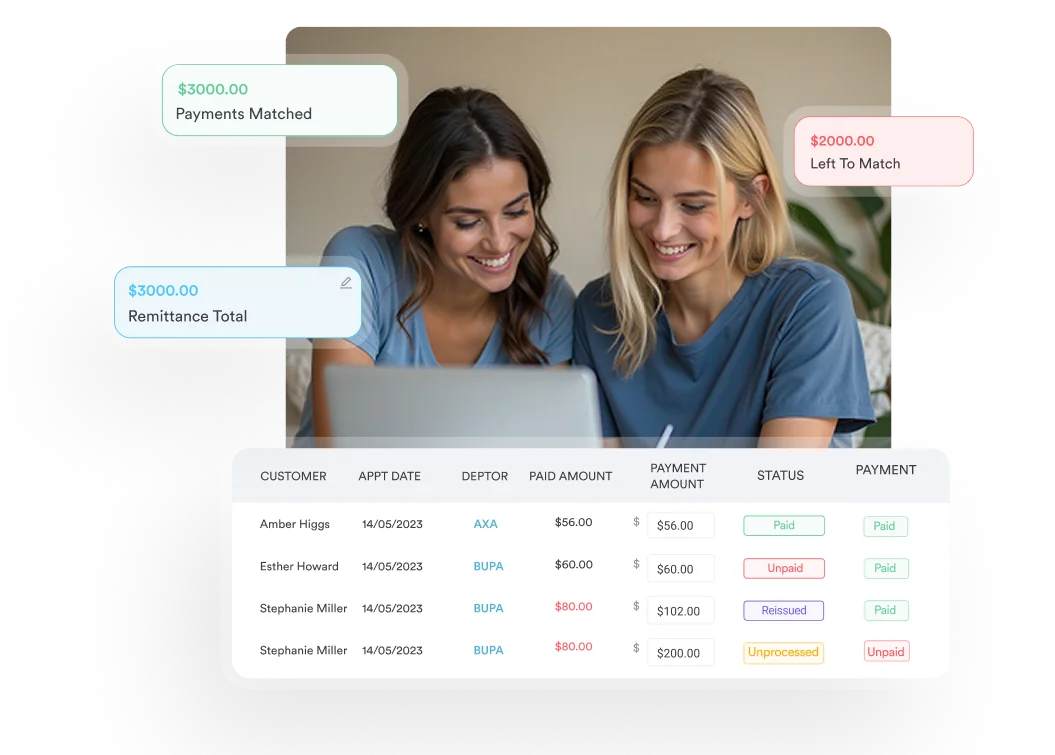
The outcome is fewer claims sent with a missing date or document, and less time spent chasing paperwork after a denial.

Pabau keeps orders, evaluations and signed forms on the patient record and runs claims and billing from the same place. See how it fits your DME and therapy workflow.

K0849 is a narrow code. It needs a captain’s chair, a group 3 standard base and a patient at 300 pounds or under. Miss any one of the three, and the claim belongs to a neighboring code.
The larger risk sits in the calendar. The exam window, the order date and the PA decision are fixed dates that a reviewer checks line by line. Schedule delivery around them, and the most common K0849 denials have nothing to catch.
Teams that log those dates in one place can prove the sequence on an audit as easily as on a PA request. Book a demo to see how Pabau keeps K0849 documentation and billing on one patient record.

Need a framework for managing claim denials across your DME work? Denial management in healthcare covers the appeal levels and the workflow controls that reduce rework.
Want to understand the broader billing compliance picture? Medical billing compliance explains the documentation and audit obligations behind Medicare claims.
Keeping track of the equipment you supply? Durable medical equipment list gives you a ready-made log for DME items and their details.
Preparing an appeal after a denied claim? Medical appeal form structures the request so reviewers see the missing evidence quickly.
New to Medicare claims? Medicare billing walks through how Part B claims move from submission to payment.
HCPCS Code K0849 covers a group 3 standard power wheelchair with a captain’s chair and a patient weight capacity up to and including 300 pounds. Sling or solid seat and back chairs use K0848, and captain’s chairs rated for 301 to 450 pounds use K0851.
Both are group 3 standard power wheelchairs rated up to 300 pounds, and they differ only by seat. K0848 uses a sling or solid seat and back, while K0849 uses a captain’s chair. A K0849 claim for a sling-seat chair is denied when PDAC product verification doesn’t confirm the captain’s chair.
Yes, K0849 requires prior authorization before delivery under the Medicare Prior Authorization Program for Power Mobility Devices. A standard decision takes 5 business days, and delivering before an affirmed decision results in non-payment. Submit the request as soon as the face-to-face exam and written order are complete.
Medicare needs a face-to-face exam by the treating practitioner within 6 months before the written order, and a written order signed before delivery. The file also needs medical records showing the mobility limitation in the home. A specialty evaluation, documented ATP involvement and a home assessment complete it.
The most common reasons are a missing prior authorization at delivery, a written order dated after delivery and a face-to-face exam by an ineligible provider. Records that name the diagnosis but not the home mobility limitation also lead to denials. So do chairs that fail PDAC verification against the captain’s chair descriptor.
Yes. K0849 rentals are billed RR with KH in month 1 and RR with KI in months 2 and 3. Months 4 through 13 use RR with KJ. Ownership transfers after 13 months of continuous rental. If the beneficiary elects purchase in month 1, which the supplier must offer, the claim uses NU instead.