CPT Code 19361: Latissimus dorsi flap breast reconstruction
CPT code 19361: Official descriptor and payment basics CPT code 19361 is the Cat...

Last Updated: Nov 18, 2026
K0862 is the HCPCS code for power wheelchair, group 3 heavy duty, multiple power option, sling/solid seat/back, patient weight capacity 301 to 450 pounds.
The base is built to run several powered seating functions. Medicare covers it when the patient needs a power tilt and recline system or a chair-mounted ventilator. Prior authorization, a specialty evaluation and a RESNA-certified ATP are all required before delivery.
Let Pabau's smart automation suggest the right codes, reduce claim denials, and keep your practice compliant—effortlessly.
Automate repetitive tasks and focus on what matters most—your patients.
Reduce coding errors and ensure compliance with the latest regulations.
Clean claims, fewer denials, and faster reimbursements.
Powerful insights and reporting to help your practice thrive.
HIPAA compliant SOC 2 certified GDPR-compliant Trusted by 4,000+ clinics worldwide

K0862 is a Group 3 heavy-duty power wheelchair with a multiple power option base, rated for patients weighing 301 to 450 pounds.
Weight capacity separates K0861, K0862, K0863 and K0864, while a single power option chair codes to the K0856 to K0860 range instead.
Medicare covers it under LCD L33789 when the patient needs a power tilt and recline system or a chair-mounted ventilator.
Prior authorization, a specialty evaluation, a RESNA-certified ATP and a written order must all be in place before delivery.
K0862 is paid from the DMEPOS fee schedule and sits outside competitive bidding, so no bid contract is needed to supply it.
HCPCS code K0862 describes a power wheelchair, group 3 heavy duty, multiple power option, sling/solid seat/back, patient weight capacity 301 to 450 pounds.
CMS lists that exact descriptor in its master list of DMEPOS items that may need prior authorization. It’s a complex rehab power base built for a heavier patient who needs more than one powered seating function.
Two things define the code. “Multiple power option” means the base’s electronics can run several powered seating systems, such as tilt and recline together. “Heavy duty” sets the weight band. Get either wrong and the claim is miscoded, however good the medical record is.
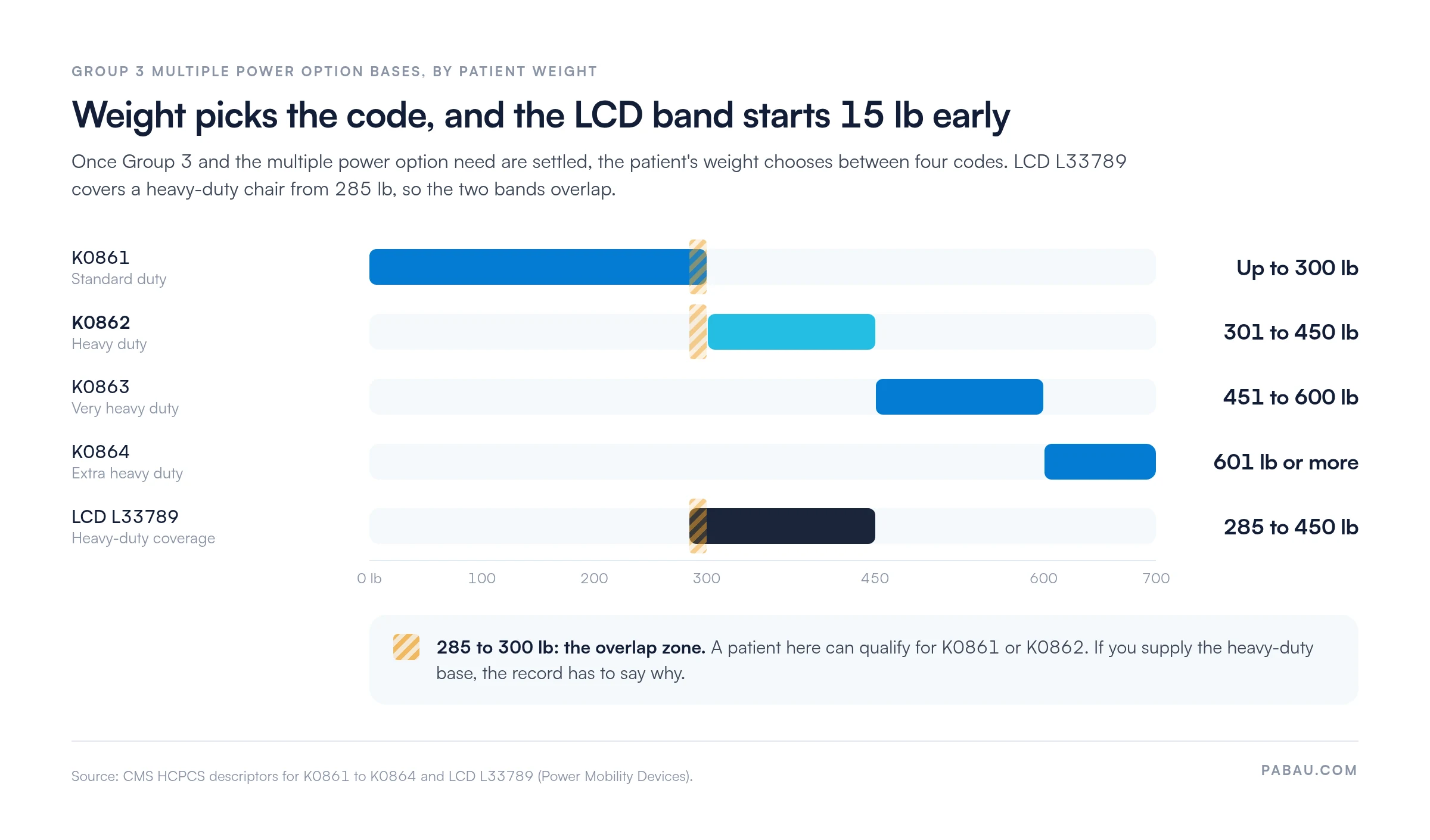
K0862 sits in a family of four multiple power option bases that differ only by weight capacity:
All four use a sling or solid seat and back. The single power option Group 3 bases have their own range, K0856 to K0860, starting with K0856 for standard chairs up to 300 lb.
Most K0862 coding errors come from answering these out of order. Work down the list and the code picks itself.
One wrinkle trips up experienced billers. LCD L33789 covers a heavy-duty chair for patients weighing 285 to 450 lb, not 301 to 450 lb. So a 290-lb patient can qualify for either K0861 or K0862. If you choose the heavy-duty base, the record has to say why.
The chart below shows where that overlap sits.
Take an illustrative patient with multiple sclerosis who weighs 340 lb. They can’t self-propel a manual chair, and they can’t use a scooter safely. A Group 2 chair won’t meet their seating needs.
The treating practitioner sees them face to face and documents why they can’t manage daily activities at home without a power chair. A physical therapist with no ties to the supplier runs the specialty evaluation. They find the patient needs power tilt for pressure relief and power recline for transfers and catheter care.
That’s a neurological condition, so it’s Group 3. Tilt and recline together make it a multiple power option base. At 340 lb, the heavy-duty band applies. The code is K0862, and the power seating system goes on its own claim line.
Change one fact and the code changes too. At 470 lb it’s K0863. If the patient needed tilt only, the base would come from the single power option range instead.
The four DME MACs share one Power Mobility Devices LCD, L33789. A K0862 claim has to clear three layers of it.
Two people outside the prescriber’s office also have to be involved. A licensed or certified medical professional, such as a PT or OT, completes a specialty evaluation.
That person can have no financial relationship with the supplier. The supplier must also employ a RESNA-certified Assistive Technology Professional (ATP) who takes a direct, in-person part in choosing the chair.
Power wheelchairs no longer use a Certificate of Medical Necessity. The file is built around a face-to-face encounter and a standard written order, plus the Group 3 extras. Keep it for at least seven years, and follow billing compliance requirements for records and audits.
There’s one more check that sits outside the patient file. K0862 is on the list of codes that need a coding verification review. The chair model must be listed under K0862 on the PDAC product classification list, or the claim is denied as incorrect coding.
K0862 is on the CMS Required Prior Authorization List, so prior authorization is a condition of payment. Here’s how a request usually runs.
A non-affirmation means the claim will be denied if you deliver anyway. You can’t appeal a non-affirmation, but you can fix the gaps and resubmit the request. Medicare Advantage plans run their own prior authorization rules and timelines, so check each plan separately.
K0862 is the base unit only, with its drive electronics and a sling or solid seat and back. The power seating system that justifies the multiple power option base is billed on its own line. So are most seating, positioning and control accessories, each under its own HCPCS code.
Watch where the patient lives, too. During a Medicare Part A skilled nursing facility stay, the facility is responsible for equipment under consolidated billing. A supplier can’t bill K0862 for that period.
Medicare pays K0862 from the DMEPOS fee schedule, not the Physician Fee Schedule. Pull the current-year amount for your state from that file rather than a saved table. The patient pays 20% coinsurance once the Part B deductible is met.
Group 3 complex rehab power wheelchairs, K0848 to K0864, are permanently excluded from competitive bidding under MIPPA 2008. The fee schedule applies everywhere, and you don’t need a bid contract to supply K0862.
Group 3 chairs can be bought outright when first supplied, or rented on the capped rental model. The modifiers below tell Medicare which route the patient chose, and posting each rental month to the right claim is core revenue cycle management work.
Place of service is usually 12, the patient’s home. A home-use chair billed with POS 11, the office, will trip an edit.
A clean claim starts with this list. Run it before the chair leaves the warehouse, when fixing a gap is still cheap.
Most denials trace back to paperwork assembled weeks before the claim went out. Good denial management starts with knowing the usual suspects. The CARC codes in brackets below are explained in our guide to medical billing denial codes.
A denied claim follows Medicare’s five-level appeals process. Most winnable cases are settled at the first two levels.
Patient records move between the practice and the supplier throughout, so HIPAA-compliant documentation practices apply at every handoff.
Prior authorization is where a K0862 claim usually stalls. The supplier waits on face-to-face notes, the evaluation sits in a therapist’s inbox, and the six-month clock keeps running.
Pabau, the practice management and billing platform we build, keeps that work in one patient record. The practice can record the specialty evaluation on a digital form that’s signed and dated on the patient record. The practitioner’s notes sit beside it, ready to send when the supplier asks.
When you bill, Pabau’s claims management software pre-fills the claim from the record, and the prior authorization’s code and dates are tracked on the case. US claims go out through Claim.MD, with eligibility checks and remittance posting built in.

Pabau stores evaluations, signed forms and practitioner notes on each patient record. Its claims tools pre-fill each claim from the patient record and warn you when an authorization number is missing.

K0862 is a weight code inside a power option family. Confirm Group 3 first, then the multiple power option need, then the weight. That order prevents most miscoding before anyone touches the paperwork.
The rest is timing. The evaluation, the order, the ATP and the prior authorization all have to land before delivery. Build the file in that sequence and the claim has little left to trip on.
Book a demo to see how Pabau keeps evaluations, orders and claims for complex rehab equipment on one patient record.

Need a foundation in DME claim submission? Medical billing fundamentals explains the end-to-end claim lifecycle from coding through payment posting.
Dealing with recurring claim rejections? Denial management workflows in healthcare covers CARC and RARC code interpretation and appeal strategies.
Looking for clean-claim submission best practices? Clean claim submission breaks down the elements a claim must contain before it reaches a payer.
K0862 is rated for patients weighing 301 to 450 pounds. LCD L33789 allows a heavy-duty chair from 285 pounds, so a lighter patient’s notes must justify it. Above 450 pounds, the multiple power option base codes to K0863.
No. MIPPA permanently excluded Group 3 complex rehab power wheelchairs, K0848 to K0864, from competitive bidding in 2008. Any enrolled, accredited supplier can provide K0862 at the fee schedule amount.
Yes. Group 3 power wheelchairs are complex rehab technology. That’s why Medicare requires a specialty evaluation and a RESNA-certified ATP on top of the usual power wheelchair criteria.
State Medicaid programs set their own coverage, rates and prior authorization rules for power wheelchairs. Some pay a share of the Medicare fee schedule, while others set their own rates. Check the state’s current DME fee schedule before billing.
Medicare generally expects equipment to last five years, its reasonable useful lifetime. An earlier replacement needs a change in the patient’s condition, or loss or irreparable damage. Repairs to an owned chair are billed separately.