CPT code 92511: Nasopharyngoscopy with endoscope
CPT code 92511: official descriptor and procedure overview CPT code 92511 descri...

Last Updated: Oct 13, 2026
A medical appeal form is the paperwork behind a formal request for an insurer to reconsider a decision. That decision may be a denied claim, a rejected prior authorization, or a finding that a service was not medically necessary.
Most payers publish their own claim-level appeal form, and that document carries the claim number, your NPI, and the denial code. The template on this page covers the other half of the job. It collects the patient’s account of the appeal, their current clinical picture, and their signature.
Download it as a PDF, then hand it to the patient or complete it with them at the front desk. It asks for identification and contact details, the reason for the appeal, relevant history, current medication and allergies, and a signed attestation.
An office-use block at the end gives your team somewhere to log who received it and what happened next. The rest of this guide covers the claim-level detail, documentation, deadlines, and submission steps that go to the payer.
A patient-completed appeal form covering identification, contact and emergency contact details, the reason for the appeal, relevant history, and current medication and allergies. It closes with a three-point attestation the patient signs and a for-office-use block for logging receipt and action taken.
Download template
A medical appeal form supports a formal request for an insurer to reconsider a denied claim, a denied prior authorization, or a medical necessity decision.
The template on this page is patient-facing. It captures identification, contact details, the reason for the appeal, relevant history, current medication and allergies, and a signed attestation.
Claim-level detail belongs on the payer’s own appeal form or your cover letter. That means the claim number, your NPI, the date of service, the billed amount, and the denial reason code.
Payers set hard filing deadlines, commonly 180 days for a commercial plan and 120 days for a Medicare redetermination. The denial letter states the one that applies.
Practice management software like Pabau keeps the signed form, the clinical notes, and the claim status on one patient record. The appeal package then comes together in one place.
A medical appeal form is a formal written request asking an insurance company to reconsider a coverage decision. Insurers deny claims and prior authorizations for several reasons. The usual ones are medical necessity, billing code errors, incomplete documentation, and policy exclusions.
An appeal is your structured chance to present further clinical evidence, correct a documentation error, or dispute the stated denial reason.
In practice, an appeal runs on two documents. The payer’s own form or your cover letter carries the claim-level facts. Those are the claim number, your NPI, the date of service, and the denial code.
A patient-completed form like the template above carries the patient’s side of the story. It records why they are appealing, what their history is, and what they are currently taking. Both documents sit inside one package alongside the clinical notes and the denial letter. The split below shows which facts belong on which one.
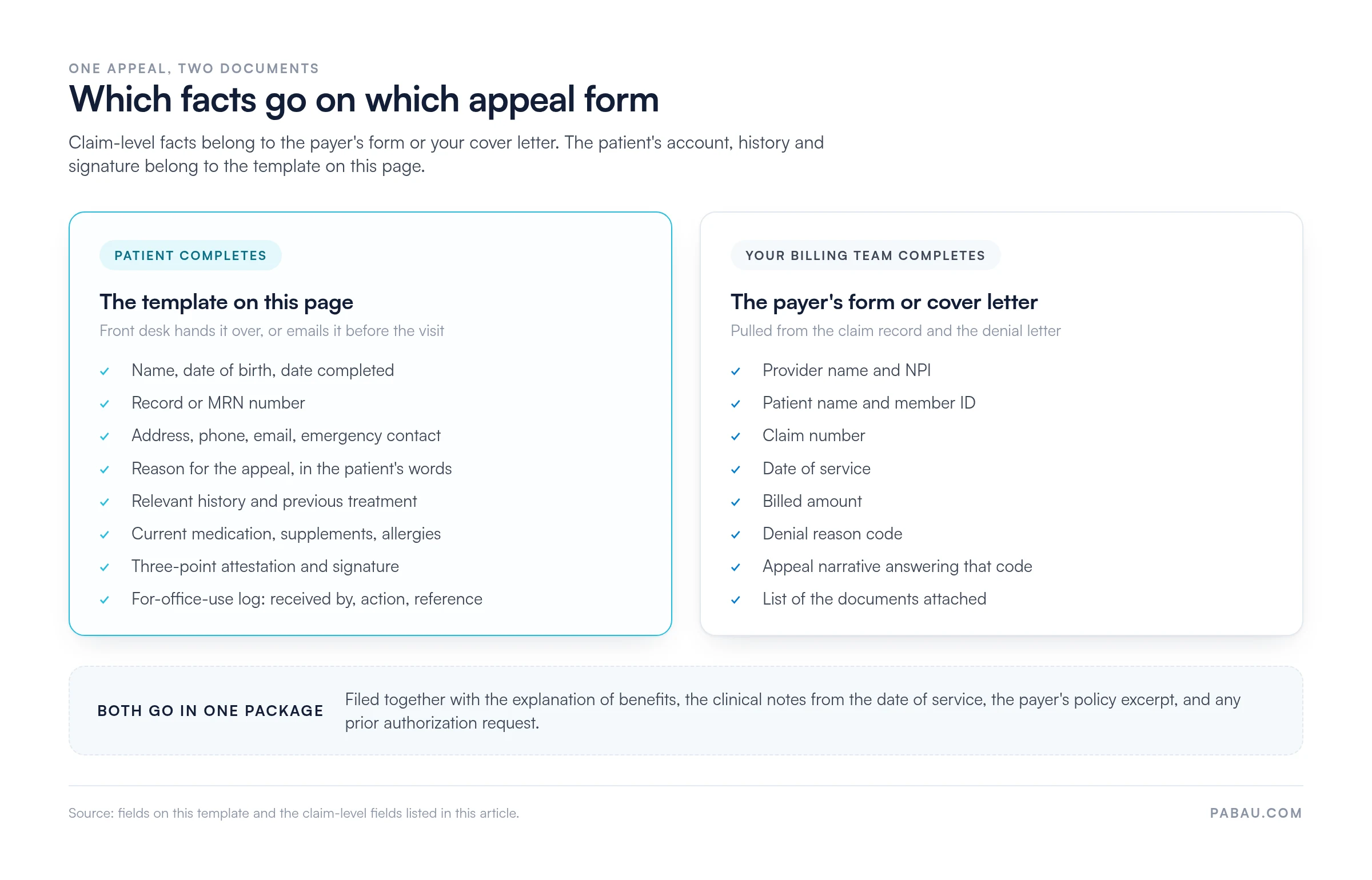
Insurers must review appeals and issue a determination within set timeframes. Federal rules give 30 days for a pre-service appeal, 60 days for a post-service appeal, and 72 hours for an urgent one.
An appeal is the first formal step in the dispute process. If it is denied again, you can escalate to external review or file a grievance, depending on the plan type and state rules.
File an appeal whenever an insurer denies a claim or a prior authorization that you believe should have been approved. Common triggers include denials after service delivery, prior authorization rejections, medical necessity denials for standard procedures, and disputes over coding or contracted rates.
Read the denial letter or explanation of benefits first. It states the specific reason code and the filing deadline, and both shape what you send. Looking the code up against the denial reason codes tells you whether a corrected claim would settle it faster than an appeal.
Some denials are clearly administrative, such as a duplicate claim that was already paid or a wrong claim number reference. Call the payer’s provider line first for a simple reconsideration in those cases.
If the payer stands by the denial, file a formal appeal on their own form. The same applies where you need to present clinical evidence for a medical necessity decision. Pull the claim details from your medical claims management system before you start writing.
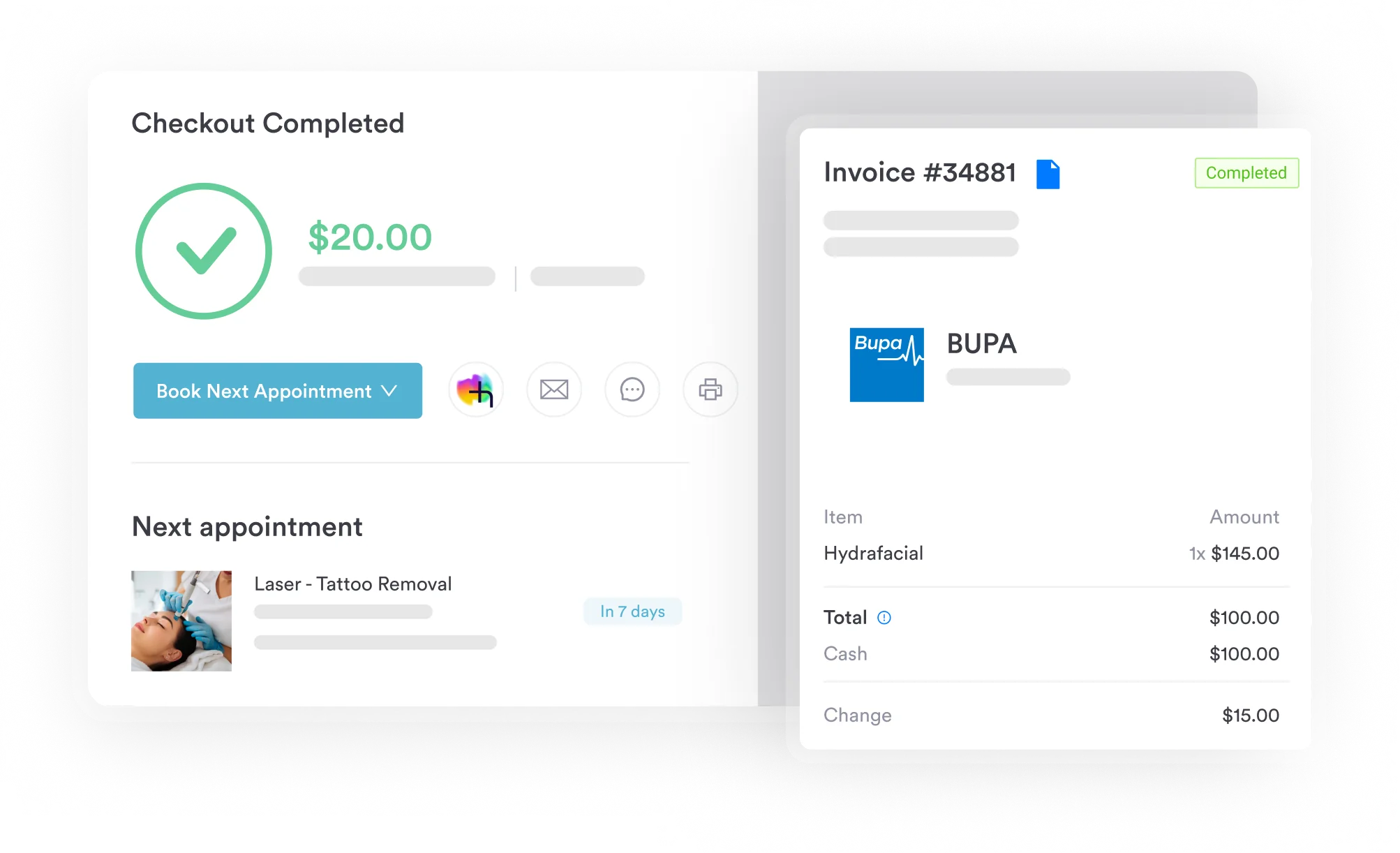
An appeal package is built from two sets of fields. The patient completes one set, and your billing team supplies the other from the claim record. The tables below break down each one, starting with the downloadable template.
One formatting note before you print it. The date fields are laid out as dd / mm / yyyy, so a US patient may enter the month first out of habit. Ask patients to write the month as a word, or relabel those three fields before you add the form to your intake pack.
These fields identify the claim under dispute. They appear on the payer’s own appeal form, or in the cover letter you attach when the payer has no set form.
Most payers expect specific documents alongside the appeal form. Always include the explanation of benefits or remittance advice showing the denial.
For a medical necessity denial, attach the clinical notes from the date of service, focusing on the documentation that explains why the service met criteria. If you are appealing a prior authorization denial, include the original request and the clinical evidence you sent with it.
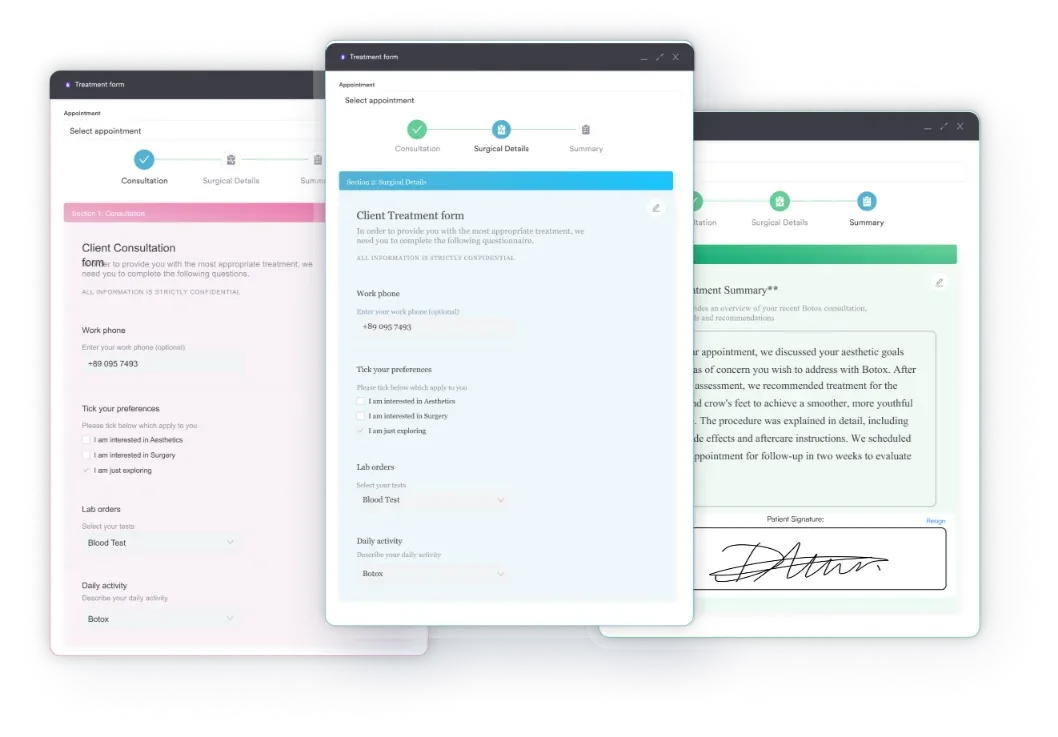
For a medical necessity denial, add a clinical narrative of one to two pages explaining how the service meets the payer’s criteria. Keeping patient-facing paperwork in digital form makes the package faster to assemble. The signed form lands on the patient record instead of a filing tray.
Prior authorization denials need a faster response, because the patient is usually waiting to start treatment. Check first whether the case qualifies for an expedited appeal, which carries a 72-hour decision window for urgent situations. Your appeal should reference the original prior authorization request number, restate the clinical indication plainly, and answer the exact reason the payer gave.
Some policies require a second opinion, a specialist consultation, or further testing before the service is approved. Say what additional evidence you are supplying and when the remaining steps will be complete.
If the denial rests on an outdated guideline, attach current literature or a major society guideline showing the service is appropriate for this patient’s condition. Expedited filing helps here, since the clinical need is time-sensitive.
Medical necessity denials are the most common appeal type. The payer decided the service did not meet its definition of medical necessity, based on its clinical criteria. Your narrative has to answer that decision directly and explain why the service was necessary for this patient.
Include the clinical history, the assessment documenting why treatment was indicated, and any literature or policy language supporting your position.
Many payers run coverage decisions through standardized criteria tools such as InterQual or MCG. If you can read the payer’s criteria for the service code, cite them and show how the patient meets each one. That argues inside their framework rather than around it.
Following denial management best practices helps your team track which payer uses which criteria. It also lets you reuse the narrative that worked last time.
Check the denial letter for the payer’s submission instructions. Most accept appeals by fax, by mail, or through a provider portal. Mailed and faxed packages typically take five to seven business days to reach the appeals department, while a portal submission is logged immediately.
Include a cover letter stating the claim number, the patient name, and a one-sentence summary of your case, followed by the supporting documents.
Keep a copy of the submitted package, including the fax confirmation page if you faxed it. Note the filing deadline and the payer’s expected response date, so you can chase a determination that never arrives.
For expedited appeals, confirm the route before sending. Some payers route urgent appeals to a separate fax number or email address, and a package sent to the standard queue loses the urgency.
Federal rules and state insurance regulations set the filing windows below. Missing one usually ends the appeal, so record the deadline the day the denial arrives.
Treat these as the outer limits. Plan documents, state law, and your payer contract can all shorten a window, so the denial letter is the authority for any individual case.
Medicare uses a specific form for the first level of appeal, called a redetermination. The CMS redetermination guidance sets out the official request form and its instructions.
A redetermination goes to the Medicare Administrative Contractor that processed the claim and asks it to review the payment decision. If that is denied, the next level is a reconsideration by a Qualified Independent Contractor outside your contractor’s region.
Commercial appeals do not use the Medicare redetermination form. Each insurer has its own, so confirm the payer before you complete it. The structure is similar across payers, covering provider details, claim details, the appeal reason, and attachments.
Submission routes, timeframes, and documentation rules are where they diverge. Clinical notes and letters held in one system shorten the hunt for the right documents each time.
The narrative decides most appeals. A vague or repetitive one that never answers the stated denial reason tends to fail, even where the service was appropriate. Strong narratives run to one or two pages and stay specific to the patient and the denial. Quote the payer’s own policy wherever it is available.
Incomplete documentation is the most common reason an appeal fails. Packages go out without the explanation of benefits, the clinical notes, or the policy excerpt the reviewer needs. Missed deadlines come next, and appeal rights expire once the window closes. Third is a narrative that restates the denial reason without adding clinical evidence or answering the payer’s objection.
Practices also send appeals to the wrong place. A denial from the primary payer gets filed with the secondary, or a commercial appeal goes out on a Medicare form. Confirm the payer and use their form and their submission route. A medical billing compliance checklist catches these before the package leaves the practice.
Most appeal packages are assembled from four places at once. The signed patient form sits in a tray or an inbox, and the clinical notes are in the chart. The denial letter is wherever billing filed it, and the deadline lives in somebody’s head. That hunt is where the working days go.
Practice management software like Pabau keeps those pieces together. Digital forms are completed on a tablet or sent to the patient before their visit, and the signed copy files straight onto their record.
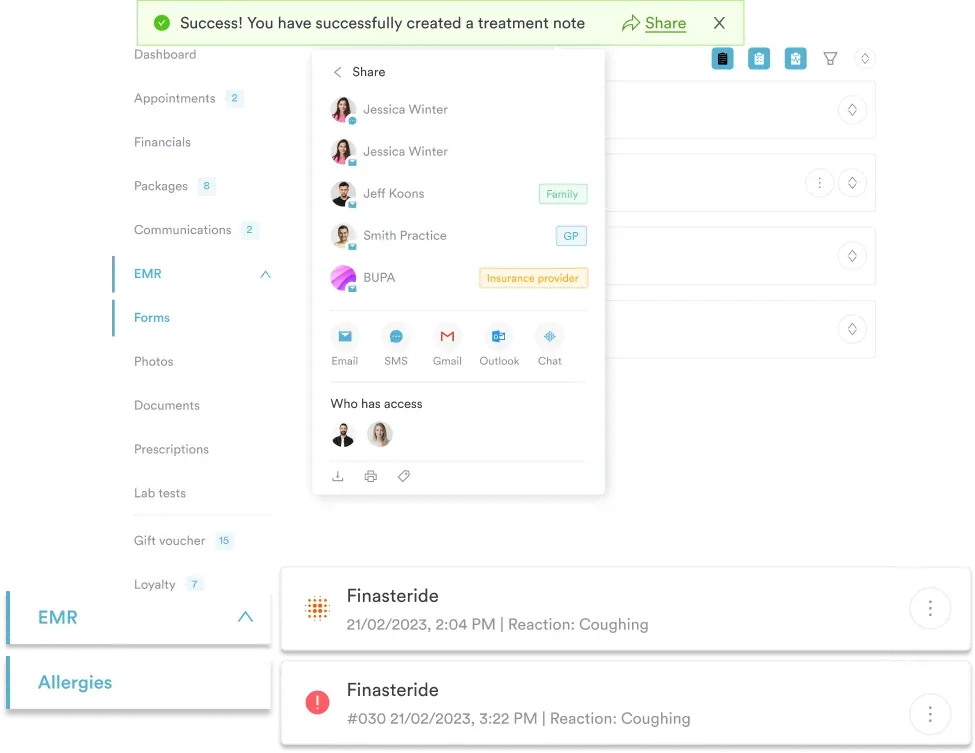
Clinical notes, uploaded letters, and consent forms sit beside it, so the person building the appeal works from one screen. Automated workflows can prompt your billing team before a filing deadline passes.
Claims are submitted and tracked from that same record through our claims and billing integration. Your team can see which claims came back denied without opening a separate portal. Pabau submits what your clinicians and coders have already documented, so the claim reflects the chart rather than a re-keyed copy of it.

Pabau stores completed forms, clinical notes, and uploaded documents on one patient record, and can prompt your billing team before a filing deadline passes. Appeal packages come together without the hunt through email and filing trays.

Appeals are won on specifics. The reviewer needs the stated denial reason answered directly, with clinical detail tied to this patient and this date of service. A patient-completed form does part of that work for you. It captures their account, their current medication, and a signed attestation, all dated and filed before the narrative is written.
Treat the template as the front end of your appeal process rather than the whole of it. Claim-level facts go on the payer’s form or your cover letter, and the deadline printed on the denial letter governs the rest. Miss that date and the merits of the case stop mattering.
Standardizing the steps is what makes appeals repeatable. That work starts upstream, with insurance eligibility checks at booking, long before a denial arrives. Book a demo to see how Pabau keeps appeal forms, clinical notes, and claim status on one patient record.

Looking for more billing templates? Superbill guides for healthcare providers explain how to structure billing documentation for both insurance submission and patient records.
Need to understand denial codes? Denial code reference helps your billing team quickly identify the specific reason for each claim denial and tailor your appeal strategy.
Want to strengthen compliance? Medical billing compliance framework covers appeal timelines, required documentation, and payer regulations across all major insurance types.
It is a patient-facing form. It asks for name, date of birth, record or MRN number, address, phone, email, and an emergency contact. An appeal section then collects the reason for completing the form and whether the patient has filled it in before. It also asks for relevant history and current medication, supplements and allergies. The patient ticks a three-point attestation and signs it. A for-office-use block records who received the form, the action taken, and your reference number.
Gather the claim number, the denial letter, the clinical documentation, and any payer policy references. Complete the payer’s appeal form, since Medicare uses a redetermination form and commercial insurers have their own. Attach the explanation of benefits and the supporting documents. Submit by fax, mail, or provider portal before the filing deadline, which is commonly 120 to 180 days from the denial. Keep a copy for your records.
Yes. If the request was denied, you can appeal, and urgent cases usually qualify for an expedited decision within 72 hours. Include the original prior authorization request number, the clinical evidence supporting medical necessity, and any further testing or specialist consultation the payer asked for.
Include the explanation of benefits showing the denial, the complete clinical notes from the date of service, and any relevant lab or imaging results. Add the prior authorization request where one applies, plus the excerpt from the payer’s clinical policy showing the approval criteria. For medical necessity denials, attach a clinical narrative explaining how the service met those criteria.