Skin clinic software Australia: 6 best picks, AUD prices
Skin clinic software in Australia costs a two-practitioner practice between A$84...

Last Updated: Sep 22, 2026

Medicare pays a benefit against a fixed schedule fee, but your practice sets its own fee.
Bulk billing means accepting the benefit as full payment, so you cannot charge the patient anything extra.
Most practices claim through Medicare Online inside their practice software, and bulk bill payments land in 2 to 3 working days.
Since 1 July 2026, assignment of benefit no longer needs an approved form, but you must keep the agreement for 2 years.
The practitioner is responsible for every claim made under their provider number, whoever presses submit.
A practice’s billing setup shows up in three places. Gap revenue that never gets invoiced. Claims that come back rejected. And how the practice fares if the Department of Health ever asks it to substantiate what it billed. Practices that also run cosmetic services outside Medicare can compare medical spa systems for that side of the ledger.
The official guidance is accurate and scattered. Item rules live on MBS Online. Claiming channels live with Services Australia. Compliance material sits with the Department of Health, Disability and Ageing and the Professional Services Review.
This guide puts the whole thing in one place. It follows a claim from the appointment to the money in your account. Then it covers the three billing models, the rules that bite, and where practices most often get caught.
A practitioner provides a service listed in the Medicare Benefits Schedule. A claim then goes to Services Australia under that practitioner’s provider number, and Medicare pays a benefit. If the service was bulk billed, the benefit is paid to the practice. Otherwise it goes to the patient.
Three numbers do all the work here, and practices mix them up constantly.
The schedule fee is the amount the government attaches to each item number. It is set in legislation and indexed each 1 July. It is not a price, and nobody is obliged to charge it.
The Medicare benefit is the amount Medicare actually pays. For most out-of-hospital services it is 85% of the schedule fee. Non-referred GP attendances on non-admitted patients attract 100%. Services provided as part of an episode of hospital treatment attract 75%.
The gap is what is left when your fee is higher than the benefit. The patient pays it out of pocket. Set your fee at the benefit and there is nothing left to collect, which is what bulk billing does.
Picking the item is the fast part of this. Everything after it is workflow. Our guide to MBS item numbers covers how the numbers are structured and where to look them up.
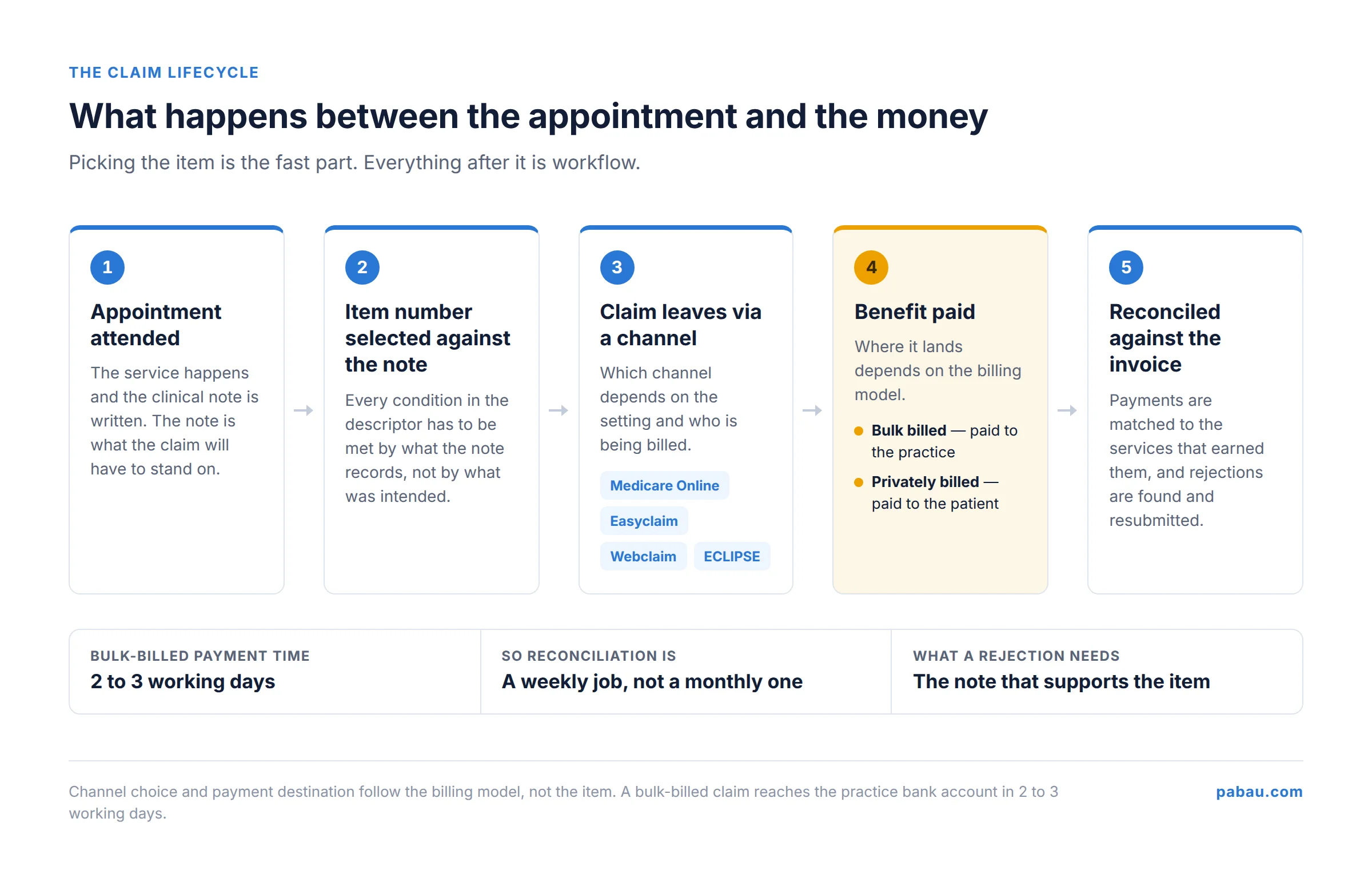
One rule sits underneath the whole diagram. Providers are responsible for claims made under their provider number, regardless of who submits them or who receives the payment. A receptionist can press the button. The liability stays with the practitioner.
Practices bulk bill everything, charge a private fee for everything, or split the difference. The choice is a revenue decision with an admin cost attached, and it can be made per service rather than once for the whole practice.
| Bulk billing | Mixed billing | Private billing | |
|---|---|---|---|
| How the money flows | Patient assigns the benefit, Medicare pays the practice | Assigned for some patients or items, invoiced for the rest | Patient pays your fee, then claims the benefit back |
| What the patient pays | Nothing for that service | Nothing or a gap fee, depending on the rule you set | Your fee, minus whatever Medicare refunds them |
| Admin load | Lowest, with no debtors to chase | Highest, because staff apply a policy at the desk | Moderate, but you carry the debtors |
| Revenue per service | Capped at the benefit | Set by your mix | Set by you |
| When it fits | High volume, or a population that will not pay a gap | Concession patients alongside a fee-paying base | Longer consultations and procedural work |
Mixed billing looks like the safe middle, and it is the most expensive to run. Someone has to decide, at the desk, which rule applies to the patient standing there. Write that policy down or your front desk will invent five versions of it.
Bulk billing also removes work that never shows up in a revenue calculation. No invoices, no debtors, no card fees, and no awkward conversations about money. Working out whether to bulk bill comes down to the incentives you can claim against the gap revenue you give up.
Services Australia groups its electronic channels under Medicare Digital Claiming. There are four, plus a manual fallback. Nearly every practice uses one as its everyday channel and keeps a second for when that one fails. Which channels you get depends on the product, so it is worth comparing Australian billing software before you commit.
| Channel | How it connects | What it suits | Payment speed |
|---|---|---|---|
| Medicare Online | Built into your practice management software, over a PRODA account | Everyday bulk bill and patient claims at any volume | Bulk bill payments in 2 to 3 working days |
| Medicare Easyclaim | Your EFTPOS terminal, standalone or linked to your software | Practices that want the patient’s benefit paid on the spot | Patient benefit almost immediately, practice in 2 to 3 working days |
| HPOS Webclaim | A browser, through HPOS with a PRODA account | Low volume, new practices, and outages | Processed within 2 business days if no manual assessment is needed |
| ECLIPSE | An extension of Medicare Online inside compatible software | In-hospital claims and simplified billing with health funds | Varies by fund and claim type |
| Manual assignment | Paper at the point of care, entered into Webclaim afterwards | Home visits and anywhere without internet or a printer | Follows whichever channel you finally submit through |
This is the default for most practices. The claiming sits inside the practice management software, so the item you record against the appointment becomes the claim. It handles bulk bill claims, patient claims, Department of Veterans’ Affairs claims, and Australian Immunisation Register notifications.
Setting it up takes three things. Confirm your software supports it, register a PRODA account, then register for online claiming. Your software developer issues a minor ID for the location, which is what links the site to your PRODA organisation.
Easyclaim runs through the EFTPOS terminal, either on its own or connected to your software. For a bulk bill claim, you swipe the Medicare card and the patient presses a key to assign their benefit. The terminal prints their receipt.
Its real advantage is on patient claims. The benefit goes back onto the patient’s own card almost immediately, so they leave having already been refunded. There is nothing to batch and nothing to store.
Webclaim needs no claiming software at all. You need internet access, a printer, and a PRODA account to reach Health Professional Online Services. From there you can lodge Medicare patient claims, bulk bill claims, and DVA claims by hand.
That makes it the sensible fallback. When your practice software or your terminal goes down, Webclaim keeps claims moving that day.
ECLIPSE stands for Electronic Claim Lodgement and Information Processing Service Environment. It extends Medicare Online to in-hospital work, connecting practitioners, hospitals, billing agents, private health insurers, and the DVA in one transaction.
Simplified billing is the outcome ECLIPSE makes possible, and the two get confused. It cuts down the number of accounts a private patient receives after a hospital stay. A hospital or billing agent claims the Medicare benefit and the insurer’s gap payment together.
The patient is then left with one out-of-pocket amount to pay the provider. Services Australia publishes a list of approved billing agents, which is where most private specialists start rather than building the capability in-house.
Paper survives as a fallback rather than a channel. Where there is no internet or printer, you can complete a manual assignment of benefit and enter it into Webclaim once you are back online.
The rules around that paperwork changed on 1 July 2026. An approved form such as the DB4E or DB020 is no longer required. An assignment agreement can now be paper or electronic, in any format you like. It just has to carry the information set out in the Health Insurance Regulations 2018, and be agreed in writing.
A 12-month transition also allows verbal assignment of benefit for all bulk billed patients, in every setting. Whichever way you capture it, keep a copy for 2 years from the date the claim is made.
Medicare sets the schedule fee and the benefit. Your fee is entirely your own decision. That is the single most misunderstood point in Australian practice billing, and it is true across professions. Optometrists, for instance, have been free to set their own fees since 1 January 2015.
Two things complicate it. Schedule fees are indexed each 1 July, and that indexation has historically trailed the cost of running a practice. So a fee pegged to the schedule quietly shrinks in real terms every year you leave it alone.
Most practices anchor to one of two references. The AMA publishes a list of fees that sits well above the schedule fee, used mainly by specialists and private billing practices. The alternative is costing your own consultation, using room time, staff cost, and consumables.
Whichever you use, one rule is absolute. You cannot charge a gap on a bulk-billed service. Section 20A of the Health Insurance Act 1973 requires the practitioner to accept the assigned benefit as full payment for that service.
The one narrow exception is a vaccine supplied from the practitioner’s own stock held on the premises. Everything else, including consumables and administration charges, is off limits on a bulk-billed item.
One patient-side mechanism is worth knowing when you set fees. Under the original Medicare Safety Net, a patient’s benefit for out-of-hospital services rises to 100% of the schedule fee. That happens once their annual out-of-pocket costs pass a threshold. That threshold was $594.40 as at January 2026.
Compliance in Medicare billing is mostly documentation. The claim has to be for a service that happened, that met the item’s descriptor in full, and that the clinical record can substantiate afterwards.
Four obligations carry the rest.
Bill under the correct provider number. The practitioner who provided the service is the practitioner whose number goes on the claim, at the location where it happened. A new practitioner cannot bill until their Medicare provider number is issued for that location.
Meet the descriptor completely. Item descriptors carry minimum times, required clinical content, and exclusions against other items. Meeting most of a descriptor is not meeting it. Other code sets read the same way, and the US hand X-ray code 73130 needs a minimum of three views.
Keep records that stand up alone. The note has to explain the service to someone who was not there. Templated text repeated across patients is the single most common finding in published review outcomes.
Fix errors before someone else finds them. Voluntary acknowledgment attracts no penalty. Once compliance action has started, the Health Insurance Act imposes a 20% penalty on debts over $2,500.
The 80/20 rule is a volume trigger. Rendering or initiating 80 or more relevant services on each of 20 or more days in a 12-month period is a prescribed pattern of services. A companion 30/20 rule applies to certain items.
What makes it unusual is that the pattern itself is deemed to be inappropriate practice, unless exceptional circumstances applied. There is no argument about clinical quality to be had first.
Where a breach is identified, the delegate must refer the practitioner to the Director of the Professional Services Review. The Health Insurance Act 1973 requires it. That referral is mandatory, not discretionary. A review outcome can affect the practitioner’s billing privileges, including full or partial disqualification from Medicare.
These come from the Department of Health’s published compliance activities and from PSR Director’s updates, rather than from anyone’s guesswork about what auditors dislike.
Read that list as a documentation checklist rather than a warning. Six of the eight are resolved by a note that matches the item billed.
Co-claiming is also where code sets diverge. The UK private schedule handles one such overlap with CCSD code 20240, billed on its own line beneath the primary procedure.
Optometry items sit in Group A10 of Category 1 in the MBS, covering consultations and the associated tests. Benefits are payable at 85% of the schedule fee for those services.
Optometrists have set their own fees since 1 January 2015. Where the fee is above the benefit, you have to tell the patient the benefit payable at the time of the consultation. You also have to tell them the extra attracts no benefit.
Allied health billing runs on referral. The eligible items are tied to chronic condition management, so a GP referral has to exist before the service is provided. The referral, not the profession, is what makes the item claimable.
Practices that take these referrals should hold the paperwork against the client record. It is the first thing asked for when a claim is queried.
Nurse practitioners have their own MBS items and bill under their own provider number. The practical question in most practices is who provided the service. A service by the nurse practitioner and one provided on behalf of a doctor attract different items.
Probably not, because the official training is free and covers the fundamentals. Paid courses earn their place in two situations, and neither is “we are new to this”.
Services Australia runs Health Professional Education Resources, with eLearning modules on the MBS, Medicare Digital Claiming, MyMedicare, and Medicare basics for new health professionals. The RACGP publishes Medicare compliance material and runs gplearning, free to members. AskMBS answers interpretation questions on specific items by email.
Pay for training when a practice manager is taking on billing responsibility for the first time and needs structure rather than reference pages. Pay for a consultant when you are remediating after an audit, where the value is in the review rather than the teaching.
The claim itself leaves through Medicare Online, Easyclaim, Webclaim, or ECLIPSE. Everything on either side of it happens in the practice. The appointment, the note that substantiates the item, the invoice, the payment, and the balance nobody has chased yet.
That is where practice management software like Pabau earns its keep. Client records, treatment notes, digital forms and consent, invoicing, and payments sit in one system. The record that supports a claim stays attached to the appointment it came from. Nobody goes looking through three tools to answer a query. Submitting, tracking and reconciling each claim from that same record is the job billing and claims software is built for.
On the money side, invoices and payments run against the same client record, including deposits and outstanding balances. Pabau Pay, our card terminals, keeps in-person payments in the same place as the rest. That leaves no separate provider to reconcile at the end of the week.
Reporting is what makes the billing model a decision rather than a habit. You can see appointment volumes, revenue by practitioner, and what is still owed. A question about your billing mix then gets answered from your own numbers. Every subscription includes all of it.

Pabau keeps client records, treatment notes, invoicing and payments in one system. The documentation behind a claim sits with the appointment it came from. Reporting shows revenue by practitioner and outstanding balances, so you can review your billing mix on your own figures.

Medicare billing rewards practices that treat it as a workflow rather than a monthly scramble. The mechanics are fixed and public. What varies between practices is whether the item, the note, and the invoice agree with each other on the day.
If you change one thing after reading this, write down your billing policy. Which patients are bulk billed, which items carry a gap fee, and who at the desk decides. Most rejected claims and most awkward audit conversations trace back to that document not existing.
The trade-off worth remembering is that bulk billing caps your revenue per service and removes an entire layer of admin. Private billing does the reverse. Neither is the right answer for every practice, and the numbers move every 1 July.
Book a demo to see how Pabau keeps the records, invoices and payments behind your Medicare billing in one place.

Weighing up whether to keep bulk billing? Bulk billing in 2026 works through the incentive changes and what they do to revenue per service.
Need the item numbers behind the claim? MBS item numbers explained breaks down how an item is structured, with a cheat sheet for the front desk.
Comparing systems to run the billing side? Best medical billing software in Australia compares the platforms Australian practices use for invoicing, payments and reporting.
Documenting a legal blindness diagnosis? Legal blindness coding guide explains why this code follows the American standard instead of the usual severity scale.
Chasing money that never arrives? Healthcare revenue cycle management explains how practices track a charge from the appointment through to a cleared payment.
Bulk billing means the patient assigns their Medicare benefit to you and you accept it as full payment. Private billing means you set your own fee and the patient pays it, then claims the benefit back. The difference for the practice is revenue per service against admin load.
Simplified billing reduces the number of accounts a private patient gets after a hospital stay. A hospital or an approved billing agent claims the Medicare benefit and the health insurer’s gap payment together, through ECLIPSE. The patient is left with one out-of-pocket amount to pay the provider.
Payments for bulk billed services reach your nominated bank account in 2 to 3 working days. A Webclaim submitted through HPOS is processed within 2 business days where no manual assessment is needed. Patient claims are usually paid to the patient by the next working day.
The 80/20 rule covers rendering or initiating 80 or more relevant services on each of 20 or more days in a 12-month period. That pattern is deemed to be inappropriate practice unless exceptional circumstances applied. A breach must be referred to the Director of the Professional Services Review.
No. Section 20A of the Health Insurance Act 1973 requires you to accept the assigned Medicare benefit as full payment for that service. Consumables, booking fees and administration charges are all caught. The only exception is a vaccine supplied from the practitioner’s own stock.
The practitioner whose provider number is on the claim. Providers are responsible for claims made under their number, regardless of who submits them or who receives the payment. Delegating the keystrokes does not delegate the obligation.