CPT Code 30801: Superficial turbinate ablation billing guide
CPT Code 30801: Official descriptor and procedure overview The American Medical ...

Last Updated: Nov 27, 2026
CCSD code XR290 is the UK private healthcare code for cerebral angioplasty, with or without insertion of a metallic stent. Bupa’s consultant finder lists it as “Cerebral angioplasty +/- insertion of metallic stent” for an interventional neuroradiologist.
That puts XR290 among major neurovascular procedures, next to aneurysm coiling and AVM embolisation. Some coding references describe it as extra plain film X-ray views, and no insurer or CCSD source we found supports that. A claim built on that reading sends the wrong descriptor, authorisation and fee.
Start from the correct descriptor, then make the procedure note and the authorisation tell the same story.

CCSD code XR290 covers cerebral angioplasty, with or without a metallic stent, and is billed by interventional neuroradiologists.
XR290 isn’t a plain film X-ray code, so never use it for additional radiograph views.
The “+/-” wording means one XR290 line covers the procedure whether or not a stent goes in.
NICE recommends stenting for intracranial atherosclerotic disease only within research, so a detailed referral matters at pre-authorisation.
Bupa applies CCSD unbundling rules and pays the highest value code when an unacceptable pair is billed the same day.
XR290 covers balloon angioplasty of a narrowed cerebral artery. A consultant guides a catheter into the vessel under imaging and inflates a balloon to widen it. If the artery needs support afterwards, a metallic stent goes in during the same procedure.
The CCSD technical guide treats “+/-” as an optional part of a procedure. Its own example is a proctoscopy “+/- biopsy,” which stays correct when no biopsy was possible. XR290 works the same way, so bill it once whether or not a stent went in.
Abandoned procedures follow a different rule. The guide says to code them to the stage reached, not the plan. A procedure stopped before angioplasty may therefore need a different code from the one booked.
XR reads like X-ray, which is how the wrong descriptor spread. In the CCSD technical guide, interventional radiology is chapter 17, under the X prefix. Plain radiography sits in the separate radiology chapter.
If a report describes extra radiograph views, XR290 is the wrong code. Other CCSD procedures, X-prefix codes included, have their own pages in our CCSD code reference library.
NICE’s guidance on intracranial stenting outlines the procedure. Knowing the steps helps you read the procedure note and see what belongs on the claim.
NICE notes that more than one stent, or more than one lesion, can be treated in a session. The descriptor doesn’t count lesions, so ask the insurer before adding a second XR290 line.
The Bupa consultant profile that lists XR290 also lists four related codes. Each describes a different job, so the procedure note decides which one fits.
Two of these carry grades in Bupa’s 2015 imaging and radiology review. A2223 sat at Inter 1, with a proposed move to Major 1. XR352 sat at Major 3, with a proposed move to Major+ 1. XR290 isn’t in that paper, so check its current grade with Bupa.
A stent can also support aneurysm coiling. There, the aneurysm treatment is the procedure, which points to CCSD code XR306 rather than XR290. AVM work has its own page too, under CCSD code XR390.
The chart below runs a procedure note through all five codes, with XR290 first because it is the only one that widens a narrowed artery.
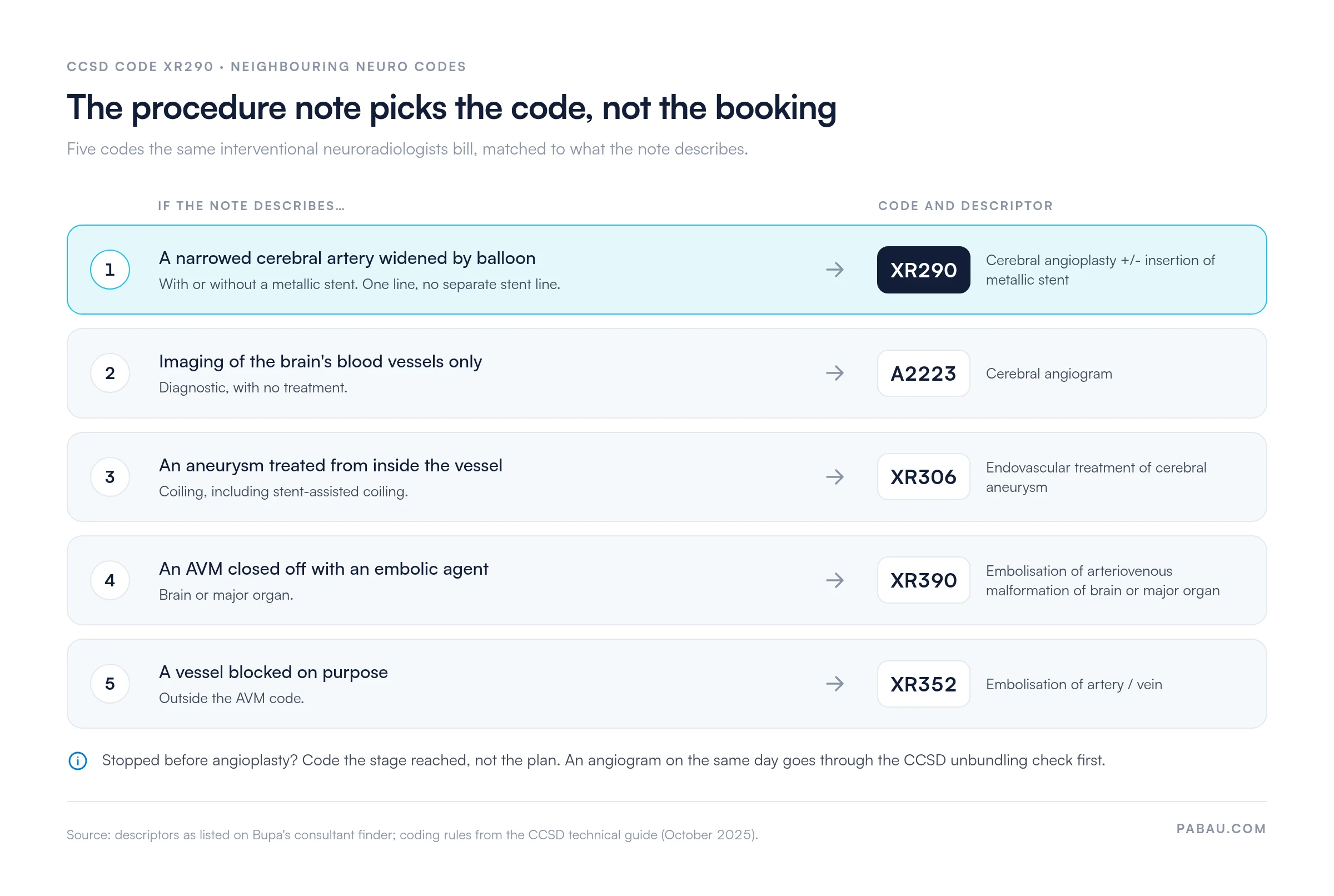
If an angiogram and XR290 happen on the same day, check the pair in the CCSD schedule first. Bupa’s guide for consultants says it applies every CCSD unbundling combination to its codes. For an unbundled pair billed for one patient, on one day, in one setting, Bupa pays the highest value code.
NICE reviewed stenting for intracranial atherosclerotic disease in guidance first published in July 2012. It found no substantial difference in outcomes against medical treatment after one to two years. It also found a significant risk of stroke and death around the procedure.
So NICE recommends the procedure only in the context of research. Usual care is antiplatelet medication with a statin, plus control of risk factors. Expect the insurer to ask why this patient needs intervention.
Ask the referring consultant to cover these points:
Bupa may also ask for a funding request form or a medical report. Under the Access to Medical Reports Act 1988, it needs the patient’s permission before it asks you for that report.
Collect the paperwork at booking. Chasing a referral letter after the procedure is where most delays start.
Here’s how an illustrative claim might run. A stroke physician refers a Bupa patient with a narrowed cerebral artery and repeated TIAs despite medication.
The consultant neuroradiologist gives the patient code XR290 and its description, as Bupa’s guide asks. Bupa requests a medical report, and the patient agrees to its release. Pre-authorisation then comes through with a number tied to XR290.
On the day, the balloon widens the artery, but the vessel recoils. A self-expanding stent goes in, and the note records both steps. The invoice carries one XR290 line, the authorisation number and the treatment date.
Fees for XR290 depend on the insurer and your agreement with it, so we don’t quote a figure. Check the current rate in these sources:
For modifiers, confirm them against the CCSD Technical Guide and the payer’s manual. Our Bupa fee schedule guide explains how Bupa’s published limits work.
Neurointerventional claims tend to stall on admin. The authorisation number sits in an email, the referral in a scan, and the invoice gets typed from memory.
Pabau, practice software with built-in Healthcode billing, keeps those pieces on the patient record. Prior authorisation is tracked on the case, and Pabau warns you when the authorisation code is missing. Claims management tools then send the claim to Healthcode electronically.
Coding still needs a person. Pabau doesn’t check the CCSD code on the claim, so the checklist above stays with your billing team.
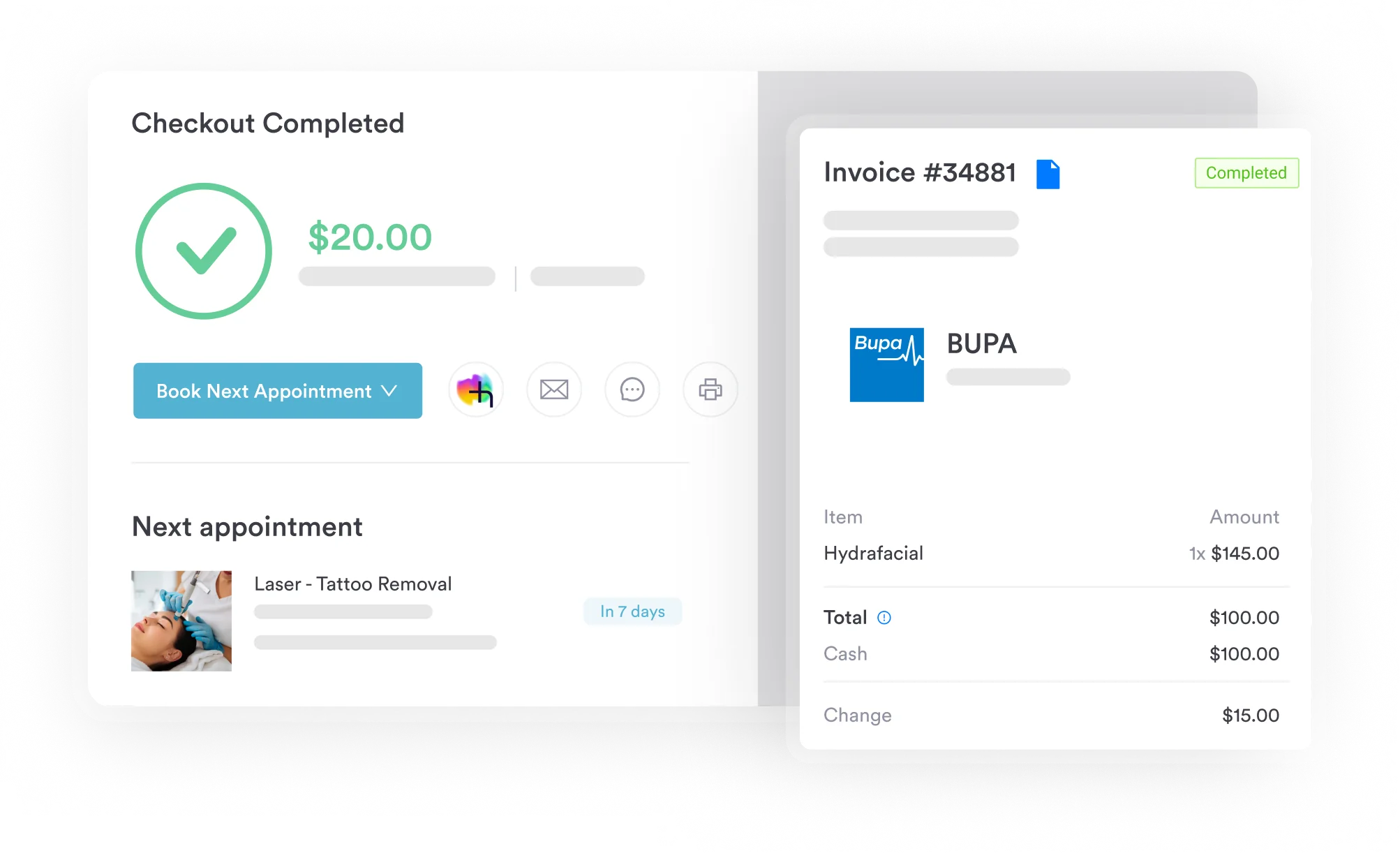

Pabau tracks prior authorisation on each case and warns you when the code is missing. It then submits CCSD-coded claims to Healthcode electronically.

XR290 is a cerebral angioplasty code, and each part of the claim should say so. When the descriptor, the procedure note and the authorisation match, the insurer has little to query.
The harder work is the indication. NICE’s position on intracranial stenting means the referral carries the claim, so ask for detail before you request authorisation. Then confirm the grade and fee in each insurer’s current schedule.
Book a demo to see how Pabau keeps authorisations and Healthcode claims together for neurointerventional work.

Need the bigger picture on Bupa’s codes? Bupa CCSD codes explains how Bupa’s procedure codes and billing rules work for UK private practice.
Treating a cerebral aneurysm instead? CCSD code XR306 covers endovascular treatment of cerebral aneurysm, including coiling.
Billing AVM embolisation? CCSD code XR390 walks through embolisation of an arteriovenous malformation of the brain or a major organ.
Coding angioplasty in another vessel? CCSD code XR430 covers renal angioplasty, with or without a stent.
They treat conditions of the brain, spine and their blood vessels through catheters, guided by imaging. Their work includes cerebral angioplasty, aneurysm coiling and AVM embolisation, usually in a hospital angiography suite.
No. Angioplasty widens a narrowed artery with a balloon. A stent is a small mesh tube left in place to hold the artery open. XR290 covers angioplasty with or without a stent.
It maps the blood vessels of the brain using contrast dye and X-ray imaging. It can show narrowing, aneurysms and AVMs. On its own, it’s a diagnostic test with its own code.
The consultant invoices their professional fee under the procedure code. The hospital bills its own charges separately, such as theatre time, devices and the stay. Both should quote the same pre-authorisation number.
It depends on the policy and the reason for treatment. The insurer decides at pre-authorisation, using the code and the clinical details. For atherosclerotic narrowing, NICE advises stenting only within research.