HCPCS Code K0900: Customized DME billing and coding guide
HCPCS Code K0900: Official descriptor and code overview HCPCS Code K0900 is a CM...

Last Updated: Nov 18, 2026
K0899 is the HCPCS Level II code for a power mobility device, not coded by DME PDAC or does not meet criteria. It applies to a power wheelchair or scooter that has no PDAC code verification, or that meets the requirements of no specific code.
K0899 is not a "not otherwise classified" code. That role belongs to K0898 for power wheelchairs. Medicare denies K0899 as not reasonable and necessary, so a signed ABN decides whether the beneficiary can be billed.
Let Pabau's smart automation suggest the right codes, reduce claim denials, and keep your practice compliant—effortlessly.
Automate repetitive tasks and focus on what matters most—your patients.
Reduce coding errors and ensure compliance with the latest regulations.
Clean claims, fewer denials, and faster reimbursements.
Powerful insights and reporting to help your practice thrive.
HIPAA compliant SOC 2 certified GDPR-compliant Trusted by 4,000+ clinics worldwide

K0899 is billed when a power mobility device has no PDAC code verification, or when it fails the criteria of every specific code.
K0899 is not a “not otherwise classified” code. The NOC code for power wheelchairs is K0898.
PDAC never issues a letter assigning K0899. The code applies because no verification exists, or because the device fails review.
Medicare denies K0899 as not reasonable and necessary, so a signed ABN and the GA modifier decide who pays.
Pabau’s claims management software keeps orders, encounter notes and ABNs on the patient record before a PMD claim goes out.
HCPCS code K0899 is defined as: Power mobility device, not coded by DME PDAC or does not meet criteria. Its short descriptor is “Pow mobil dev no dmepdac”. The Medicare power mobility devices policy article requires it for a power wheelchair or power-operated vehicle (POV) that no specific code can describe.
The rule has two parts. A device must be billed with K0899 if it has no written coding verification review (CVR) from PDAC. The same applies when PDAC reviewed it and found it meets the requirements of no code.
That makes K0899 a status code more than a device code. It tells Medicare the product is either unverified or non-qualifying. It does not describe what the device is or does.
The power mobility devices LCD (L33789) states the outcome plainly. An unreviewed or non-qualifying POV or power wheelchair “will be denied as not reasonable and necessary and should be coded as K0899.”
The device’s PDAC coding status decides whether K0899 applies. A coder reaches it in the situations below.
K0899 is the correct code when:
K0899 is not the correct code when:
The practical test is a lookup. If the exact make and model appear on the Product Classification List, bill the listed code. If they do not, the device goes to K0899 until PDAC verifies it. The decision path below runs from that lookup to the question of who pays.
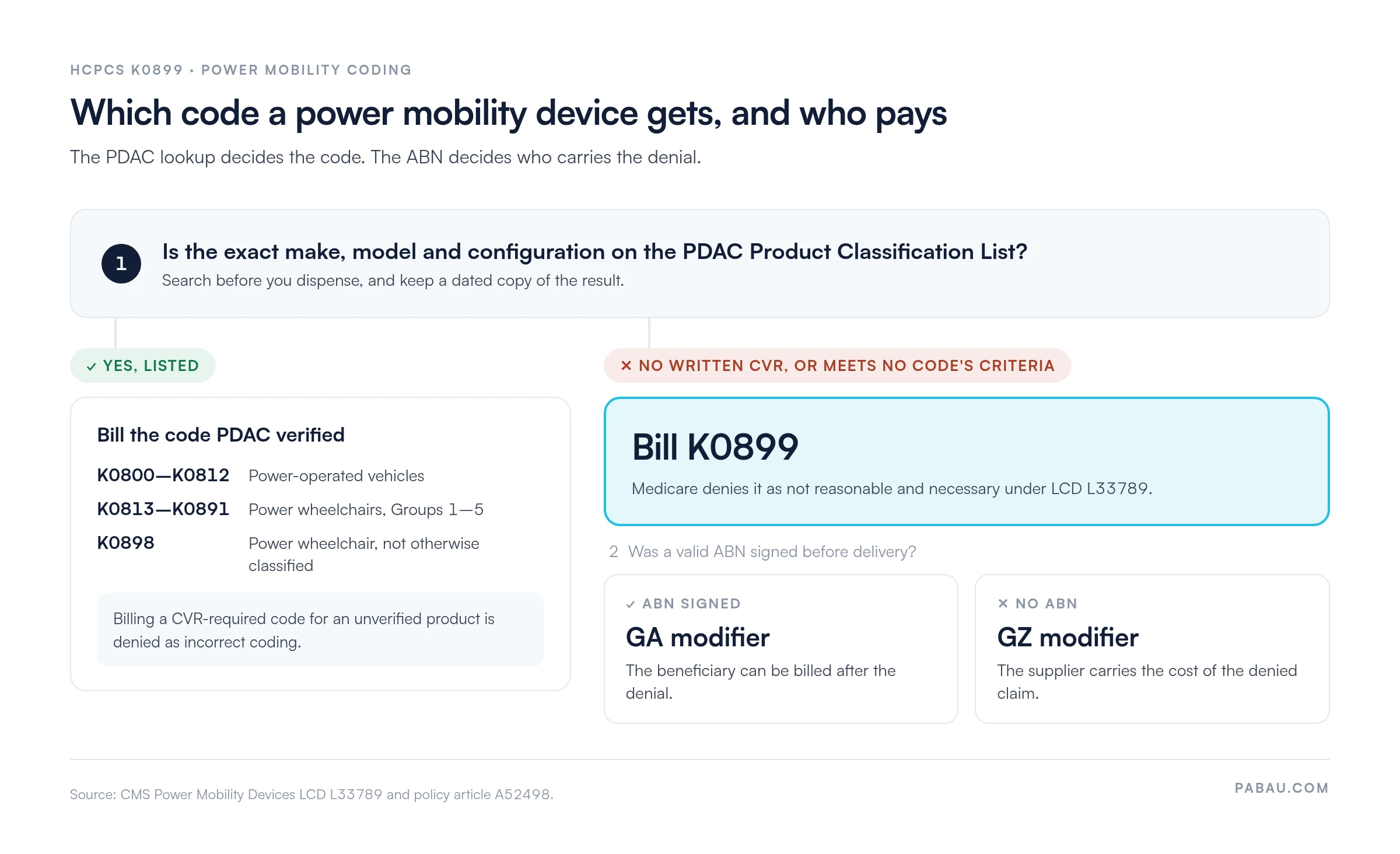
PDAC, the Pricing, Data Analysis and Coding contractor, reviews power mobility products and decides which HCPCS code each one meets. The manufacturer usually submits the product, along with the documentation and testing results PDAC requests.
Products that pass appear on the Product Classification List under their verified code. No determination letter assigns K0899. A device lands on K0899 because no verification exists, or because PDAC reviewed it and matched it to no code.
For a supplier, the verification check works like this:
Billing a CVR-required code for an unverified product does not avoid the problem. The policy article says that claim line “will be denied as incorrect coding.”
K0899 is often confused with K0898, the power wheelchair code “not otherwise classified”. The difference decides whether a claim can be paid. K0898 is a verified code for a power wheelchair that fits no specific group, while K0899 marks a device with no verification.
When in doubt, check the Product Classification List before you bill. A short lookup prevents an incorrect coding denial that takes hours to appeal.
Because the LCD directs a K0899 denial, the billing question becomes who carries the cost. A supplier who expects the denial and wants to bill the beneficiary needs a signed advance beneficiary notice of noncoverage (ABN) before delivery.
Modifier rules change with the HCPCS update and with policy revisions. Confirm them against your DME MAC’s current policy and the CMS HCPCS overview before you submit.
An end-to-end workflow for a K0899 claim follows this order:
A clean claim still matters on a code Medicare will deny. A claim with the wrong modifier or a missing ABN shifts liability back to the supplier.
K0899 claims need the same records as any power mobility device claim, plus proof of the coding check and the ABN. Build the medical billing documentation file before delivery, not after a denial arrives.
K0899 is not on the Medicare required prior authorization list for power mobility devices. The CGS prior authorization page lists the codes CMS requires nationwide, and the list stops at specific POV and power wheelchair codes.
The list matters once PDAC verifies a product. A device first billed as K0899 may later move to a code such as K0823, which does require prior authorization. Check the list whenever a product’s code changes.
Every K0899 claim is expected to deny under the LCD, so the problems that matter come before and after that denial. These are the errors that cost the supplier money:
Appeals follow the standard Medicare five-level process. Read the CARC and RARC codes on the remittance first, using denial codes in medical billing as a guide.
An appeal has the best footing when the product was verified on the date of service and simply billed under the wrong code. Strong denial management workflows keep the coding check and the ABN on file, so that case is quick to prove.
Medicare’s position on K0899 is fixed by the LCD. Other payers set their own rules, so check each policy before you dispense.
Where coverage is unlikely, collect a signed acknowledgment of financial responsibility before delivery. Tracking those rules across a DME patient panel is part of a structured revenue cycle management workflow.
Most K0899 losses trace back to paperwork. The ABN is missing, the order arrived after delivery, or nobody saved the coding check.
Pabau, the practice management and billing platform we build, holds those documents in one patient file. Encounter notes, signed orders and ABNs are captured through digital forms with e-signatures.
US claims go out as CMS-1500 and 837P files through Claim.MD, and the ERA remittance comes back into Pabau. When Medicare denies the device, your team posts the denial next to the signed ABN and bills the beneficiary with confidence.

Pabau’s claims management software keeps orders, encounter notes and signed ABNs on the patient record. Your team can check each power mobility claim before it goes out.

Treat K0899 as a warning about coding status. Before you bill it, confirm the product has no verified code. If one exists, use it.
When K0899 is the correct code, plan for the denial from the start. A signed ABN, the right modifier and a documented coding check decide whether the supplier or the beneficiary pays.
Book a demo to see how Pabau keeps power mobility orders, ABNs and claims documented before they reach Medicare.

Need a framework for reducing claim denials across your DMEPOS lines? Denial management in healthcare covers the operational workflow for capturing, categorizing, and resolving claim denials before they age.
Confused by remittance codes on a K0899 denial? Electronic remittance advice explains how to read ERA files, interpret CARC and RARC codes, and route denial reasons to the right correction workflow.
Looking to benchmark your overall billing process? What is medical billing covers the end-to-end process from patient intake through claim submission and payment posting.
Was the chair verified under the NOC code instead? HCPCS code K0898 explains when a power wheelchair that fits no specific group is billed as not otherwise classified.
Billing a wheelchair cushion with no PDAC verification? HCPCS code K0669 covers seat and back cushions that meet no specific code or lack written PDAC coding verification.
HCPCS code K0899 means power mobility device, not coded by DME PDAC or does not meet criteria. Suppliers use it for a power wheelchair or scooter that PDAC has not verified, or that meets no specific code’s criteria.
No. K0899 covers devices with no PDAC code verification or that fail the criteria of every code. The not otherwise classified code for power wheelchairs is K0898.
No. PDAC verifies products against specific codes and lists them on its Product Classification List. A device falls to K0899 because no verification exists, or because PDAC matched it to no code.
Medicare denies K0899 as not reasonable and necessary under the power mobility devices LCD. With a signed ABN and the GA modifier, the supplier can bill the beneficiary instead.
No. K0899 is not on the Medicare required prior authorization list for power mobility devices. Many specific power wheelchair and scooter codes are on it.
Use GA when a valid ABN was signed before delivery, and GZ when no ABN was obtained. The KX modifier is not appended, because K0899 fails the coverage criteria.