HCPCS Code Q4175: Billing, coverage, and documentation guide
HCPCS Code Q4175: Code Description and Product Identity HCPCS Code Q4175 is the ...

Last Updated: Nov 20, 2026
K0857 is the HCPCS Level II code for a Group 3 standard power wheelchair with a single power option and a captain's chair. It is rated for patients up to and including 300 pounds.
Prior authorization is mandatory under the CMS power wheelchair program, and the KX modifier must appear on every claim. The supplier needs an affirmative decision from the DME MAC before the chair is delivered.
Let Pabau's smart automation suggest the right codes, reduce claim denials, and keep your practice compliant—effortlessly.
Automate repetitive tasks and focus on what matters most—your patients.
Reduce coding errors and ensure compliance with the latest regulations.
Clean claims, fewer denials, and faster reimbursements.
Powerful insights and reporting to help your practice thrive.
HIPAA compliant SOC 2 certified GDPR-compliant Trusted by 4,000+ clinics worldwide

K0857 is a Group 3 standard power wheelchair base with a single power option and a captain’s chair, for patients up to 300 pounds.
Seat type and weight class separate K0857 from its neighbors: K0856 has a sling/solid seat and back, and K0859 is the heavy-duty captain’s chair version.
CMS requires prior authorization for K0857, so a claim without an affirmative decision on file is denied.
The KX modifier must appear on every K0857 claim to attest that documentation supporting medical necessity is complete and on file.
Pabau’s claims management software helps practices and billing teams track prior authorization status and warns when an authorization code is missing.
HCPCS Code K0857 describes a “power wheelchair, group 3 standard, single power option, captains chair, patient weight capacity up to and including 300 pounds.” The CMS Master List entry for K0857 uses the same descriptor and marks the code for prior authorization. Three features define the code: a Group 3 standard base, one power seating option, and a captain’s chair seat. Group 3 chairs sit above the Group 1 and 2 categories and serve patients with complex mobility and postural needs.
The code is maintained by CMS under the HCPCS Level II coding system. That system covers DME, prosthetics, orthotics, supplies, and certain drugs not found in the CPT code set. K0857 sits in the K-series of HCPCS Level II codes, the temporary codes CMS assigns for use by the DME MACs.
Medicare Part B covers K0857 as DME when the beneficiary meets every medical necessity criterion in the Power Mobility Devices Local Coverage Determination (LCD), L33789. Claims go to the beneficiary’s DME Medicare Administrative Contractor (MAC). All four DME MAC jurisdictions apply this one LCD: CGS for Jurisdictions B and C, and Noridian for Jurisdictions A and D.
Coverage requires all of the following conditions to be documented:
Group 3 coverage requires a mobility limitation caused by a neurological condition, myopathy, or congenital skeletal deformity. It also requires a specialty evaluation and a supplier that employs a RESNA-certified assistive technology professional (ATP). For a single power option base like K0857, the power mobility device LCD (L33789) adds the Group 2 single power option criteria. The patient needs a drive control other than a standard proportional joystick. A qualifying power tilt or power recline seating system in use on the chair also meets it.
A patient who needs both power tilt and power recline falls under the multiple power option bases, such as K0861, instead. K0857 itself is set apart by its captain’s chair seat and its 300-pound weight class.
Before you build a K0857 prior authorization packet, check the current version and effective date of L33789 in the CMS Coverage Database. Then read any DME MAC billing articles that go with it, because the LCD is revised periodically.
Documentation requirements for K0857 billing are extensive, and missing any single element is sufficient grounds for a denial or recoupment. CMS requires all of the following to be on file before the item is delivered and billed:
Once all documentation is on file, add the KX modifier to the claim. It attests that the medical necessity criteria in the applicable LCD are met and that documentation is available for review. Claims submitted without KX will be denied. A claim that carries KX without the documentation to back it is open to audit and recoupment.
Prior authorization (PA) is required for K0857 under the CMS Prior Authorization Program for power mobility devices. CMS lists K0857 as a PA item. CMS designated power wheelchairs as a PA-required item in response to high error rates and program integrity concerns in the DME space.
Without an affirmative PA decision, the claim will be denied on submission. The six steps below run in a fixed order, and each one has its own timing window.
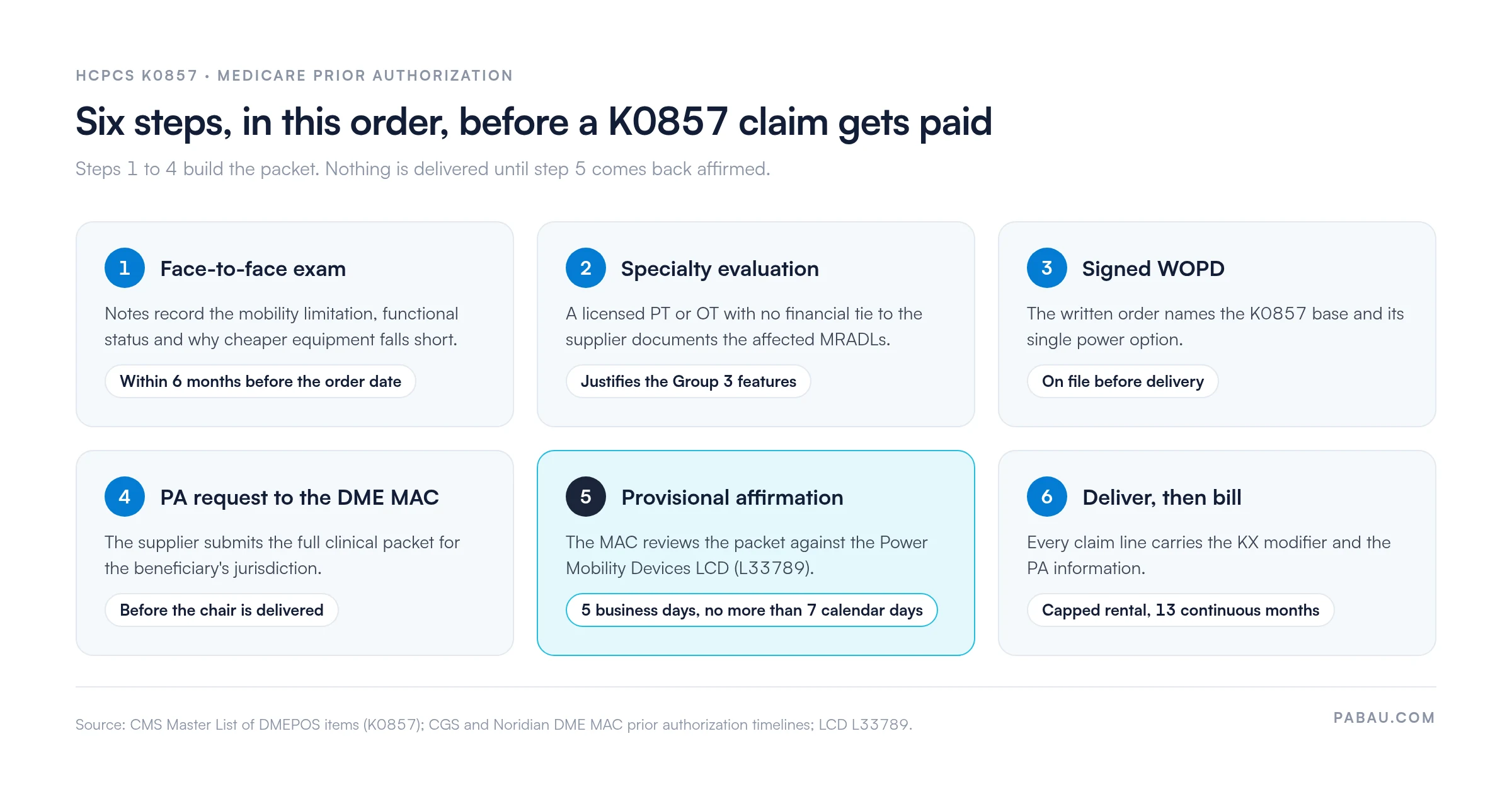
In detail, the PA submission process follows these steps:
Commercial and Medicare Advantage plans set their own rules for power wheelchairs, and many require prior authorization under criteria and timelines that differ from Medicare’s. Check the current medical policy on each payer’s provider portal before you submit, because requirements vary by plan.
Medicare reimburses K0857 under the capped rental payment category. Medicare pays a monthly rental for a continuous-use period, after which ownership transfers to the beneficiary. Because Group 3 chairs count as complex rehabilitative power wheelchairs, the beneficiary may also choose to buy the chair outright when it is first delivered. The monthly rental amount is set by the CMS DMEPOS fee schedule and varies by state and by rural or non-rural location.
Key reimbursement considerations for K0857:
Because rates are geographically specific and change annually, specific dollar figures are not stated here. Download the current DME fee schedule from CMS.gov for the exact allowable in your MAC jurisdiction before the billing date.
Several Group 3 bases share the same single power option. Within that range, seat type and patient weight class decide the code. The descriptors below come from the CMS Master List of DMEPOS items:
The order and delivery records must support both the seat type and the weight class you bill. A chair delivered with a sling or solid seat and back belongs under K0856, not K0857. A patient over 300 pounds needs a heavy-duty base, such as K0859. A chair delivered with both power tilt and power recline needs a multiple power option base, so K0857 does not apply. Check the base described in the WOPD against the code descriptor before you submit.
Correct billing of HCPCS Code K0857 requires the right combination of modifiers, billing settings, and accessory codes. A claim line without the KX modifier is denied, whatever documentation sits behind it.
Power wheelchair accessories (cushions, headrests, controllers) are billed separately under their own HCPCS codes. Do not bundle accessory costs into K0857. Each accessory requires its own medical necessity documentation. Pabau’s claims management software tracks prior authorization status on the case and warns when an authorization code is missing.
The K0857 denials below trace back to five root causes, and each has a check you can run before the claim goes out:
When a K0857 claim is denied, review the remittance advice for the specific CARC/RARC denial code before resubmitting. Appeals should include the full documentation packet and a written response addressing the specific denial reason. Running the checks in the table before submission catches each of these errors while the claim can still be corrected.
To bill K0857 to Medicare, a supplier must meet the DMEPOS supplier standards set by CMS. It must also keep active enrollment with its National Provider Enrollment contractor, which replaced the National Supplier Clearinghouse. Key requirements include:
Accreditation must be maintained continuously. A lapse voids Medicare billing privileges for every DMEPOS code, K0857 included. Suppliers must also meet the HIPAA requirements for the protected health information they handle during ordering and delivery. The AAPC’s HCPCS code lookup and the PGM Billing HCPCS lookup tool help you confirm code descriptors and coverage notes during claim review.
A K0857 claim depends on dates lining up: the face-to-face visit, the signed WOPD, the MAC’s affirmation and the delivery. When those dates sit in email threads and spreadsheets, a chair can go out before the authorization is on file.
In Pabau, the practice management and billing platform we build, the authorization code, its dates and its sessions are recorded on the patient’s case. Pabau warns the team when a case has no authorization code, so the missing approval surfaces before delivery rather than on the remittance.
US practices then send CMS-1500 claims through Claim.MD from the same system and receive ERA remittances back. The PA request itself still goes to the DME MAC, because Pabau tracks authorizations rather than submitting them.

Pabau records the authorization code, dates and sessions on each case. It warns your team when one is missing, so you see it before the chair is delivered.

Billing HCPCS Code K0857 correctly starts with matching the code to the chair. That means a Group 3 standard base, one power option, a captain’s chair, and a patient up to 300 pounds. Settle that match before the WOPD is signed, because every later document repeats it.
After that, the order of events decides whether the claim pays. Hold delivery until the DME MAC’s affirmation is on file, and put the KX modifier on every claim line. Those two habits close off the first two denial reasons in the table above.
Pabau records the authorization on each case and warns your team when one is missing. Book a demo to see how it keeps K0857 claims from going out ahead of their approval.

Need a broader HCPCS billing reference? Medical billing fundamentals covers the end-to-end claims process from order intake through payment posting.
Dealing with claim denials across multiple codes? Denial codes in medical billing explains common CARC and RARC codes and how to respond to each.
Looking to streamline DME claim submissions? Claims management software from Pabau tracks prior authorization status on each case and flags a missing authorization code.
Billing the extra heavy-duty version? HCPCS code K0855 covers the Group 3 extra heavy-duty base with a captain’s chair.
Same power option, heavier patient? HCPCS code K0858 covers the heavy-duty single power option base with a sling or solid seat.
HCPCS Code K0857 covers a Group 3 standard power wheelchair with a single power option and a captain’s chair. It is rated for patients up to and including 300 pounds. Medicare Part B covers it as durable medical equipment when the medical necessity criteria in the power mobility device LCD are met.
Yes. K0857 requires prior authorization under the CMS Prior Authorization Program for power mobility devices. The supplier must obtain a provisional affirmation from the MAC before delivering the chair. Submitting a claim without PA will result in an automatic denial.
Both are Group 3 standard power wheelchairs with a single power option, for patients up to and including 300 pounds. The difference is the seat: K0856 has a sling or solid seat and back, while K0857 has a captain’s chair. The written order and delivery records must describe the seat that matches the code you bill.
The KX modifier is required on every K0857 claim to attest that documentation supporting medical necessity is on file. Other modifiers depend on the billing scenario: RR (rental), NU (new equipment), GA (ABN on file), or GZ (no ABN, supplier assumes liability).
K0857 is governed by the Power Mobility Devices LCD (L33789), which applies to all four DME MAC jurisdictions. Check the CMS Coverage Database for the current version.
Yes. Medicare covers K0857 on a capped rental basis. The supplier bills a monthly rental rate for up to 13 continuous months, after which the chair transfers to beneficiary ownership at no additional charge. Use the RR modifier during the rental period.