Pabau Engage inbox

Pabau Engage is here: every patient conversation in one inbox.

Learn more
HCPCS Code

HCPCS code K0851 – Group 3 heavy duty power wheelchair


Code Definition

K0851 is the HCPCS Level II code for power wheelchair, group 3 heavy duty, captains chair, patient weight capacity 301 to 450 pounds.

It's often miscoded as a Group 2 chair, or swapped with the standard-duty Group 3 code K0848 or the sling-seat K0850. Medicare also requires prior authorization, a written order before delivery and modifier KX on the claim.

Level
K0000-K9999 Temporary codes for durable medical equipment regional carriers
Category
K0848-K0864 Power wheelchairs, Group 3
Code range
K0850-K0851 Heavy duty, patient weight capacity 301 to 450 pounds
Billable
No
Code also known as
heavy duty PWC, bariatric power chair, HD power wheelchair
Save time. Improve accuracy. Get paid faster.
Automate coding with Pabau

Let Pabau's smart automation suggest the right codes, reduce claim denials, and keep your practice compliant—effortlessly.

  • AI-powered code suggestions
  • Real-time compliance checks
  • Faster claims, fewer denials
Why practices choose Pabau
Save hours every week

Automate repetitive tasks and focus on what matters most—your patients.

Improve accuracy

Reduce coding errors and ensure compliance with the latest regulations.

Get paid faster

Clean claims, fewer denials, and faster reimbursements.

Grow with confidence

Powerful insights and reporting to help your practice thrive.

HIPAA compliant SOC 2 certified GDPR-compliant Trusted by 4,000+ clinics worldwide

Key takeaways

Key takeaways

HCPCS code K0851 is a Group 3 heavy duty power wheelchair with a captains chair seat, rated for patients weighing 301 to 450 pounds.

Group 3 coverage adds a specialty evaluation and a RESNA-certified ATP to the basic power wheelchair criteria in LCD L33789.

Prior authorization has applied nationwide since September 1, 2018, and the written order must reach the supplier before delivery.

Medicare pays K0851 as a capped rental, 15% of the purchase price in months 1 to 3 and 6% in months 4 to 13.

Pabau, the practice software we build, tracks prior authorization codes, dates and sessions on each case and warns your team when one is missing.

K0851 is a Group 3 chair, not a Group 2 one

HCPCS code K0851 sits in the Group 3 power wheelchair family, K0848 to K0864, not in Group 2. Medicare sets its coverage rules in LCD L33789, Power Mobility Devices, which treats Group 2 (K0820 to K0843) as a separate family.

That label changes the whole file. Group 3 coverage brings a stricter diagnosis test, a specialty evaluation and a supplier with specialist credentials. HCPCS Level II codes like this one are maintained by the Centers for Medicare and Medicaid Services (CMS).

FieldDetail
Official descriptorPower wheelchair, group 3 heavy duty, captains chair, patient weight capacity 301 to 450 pounds
Code familyK0848-K0864, Group 3 power wheelchairs
Weight tierHeavy duty, 301 to 450 lbs (shared with sling-seat K0850)
Seat typeCaptains chair
Power optionsNone; single and multiple power option chairs use K0856-K0864
Coverage policyLCD L33789, Power Mobility Devices
Payment categoryCapped rental, pricing indicator 36
Prior authorizationRequired nationwide since September 1, 2018
Competitive biddingExcluded; the national fee schedule applies

Weight and seat type pick the right K08xx code

Every chair in K0848 to K0855 is a Group 3 chair with no power options. Two facts decide which one you bill, the patient’s weight tier and the seat. A captains chair has a car-style seat, while sling and solid seats use separate codes, such as K0850 in the same weight tier.

CodeDuty levelSeat typePatient weight capacity
K0848StandardSling/solid seat and backUp to and including 300 lbs
K0849StandardCaptains chairUp to and including 300 lbs
K0850Heavy dutySling/solid seat and back301 to 450 lbs
K0851Heavy dutyCaptains chair301 to 450 lbs
K0852Very heavy dutySling/solid seat and back451 to 600 lbs
K0853Very heavy dutyCaptains chair451 to 600 lbs
K0854Extra heavy dutySling/solid seat and back601 lbs or more
K0855Extra heavy dutyCaptains chair601 lbs or more
K0856Standard, single power optionSling/solid seat and backUp to and including 300 lbs
K0859Heavy duty, single power optionCaptains chair301 to 450 lbs

The weight line isn’t a hard cliff at 301 pounds. The LCD covers a heavy duty chair for a beneficiary weighing 285 to 450 pounds. A patient at 95% or more of the lower class’s limit can move up a tier.

Here’s how that plays out. A patient weighing 292 pounds with a captains chair order qualifies for K0851, not K0849, as long as the chart records the weight. Add a power tilt and the same patient moves to K0859, the single power option code.

The grid below places all eight no-power-option codes by weight tier and seat, so you can see where K0851 sits among its neighbors.
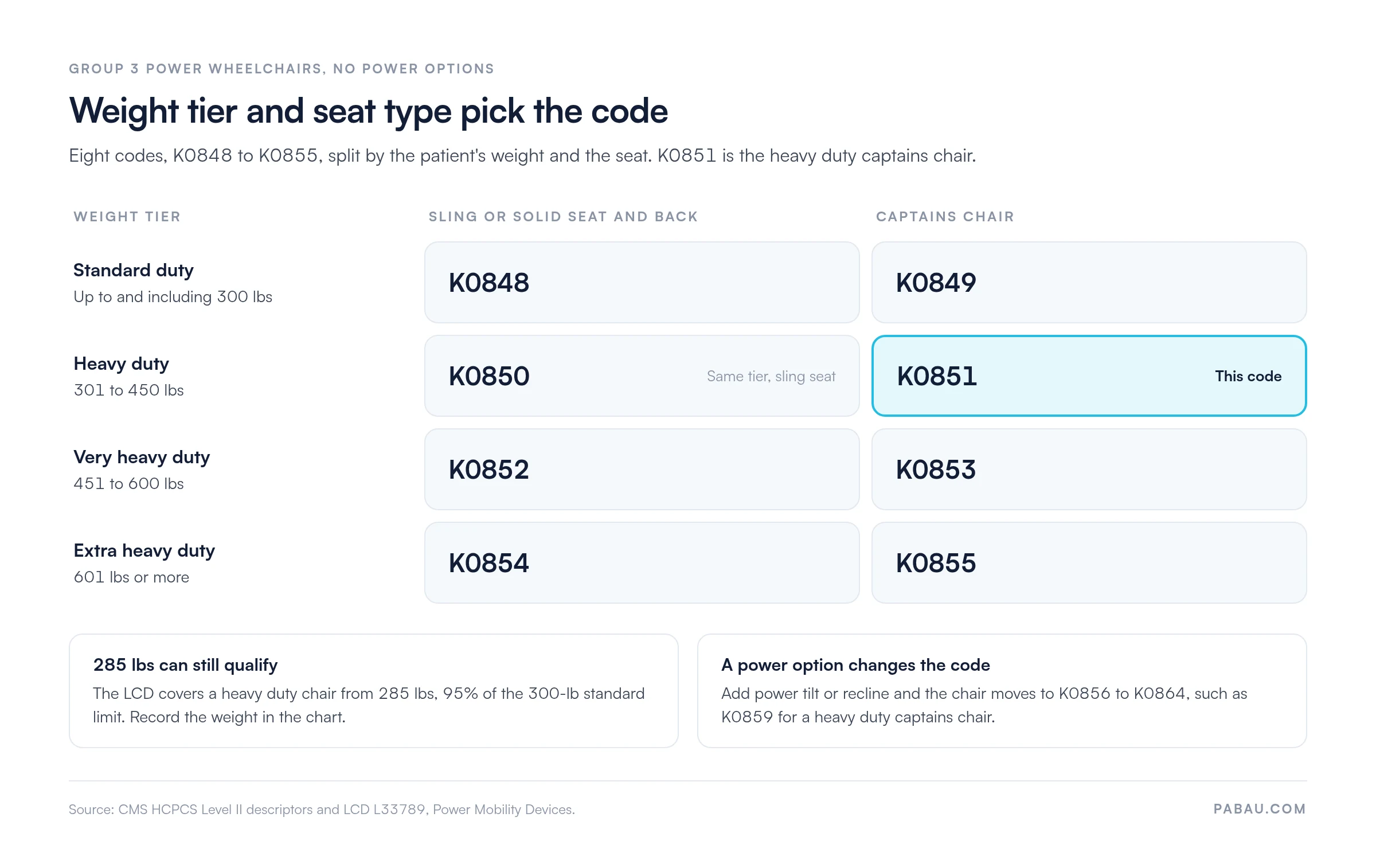
Grid of Group 3 power wheelchair codes without power options by weight tier and seat
Only the seat separates K0851 from K0850, so check the order before you pick a code. Descriptors from CMS HCPCS Level II and LCD L33789.

Medicare covers K0851 only when every test is met

Coverage rests on documented function as well as the diagnosis. Under LCD L33789, a K0851 chair needs the basic power wheelchair criteria plus the Group 3 additions below.

  1. A mobility limitation in the home. The patient can’t safely complete mobility-related activities of daily living, such as toileting, feeding or bathing, within the home.
  2. Simpler aids won’t do the job. A cane, walker, manual wheelchair or scooter can’t meet the need, and the patient can safely operate a power chair.
  3. A qualifying condition. The mobility limitation is due to a neurological condition, myopathy or congenital skeletal deformity.
  4. A specialty evaluation. A PT, OT or physician with rehabilitation training assesses the patient. That evaluator can’t have a financial relationship with the supplier.
  5. A RESNA-certified ATP. The supplier employs an Assistive Technology Professional who specializes in wheelchairs and is directly involved in choosing the chair.
  6. A face-to-face encounter. The treating practitioner sees the patient within the six months before the written order date.

Commercial payers and Medicaid programs set their own rules. Check the plan’s policy rather than assuming the LCD carries over.

The paperwork has to exist before the chair is delivered

Most K0851 problems start in the referring practice. The supplier can only submit what your team documents, and several items must be dated before delivery. Knowing the full medical billing workflow helps you see where each one fits.

DocumentTimingWho produces it
Face-to-face encounter notesWithin the six months before the written orderTreating physician, NP, PA or CNS
Standard Written Order (SWO)Written after the encounter; received by the supplier before delivery (WOPD)The same treating practitioner
Specialty evaluationBefore the PA request; no financial tie to the supplierPT, OT or rehab-trained physician
ATP involvement recordBefore the PA requestSupplier’s RESNA-certified ATP
Prior authorization decisionAffirmed before deliverySupplier, from the beneficiary’s DME MAC
Proof of deliveryAt delivery; kept on fileSupplier

The SWO names the beneficiary, the order date, the item, the quantity, the practitioner’s name or NPI and their signature. K0851 is on the CMS list of items that need a written order prior to delivery. So the order must reach the supplier first. A chair delivered before that date isn’t covered.

Prior authorization for K0851 runs through your DME MAC

CMS has required prior authorization for K0851 nationwide since September 1, 2018. A claim without an affirmed request is denied. A non-affirmed request isn’t the end, though. You can fix the gap the reviewer named and resubmit.

Here’s the walkthrough, start to finish.

  1. Assemble the package. Include the face-to-face notes, the SWO, the specialty evaluation and supporting chart notes.
  2. Send it to the beneficiary’s DME MAC. CGS handles Jurisdictions B and C, and Noridian handles Jurisdictions A and D.
  3. Wait for the decision. A decision letter normally arrives by the fifth business day, and no later than seven calendar days. Expedited requests are handled in about 2 business days.
  4. Read the detail on any non-affirmation. It lists what was missing, so correct those items and resubmit.
  5. Deliver only after affirmation. Then put the unique tracking number (UTN) from the decision on the claim.

Pro Tip

Ask the supplier which MAC timeframe applies before you schedule delivery, and build that window into the order. Send the specialty evaluation with the first request, since a missing evaluation is a common reason for non-affirmation.

How a K0851 claim moves from order to payment

Once the chair is delivered, the supplier bills it on a monthly cycle. A clean claim here carries more detail than most DME claims, because the UTN and the rental modifiers travel with it.

  1. Use place of service 12. Home is the setting for nearly every Medicare power wheelchair claim.
  2. Record the purchase or rental choice. For a Group 3 chair, the beneficiary can buy it in the first month or rent it. BP marks a purchase election, and BR a rental one.
  3. Add KX when the coverage criteria are met and documented.
  4. On a rental, add the month modifier. KH covers month 1, KI months 2 and 3, and KJ months 4 to 13. A purchase line (NU + BP) doesn’t carry KH.
  5. Include the UTN from the prior authorization decision.
  6. Answer any ADR by the deadline in the Additional Documentation Request.

K0851 modifiers: The short list worth knowing

ModifierMeaningWhen it goes on the claim
KXMedical policy requirements metEvery claim where the LCD criteria are documented
BP / BR / BUPurchase elected / rental elected / no decision after 30 daysFirst claim for the chair
KH / KI / KJCapped rental months 1 / 2-3 / 4-13Rental claims only, one per month. A purchase line (NU + BP) does not carry KH.
NU / RRNew equipment purchase / rentalPurchase or rental lines
UEUsed equipmentWhen the chair supplied is used
GAABN on fileCoverage may be denied and the beneficiary signed an ABN
GYStatutorily excluded or not a benefitYou need a denial for a secondary payer

KX and GA don’t belong on the same line. KX says the criteria are met, while GA says they may not be, so the pair sends a conflicting signal.

Medicare pays 15% a month, then 6%

K0851 carries pricing indicator 36, a capped rental. Medicare pays 15% of the purchase price each month for months 1 to 3, then 6% a month from month 4 to month 13. The beneficiary owns the chair after month 13.

Group 3 chairs, K0848 to K0864, are excluded from DMEPOS competitive bidding under the Medicare Improvements for Patients and Providers Act of 2008. The national fee schedule applies wherever the beneficiary lives. Pull the current allowable from the CMS DMEPOS fee schedule, since rates change each year.

Six K0851 denials, and the fix for each one

K0851 denials follow a pattern, which makes them easier to prevent than to appeal. A steady approach to denial management in healthcare pays off here. The full list of medical billing denial codes explains each code across claim types.

DenialWhat it meansThe fix
CO-197Precertification or authorization absentRequest prior authorization, then resubmit with the UTN once affirmed
CO-50Not deemed medically necessaryCheck the specialty evaluation and diagnosis support the Group 3 criteria; appeal with records
CO-4Modifier missing or inconsistent with the codeAdd KX, or remove a KX/GA pairing, then correct the claim
CO-16Claim lacks informationSupply the missing SWO element or UTN and resubmit
CO-97Bundled into another service’s allowanceDon’t bill items the LCD includes in the base chair separately
Same or similarA power wheelchair was supplied within its 5-year reasonable useful lifetimeDocument loss, irreparable damage or a changed medical need

Before you submit: A K0851 checklist

  • The code matches the seat and weight tier, K0851 for a captains chair at 301 to 450 pounds.
  • The face-to-face encounter falls within the six months before the SWO date.
  • The specialty evaluation is signed by someone with no financial tie to the supplier.
  • The supplier received the written order before the delivery date.
  • The prior authorization is affirmed and the UTN is on the claim.
  • The line carries KX, plus BP for a purchase, or BR plus KH/KI/KJ for a rental.

Common mistakes that trip K0851 claims up

  • Calling it a Group 2 chair. Group 2 ends at K0843, so Group 2 criteria and forms won’t support a K0851 claim.
  • Mixing up K0850 and K0851. They share a weight tier, and only the seat separates them.
  • Billing K0851 with a power tilt or recline. Power options move the chair to K0856-K0864.
  • Assuming competitive bidding applies. It doesn’t for Group 3, so there’s no contract-supplier test.
  • Folding accessories into the base code. Cushions, positioning parts and most add-ons carry their own codes.
  • Ordering for use outside the home only. The LCD ties coverage to mobility needs in the home.

How Pabau keeps K0851 prior authorization on track

For the referring practice, the hard part is the paper trail behind the chair. Encounter notes, the written order and the authorization number tend to live in different places, and a missing one only shows up as a denial.

In Pabau, that trail lives on the patient’s case. Your team records the prior authorization code, its dates and the number of authorized sessions on the case. Pabau warns staff when an authorization is missing.
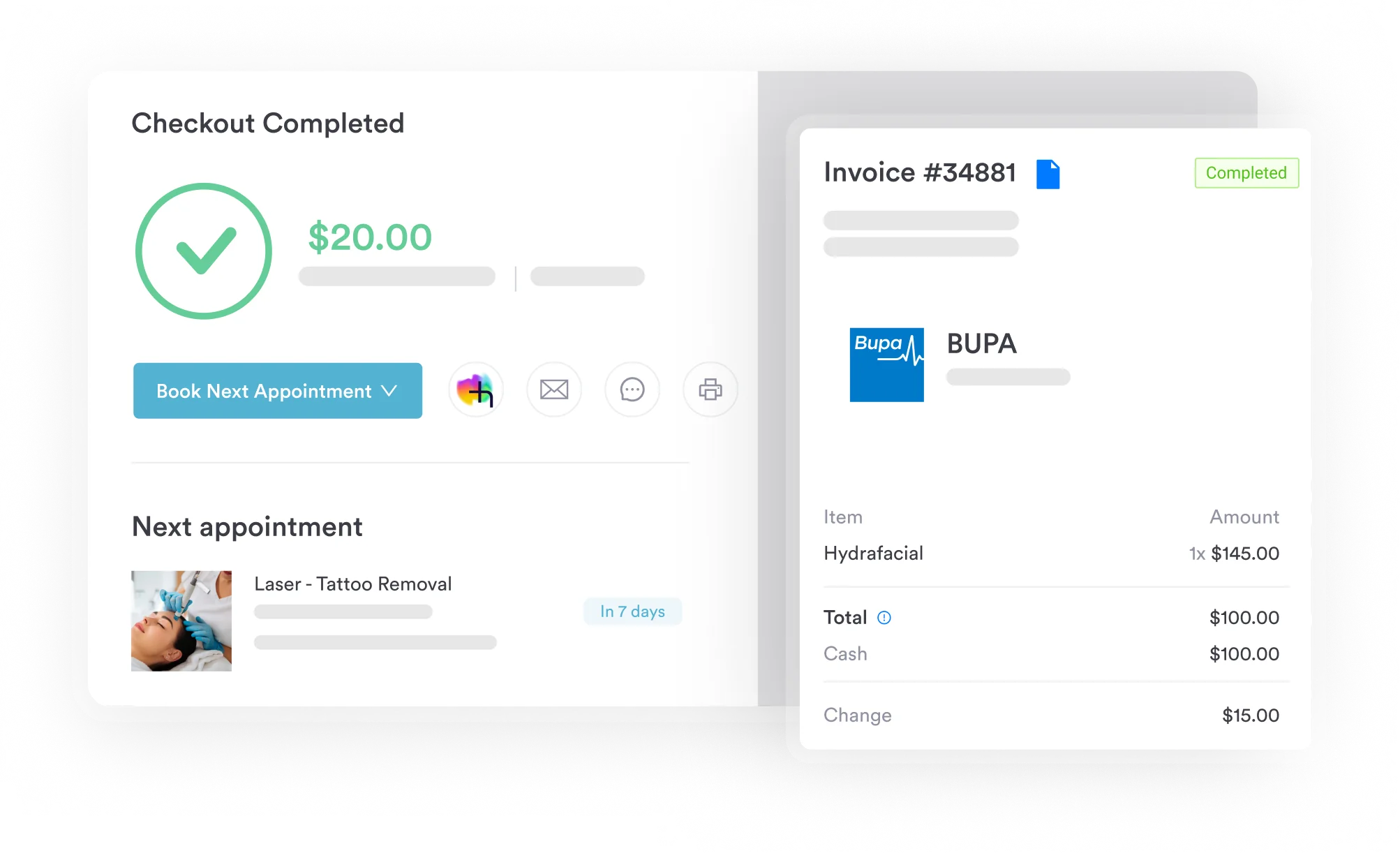
Automate claims and billing with Pabau
Pabau’s claims tools send a K0851 rental claim from the patient record, with the prior authorization number already attached.

US claims then go out through Claim.MD from the same record. Keeping claims management in one place means your billers stop chasing details across inboxes.

Keep every authorization on the patient case

Pabau tracks prior authorization codes, dates and sessions on each case, warns your team when one is missing, and sends US claims through Claim.MD.

Pabau claims management dashboard

Conclusion

Treat K0851 as a Group 3 claim from the first note. That one decision sets the criteria, the evaluations and the people who must sign before the chair moves.

The practices that get these chairs approved quickly do the slow work early. They date the encounter, the order and the evaluation in the right sequence before the prior authorization goes in. The trade-off is a longer wait at the start, which beats a denied rental later.

Book a demo to see how Pabau keeps prior authorization details on each case and flags the ones that are missing.

Continue your research

Continue your research

Need a full picture of how medical billing workflows connect? What is medical billing explains the end-to-end claims cycle from charge capture to payment posting.

Seeing repeat denials across your DME claims? Denial management in healthcare covers root-cause analysis and appeal strategies for common DME denial patterns.

Want to understand what a clean claim actually requires? Clean claim submission breaks down the elements that separate a first-pass approval from an avoidable rejection.

Need a power tilt or recline on a heavy duty captains chair? HCPCS code K0859 covers the single power option version of this chair.

Is the patient over 600 pounds? HCPCS code K0855 explains the extra heavy duty captains chair and its coverage.

Frequently asked questions

Can Medicare beneficiaries buy a K0851 chair outright?

Yes. Group 3 power wheelchairs carry a purchase option in the first month. The beneficiary chooses purchase (BP) or rental (BR). With no decision after 30 days, the supplier bills BU and the rental continues.

Who can do the specialty evaluation for K0851?

A licensed or certified medical professional, such as a PT or OT, or a physician with specific rehabilitation training. They must have no financial relationship with the supplier.

How long before Medicare replaces a K0851 chair?

The reasonable useful lifetime is five years. Earlier replacement needs proof of loss, irreparable damage or a change in medical condition.

Does a patient who weighs 290 pounds qualify for K0851?

They can. The LCD covers heavy duty chairs from 285 pounds, which is 95% of the 300-pound standard limit. Record the weight in the chart.

Does Medicaid cover K0851?

Most state Medicaid programs cover power wheelchairs, but criteria and prior authorization rules vary by state. Check the state’s DME policy before ordering.
Avatar photo
Monika Lazarevska
Content Writer

Monika Lazarevska writes content for owners and healthcare professionals who want clear, no-fluff content that actually helps them run their practice better. With a background in storytelling and SEO, she knows how to make even the driest topics worth reading. Off the clock, you'll find her in a café somewhere in Europe, probably with a good book and an even better coffee.
×