CCSD code H4430: Examination of rectum under anaesthetic
CCSD code H4430 pays for the examination alone CCSD code H4430 is the UK private...

Last Updated: Oct 20, 2026
K0850 is the HCPCS Level II code for power wheelchair, group 3 heavy duty, sling/solid seat/back, patient weight capacity 301 to 450 pounds.
Choose a neighboring code and the claim is denied on equipment classification rather than medical necessity. Sorting that out after delivery costs more than checking the chair's rating before it ships.
Let Pabau's smart automation suggest the right codes, reduce claim denials, and keep your practice compliant—effortlessly.
Automate repetitive tasks and focus on what matters most—your patients.
Reduce coding errors and ensure compliance with the latest regulations.
Clean claims, fewer denials, and faster reimbursements.
Powerful insights and reporting to help your practice thrive.
HIPAA compliant SOC 2 certified GDPR-compliant Trusted by 4,000+ clinics worldwide

HCPCS code K0850 covers a group 3 heavy duty power wheelchair with a sling or solid seat and back. The rated capacity runs from 301 to 450 pounds.
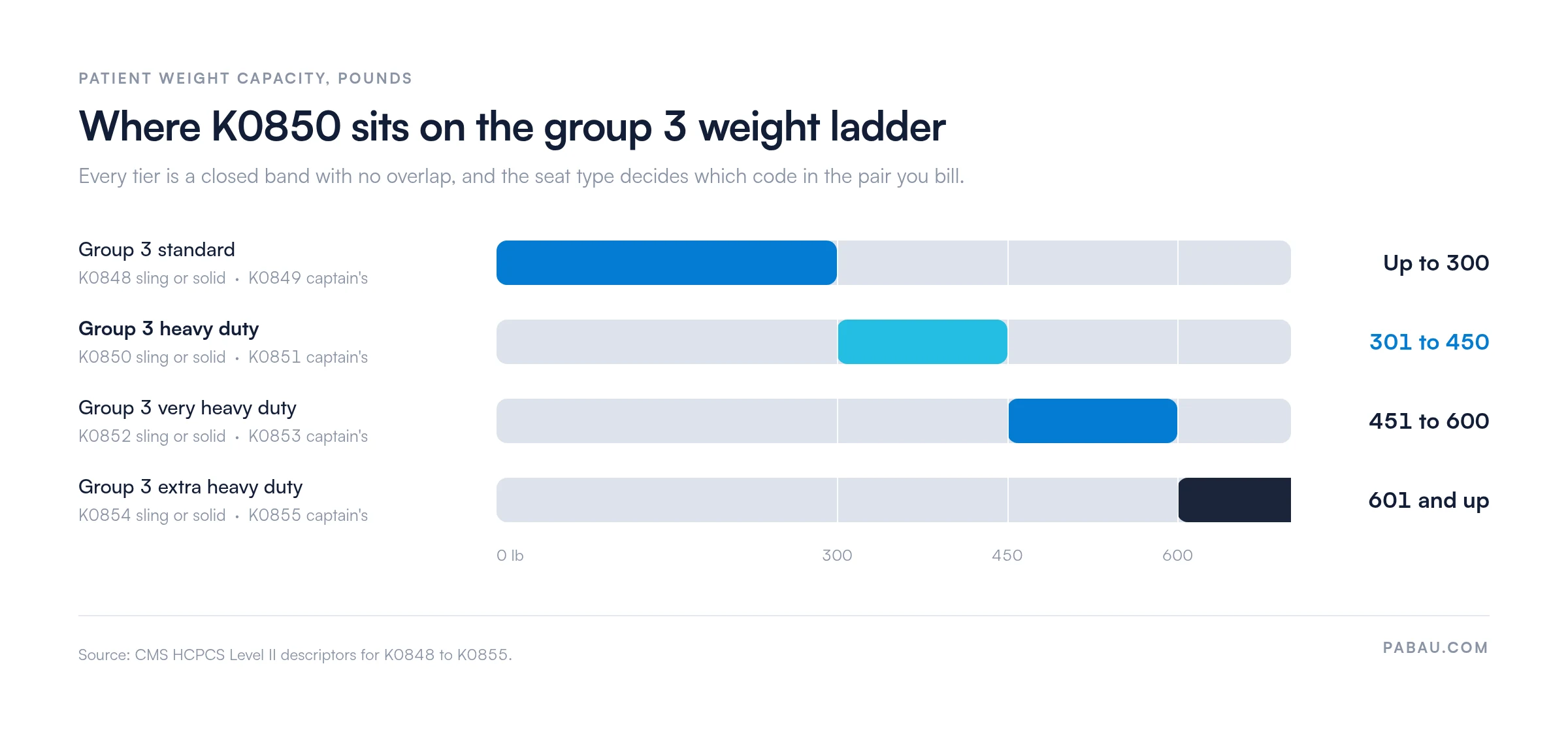
The band is closed at both ends. Patients at or below 300 pounds take K0848 or K0849, and above 450 pounds the codes are K0852 through K0855.
Seating decides the second axis. A captain’s chair in the same 301 to 450 pound band is K0851, not K0850.
Prior authorization has been required nationwide since September 1, 2018. The unique tracking number from the affirmative decision goes on the claim.
Modifier KX attests that the LCD requirements were met. NU, RR, and UE set the payment methodology, and a wrong modifier is a leading cause of denials.
HCPCS code K0850 describes a power wheelchair, group 3 heavy duty, sling/solid seat/back, patient weight capacity 301 to 450 pounds. The code belongs to HCPCS Level II, maintained by the Centers for Medicare and Medicaid Services (CMS), and sits in the durable medical equipment category.
Two specifications decide the code, and both have to match the chair that was delivered. The first is the weight band, which runs from 301 to 450 pounds and stops there. The second is the seating, a sling or solid seat and back rather than a captain’s chair.
Change either specification and the code changes with it. The ladder below shows how the four group 3 weight tiers stack against each other.
Group 3 itself is a clinical classification rather than a weight one. The power mobility devices LCD covers a group 3 chair only for certain causes. The limitation has to stem from a neurological condition, a myopathy, or a congenital skeletal deformity.
Heavy duty is the weight tier applied inside group 3, and for K0850 that tier ends at 450 pounds. The table below sets out the code’s attributes in one place.
Medicare reimburses K0850 under the DME fee schedule, which CMS updates annually. The 2026 schedule lists both purchase and rental rates for group 3 heavy duty power wheelchairs, and rates vary by Medicare Administrative Contractor (MAC) region.
Verify the current figure with the CMS DMEPOS fee schedule before you submit, because third-party reference sites often miss mid-year updates.
Under Medicare’s capped rental methodology, power wheelchairs are rented for up to 13 months. After the 13th rental payment, ownership transfers to the beneficiary at no extra cost. That transfer changes which modifier you apply at each billing stage.
Competitive bidding does not reach K0850. Complex rehabilitative power wheelchairs in the K0848 to K0864 range are excluded from the DMEPOS competitive bidding program by statute. National fee schedule pricing therefore applies in every area.
Confirming the payment basis before delivery is what keeps the money side clean. Billing the purchase price when the payer expects monthly rental, or the reverse, produces a denial and a compliance flag at the same time.
Coverage rests on medical necessity documented against the power mobility devices Local Coverage Determination (LCD) issued by the relevant MAC. The LCD defines the clinical conditions a beneficiary must meet before a group 3 heavy duty chair qualifies.
Requirements vary by MAC jurisdiction, so read the LCD for the patient’s area rather than assuming one national standard.
Most MACs apply the following criteria to a group 3 heavy duty power wheelchair:
CMS Policy Article A52504 governs wheelchair options and accessories, including group 3 classifications. Reading that policy article next to the applicable MAC LCD gives the fullest picture of coverage.
Sound medical billing compliance on K0850 depends on satisfying the national policy and any extra MAC-specific criteria.
Documentation deficiencies drive more K0850 denials than any other cause. Medicare expects a complete package before the claim is submitted, not one assembled after a denial arrives.
In most MAC jurisdictions a single missing element triggers an automatic denial.
Collecting each item through structured digital forms rather than loose scans lowers the risk of a missing element. A consistent workflow surfaces an incomplete file while there is still time to fix it.
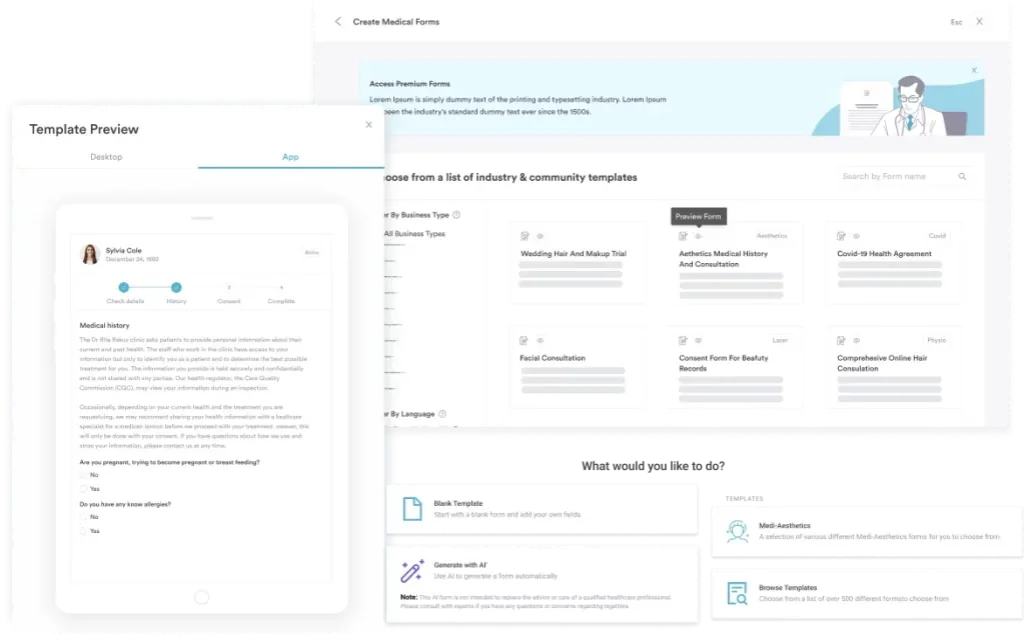
Audit the date order on every K0850 file before submission. The face-to-face examination has to precede the written order. The written order has to precede the prior authorization request, and the affirmative decision has to precede delivery. Out-of-sequence dates are an immediate audit trigger on Medicare DME claims.
K0850 sits on the CMS Required Prior Authorization List under 42 CFR 414.234(c)(1). The requirement has been nationwide since September 1, 2018, so no jurisdiction lets a supplier skip it. Submit the request and secure approval before the equipment is delivered or billed.
A claim submitted without an affirmative decision is denied automatically, and those denials rarely survive appeal. The process runs in this order:
Tracking authorization status across every open K0850 order matters once more than one chair is in flight. A supplier needs to see at a glance which orders are authorized, which are pending, and which came back non-affirmed.
The modifier on a K0850 claim sets both the payment methodology and the compliance posture of the line.
Each one tells Medicare whether the chair is rented or purchased, whether it is new or used, and whether the LCD requirements were met. Most MACs deny an unmodified K0850 line.
KX is the one that decides most claims. Without it, the MAC reads the line as documentation that was never completed, and denies it. Never append KX speculatively, because the modifier attests that your file already satisfies the LCD.
Rental and purchase modifier errors show up consistently in DME audits. Billing RR after ownership transferred at month 13, or NU for a used chair, creates exposure under the False Claims Act. When the right modifier is unclear for a scenario, ask a certified coder or your compliance officer.
Every K0850 claim needs one or more ICD-10 diagnosis codes that establish medical necessity for a group 3 heavy duty chair.
The diagnosis has to reflect the condition causing the mobility limitation. MACs maintain approved diagnosis lists inside their LCDs, so the codes below appear often without being accepted everywhere.
Confirm applicability against your MAC’s LCD and the AAPC HCPCS code reference before billing. A diagnosis missing from the approved list produces a medical necessity denial even when the clinical record supports the chair thoroughly.
K0850 sits inside the group 3 power wheelchair series, which runs from K0848 through K0864. The codes in that series are separated on two axes. The first is the patient weight band, and the second is the seat configuration.
Reading the ladder in order makes the decision mechanical. Find the weight band the delivered chair is rated for, then pick the column that matches its seat.
A beneficiary at 295 pounds in a sling-seat chair is K0848, and the same patient in a captain’s chair is K0849. At 320 pounds those two answers become K0850 and K0851.
The upper boundary catches suppliers out just as often as the lower one. K0850 stops at 450 pounds. A chair rated for 500 pounds is K0852 or K0853, and one rated above 600 pounds is K0854 or K0855.
Codes K0856 through K0864 repeat the same weight ladder for chairs with single or multiple power options, such as a powered tilt or recline. Our HCPCS code library carries the rest of the K-series if you need to check a neighboring descriptor.
Billing a tier the equipment does not match is a coding error that an audit can read as something worse. Check the rating before the chair leaves the warehouse.
Read the delivered chair’s rated capacity off the manufacturer spec sheet, not off the patient’s weight. Coding follows the equipment rating, and the clinical record then has to justify that rating. A 460 pound patient in a chair rated to 450 pounds is both a coding problem and a safety problem, so resolve it before delivery.
Most K0850 denials trace back to a short list of preventable errors. Suppliers who bill group 3 heavy duty chairs regularly meet the same audit triggers. Learning them in advance costs far less than discovering them through a Recovery Audit Contractor review.
A short pre-delivery check, built from the documentation requirements above, catches most of these before they turn into denials.
Run the five in order and the file tells you whether the claim is ready. Suppliers who treat each point as a gate see markedly lower denial rates on power wheelchair claims.
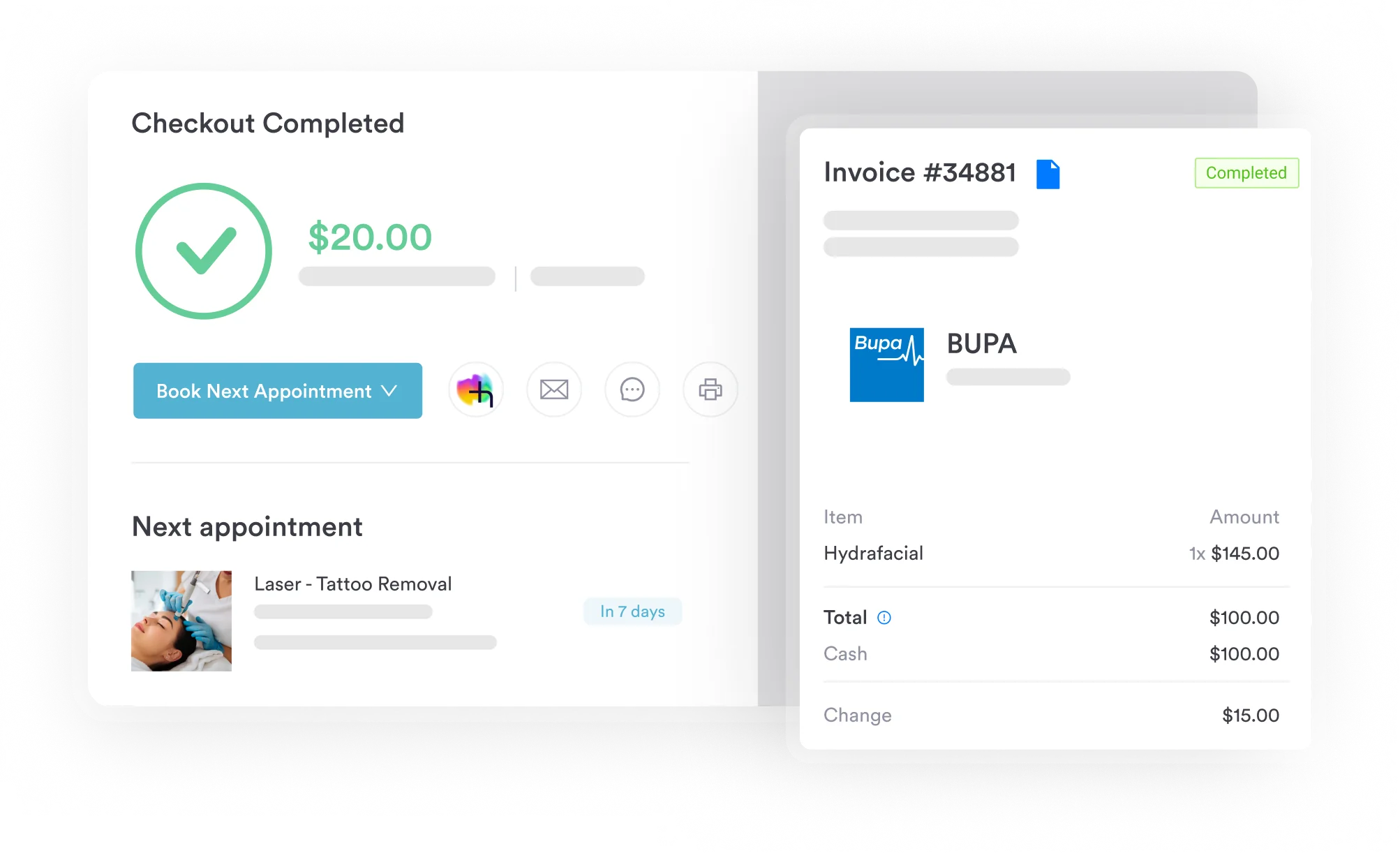
Most suppliers assemble a K0850 file across several systems. The mobility evaluation sits in the clinical record. The written order arrives as a scan, and the weight is buried in a progress note. The delivery receipt is a signed sheet in a folder.
Nobody sees the whole file at once, which is how a claim goes out with one piece missing. Practice management software like Pabau keeps those pieces on a single patient record. The face-to-face evaluation, the written order, the recorded weight, and the signed proof of delivery live together, each with a timestamp.
That timestamping matters here, because the order of those dates is what an auditor checks first. Pabau’s claims management software then submits electronically through Claim.MD in the US and tracks what each payer sends back.
Pabau does not choose codes or modifiers for you, so that judgment stays with your coder. What it gives you is one place to confirm the file is complete before the claim leaves.

Pabau brings the mobility evaluation, written order, recorded weight, and proof of delivery together on one record. The claim then goes out electronically with the file complete.

K0850 answers one narrow question. Was the delivered chair a group 3 heavy duty model with a sling or solid seat, rated for 301 to 450 pounds? Step outside that band in either direction and a different code applies.
The rest is sequence. Examine, order, authorize, deliver, then bill with the unique tracking number and the KX modifier. Suppliers who hold that order see far fewer denials than those who assemble the file after the claim comes back.
Keeping the file in one system is what makes that sequence checkable before delivery rather than after. Book a demo to see how Pabau tracks DME documentation from the mobility evaluation through to proof of delivery.

Need a framework for reducing claim denials across your practice? Denial management in healthcare covers systematic approaches to identifying and resolving recurring denial patterns.
Want to understand the full billing cycle for DME claims? Revenue cycle management explains the end-to-end process from eligibility verification through payment posting.
Chasing claims that pay on the first pass? Clean claim submission sets out what a payer needs before it will pay without a resubmission.
Looking for guidance on documenting what you billed? Superbill documentation outlines the core elements that make a claim submission defensible from the start.
Yes. The power mobility devices LCD requires a specialty evaluation for every group 3 power wheelchair. A physical therapist, occupational therapist, or physician trained in rehabilitation wheelchair assessment performs it. That person cannot have a financial relationship with the supplier.
CMS reviews a standard prior authorization request within 10 business days and an expedited request within 2 business days. Expedited review needs documentation that the standard timeframe would put the beneficiary’s health at risk. A non-affirmed decision can be resubmitted with stronger evidence.
No. Complex rehabilitative power wheelchairs in the K0848 to K0864 range are excluded from the DMEPOS competitive bidding program by statute. National fee schedule amounts apply in every area, so there is no competitive bidding rate to look up for K0850.
Ownership transfers to the beneficiary after the 13th rental payment. Medicare then covers reasonable and necessary repairs, billed as parts and labor. Maintenance the owner can carry out is not separately payable.
Medicare Advantage plans cover the same benefit as Original Medicare, but they set their own prior authorization rules and supplier networks. Check the plan’s DME policy before delivery, because an Original Medicare tracking number does not carry across.