Pabau Engage inbox

Pabau Engage is here: every patient conversation in one inbox.

Learn more
HCPCS Code

HCPCS code K0462 – Temporary replacement DME billing


Code Definition

K0462 is the HCPCS Level II code for temporary replacement for patient owned equipment being repaired, any type. It covers a like-for-like loaner that a supplier provides while the patient's own DME is in for repair.

Medicare pays one month's rental for the loaner when the repair takes more than one day. K0462 has no fee schedule amount, and payment cannot exceed the rental allowance for the owned item. It does not cover new rentals, permanent replacements, or equipment the patient still rents.

Level
Level II
Category
K0000-K9999 Temporary codes assigned to durable medical equipment regional carriers
Status
Active code (K0462)
Code also known as
loaner DME, temporary loaner equipment, DME loaner during repair
Save time. Improve accuracy. Get paid faster.
Automate coding with Pabau

Let Pabau's smart automation suggest the right codes, reduce claim denials, and keep your practice compliant—effortlessly.

  • AI-powered code suggestions
  • Real-time compliance checks
  • Faster claims, fewer denials
Why practices choose Pabau
Save hours every week

Automate repetitive tasks and focus on what matters most—your patients.

Improve accuracy

Reduce coding errors and ensure compliance with the latest regulations.

Get paid faster

Clean claims, fewer denials, and faster reimbursements.

Grow with confidence

Powerful insights and reporting to help your practice thrive.

HIPAA compliant SOC 2 certified GDPR-compliant Trusted by 4,000+ clinics worldwide

Key takeaways

Key takeaways

HCPCS Code K0462 applies only to a temporary loaner while patient-owned DME is repaired, not to new rentals or purchases.

Medicare pays one month’s rental for the loaner when the repair takes more than one day, capped at the owned item’s rental allowance.

A repair order and a standard written order for the original equipment must be on file before billing.

The claim narrative names the repaired item, the loaner, what was repaired, and why the repair took more than one day.

Pabau, our practice management platform, keeps that paperwork with the claim for practices that bill insurance, including DME items.

HCPCS Code K0462: Definition, descriptor, and quick reference

HCPCS Code K0462 is the Level II code for a temporary loaner that replaces patient-owned equipment while it is being repaired. CGS, a DME MAC, confirms in its 2021 billing update that Medicare pays one month’s rental for a loaner. The repair has to take more than one day.

The official descriptor reads Temporary replacement for patient owned equipment being repaired, any type. It sits in the K-code series of HCPCS Level II, which DME MACs use for items that have no permanent national code yet. The code has no CPT equivalent.

FieldDetail
HCPCS CodeK0462
Official descriptorTemporary replacement for patient owned equipment being repaired, any type
Code typeHCPCS Level II, K-code series (CMS-maintained)
Primary payerMedicare Part B (DMEPOS benefit). Medicaid and commercial payers vary by plan
Supplier requirementMust be enrolled as a DMEPOS supplier with the relevant DME MAC
Claim formCMS-1500 (professional) or 837P (electronic)

The CMS HCPCS overview explains how the code set is maintained. CMS publishes HCPCS updates every quarter, so check the current descriptor and status before filing.

What does K0462 cover? Included and excluded items

K0462 covers a like-for-like temporary substitute for equipment the patient already owns, provided while that item is under repair by a supplier or manufacturer. The loaner must serve the same function as the item being repaired. A durable medical equipment list that records each item’s HCPCS code makes that match easy to show.

  • Covered: Powered and manual wheelchairs, scooters, hospital beds, continuous passive motion devices, and other DMEPOS items the patient owns. The loaner must cover a documented repair period.
  • Not covered: Rental equipment not tied to an owned-item repair, and loaners for equipment the patient still rents. Repairs during a capped rental period are the supplier’s responsibility.
  • Not covered: New replacement purchases, which use the RA modifier with the original equipment code. A loaner that does not match the item under repair is not covered either.
  • Not covered: Items supplied because a patient’s existing equipment is simply worn out or obsolete, rather than undergoing active repair. That scenario requires a replacement code or a new order cycle.
  • Not paid: A loaner for a repair finished within one day. Medicare pays the K0462 rental only when the repair takes longer.

The distinction between a loaner and a rental matters for payers. A rental has its own fee schedule allowable, its own rental caps, and its own coding. Billing K0462 for what is functionally a new rental creates a documentation mismatch that the DME MAC will catch on review.

When to use K0462: Clinical scenarios and documentation requirements

K0462 fits when a patient cannot go without their own DME while it is repaired, and the supplier provides a temporary substitute. Three conditions must all be true before billing.

  1. Repair order on file: A written repair order for the patient’s original equipment must be in the record before the loaner is provided. It shows the item, the reason for repair, and the expected repair duration.
  2. Standard written order on file: A standard written order documents the patient’s continuing need for this type of equipment. Some items need a written order prior to delivery instead. CMS eliminated Certificates of Medical Necessity for dates of service on or after January 1, 2023. The order behind the owned equipment usually supports the loaner, but confirm this with your DME MAC.
  3. Loaner is a temporary substitute: The delivery documentation must identify the loaner as a temporary replacement, not a new rental or equipment order. Use separate delivery tickets for the loaner and for the repaired item when it is returned.

Take a patient whose own power wheelchair needs a motor repair estimated at two weeks. The supplier provides a loaner power wheelchair, files the repair order, and bills K0462 for the loaner. When the repaired chair goes back to the patient, the loaner returns to the supplier on the same day.

Pro Tip

Match the claim line’s from/through dates to the repair period documented in the repair order. Dates that run past the confirmed repair period are an audit trigger.

K0462 modifiers: Which ones apply and when

HCPCS Code K0462 requires at least one modifier on most Medicare claims. Modifier selection depends on the nature of the loaner arrangement and the documentation on file.

ModifierMeaningWhen it applies to K0462
KXMedical necessity documentation on fileRequired on most Medicare claims when a Local Coverage Determination (LCD) specifies it. It attests that the standard written order and supporting records are on file
RRRentalUse when the loaner arrangement is structured as a rental transaction. Check payer policy before applying it alongside K0462
NUNew equipment (purchase)Not typically used with K0462. It applies when equipment is sold outright, not loaned
RAReplacement of a lost, stolen, or irreparably damaged itemNot used with K0462. It applies to permanent replacements, not temporary loaners
GAWaiver of liability on fileUse when the item may not meet LCD criteria and a signed ABN is in the file

Always verify modifier requirements against the applicable LCD from your DME MAC, which is Noridian or CGS (the DME MACs for Jurisdictions A–D). Modifier rules can differ across jurisdictions, and a wrong or missing modifier is a common reason for a denied K0462 claim.

Medicare coverage rules for HCPCS Code K0462

Medicare Part B covers DME under the DMEPOS benefit described in the CMS Internet-Only Manual (IOM), Publication 100-02, Chapter 15. Temporary replacement equipment provided during a repair period is a recognized coverage category under that chapter, subject to the following requirements.

  • Supplier enrollment: The supplier must be enrolled as a DMEPOS supplier, hold a valid National Provider Identifier (NPI), and hold CMS-approved accreditation. Billing K0462 from an unenrolled supplier results in immediate denial.
  • Face-to-face encounter: For high-cost DME items, Medicare requires a face-to-face evaluation with a treating physician before equipment is supplied. If the original equipment required that visit, its documentation must be on file for the loaner claim as well.
  • Home health episodes: DME is excluded from home health consolidated billing, so the supplier bills K0462 to Part B even during a home health episode. K0462 is not on the CMS consolidated billing code list.
  • Local Coverage Determinations: DME MACs issue LCDs for specific equipment categories. If an LCD governs the original equipment, its coverage criteria apply to the loaner as well. Check the Noridian or CGS LCD database for the equipment type involved.

Reviewing medical billing compliance requirements before filing helps the claim meet both national and local coverage criteria. Medicaid and commercial insurers may recognize K0462 but often require prior authorization for the loaner period. Confirm coverage before delivering the item.

HCPCS Code K0462 is specific to the loaner-during-repair scenario. Several adjacent codes cover similar but distinct situations, and confusing them is a common billing error.

CodeUse caseKey difference from K0462
K0462Temporary loaner while owned DME is repairedReference code for this comparison
E-codes (e.g. E1130) and item-specific K-codes (e.g. K0001)New rental or purchase of a specific DME itemItem-specific codes for new equipment. K0462 is the crosscutting loaner code for any item type
K0108Wheelchair component or accessory, not otherwise specifiedCovers parts and accessories, while K0462 covers the whole item provided temporarily
E1399DME, miscellaneous (NOS)Used when no specific code applies. K0462 is the specific code for temporary replacement, so use it instead
RA modifier on original codePermanent replacement of lost, stolen, or irreparably damaged itemRA signals a permanent swap. K0462 signals a temporary loaner, with the original expected to return

How Medicare pays for K0462

K0462 has no fee schedule amount. Medicare pays one month’s rental for the loaner when the repair takes more than one day. The amount depends on the type of replacement equipment supplied, and it cannot exceed the rental allowance for the patient-owned item under repair. The chart below puts the three payment checks in order.
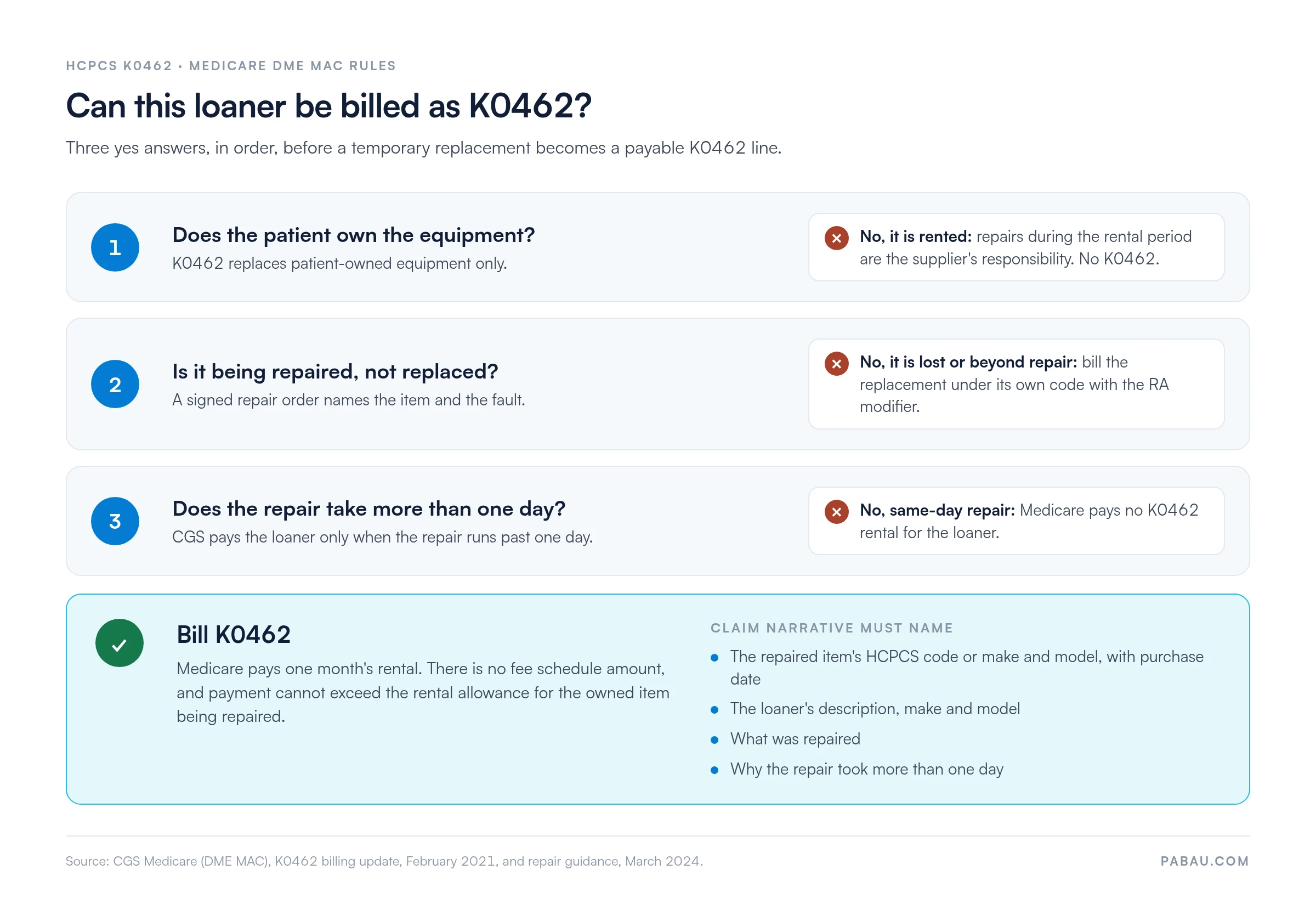
Decision chart for billing HCPCS K0462: the patient must own the equipment, it must be under repair rather than replaced, and the repair must take more than one day. Then Medicare pays one month's rental, capped at the rental allowance for the owned item, with a four-part claim narrative. Source: CGS Medicare.
A loaner becomes a payable K0462 line only after all three checks pass, and the narrative explains the repair. Rules from CGS Medicare, a DME MAC.
  • Medicare cost-sharing: Medicare Part B pays 80% of the allowed amount after the annual deductible. The beneficiary or their supplemental plan pays the remaining 20% coinsurance.
  • Rented equipment: Per CGS repair guidance, Medicare does not separately pay for repairs to a capped rental item during its rental period. The supplier covers that loaner, so K0462 applies only to equipment the patient owns.
  • Private payer variation: Commercial insurers that follow Medicare payment may reimburse K0462 at a percentage of the Medicare allowable. Others require prior authorization or use their own fee schedules. Obtain a coverage determination before providing the loaner to a commercial plan member.

Use the AAPC HCPCS code lookup or the PGM Billing HCPCS tool to check the current code status and coverage notes before you submit.

Common denial reasons for K0462 claims and how to avoid them

Most K0462 denials come from missing paperwork, an incomplete claim narrative, or billing the loaner and the owned item for the same dates. Reviewing denial management processes for DME helps teams catch these before submission.

Denial reasonPrevention step
Missing repair orderObtain and file a signed, dated repair order before the loaner is delivered. The date of service cannot precede the repair order date
Missing standard written orderConfirm the written order for the original equipment is on file and covers the same item category as the loaner
Incorrect or missing modifierApply KX when the LCD requires medical necessity attestation, and check payer-specific modifier rules before filing
Duplicate billing with original equipment codeDo not bill the original item’s HCPCS code for the same date range as K0462. The original equipment is under repair, not in active use
Unenrolled supplierVerify DMEPOS enrollment and accreditation status with the relevant DME MAC before billing any K-code claim
Incomplete claim narrativeName the repaired item and its purchase date, the loaner, what was repaired, and why the repair took more than one day

Pro Tip

Run a pre-submission checklist for every K0462 claim: repair order date, standard written order, loaner delivery ticket, claim narrative, and modifier selection. Catching one missing document before submission costs minutes, while chasing a denial costs days.

How to submit a K0462 claim: Step-by-step

Filing HCPCS Code K0462 follows the standard DMEPOS claim workflow. A few loaner-specific steps come before the claim reaches the DME MAC.

  1. Gather documentation. Collect the signed repair order, the standard written order for the original equipment, and the delivery ticket for the loaner. All three must predate or match the first date of service on the claim.
  2. Verify supplier eligibility. Confirm DMEPOS enrollment, NPI status, and accreditation are active with the relevant DME MAC. Use the PECOS enrollment database if needed.
  3. Select K0462 with the correct modifier. Apply KX if the LCD requires medical necessity attestation. Add the GA modifier and an Advance Beneficiary Notice (ABN) if coverage is uncertain. Do not apply NU or RA, which belong to purchase or permanent replacement scenarios.
  4. Populate the claim form. On the CMS-1500, enter K0462 in Box 24D, the loaner’s from/through dates in Box 24A, and the place of service code (typically 12 for home). On the 837P electronic transaction, map fields accordingly and include the NPI in the billing provider loop.
  5. Write the claim narrative. CGS requires four details. Name the repaired item’s HCPCS code or make and model with its purchase date, and describe the loaner. Then state what was repaired and why the repair took more than one day.
  6. Submit to the DME MAC. Route the claim to the correct MAC jurisdiction based on the beneficiary’s residence.
  7. Review the remittance advice. When the electronic remittance advice or EOB returns, check the claim adjustment reason codes. Two to know are CARC 4 (modifier inconsistent or missing) and CARC 50 (not medically necessary). A guide to decoding denial codes covers the rest. Appeal with the repair order and written order if the denial is based on a documentation reason code.

How claims management software keeps K0462 claims complete

A loaner claim usually draws on paper repair orders, delivery tickets and a separate billing portal. A missing order or a thin narrative only shows up when the remittance comes back denied.

Pabau, the practice management platform we build, keeps those documents on the patient record. US practices that bill insurance, including DME items, send CMS-1500 and 837P claims through Claim.MD. They run eligibility checks and receive ERA remittances in the same system. Its connected claims management also handles secondary claims.

A prior authorization’s code and dates sit on the patient’s case, with a warning when one is missing. That way, a K0462 claim leaves with its paperwork in place, and its remittance is reconciled where the claim was filed.

Manage DME billing documentation in one place

Pabau keeps repair orders, written orders and claim status on the patient record. Practices that bill insurance, including DME items, can file K0462 claims with the paperwork in place.

Pabau claims management dashboard

Conclusion

K0462 exists for one job: keeping a patient equipped while their own device is repaired. Treat the repair order as the anchor of the claim. When the order, the narrative and the claim dates describe the same repair, the claim holds up on review.

The trade-off is a few minutes at intake. Before the loaner leaves, confirm that the patient owns the item and that the repair will run past one day. Neither can be fixed on the claim afterward.

Book a demo to see how Pabau keeps repair orders, written orders and claim status together for practices that bill insurance, including DME items.

Continue your research

Continue your research

Need a broader grounding in DMEPOS billing? Medical billing fundamentals explains how claims move from service delivery to payment and where DME codes fit in the cycle.

Getting repeat denials on DME claims? Denial management in healthcare covers the structured workflow for appealing and preventing common DME MAC denials.

Want to improve first-pass claim accuracy? Submitting a clean claim walks through the data elements, modifier rules, and edit checks that keep DMEPOS claims out of the rejection queue.

Tracking the equipment your patients own? Durable medical equipment list records each item’s category, HCPCS code, and coverage status in one reference.

Frequently asked questions

What does HCPCS Code K0462 cover?

HCPCS Code K0462 covers temporary replacement durable medical equipment provided to a patient while their owned DME is undergoing repair. It applies to any equipment type, such as powered wheelchairs, hospital beds and scooters. The loaner must be a like-for-like substitute, and a repair order for the original item must be on file.

What modifiers are used with K0462?

The KX modifier is the most commonly required modifier for K0462 on Medicare claims. It attests that medical necessity documentation is on file. The GA modifier applies when an Advance Beneficiary Notice is in place and coverage is uncertain. RR may apply when the loaner arrangement is structured as a rental. NU and RA are not used with K0462.

Does Medicare cover K0462?

Yes. Medicare Part B covers a K0462 loaner under the DMEPOS benefit when the supplier is enrolled and the patient owns the equipment. The repair must also take more than one day. Medicare then pays one month’s rental, capped at the rental allowance for the owned item. Local Coverage Determinations from the relevant DME MAC may add criteria for particular equipment types.

Can K0462 and the original equipment code be billed at the same time?

No. The original equipment is under repair, so it must not be billed as if in active use during the same dates as K0462. Billing both codes for overlapping dates is a duplicate-billing flag and a common audit trigger. Bill K0462 only for the dates the loaner is in the patient’s possession.

Why are K0462 claims denied?

The leading denial reasons are a missing repair order or standard written order, and an incorrect or omitted modifier, most often KX. Billing the original equipment code for the same dates is another. An incomplete claim narrative and supplier enrollment issues also cause denials. Resolving these before submission prevents most K0462 denials.

How long can K0462 be billed during a repair period?

Medicare pays one month’s rental for the loaner when the repair takes more than one day, up to the rental allowance for the owned equipment. The claim dates must match the repair period in the repair order. The claim narrative must also explain why the repair took more than one day.
Tanja Lepcheska
Content Writer

Tanja is a Senior Content Writer who has a skill to turn complex med spa topics into easy, engaging reads that actually make sense. She loves helping clinic owners feel confident about growing their business. When she’s not writing, you’ll probably find her rewatching her favorite romantic movies, working on a new crochet project, or rearranging her home decor “just one more time.”
×