HIPAA compliant texting: What you can send patients & how to communicate securely
HIPAA compliant texting is possible when a text holds no protected health inform...

Last Updated: Oct 16, 2026

Medical billing compliance means submitting claims that follow federal law, state law, and the payer contracts you signed.
Four federal laws carry most of the risk: the False Claims Act, the Anti-Kickback Statute, the Stark Law, and HIPAA.
Upcoding, unbundling, duplicate and phantom billing, and medical-necessity misrepresentation are the patterns that trigger audits.
False Claims Act penalties run from $14,308 to $28,619 per claim, plus up to three times what the program lost.
The OIG’s seven compliance elements scale down to a solo practice, and the checklist below shows exactly how.
A printable checklist mapped to the OIG’s seven compliance elements and scaled for a practice of one to ten people. Covers your written billing policy, the named compliance contact, training records, monthly claim self-audits, exclusion-list screening, and the correction-and-repayment steps.
Download templateMedical billing compliance means billing only for what you did, documented as you did it, in the way federal law and payer contracts require. Get that right and an audit is paperwork. Get it wrong as a habit and it becomes an enforcement matter. Cosmetic treatments are usually self-pay, but a practice offering both can still use our med spa management software comparison for charting and checkout.
The Justice Department recovered more than $6.8 billion in False Claims Act settlements and judgments in the fiscal year ending September 30, 2025. Over $5.7 billion of that involved health care. Whistleblowers filed 1,297 of those cases, the most in a single year.
Those numbers are less frightening than they look. What gets prosecuted is almost always a pattern, and for an honest practice compliance is mostly documentation discipline. But not knowing a rule has never been a defense. This article is general guidance rather than legal advice, so have a healthcare attorney or a certified coder review your own billing.
Four federal laws carry most of the billing risk for a small practice. Every state also has its own insurance fraud statute, which reaches private-payer claims that federal law does not touch.
| Law | What it prohibits | A billing example | Penalties |
|---|---|---|---|
| False Claims Act | Knowingly submitting a false claim to a federal program, including through reckless disregard | Billing a 45-minute visit for a patient seen for 15 | $14,308 to $28,619 per claim, plus up to three times the program’s loss |
| Anti-Kickback Statute | Offering or taking anything of value for referrals of federally reimbursable care | Paying a wellness partner a fee per patient sent to you | Up to $100,000 and 10 years in prison, plus civil penalties up to $127,973 per act |
| Stark Law | A physician referring designated health services to an entity they have a financial tie to | Referring Medicare physical therapy to a practice your spouse owns | Up to $31,670 per claim, and up to $211,146 for circumvention schemes |
| HIPAA | Unsecured protected health information, and electronic claims that ignore the required standards | Emailing an outside biller a spreadsheet of patient names and balances | $145 to $73,011 per violation, up to $2,190,294 a year |
The False Claims Act is the law behind most billing cases. It prohibits knowingly presenting a false or fraudulent claim for payment to the federal government. “Knowingly” covers actual knowledge, deliberate ignorance, and reckless disregard, and no intent to defraud is required.
Each item or service billed counts as its own claim, so a coding habit multiplies quickly. One mis-billed drug line repeated weekly, such as J9070 on a chemotherapy day, becomes dozens of claims in a quarter. The law also lets any employee, patient, or former partner sue on the government’s behalf for a share of the recovery.
The Anti-Kickback Statute makes it a felony to knowingly offer, pay, solicit, or receive anything of value in return for referrals of federally reimbursable business. Remuneration means anything of value, including cash, free rent, discounted equipment, or a cut of the fee.
This is the one that catches aesthetic practices with referral arrangements. A per-patient payment to a partner practice is the classic problem, and a claim tainted by a kickback is also a false claim. Statutory exceptions and safe harbors exist, but protection only applies when an arrangement meets every condition.
The Stark Law bars a physician from referring designated health services payable by Medicare to certain entities. The bar applies where the physician or an immediate family member has a financial relationship with that entity, unless an exception applies. It is strict liability, so intent is irrelevant.
Designated health services include clinical laboratory work, physical therapy, imaging, and outpatient prescription drugs. A cosmetic-only practice rarely touches any of them. A hybrid practice adding physical therapy or lab work should check the rules before it refers.
HIPAA does two separate jobs in billing. The Privacy and Security Rules govern how protected health information, known as PHI, is stored and shared, and the Office for Civil Rights enforces them.
The Administrative Simplification rules set the required format and content for electronic claims and related transactions, and CMS enforces those. A professional claim travels to the payer as an 837 file. Submit claims electronically and you are a covered entity, so both sets apply to you.
These are the patterns payers and auditors watch for. Each has an innocent version and a deliberate version, and the documentation is what separates them.
The same treatment can be a covered medical service or an uncovered cosmetic one, and the chart is what decides. Nothing about the treatment itself settles the question.
Medicare excludes cosmetic surgery, which it defines as any procedure aimed at improving appearance. The exceptions are prompt repair of an accidental injury and improvement of the function of a malformed body member. Separately, federal payment is limited to services that are reasonable and necessary for diagnosing or treating illness or injury. Commercial plans copy both ideas closely. Denials on a code repeat until someone spots the pattern, and denial tracking software is where that pattern shows.
So the temptation is easy to describe. A patient wants a treatment you offer, their plan will not pay for the cosmetic version, and a payable diagnosis code exists.
Choosing that code because it pays, rather than because the record supports it, is a false claim. It is also among the easiest things for an auditor to catch, because the note will not match. Injury codes carry the same exposure in their seventh character, so S62.630K claims a nonunion the record has to show. External cause coding adds a sequencing rule, since W18.11XS can never be the first diagnosis and the note has to date the fall. Where coverage is genuinely arguable, a medical necessity letter puts your reasoning on the record.
| Treatment | Potentially billable when the record shows | Cash-pay when |
|---|---|---|
| Botulinum toxin | A documented diagnosis such as chronic migraine, with the treatment history the plan requires | The goal is softening lines, however the patient words it |
| Eyelid surgery | Visual field testing showing the lid obstructs vision, supported by photographs | The complaint is tired-looking eyes |
| Laser skin treatment | Treatment of a diagnosed condition, such as a vascular lesion, documented at the visit | The aim is tone, texture, or general rejuvenation |
| Rhinoplasty | A documented functional problem, such as a deviated septum obstructing breathing | The aim is reshaping for appearance |
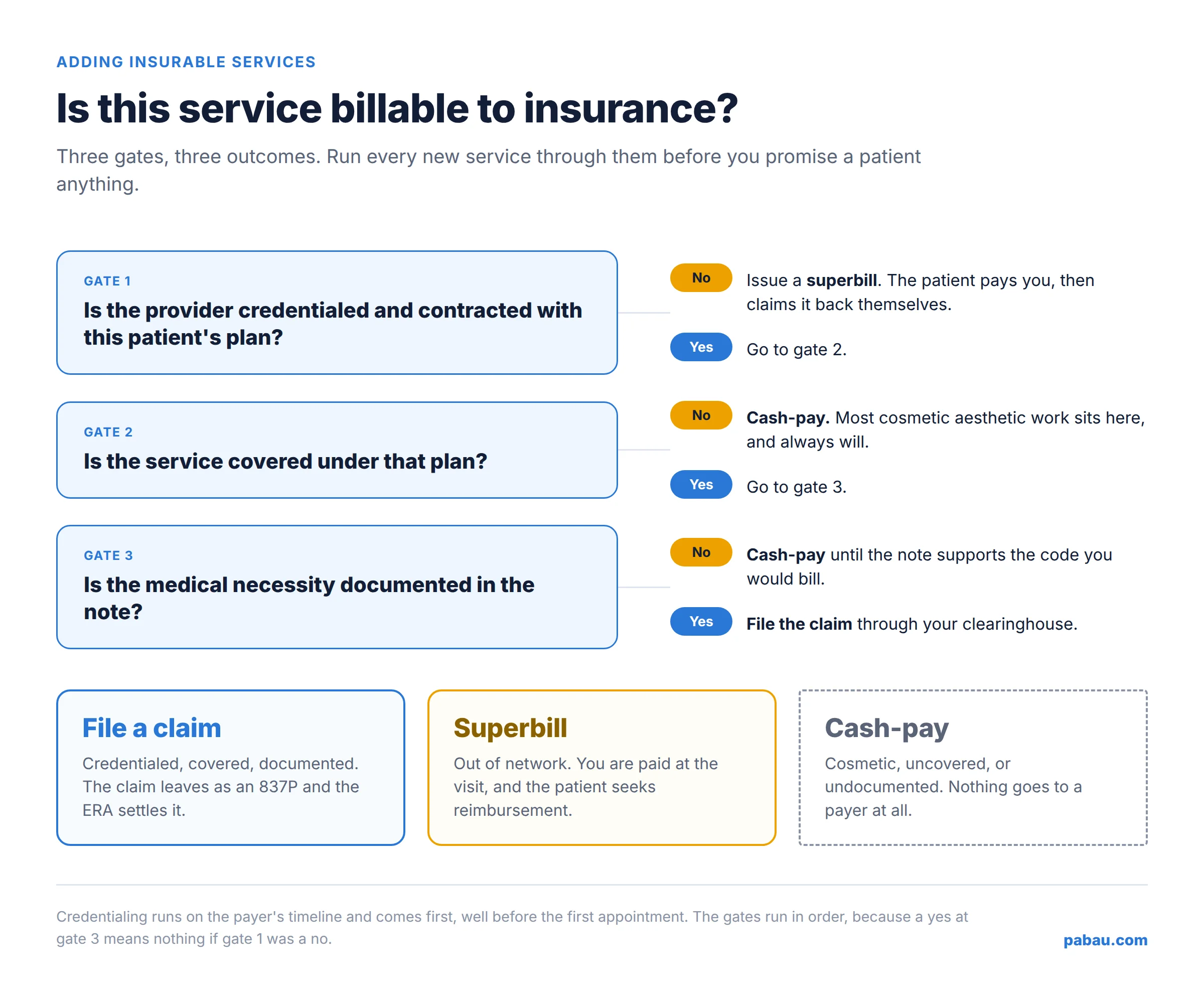
Every row in that table comes down to the same rule. The documentation decides, and it has to exist before the claim goes out, not after a denial arrives. A sequela code such as S63.615S makes the same demand, because it says you are treating what the injury left behind. Two earlier gates matter as well. You have to be credentialed with the payer, and any prior authorization has to be on file before treatment.
Insurers outside the US apply that test too. A ptosis correction billed as C1813 reads as cosmetic to many UK private insurers unless the record shows the lid affects vision. Surgery turns on the operative note in the same way, so billing 49507 for a hernia the note calls reducible is upcoding.
An ENT claim in the UK hangs on one line of the note. The CCSD code D1530 covers a myringotomy only when the record confirms that no ventilation tube was placed. If a tube stays in, the claim becomes D1510, so bill the procedure performed, not the one authorized.
Superbills carry the identical obligation carry the identical obligation. Because you do not file one yourself, a superbill can feel like lower stakes. It is a statement your patient submits to their insurer on the strength of your codes and signature. Inflated codes on one are still a false statement, and your patient carries the consequences alongside you.
Which leaves the conversation nobody enjoys having. Verify the patient’s coverage first, then tell them before treatment which parts their plan may pay for and which parts they pay themselves. Record that in writing. A patient who hears “we’ll code it so it goes through” is a patient who can report you later.
The Office of Inspector General, known as the OIG, published its General Compliance Program Guidance in November 2023. It applies to everyone in the health care industry and replaced the practice of issuing compliance guidance through the Federal Register. The guidance is voluntary, and it says small entities should right-size the seven elements rather than skip them.
| OIG element | At a hospital | In a small practice |
|---|---|---|
| 1. Written policies and procedures | A code of conduct plus a versioned policy library | A two-page billing policy covering code selection, documentation, and corrections |
| 2. Compliance leadership and oversight | A full-time compliance officer, a committee, and board reporting | One named compliance contact who reports to the owner each quarter |
| 3. Training and education | An annual curriculum with tracked completion | Coding and documentation basics at onboarding, plus one refresh a year |
| 4. Effective lines of communication | An anonymous hotline and a formal disclosure program | A written open-door rule, a no-retaliation promise, and the OIG Hotline posted |
| 5. Enforcing standards | A graduated discipline matrix | Consequences agreed in writing before anything goes wrong |
| 6. Risk assessment, auditing, and monitoring | A risk-based audit plan run by internal audit | An annual risk review, a monthly sample of claims checked against notes, monthly exclusion-list screening |
| 7. Responding to detected offenses | An investigations function and corrective action tracking | A named decision-maker, a written correction procedure, and repayment inside 60 days |
The OIG’s own floor for a small entity is one risk assessment and one claims audit a year. The monthly sample of five to ten claims is our addition, run as a small chart audit. Pull the high-dollar lines first, since a biologic such as J1442 costs more to get wrong than a full day of office visits. Ten minutes a month catches a drifting coding habit while it is still a handful of claims.
Element seven is where a mistake becomes an exposure. Federal law requires you to report and return a Medicare or Medicaid overpayment within 60 days of identifying it. You have identified an overpayment once you knowingly received or retained it, using the False Claims Act’s knowledge standard. That standard includes deliberate ignorance and reckless disregard.
The clock can pause for up to 180 days while you investigate in good faith whether related overpayments exist. Keeping the money past the deadline creates False Claims Act liability by itself, separately from whatever caused the original error.
No software makes a practice compliant. The seven elements above describe habits, not features. What a system can do is remove the failure points that come from re-typing the same information in three places. Those failure points look the same in a med spa and in a physical therapy practice.
Practice management software like Pabau keeps maintained CPT and ICD-10 catalogs built in. Codes get searched rather than remembered, or copied across from last year’s cheat sheet. Diagnoses on a claim populate automatically from the active Problems documented on the client’s record. That keeps the chart and the claim saying the same thing, which is what an auditor checks.
Claims are validated before they leave, through our integration with the clearinghouse Claim.MD. Every claim then carries its own activity history covering submissions, corrections, and denials. Run a monthly self-audit, or field a payer question about a March claim. The answer sits on the record rather than in someone’s inbox.
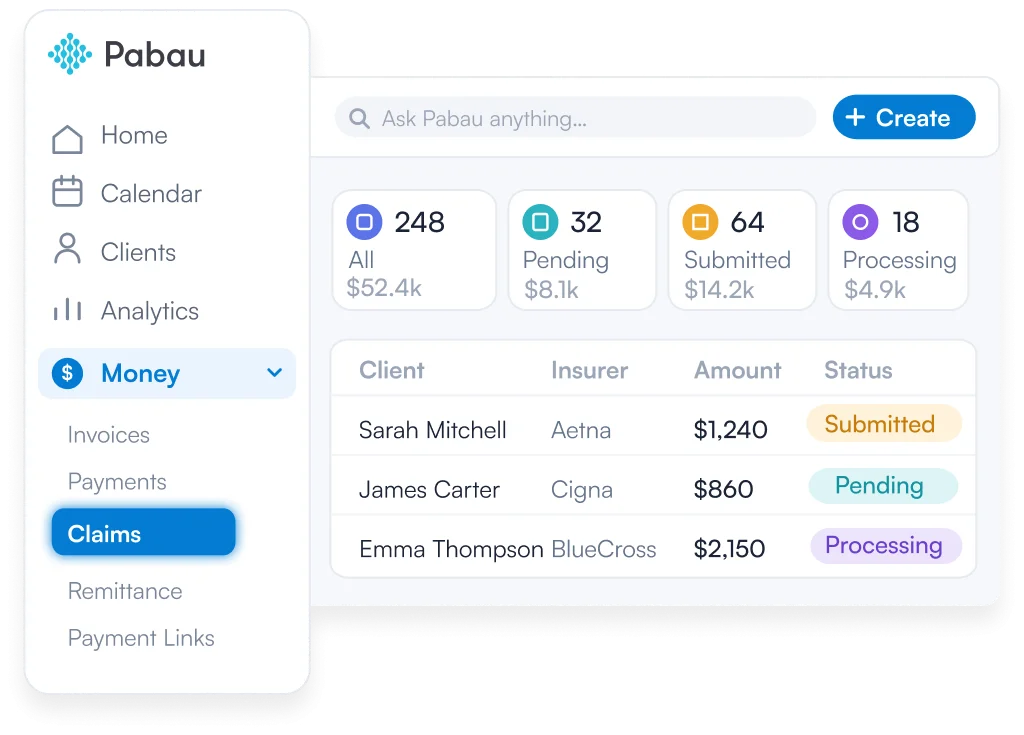

Pabau builds claims from documented client records, with maintained CPT and ICD-10 catalogs, pre-submission validation through Claim.MD, and a full activity history on every claim. That gives your self-audits and payer requests one place to start.

Compliance has a reputation as a brake on billing. It works the other way around. When the note supports every code you send, you can bill confidently for everything you actually did. An audit then becomes an afternoon of paperwork instead of a threat.
The trade-off worth remembering is that this only works in advance. A program assembled after a payer letter arrives buys you very little. Written down beforehand, the same program is a few hours of work and a monthly habit.
Start with the checklist above, name someone to own it, and put the first self-audit in the calendar. Book a demo to see how Pabau keeps documentation, coding, and claims on one record for practices billing insurance.

New to submitting claims at all? Medical claims clearinghouse explains how a claim travels from your practice to the payer and back.
Working a pile of denials? Denial management in healthcare gives you a five-step process for recovering the claims you already submitted.
Want the bigger picture? Revenue cycle management shows where billing compliance sits in the run from booking to payment.
Coding nerve damage from another condition? Mononeuropathy coding guide explains why the underlying disease is sequenced first and G59 comes second.
Need the deadlines that go with the rules? Timely filing limits by payer lists the filing and appeal windows per payer.
Medical billing compliance is billing in a way that follows federal law, state law, and your payer contracts. In practice it means every code you submit is supported by documentation created at the time of the visit. The four federal laws that matter most are the False Claims Act, the Anti-Kickback Statute, the Stark Law, and HIPAA.
Seven elements come from the OIG’s General Compliance Program Guidance. They are written policies and procedures, compliance leadership and oversight, training and education, and effective lines of communication. The last three are enforcing standards, risk assessment with auditing and monitoring, and responding to detected offenses. The checklist above scales each one for a small practice.
If it isn’t documented, it wasn’t done, so bill only what the record supports. Every other billing rule follows from that one. A useful test is to ask whether an auditor reading only your note would arrive at the code you submitted.
The practice that submits the claim is responsible, even when an outside billing company prepared it. Outsourcing the work does not outsource the liability, and the OIG treats the owner as ultimately accountable. That is why a named compliance contact and a monthly claims sample matter, whoever presses submit.