CCSD code H4430: Examination of rectum under anaesthetic
CCSD code H4430 pays for the examination alone CCSD code H4430 is the UK private...

Last Updated: Oct 20, 2026
K0848 is the HCPCS Level II code for power wheelchair, group 3 standard, sling/solid seat/back, patient weight capacity up to and including 300 pounds.
DME suppliers, medical billers, and healthcare administrators use this code when billing Medicare and other payers for this category of power mobility device.
The code sits within the K-series of HCPCS Level II codes. The Centers for Medicare and Medicaid Services (CMS) maintains those codes for items that CPT does not cover. Classification decides the payment rule that follows, so it is the first thing to confirm on a DME claim.
Group 3 power wheelchairs are designed for patients who cannot use a manual wheelchair or a lower-group power chair due to their medical condition. The "standard" designation in K0848 refers to a sling or solid seat and back configuration. Rehab and complex seating options carry different codes.
Let Pabau's smart automation suggest the right codes, reduce claim denials, and keep your practice compliant—effortlessly.
Automate repetitive tasks and focus on what matters most—your patients.
Reduce coding errors and ensure compliance with the latest regulations.
Clean claims, fewer denials, and faster reimbursements.
Powerful insights and reporting to help your practice thrive.
HIPAA compliant SOC 2 certified GDPR-compliant Trusted by 4,000+ clinics worldwide

HCPCS Code K0848 covers a group 3 standard power wheelchair with sling or solid seat and back, for patients up to 300 lbs.
Medicare requires a face-to-face mobility examination within 6 months before the order date, a Standard Written Order Prior to Delivery (WOPD), and prior authorization.
Power mobility devices do not use a Certificate of Medical Necessity. CMS removed the CMN for PMDs in 2005 and retired the last remaining CMN forms in 2023.
Group 3 coverage also requires a neurological condition, myopathy, or congenital skeletal deformity, plus a specialty evaluation by a PT, OT, or trained practitioner.
Missing the KX modifier when documentation requirements are met is one of the most common reasons K0848 claims are denied. RR is required for rental billing.
Practice management software like Pabau tracks the documentation, prior authorization status, and superbill detail these claims depend on.
Medicare covers HCPCS Code K0848 under its DME benefit when the patient meets specific medical necessity criteria. Coverage is not automatic. The treating physician must document that the beneficiary’s mobility limitation cannot be adequately addressed by a cane, walker, or manual wheelchair.
CMS coverage policy and the CGS group 3 documentation checklist for K0848 through K0855 set the conditions. All of the following must be satisfied:
Medicare Advantage plans generally follow traditional Medicare coverage criteria for power wheelchairs, but individual plan policies can vary. Always verify prior authorization requirements directly with the specific MA plan before supply.
Incomplete documentation is the leading cause of K0848 claim denials. Before you submit a claim, every required document must be present, correctly completed, and on file. Each item also carries a date the MAC can check against the order, so the sequence matters as much as the paperwork.
Power mobility devices do not use a Certificate of Medical Necessity, and K0848 never has. CMS eliminated the CMN for power mobility devices effective October 25, 2005, under the conditions-of-payment rule at 42 CFR 410.38. K0848 and the rest of the group 3 code set became effective on November 15, 2006, well after that date.
CMS then retired the last remaining CMN and DIF forms across DME on January 1, 2023, in MLN article SE22002. Claims submitted with CMN data elements are now rejected. Any K0848 checklist that still asks for a CMN is working from guidance that expired years ago.
What K0848 does require is the Standard Written Order Prior to Delivery, once known as the seven-element order. That legacy name is superseded, so use WOPD in current workflows. The supplier must hold the WOPD on file before the chair is delivered.
The WOPD carries the beneficiary’s name and MBI, the order date, a description of the item, and the quantity. It also names the practitioner, gives their NPI, and carries their signature. The practitioner who performed the face-to-face mobility examination is the one who must write it.
Prior authorization is required for HCPCS Code K0848 under traditional Medicare. CMS implemented mandatory prior authorization for certain power mobility device codes, and K0848 is on that list. Claims submitted without prior authorization approval are denied.
Confirm eligibility and authorization status before the chair leaves your warehouse. Missing this step is one of the most avoidable denial causes in DME billing. Keep the approval number with the order, because a claim submitted before the decision arrives will not be paid.
The DME MAC that covers the beneficiary’s state is set by jurisdiction. Jurisdictions B and C are administered by CGS Administrators, while Jurisdictions A and D are administered by Noridian Healthcare Solutions. Both publish local coverage determinations (LCDs) that set the specific criteria for K0848 coverage in their regions.
Medicare reimbursement rates for HCPCS Code K0848 vary by DME MAC jurisdiction and are updated annually. The rates below reflect fee schedule figures. K0848 is priced under the DMEPOS fee schedule, not the Physician Fee Schedule. Verify current amounts there, or in your MAC’s own fee schedule lookup tool.
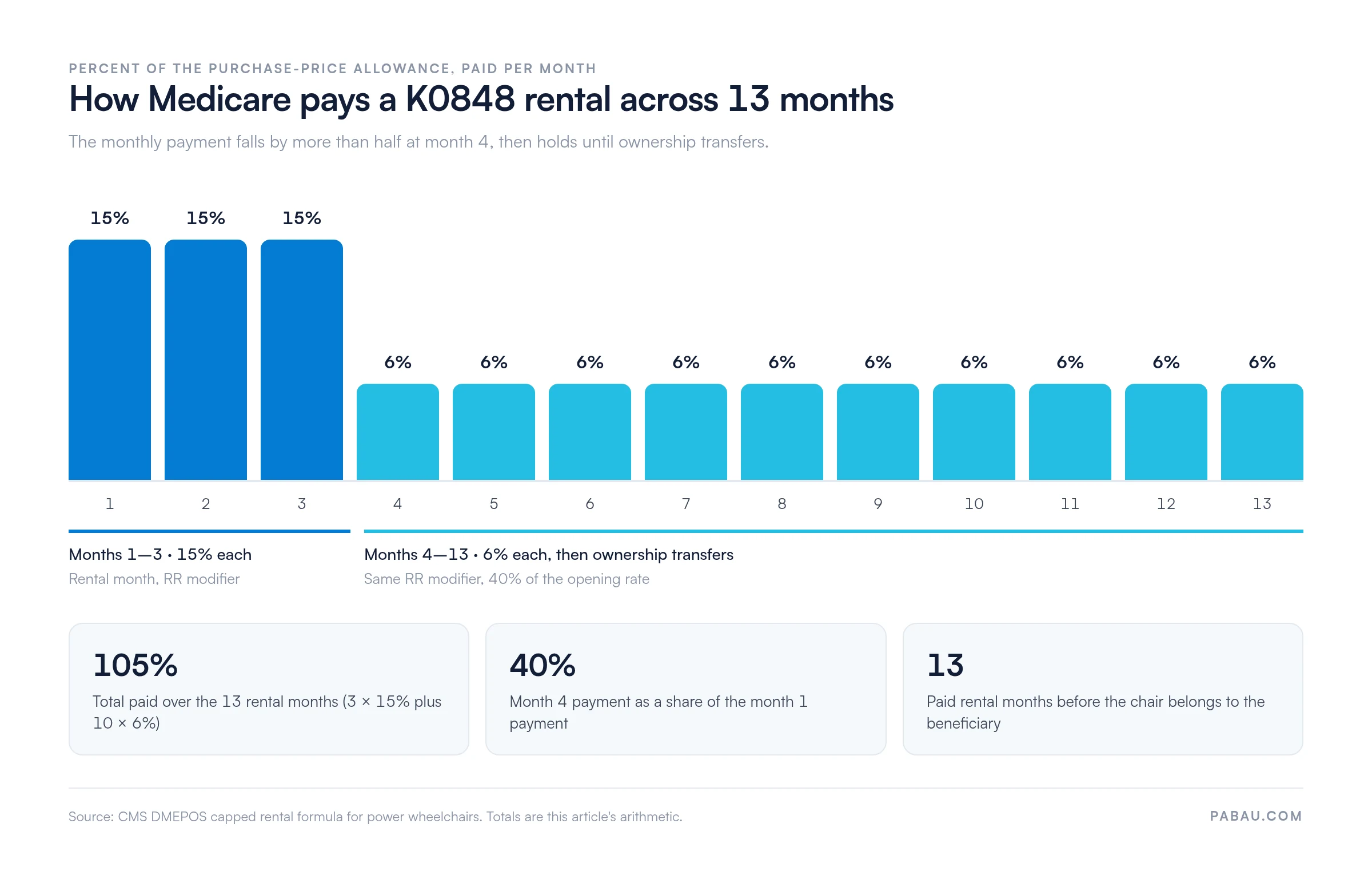
K0848 is billed under the capped rental benefit for Medicare. Medicare pays a monthly rental amount for up to 13 months, and ownership transfers to the beneficiary after the 13th paid month. The supplier services the device throughout the rental period. Power wheelchairs use their own payment formula.
Medicare pays 15% of the purchase price allowance for months 1 through 3, then 6% for months 4 through 13. The month 4 payment is 40% of what months 1 through 3 paid, so the revenue curve drops early and then stays flat.
Confirm K0848 rates on the DMEPOS fee schedule for your jurisdiction, or in your MAC’s fee schedule lookup tool, before you bill. Rates vary by locality and change each January 1. Never rely on prior-year figures for active claims.
Correct modifier usage is one of the most technically demanding parts of billing HCPCS Code K0848. Each modifier carries a distinct meaning, and using the wrong one will result in automatic denial. Think of modifiers as attestations: you are telling the MAC exactly what you are billing and why it qualifies.
The KX modifier is the most critical. Its absence signals to the MAC that documentation requirements have not been met, triggering automatic denial.
Bill KX on every K0848 claim where your file is complete, and never bill it speculatively. When a denial does come back, the remittance carries a reason code. Our guide to denial codes explains what each one is asking you to fix.
K0848 has a higher denial rate than most DME codes because of its documentation-intensive requirements. Most errors are preventable. Strong revenue cycle management starts with knowing exactly where these claims break down.
Selecting the wrong power wheelchair code is a common and avoidable billing error. These codes are separated by group, seat and back configuration, weight capacity, and the number of power options.
Use the comparison table below to confirm K0848 is the correct code before billing. The AAPC HCPCS code lookup is a quick way to read the full description of an adjacent code.
The most common code-selection error is billing K0848 for a patient whose weight exceeds 300 pounds. The group 3 alternatives are K0850 for 301 to 450 lbs, and K0852 for 451 to 600 lbs. A weight-based code error is not a modifier problem. It needs a corrected claim carrying the right code.
DME billing for codes like HCPCS Code K0848 means tracking several documentation deadlines at once. Prior authorization approvals, the 6-month face-to-face window, WOPD signature dates, specialty evaluation records, and rental billing milestones all run in parallel.
Letting any one slip means a denied claim or a corrected-claim workflow that costs staff time and delays reimbursement.
Practice management software like Pabau keeps those dates on one record. Pabau’s streamlined claims management software tracks claim status, flags outstanding documentation, and builds superbills with the code-level detail DME MACs expect. Your team spends less time reconstructing a file after a denial.
DME billing does not sit apart from the rest of a practice’s operations. When documentation, scheduling, and billing run on one record, the omissions that cause K0848 denials surface before the claim goes out.
Build a K0848 documentation checklist into your intake workflow. Track the face-to-face exam date, WOPD signature date, specialty evaluation, home assessment, ATP appraisal, prior auth approval number, and delivery confirmation. Cross-checking each item before submission catches most denial-causing errors before a claim reaches the MAC.

Pabau’s claims management tools help DME suppliers track documentation requirements, manage prior authorization timelines, and generate clean claims for codes like HCPCS K0848. See how it fits your billing workflow.

Every K0848 requirement carries a date: the face-to-face exam, the written order, the prior authorization decision, and the delivery. Claims fail when those dates fall out of order, which is a scheduling problem more than a clinical one.
So build that sequence into the workflow before the next order arrives. A supplier who can show the exam date, the WOPD, the specialty evaluation, and the authorization number on one screen passes review. The chair still has to match the patient’s weight and seating needs, but the paperwork is where the money is won or lost.
Is your team billing K0848 and related DME codes? Book a demo to see how Pabau tracks documentation deadlines and claim status from order to reimbursement.

Need to understand DME billing fundamentals before tackling K0848? Medical billing explained covers the full claims lifecycle from patient intake to payer reimbursement.
Struggling with claim denials on your HCPCS codes? Denial management in healthcare outlines the most common denial categories and how to build a systematic appeals workflow.
Want a framework for keeping DME billing compliant? Medical billing compliance guide covers payer requirements, audit preparation, and documentation standards for DME and clinical practices.
Want every claim to go out right the first time? What a clean claim looks like walks through the fields payers check before they pay.
Checking coverage before you deliver equipment? Insurance eligibility verification explains what to confirm with the payer before an order is written.
HCPCS Code K0848 bills Medicare and other payers for a power wheelchair, group 3 standard, with a sling or solid seat and back. It applies to patients with a weight capacity up to and including 300 pounds. DME suppliers use the code once the physician has documented that the patient cannot safely use a manual wheelchair or a lower-group power chair. That limitation must affect mobility-related activities of daily living in the home.
Medicare reimbursement rates for K0848 vary by DME MAC jurisdiction and change each January 1. K0848 is priced under the DMEPOS fee schedule, not the Physician Fee Schedule, so check current rates there or in your MAC’s lookup tool. As a capped rental item, Medicare pays a monthly amount for up to 13 months. Power wheelchairs are paid at 15% of the purchase price allowance for months 1 through 3, then 6% for months 4 through 13.
Yes, HCPCS Code K0848 requires prior authorization under traditional Medicare before the item is delivered. Claims submitted without an approved prior authorization will be denied. Medicare Advantage plans also require prior authorization for this code, though their forms and timelines vary by plan. Always contact the specific MAC or MA plan and obtain written approval before delivery.
Billing K0848 requires a face-to-face mobility examination within 6 months before the order date. The same practitioner must then issue a Standard Written Order Prior to Delivery (WOPD). You also need supporting medical records documenting the mobility limitation, a group 3 specialty evaluation, and an on-site home assessment. The file must also hold the ATP appraisal, prior authorization from the DME MAC, and proof of delivery. Power mobility devices do not use a Certificate of Medical Necessity.
The KX modifier is required on every K0848 claim to attest that LCD documentation requirements have been met. RR (rental) is used during the 13-month capped rental period, and NU (new equipment) applies when the beneficiary purchases the item outright. MS is used for the 6-month maintenance and servicing period after ownership transfer. GA is added when an Advance Beneficiary Notice is on file and denial is anticipated.
K0848 specifically covers a group 3 standard power wheelchair with a sling or solid seat and back for patients up to 300 lbs. Adjacent codes differ by seat type, weight capacity, or seating system. K0849 uses a captains chair rather than sling/solid. K0850 covers 301 to 450 lbs and K0852 covers 451 to 600 lbs. Rehab codes have more complex, custom-fitted seating. Selecting the wrong code based on patient weight or seat configuration requires a corrected claim.
The WOPD is the written order a supplier must hold before delivering a K0848 power wheelchair. It carries the beneficiary’s name and MBI, the order date, a description of the item, the quantity, and the practitioner’s name, NPI, and signature. The practitioner who performed the face-to-face mobility examination is the one who writes it. Power mobility devices do not use a Certificate of Medical Necessity. CMS eliminated the CMN for PMDs in 2005 and retired the last CMN and DIF forms in January 2023.