Free patient financial agreement template for practices
A financial agreement is the form a patient signs before treatment to confirm wh...

2
Last Updated: Oct 23, 2026
What is medical billing? Medical billing is the process of turning a patient visit into a claim, sending it to the insurer, and collecting from payer and patient. The medical billing process spans the revenue cycle, from checking coverage before the visit to posting the final payment.
Denials are the main risk. ACA marketplace insurers denied an average of 17% of in-network claims in 2021, according to a KFF analysis. Reworking one claim costs a practice more than $25 in staff time, based on industry reports collected by Physicians Practice.
That definition assumes the practice bills insurers. Many aesthetic, wellness and private practices are self-pay or hybrid. This guide also maps the payment-model split, showing which billing stages a cash-pay practice still runs. It closes with the five numbers that tell you whether billing is working.

Medical billing turns a patient visit into a claim, then follows it until the payer and the patient have both paid.
The medical billing process runs in eight stages, from registration and eligibility checks to payment posting and appeals.
Coders translate the clinical note into CPT, ICD-10-CM and HCPCS codes, and billers turn those codes into a paid claim.
The stage-by-stage failure check pairs each stage with its usual failure, the check that stops it, and the metric that exposes it.
Denial rate, clean claim rate, days in A/R and net collection rate show whether billing works, and MGMA puts first-submission denials at 8%.
Medicare allows 12 months from the date of service to file a claim, and commercial payers set their own windows by contract.
Every denial carries a CARC on the remittance, which tells you whether to correct the claim, appeal it or rebill another plan.
The payment-model split decides your workload, because a self-pay practice skips clearinghouse submission, adjudication and payer denials.
Medical billing is how a practice gets paid for care it has already delivered, by turning each visit into a claim and collecting the balance. The work covers coverage checks, coding, claim submission, payment posting and denial follow-up.
In simple terms, medical billing does three jobs. Billing gets the payer to pay its share, gets the patient to pay theirs, and keeps a record of both.
The patient’s share comes from the plan’s cost-sharing rules. A copay is a flat fee per visit. A deductible is the amount the patient pays before the plan contributes, and coinsurance is the percentage they pay after that.
One step comes before any claim. A provider has to be credentialed and enrolled with each payer it bills, and payer enrollment can take weeks. Until enrollment is approved, claims to that payer are denied however clean they are.
Geography changes the paperwork rather than the purpose. US practices work to Medicare, Medicaid, and commercial insurance rules. Private practices in the UK bill private medical insurers using CCSD codes. A deeply placed peripheral nerve release, for example, bills as A6600. A ptosis correction using the patient’s own fascia lata bills as C1813.
The same CCSD schedule covers ear, nose, and throat surgery. Clearing multiple bony exostoses from the ear canal bills as D0280.
The medical billing process runs in eight stages, from registering the patient and checking coverage to posting payment and working denials. Stages one and two are front-end billing, the work that happens around the patient. Coding onward is back-end billing.
Because the medical billing process runs in a fixed order, slow cash is diagnosable. When collections drag, one specific stage is usually responsible, and the flow chart below shows how medical billing works from end to end.
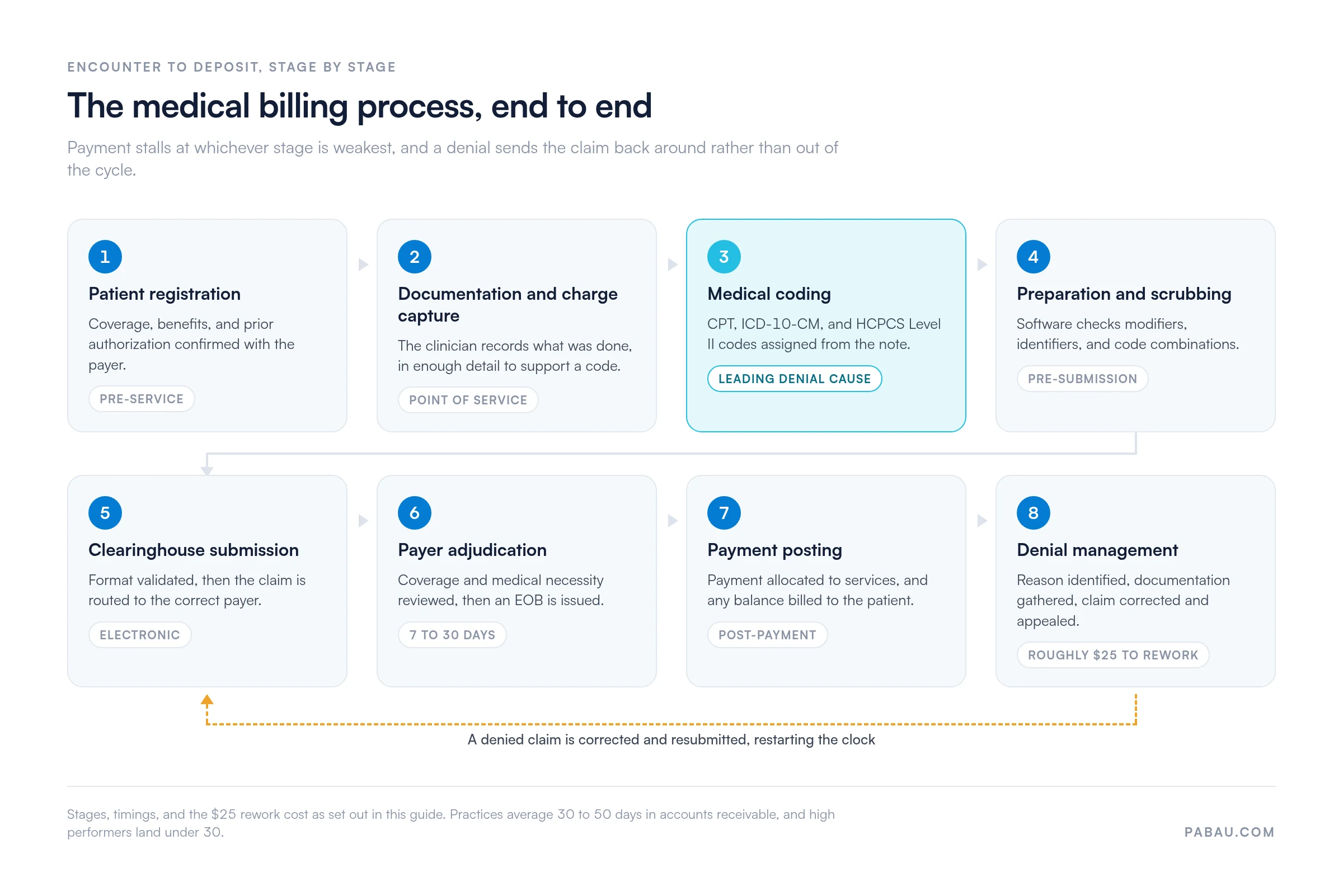
The eight stages, in order:
Before the appointment, staff collect demographic and insurance details and run an eligibility check with the payer. The check confirms the plan is active and the provider is in-network. It also returns the deductible, copay and coinsurance that will apply.
Re-verify at every visit, and always after a new plan year or a job change. Either one can move the patient onto a new plan without anyone telling the front desk.
Prior authorization belongs at this stage too. Some payers require approval before imaging, injectables or surgery. A claim for an unauthorized service is denied even when the treatment was medically necessary.
During the visit, clinicians record diagnoses, treatments, and procedures in the patient’s medical record. That documentation has to support every code billed, and every billable service has to be captured as a charge.
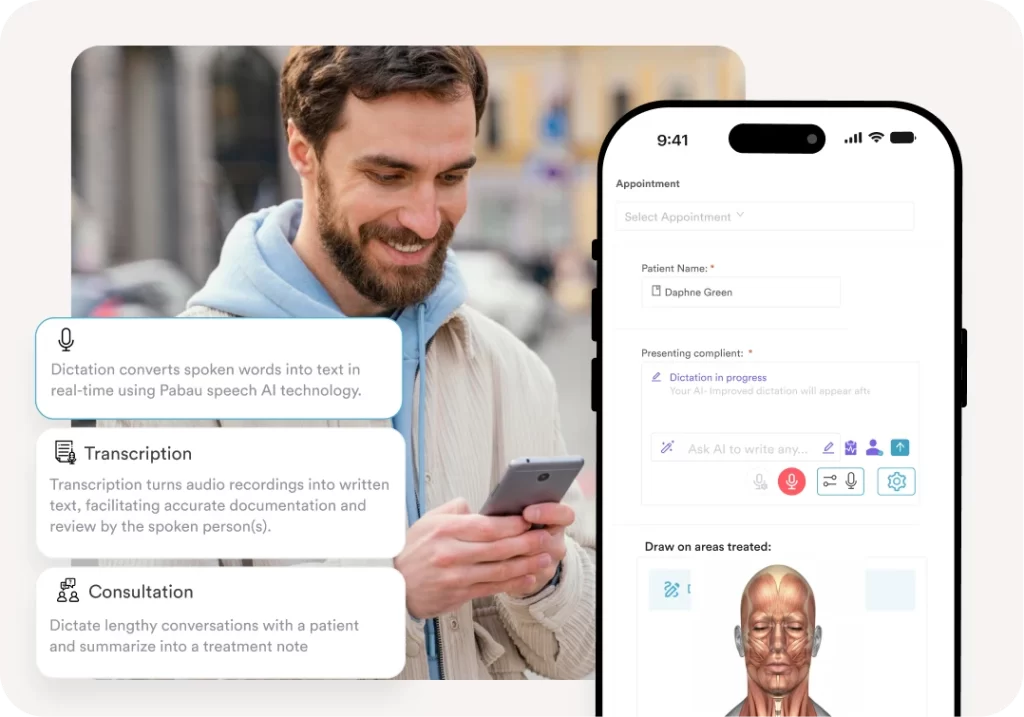
Vague or incomplete notes lead to downcoding, which means billing a lower-level service than the one performed. They also produce outright denials. Many practices now use an AI scribe to capture the detail while the patient is still in the room.
Coders translate the clinical notes into standardized codes. CPT codes describe procedures and services, and ICD-10-CM codes identify diagnoses. HCPCS Level II codes cover supplies, drugs, and equipment. A power wheelchair billed as K0856 is a HCPCS line rather than a CPT one.
The codes then have to agree with each other. Payers scrutinize medical necessity hardest, because the diagnosis code is what justifies the procedure. A lumbar facet injection under 64493 fails that test without a documented pain history. The code-set table further down gives a sample code for each system.
Only assign codes the documentation explicitly supports. If a note says “patient presents with knee pain” but records no exam findings, history, or duration, a higher-level evaluation code invites audit scrutiny. Build a short clinician checklist covering chief complaint, history, exam, assessment, and plan. Then tie your EHR templates to it. Documentation drives the code, never the reverse.
Billers compile the patient’s demographic data, insurance details, and codes into a claim. For professional services, that claim is the CMS-1500 form or its electronic version, the 837P file. Most practices let their electronic health record (EHR) system generate it automatically. Our guide to the medical insurance claim form walks through each box before you submit.
Before submission, scrubbing software checks the claim for missing modifiers, wrong patient identifiers, and invalid code combinations. A knee film billed as 73560 gets flagged here when the laterality modifier is missing. A claim that clears scrubbing with no edits is a clean claim.
Claims go to a clearinghouse, an intermediary that validates the format and routes each claim to the correct payer. The clearinghouse flags errors before the insurer sees them, so the practice can fix and resend quickly. Most US practices use one for Medicare, Medicaid, and commercial claims.
Outside the US the route changes. UK private practices submit private medical insurance claims through an insurer clearing service, or through the insurer’s own portal. Australian practices lodge Medicare and DVA claims digitally, through channels such as Tyro Health. The comparison table further down sets out all three.
Submission also races a deadline called timely filing. Medicare requires claims within 12 months of the date of service. Commercial payers set their own windows in each contract, and many are shorter, so check every payer agreement.
A claim that misses the window comes back with CARC 29, which says the time limit for filing has expired. Keep the clearinghouse acceptance report, because it is your proof that the claim went out on time.
The payer reviews the claim to decide whether it will pay. The payer checks that the service is covered, that the diagnosis supports medical necessity, and that the provider is authorized. Frequency rules apply too, which is why 92134 is often limited to a set number of scans a year. Adjudication typically takes 7 to 30 days.
On out-of-network or negotiated claims, a medical bill repricer may sit in the middle. The repricer re-prices the charge against an agreed rate before the payer settles. The paid amount can therefore differ from both the billed charge and the plan’s usual allowance.
The payer then approves the claim, asks for more information, or denies it.
So what is ERA in medical billing? An ERA, or electronic remittance advice, is the 835 file a payer sends to explain what it paid on each claim line, and why.
The patient gets a separate document, the Explanation of Benefits (EOB). The EOB tells the patient what the plan covered and what they may owe. The practice posts payment from the ERA, never from the EOB.
Staff post the payment against each billed service, record any contractual adjustment, and update the balance. If the patient still owes a deductible, coinsurance, or a non-covered charge, the practice sends a statement. Most billing software builds that statement from a stored medical invoice template.
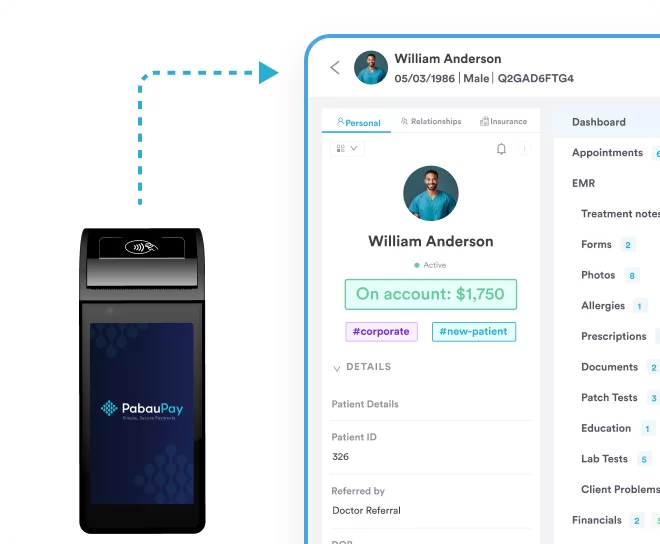
Denied claims need investigating. Staff identify the denial reason, gather supporting documentation, then correct and resubmit or appeal. Common causes include wrong patient information, missing prior authorization, and coding mismatches.
Appeals run on a clock. Medicare gives practices 120 days from receiving the remittance advice to request a redetermination, according to the CMS appeals booklet. Commercial payers set their own appeal windows in each provider contract.
Every denial arrives with a reason code, decoded in the section on reading a claim denial further down. Our guide to denial codes covers the wider list. Practices that track denial patterns can fix the cause upstream, by retraining staff or updating EHR workflows.
Track denial reasons by payer in a simple spreadsheet or RCM dashboard. Patterns emerge quickly. One payer may reject claims for a missing modifier 25, another for prior-authorization problems on imaging. Fix the root cause once and you remove dozens of future denials, instead of chasing each one individually.
The stage-by-stage failure check below gives each stage an owner and a typical failure. It then adds the check that stops the failure and the metric that shows it. The cheapest fix is a check at the stage itself, long before the claim comes back denied.
Use the last column when collections slow down. Find the metric that moved, and it points you to the stage to fix first.
Medical coding translates the clinical record into standard codes, and medical billing turns those codes into a claim and collects the payment. Coders produce the codes. Billers build the claim, chase the payer, and collect what the patient owes.
Ask what is medical billing and coding as a pair, and the answer is two jobs sharing one claim. Revenue cycle management (RCM) is the wider frame around both. RCM tracks every financial step from scheduling to the final payment.
| Aspect | Medical billing | Medical coding |
|---|---|---|
| Who does it | A biller or practice manager, often with the front desk | A certified coder, or the treating clinician in a small practice |
| Main output | A submitted claim and a posted payment | The code set the claim is built from |
| Codes touched | Takes the codes as given, then adds payer rules and claim forms | Assigns CPT, ICD-10-CM, HCPCS Level II codes and modifiers |
| Systems used | Practice management software, clearinghouse and payer portals | The clinical note, code lookup tools, and coding guidelines |
| Skill it rewards | Financial fluency and payer knowledge | Clinical literacy and close reading of documentation |
| Where it goes wrong | Late filing, missing modifiers, denials nobody works | Upcoding, undercoding, codes the note cannot support |
In solo practices one person usually handles both jobs. Larger organizations separate them. Some outsource coding to specialists and keep billing in-house, or do the reverse. The line has blurred further, because claims software for practices now suggests codes from the clinical note and submits claims with little manual work.
Medical coding is the work of converting a clinician’s record of a visit into standardized codes that payers recognize. Coders assign diagnosis codes (ICD-10-CM), procedure codes (CPT and HCPCS), and modifiers that explain the circumstances. Dental practices work from a separate set, CDT, which is why oral health assessments carry D codes rather than CPT codes.
The job needs clinical literacy, because most of it is close reading. A coder has to know an excision from a debridement, and 92012 from a comprehensive eye exam. The note has to name the graft site before a code like 20922 can go on a claim.
Coding in healthcare is the broader discipline, built on national code sets that also feed public health reporting and clinical audit. Ask what is coding in medical billing specifically, and the answer narrows. Coding in medical billing is that discipline applied to one claim, on one date of service, for one payer.
Billing medical procedures means pairing a CPT or HCPCS code for what was done with an ICD-10-CM code for why, plus any modifiers and units. CPT covers physician services and procedures. HCPCS Level II covers what CPT does not, including drugs, injectables, and supplies.
Drugs bill in units. J0585 is one unit of onabotulinumtoxinA, so a 50-unit treatment is a single J0585 line with a quantity of 50. Modifier 25 tells the payer that a same-day office visit was significant and separately identifiable from the procedure.
Outside the US, the procedure code set changes. UK private practices bill insurers with CCSD codes, while NHS hospital activity is recorded in OPCS-4.
One claim, followed end to end, shows where coding stops and billing starts. The amounts below are illustrative, but the arithmetic is how every claim resolves.
Swap E11.9 for a code the note does not support, and the claim comes back denied with that $25-plus rework cost attached. Coders and billers sit close together for that reason, even when one person does both jobs.
Medical billing has its own vocabulary. Misreading these terms slows payer calls, and slows troubleshooting when a claim goes wrong. The last five rows are the ones you need to read a remittance and measure billing.
Track your clean claim rate monthly, and break it down by payer. A drop at one payer usually points to a rule change there. A drop across every payer points back to your own coding or documentation.
A self-pay practice runs a shorter medical billing cycle that skips the payer-facing stages, focusing on collecting at the visit and issuing receipts or superbills. Medical billing guides are usually written for practices that bill insurers. Many aesthetic, wellness, and private practices take cash for some or all of their menu.
The payment-model split below shows which of the eight stages each model runs, which shrink, and which disappear.
The superbill is where a self-pay practice still touches codes. A superbill is an itemized statement with CPT and ICD-10-CM codes that the patient submits to their insurer for out-of-network reimbursement. The practice is paid at the visit, and the patient claims from the plan.
Self-pay patients in the US also have a right to a good faith estimate under the No Surprises Act. CMS guidance says providers must give one when an uninsured or self-pay patient asks, or books at least three business days ahead. Without that estimate, the patient cannot dispute the bill.
Receipts carry a second job. Patients often want to pay from a health savings account (HSA) or flexible spending account (FSA), and eligibility turns on medical necessity. IRS Publication 502 generally excludes cosmetic procedures aimed at improving appearance. A receipt should name the treatment plainly rather than imply it qualifies.
Hybrid practices run both models at once. A dermatology practice might bill an insurer for a biopsy and take cash for injectables the same afternoon. When we set up billing for hybrid practices, the first decision is which services ever go on a claim. Getting that list wrong sends cosmetic lines to payers, where they are denied.
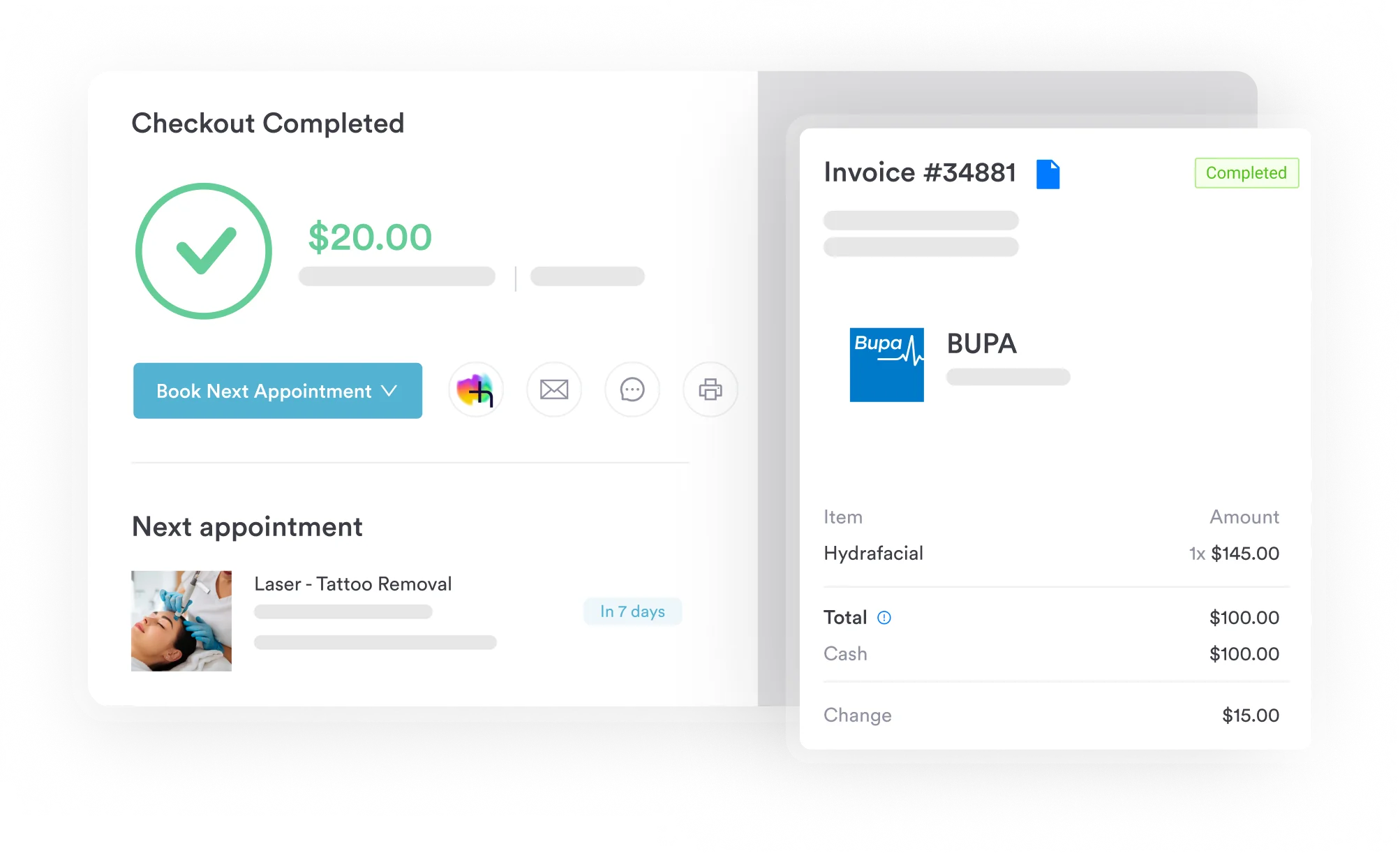
Medical billing software has moved from standalone systems to integrated platforms. The useful ones connect clinical documentation, coding, claim submission, and payment in a single workflow.
Core features include automated insurance verification, real-time eligibility checks, electronic claim submission, denial tracking, payment posting, and financial reporting.
Newer systems suggest codes from the clinical note, flag likely denials before submission, and score how likely a patient is to pay. A complete-extremity study such as 95886 is one a suggestion has to get right, because its add-on rules are strict.
Cloud platforms dominate, because they allow multi-location access, automatic updates, and direct connections to clearinghouses and payment processors.
Specialty needs drive most of the remaining differences. Behavioral health billing software has to handle time-based therapy codes and session authorization limits. Medical massage billing software leans on codes that many payers cover only with a physician referral. Respiratory practices meet the same problem with inhalation drugs, where J7626 is billed per unit dose.
The best medical billing software for US practices pairs billing with scheduling, records, and payments, so staff never re-key data between systems.
Healthcare billing software has to match the market it bills in, because both the code set and the claim route change at the border. A US clearinghouse connection does nothing for a UK private medical insurance claim.
For practices working in more than one market, software that supports several coding systems removes a manual translation step. Pabau submits claims in all three of its core markets, and the routes have little in common.
In the US, claims go through the Claim.MD clearinghouse, which submits electronically to thousands of payers. It returns real-time eligibility checks, claim status, and ERA remittance.
UK private medical insurance claims go through an insurer clearing service, which reaches insurers including Bupa, AXA Health, Vitality, and Aviva. Australian Medicare and DVA claims lodge through Tyro Health, with MBS item codes built in.
| Market | Code system | Claim route | What it changes for the practice |
|---|---|---|---|
| United States | CPT and ICD-10-CM | Claim.MD clearinghouse | Eligibility checks and ERA remittance come back into the same system |
| United Kingdom | CCSD | Insurer clearing service, or insurer portals | One route covers Bupa, AXA Health, Vitality, and Aviva |
| Australia | MBS item codes | Tyro Health, to Medicare and DVA | Medicare and DVA claims lodge digitally at the point of care |
The border matters when you shortlist software. A billing tool proven in one market is not automatically usable in another, however complete its feature list looks. Ask a vendor which clearinghouse or insurer route it supports in your country before you sign.
Data protection rules change at the border too. Billing systems have to meet the rules of the market they run in. HIPAA requires encryption, access controls, and audit trails in the US. GDPR requires consent, data portability, and breach notification in Europe. UK practices also answer to CQC oversight on data handling.
Keep billing in-house on integrated software while claim volume is modest and someone owns follow-up. Outsource when denials pile up faster than your staff can work them.
Check your payment-model split before you decide. A practice that bills insurers for a small share of its revenue rarely needs a billing company. Most of its billing ends at the card terminal.
Revenue cycle management is the whole financial path of a patient visit, and billing is the part you can measure with four or five numbers. RCM starts at payer enrollment and scheduling and ends at the final collection.
RCM covers pre-service work such as credentialing, scheduling, and eligibility checks. Point-of-service work covers check-in and copay collection. Post-service work covers coding, billing, and follow-up.
The table below sets out the billing metrics that matter most. The formulas follow the HFMA MAP Keys, the industry’s standard KPI definitions. Only the denial rate has a published benchmark we trust, so the other rows say to track your own trend.
Read the table together with the stage-by-stage failure check above. When a metric moves, the last column names the stage, and the failure check names the fix. A rising denial rate at one payer usually means a rule change there. A rise across every payer points back to your own coding or verification.
Measure monthly and compare against your own last six months. Specialty benchmarks vary widely, and a trend in your own numbers is easier to act on than a national median.
Billing mistakes delay payment and frustrate patients. The frequent ones are predictable, which also makes them preventable.
Incorrect patient information: Misspelled names, wrong birth dates, or old addresses cause immediate rejections. Front-desk staff should verify demographics at every visit, not just at first registration.
Unverified insurance: Skipping the coverage check before the appointment leads to uncompensated care. Patients assume they are covered, then get a surprise bill when the claim is denied. Real-time eligibility checks during scheduling prevent it.
Upcoding or undercoding: Billing a higher-level service than documented triggers audits and fraud exposure. Billing a lower-level service leaves money on the table. Coders have to match the documentation precisely.
Missing modifiers: Modifiers explain circumstances such as bilateral procedures, discontinued services, or assistant surgeons. Leaving them off produces incorrect reimbursement or a denial. Keep a reference sheet of the modifiers your specialty uses most.
Duplicate billing: Submitting the same claim twice, usually after a software glitch or impatient follow-up, flags the practice as high-risk. Clearinghouses catch most duplicates, but repeat offenders draw payer scrutiny.
Late filing: Medicare requires claims within 12 months of the date of service, under the Medicare Claims Processing Manual. Commercial payers set their own limits in each contract, and many are shorter. A claim filed after the deadline forfeits payment entirely.
Run this check before each claim leaves the practice:
Every denial arrives with a claim adjustment reason code (CARC) that explains why the payer cut or refused payment. A remittance advice remark code (RARC) often sits alongside it to add detail.
Both codes appear on the ERA, next to a group code. CO, contractual obligation, marks an amount the practice cannot bill to the patient. PR, patient responsibility, marks an amount the patient owes. X12 publishes the full CARC list, and these five come up most in a small practice’s denials.
Log each denial by CARC and payer. A CARC that keeps returning at one payer usually traces back to a single stage in the failure check.

Most billing problems start as documentation problems. When the note, the codes, the claim, and the payment live in four systems, staff re-key data at every handoff. Each handoff is another chance to introduce the error that gets a claim denied.
Pabau keeps that chain on one patient record:
For a hybrid practice, that means one checkout for the insured biopsy and the cash-pay injectable. Structured onboarding configures the billing setup around how your practice already works, before you go live.

Pabau connects treatment notes, coding, claim submission, and payments in one platform, so fewer claims come back denied and balances stop slipping. Every subscription includes the full billing workflow.

Medical billing breaks at its weakest stage, and that stage is usually the cheapest one to fix. An eligibility check takes minutes, while a denied claim costs more than $25 to rework and may never be paid.
So map your own payment-model split first. If most revenue comes from self-pay treatments, put your effort into checkout, receipts, and superbills. If insurers pay most of your bills, put it into verification, scrubbing, and a weekly denial review.
Then pick one number and watch it every month. The denial rate is the best place to start, because each denial already tells you, by its CARC, which stage broke.
Book a demo to see how Pabau carries a visit from treatment note to posted payment, whichever payment model your practice runs.

Comparing billing platforms? Best medical billing software US compares seven platforms on claim handling, pricing, and what they integrate with.
Coding an unspecified spine diagnosis? ICD-10 code for ankylosing spondylitis covers the ICD-10 code used when a diagnosis note does not specify the affected spinal region.
Choosing a US clearinghouse? Claim.MD clearinghouse review covers what it submits, how claim status comes back, and who it suits.
Billing patients directly? What is a superbill? sets out what the document has to list before a patient can claim.
Billing Medicare? Medicare billing for practices walks through the claiming channels, the models, and the compliance rules.
Medical coding translates clinical documentation into standardized diagnosis and procedure codes. Medical billing uses those codes to prepare and submit claims to insurance payers or patients, then tracks payments and manages denials. Coders focus on clinical accuracy. Billers focus on financial processing.
A clean insurance claim is usually paid within a few weeks of the date of service. Payer adjudication alone typically takes 7 to 30 days. A denial adds weeks, because the claim has to be corrected and resubmitted or appealed. Self-pay visits settle at checkout, so they skip the wait.
Insurance verification confirms the patient’s coverage is active, the provider is in-network, and the service is covered before care is delivered. Without it, practices risk delivering uncompensated care when claims are denied for eligibility. Re-check coverage at every visit, and always after a new plan year or a job change.
The core stages are patient registration and insurance verification, clinical documentation and charge capture, medical coding, and claim preparation and scrubbing. Then come clearinghouse submission, payer adjudication, payment posting, and denial management. Each step requires accuracy to avoid delays.
Medical billers verify insurance eligibility, prepare and submit claims electronically, and track claim status with payers. They also post payments to patient accounts, generate statements for outstanding balances, investigate denied claims, and answer billing questions from payers and patients. Practice management software holds those workflows in one place.
Common challenges include high denial rates from coding errors, slow reimbursement timelines, patient confusion about statements, difficulty tracking prior authorizations, and changing payer policies. Practices address these through staff training, automated claim scrubbing, and integrated billing software.
Medical billing takes months rather than years to learn, though payer rules take longer to master. AAPC says its self-paced Certified Professional Biller (CPB) course takes an average of four months or less. When you hire, a CPB credential covers the fundamentals. Your own payers’ rules and denials are still learned on the job.
Put simply, medical billing is how a practice gets paid for the care it delivers. Staff record the visit, turn it into codes, send a claim to the insurer, and collect whatever the patient still owes.
Medical billing gets a practice paid for care it has already delivered. The medical billing process turns each visit into a coded claim, collects the payer’s share, then bills the patient for the remaining balance.
Medicare gives you 12 months from the date of service to submit a claim. Commercial payers set their own filing windows in each provider contract, and many are shorter, so check every payer agreement.