CPT Code 30801: Superficial turbinate ablation billing guide
CPT Code 30801: Official descriptor and procedure overview The American Medical ...

Last Updated: Nov 27, 2026
X4120 is the CCSD code for removal of a Tenckhoff catheter, the soft tube placed through the abdominal wall for peritoneal dialysis. Practices use it to bill UK private insurers when the catheter is no longer needed, has failed or has become infected.
Let Pabau's smart automation suggest the right codes, reduce claim denials, and keep your practice compliant—effortlessly.
Automate repetitive tasks and focus on what matters most—your patients.
Reduce coding errors and ensure compliance with the latest regulations.
Clean claims, fewer denials, and faster reimbursements.
Powerful insights and reporting to help your practice thrive.
HIPAA compliant SOC 2 certified GDPR-compliant Trusted by 4,000+ clinics worldwide

CCSD code X4120 bills the removal of a Tenckhoff catheter, the soft tube used for peritoneal dialysis.
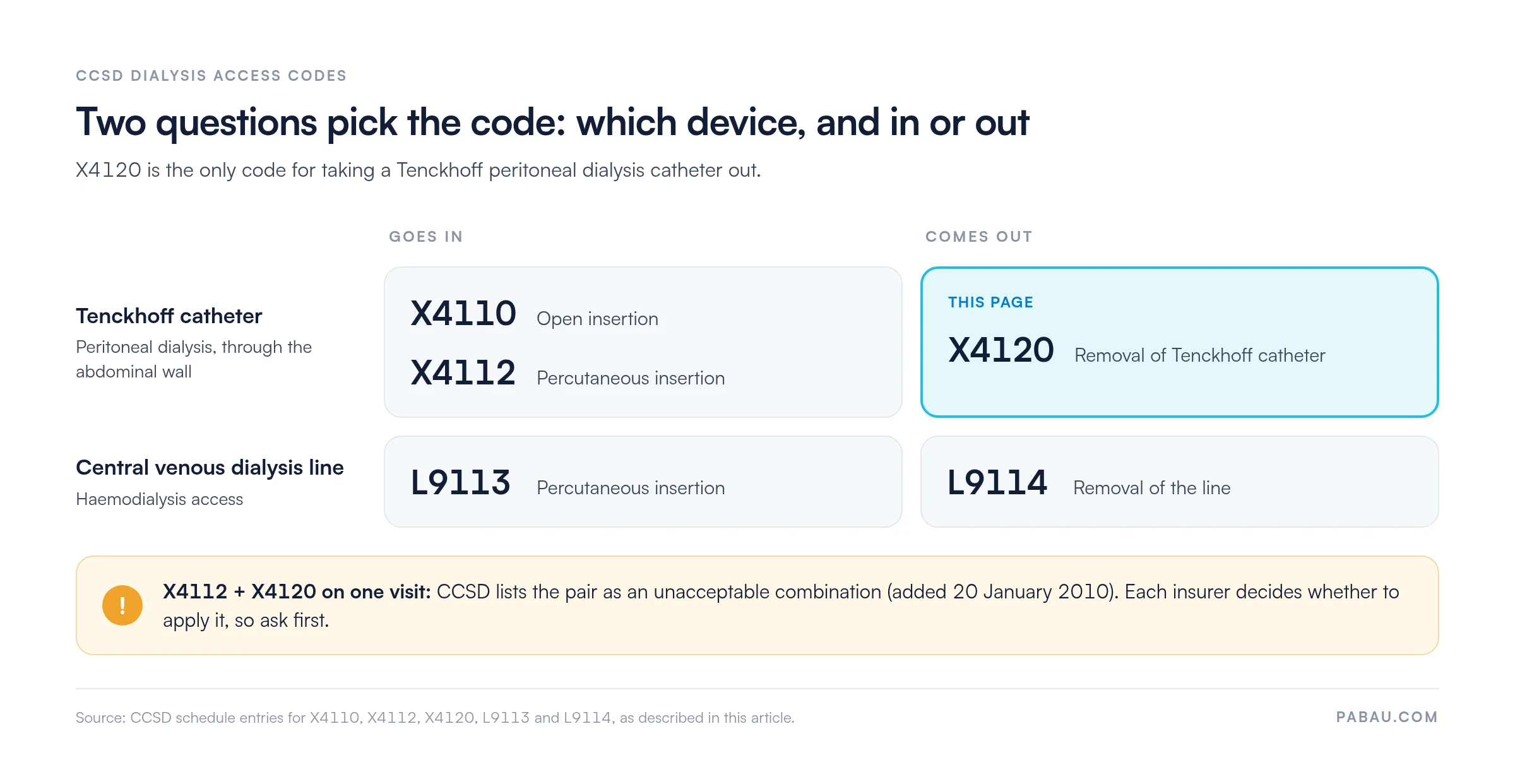
Insertion has its own codes, X4110 for open placement and X4112 for percutaneous placement.
CCSD lists X4120 as an unacceptable combination with X4112, so check with the insurer before billing both.
Each operative note should record why the catheter came out, the catheter type, the anaesthetic and the findings.
Preauthorisation rules differ by insurer and policy, so confirm them with the insurer before the procedure.
CCSD code X4120 bills the removal of a Tenckhoff catheter, the soft tube placed through the abdominal wall for peritoneal dialysis. It comes from the CCSD Schedule, which holds the standard procedure codes for the UK private healthcare sector.
The code sits in renal care. Nephrologists and surgeons take the catheter out when it is no longer needed, has failed or has become infected. UK private insurers pay against these codes, so a wrong code or a thin note stalls the claim.
Hospital records use a different system for the same procedure. In NHS coding, removal of an ambulatory peritoneal dialysis catheter falls under OPCS-4 X41.2. The insurer claim, though, needs the CCSD code. You can browse related entries in our CCSD code library.
An NHS patient leaflet on catheter removal gives three broad reasons for taking a peritoneal dialysis catheter out:
The same leaflet describes the usual procedure. Removal is mostly done under local anaesthetic in a minor procedures room. The skin is cleaned and numbed, the catheter is drawn out, and two or three stitches close the wound. Sometimes a catheter has become embedded, and then it comes out in theatre under general anaesthetic.
X4120 describes the removal itself. The official CCSD entry, including any inclusion notes, sits behind the CCSD login. Check it there before you rely on a bundling assumption.
The X41 family follows the catheter from placement to removal. Pick the code that matches what happened in theatre, not the reason the patient was booked.
One pairing needs care. The CCSD entry for X4112 lists X4120 as an unacceptable combination, added on 20 January 2010. So a same-visit swap, with one catheter out and a new one in, shouldn’t carry both codes by default. CCSD notes that each insurer decides whether to apply the rule, so ask the insurer first.
Set side by side, the five dialysis access codes turn on two questions: which device was used, and whether it went in or came out.
Insurers compare the claim against the clinical record. A complete note answers their likely questions before they ask them.
Take an illustrative patient who had a Tenckhoff catheter placed percutaneously for peritoneal dialysis. A few months after a successful kidney transplant, the catheter is no longer needed. The consultant books its removal under local anaesthetic in a minor procedures room.
The operative note records the indication, the catheter type and the anaesthetic. It also confirms that the catheter came out intact with both cuffs, and that the wound was closed with sutures. No other procedure took place during the visit.
The practice codes X4120 alone. Next, it confirms cover with the insurer and adds the authorisation reference to the claim. Finally, it submits through Healthcode. Had a new catheter gone in at the same visit, the X4112 rule above would apply first.
Healthcode runs electronic billing between UK private practices and insurers. Work through these steps in order.
Bupa publishes its own procedure code search, which helps you check how it lists a code. Our Bupa CCSD codes guide explains how that tool fits into a claim.
Payer problems aside, a few coding habits cause trouble of their own. Watch for these.
An X4120 claim can stall on paperwork. The operative note lives in one system, the authorisation reference sits in an email, and someone retypes both into the claim.
Pabau, a practice management platform with built-in claims management software, keeps those pieces on one patient record. Treatment notes and digital forms hold the indication, catheter details and anaesthetic. In the UK, claims go to insurers through Healthcode and Bupa.
Preauthorisation is tracked on the patient’s case, with the authorisation code, dates and sessions. Pabau warns you when an authorisation is missing, so you can fix it before the claim goes out.

Pabau records treatment notes, tracks authorisation codes on the patient’s case and sends UK claims through Healthcode and Bupa from the same record.

X4120 is a narrow code with a clear job. Use it when a Tenckhoff catheter comes out, and back it with a note that says why, how and under what anaesthetic.
Most of the risk sits around the code rather than in it. A same-visit replacement, an unconfirmed policy or a missing reference can each hold up payment. Settle those before the procedure, and the insurer has far less to query.
Book a demo to see how Pabau keeps the operative note, the authorisation and the Healthcode claim on one record.

Billing the haemodialysis side as well? CCSD code L9114 covers removal of a central venous dialysis line and how it differs from peritoneal catheter work.
Coding dialysis access surgery? CCSD code L7423 explains billing for ligation of an arteriovenous fistula for dialysis.
Checking what Bupa pays? Bupa procedure code fee schedule shows how to look up Bupa’s published fees for CCSD codes.
Want to cut returned claims? Denial codes in medical billing walks through common denial reasons and how to fix them.
X4120 is the CCSD code for removal of a Tenckhoff catheter. Practices use it to bill UK private insurers when a peritoneal dialysis catheter is taken out.
No. X4120 is a renal procedure code. It covers taking out a peritoneal dialysis catheter, and skin or laser treatments are coded elsewhere.
CCSD lists the pair as an unacceptable combination, added in January 2010. Each insurer decides whether it applies that rule, so check with the insurer before you bill both.
That depends on the insurer and the policy. Confirm with the insurer before the procedure, and record any reference it gives you.
NHS coding records removal of an ambulatory peritoneal dialysis catheter under OPCS-4 X41.2. The private insurance claim uses CCSD X4120.
Removal is often done under local anaesthetic in a minor procedures room. An embedded catheter may need theatre and a general anaesthetic. Record which one was used.