CPT Code 88346
CPT code 88346 is the billing code for immunofluorescence on a tissue specimen, ...

Last Updated: Nov 26, 2026
K0853 is the HCPCS Level II code for power wheelchair, group 3 very heavy duty, captains chair, patient weight capacity 451 to 600 pounds. Medicare Part B covers it as durable medical equipment, and the chair needs an affirmative prior authorization decision before delivery.
K0853 shares its weight tier with K0852, which has a sling or solid seat and back instead of a captain's chair. K0851 is the captain's chair code one tier down, at 301 to 450 pounds, and K0855 is one tier up. Common denial causes are a missing KX modifier, missing prior authorization and thin medical necessity documentation.
Let Pabau's smart automation suggest the right codes, reduce claim denials, and keep your practice compliant—effortlessly.
Automate repetitive tasks and focus on what matters most—your patients.
Reduce coding errors and ensure compliance with the latest regulations.
Clean claims, fewer denials, and faster reimbursements.
Powerful insights and reporting to help your practice thrive.
HIPAA compliant SOC 2 certified GDPR-compliant Trusted by 4,000+ clinics worldwide

K0853 covers a group 3 very heavy duty power wheelchair with a captain’s chair, for a patient weight capacity of 451 to 600 pounds.
Prior authorization is required, so do not deliver the chair before an affirmative decision. A claim billed without one is denied and follows the standard appeals process.
The face-to-face encounter must fall within six months before the written order, and the order must be in place before delivery.
The KX modifier goes on a K0853 claim only when every LCD coverage criterion is met and documented.
Pabau’s claims management software sends US claims, checks eligibility and receives remittances, so K0853 billing stays tied to the patient record.
HCPCS code K0853 is the Level II code for a group 3 very heavy duty power wheelchair with a captain’s chair. Medicare’s prior authorization list places K0853 in the very heavy duty tier, for patients weighing 451 to 600 pounds, and requires approval before Medicare pays. The Centers for Medicare and Medicaid Services (CMS) maintains the code, and Medicare Part B covers it under the durable medical equipment (DMEPOS) benefit.
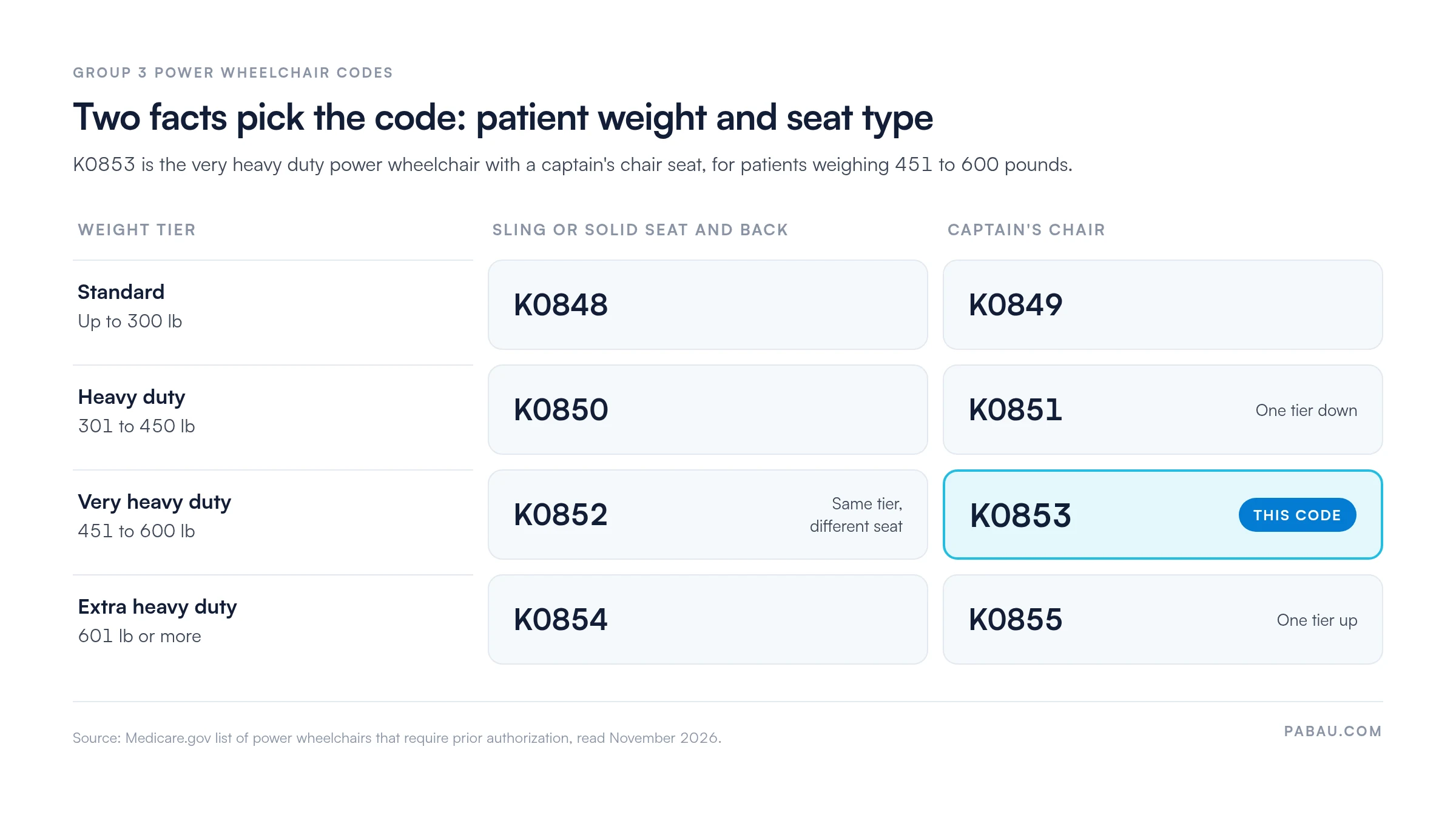
K0853 and K0852 share a weight tier. Both are group 3 very heavy duty power wheelchairs with a patient weight capacity of 451 to 600 pounds. The difference is the seat. K0853 has a captain’s chair, while K0852 has a sling or solid seat and back.
CMS defines a captain’s chair as a one- or two-piece automotive-style seat with a rigid frame and cushioning in both seat and back. Under Medicare’s power mobility policy, an automotive-style back on a solid seat pan counts as solid seat and back. So the code on the claim has to match the seat on the delivered chair.
Weight moves the code across tiers instead. A captain’s chair for a patient weighing 301 to 450 pounds is K0851, the heavy duty tier. At 601 pounds or more it becomes K0855, the extra heavy duty tier. The grid below shows how weight and seat type select each of the eight codes.
Medicare Part B covers HCPCS code K0853 under the durable medical equipment benefit when the beneficiary and the supplier both meet specific conditions. Understanding medical billing fundamentals for DMEPOS helps practices set realistic expectations before submitting.
Under the power mobility device local coverage determination (LCD) L33789, coverage depends on all of the following:
The CMS HCPCS program publishes quarterly updates to HCPCS code descriptors. Coverage criteria sit in the LCD, so confirm its current revision with your Durable Medical Equipment Medicare Administrative Contractor (DME MAC) before each claim cycle.
Medical necessity documentation for K0853 has to justify a group 3 power wheelchair and the very heavy duty weight tier. Following sound medical billing compliance practices means assembling this documentation before the chair ships, not after a denial arrives.
Required documentation includes:
Run a documentation checklist before every K0853 delivery, not after. Confirm the face-to-face encounter falls within six months before the order date, and that the written order predates delivery. Check that the notes record the beneficiary’s weight in the 451 to 600 pound range. One missing element can sink the claim, and documentation corrected after delivery carries compliance risk.
K0853 requires prior authorization under the CMS Prior Authorization Program before the chair is delivered. A claim submitted without an affirmative decision is denied, and the supplier loses the payment protection an approved request gives. Appeals of that denial follow the standard Medicare appeals process.
Confirm insurance eligibility verification and PA status before scheduling delivery. The PA submission and approval process works as follows:
Billing K0853 correctly means completing every pre-delivery step before the claim is generated. Delivering first and collecting documentation later is the fastest route to a denial. Pabau’s claims management software sends US claims and checks eligibility, so the billing record sits next to the patient’s notes.
Power wheelchairs are paid under Medicare’s capped rental methodology. The supplier bills a monthly rental with modifier RR for up to 13 months, then ownership transfers to the beneficiary. For a complex rehab power wheelchair, which includes every group 3 chair, the beneficiary can instead choose to buy it when it is first delivered. That purchase is billed with the NU modifier.
Modifier selection on K0853 claims signals both the documentation status and the payment type. A wrong or missing modifier gets the claim line denied.
KX and RR are typically used together on monthly rental claims during the capped rental period. KX and GA cannot appear on the same claim line, as they represent contradictory attestations.
Group 3 power wheelchair claims draw close review from DME MACs. Structured denial management workflows catch many of these problems before submission. Each denial arrives with claim adjustment reason codes (CARCs) and remark codes on the remittance. Our guide to denial codes for billers explains what each one means.
The table below lists frequent denial patterns and the corrective action for each.
The LCD for power mobility devices does not publish a simple list of covered ICD-10-CM codes. Instead, it describes covered conditions and requires the documented diagnosis to reflect a mobility-limiting condition that meets specific functional criteria. The ICD-10 codes on the claim must accurately represent the clinical condition. They do not guarantee coverage by themselves.
For group 3, the LCD limits coverage to mobility limitations caused by a neurological condition, a myopathy or a congenital skeletal deformity. The categories below commonly appear on group 3 claims, and the last row shows a diagnosis that falls outside that rule. Always confirm current LCD coverage policy with the DME MAC before billing.
Confirm that the ICD-10 code selected accurately reflects the documented clinical condition. Using a broader or less severe code than the medical record supports is a compliance risk. Using a code more severe than documented is upcoding.
Medicare pays for HCPCS code K0853 under a capped rental methodology. The supplier receives a monthly rental payment for up to 13 months, after which ownership transfers to the beneficiary. CMS sets the allowed amount in the DMEPOS fee schedule, which is updated each year and varies by state.
Federal law excludes group 3 complex rehab power wheelchairs from the DMEPOS Competitive Bidding Program. So K0853 is paid from the fee schedule rather than a competitively bid rate, and no bidding contract is needed to supply it.
Medicare pays 80% of the allowed amount. The beneficiary owes the 20% coinsurance plus any unmet Part B deductible. Use the CMS DMEPOS fee schedule to find the current allowable for K0853 in a specific state. Rates change each calendar year, so never use prior-year figures for current claims.
Check the DMEPOS fee schedule for your state every quarter, not just on January 1. CMS publishes quarterly fee schedule updates that can change the K0853 allowable. Billing at a stale rate, even a higher one, creates recoupment liability on post-payment review.
K0853 sits in a family of eight group 3 power wheelchair codes, split by patient weight capacity and seat type. The AAPC HCPCS code lookup and PGM Billing’s HCPCS tool provide quick descriptor verification for the full K0848-K0864 range.
On a K0853 claim, the paperwork starts in the prescribing practice. The face-to-face note, the weight, the specialty evaluation and the written order often sit in different files. The supplier then chases each one for the PA request, and a missing date stalls delivery.
Pabau’s digital forms record the encounter findings, the beneficiary’s weight and the mobility assessment against the patient record. Completed forms stay on that record with their dates, so you can check the six-month window before the order goes out.
For billing, Pabau’s claims management handles US claims, eligibility checks and electronic remittances. Your team can confirm coverage before the order and read the remittance codes when a rental claim comes back.

Pabau keeps the face-to-face note, the patient’s weight and the mobility assessment on one patient record. It also runs US claims and eligibility checks from the same place.

Picking K0853 takes two facts, the patient’s weight and the seat on the delivered chair. Getting it paid takes a sequence that cannot run backward.
Put that sequence in writing before the next referral. The face-to-face encounter comes first, then a written order within six months of it, the specialty evaluation and an affirmative PA decision. A supplier that holds every chair until that list is complete trades a few days of waiting for a claim that survives review.
To see how a practice can keep that documentation and its claims in one place, book a demo with the Pabau team.

Need to understand the broader clearinghouse workflow behind HCPCS claims? Medical claims clearinghouse guide explains how claims route from submission to payment posting.
Confused by denial codes that appear on remittances? Denial codes in medical billing covers CARC and RARC code meanings and next steps.
Looking to understand what revenue cycle management covers beyond DME? Revenue cycle management overview covers the full claim lifecycle from eligibility through payment.
HCPCS code K0853 covers a group 3 very heavy duty power wheelchair with a captain’s chair. Its patient weight capacity is 451 to 600 pounds. Medicare Part B covers it as durable medical equipment. Coverage requires prior authorization and a face-to-face encounter within six months before the written order. The notes must also document the beneficiary’s weight and a qualifying group 3 diagnosis.
K0852 and K0853 differ only by seat type. K0852 has a sling or solid seat and back, while K0853 has a captain’s chair. Both are group 3 very heavy duty power wheelchairs for patients weighing 451 to 600 pounds. The code on the claim must match the seat on the delivered chair.
Yes. K0853 is on Medicare’s required prior authorization list, so the supplier needs an affirmative decision before delivering the chair. A claim submitted without one is denied, and the supplier loses the payment protection an approved request gives. Appeals of that denial follow the standard Medicare appeals process.
You need a face-to-face encounter note from within six months before the written order, and a standard written order in place before delivery. You also need a specialty evaluation by a licensed professional such as a physical therapist. Clinical notes must record the beneficiary’s weight and group 3 diagnosis, alongside a home assessment and a functional mobility assessment. Keep all of it on file before adding the KX modifier.
Frequent denial reasons are delivery before an affirmative PA decision and a missing KX modifier. Others are notes that miss the beneficiary’s weight or group 3 diagnosis, and a face-to-face encounter more than six months before the order. A supplier without DMEPOS accreditation or a RESNA-certified ATP on staff also sees denials.
Medicare pays K0853 as a capped rental, with monthly payments for up to 13 months before ownership transfers to the beneficiary. The allowed amount comes from the DMEPOS fee schedule and varies by state. Group 3 complex rehab chairs are excluded from competitive bidding. Use the CMS DMEPOS fee schedule to find the current allowable, and recheck it each quarter.