HCPCS Code K0900: Customized DME billing and coding guide
HCPCS Code K0900: Official descriptor and code overview HCPCS Code K0900 is a CM...

Last Updated: Nov 18, 2026
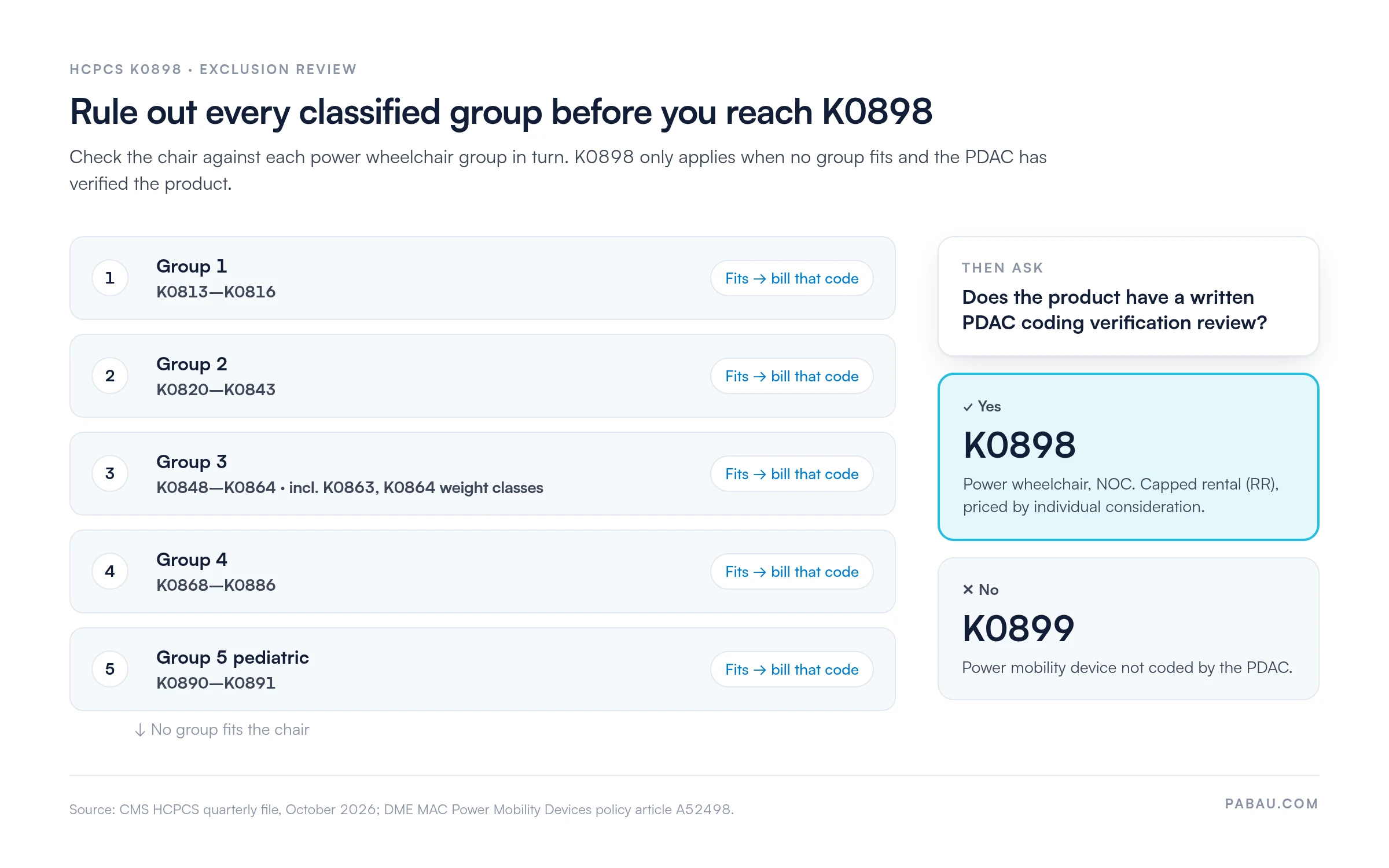
K0898 is the HCPCS Level II code for power wheelchair, not otherwise classified. It applies only when no classified power wheelchair code from K0813 through K0891 describes the chair.
Medicare pays K0898 as a capped rental item, priced by individual consideration rather than a fee schedule rate. Every claim needs a NOC narrative explaining why each classified code does not fit.
Let Pabau's smart automation suggest the right codes, reduce claim denials, and keep your practice compliant—effortlessly.
Automate repetitive tasks and focus on what matters most—your patients.
Reduce coding errors and ensure compliance with the latest regulations.
Clean claims, fewer denials, and faster reimbursements.
Powerful insights and reporting to help your practice thrive.
HIPAA compliant SOC 2 certified GDPR-compliant Trusted by 4,000+ clinics worldwide

HCPCS Code K0898 applies only when no classified power wheelchair code (K0813-K0891, Groups 1 to 5) accurately describes the device being supplied.
Medicare does not require prior authorization for K0898 because it is not on the CMS Required Prior Authorization List. A MAC or non-Medicare payer may still require one.
K0898 is priced by individual consideration rather than a published fee schedule rate, so the allowable must be established with the applicable MAC before submission.
Medicare pays K0898 as a capped rental item, so Medicare claims carry the RR modifier and the chair is rented month by month.
Every K0898 claim requires a KX modifier, a written narrative explaining why no classified code applies, and full medical necessity documentation on file.
HCPCS Code K0898 is the Level II not-otherwise-classified code for a power wheelchair that no classified code from K0813 through K0891 describes. The CMS HCPCS quarterly update lists its official descriptor as “Power wheelchair, not otherwise classified.”
The mismatch with the classified codes can sit in the chair’s design, weight capacity, seat configuration or electronics. K0898 carries no clinical or mechanical specification of its own. It works as a catch-all for atypical devices, custom-built equipment and new power-drive technologies that have no dedicated HCPCS code yet.
K codes are the temporary HCPCS Level II codes created for the DME contractors, and K0898 falls under the Medicare Part B DME benefit. As a NOC code, it draws closer documentation review from Medicare Administrative Contractors (MACs) on every claim. Coders should treat K0898 as the last resort, after ruling out every classified code in the K0813-K0891 range.
K0898 covers any power wheelchair that cannot be accurately described by a classified K code due to atypical design or non-standard features. Common scenarios include custom-fabricated chairs and devices with unconventional base configurations. Chairs with integrated standing functions that no existing code captures also qualify, as do new drive systems awaiting their own code.
What K0898 does NOT cover:
MACs routinely deny K0898 claims when a classified code could have been used. Before submitting K0898, the supplier documents a systematic review of K0813-K0891 in the patient file. That record explains which features of the device fall outside every classified description.
The DME MACs’ Power Mobility Devices policy article (A52498) adds a coding condition. K0898 may be billed only for a product that has a written coding verification review (CVR) from the PDAC contractor. A power mobility device without one is billed with K0899 instead.
Classified power wheelchair codes span five groups. Group 1 runs K0813-K0816, Group 2 K0820-K0843, Group 3 K0848-K0864, Group 4 K0868-K0886 and Group 5 pediatric K0890-K0891. Each code is defined by its group, weight capacity, power options and seat/back configuration. K0898 sits outside all of them. The table below shows the codes most frequently confused with K0898.
The most frequent misuse involves K0863 and K0864, the Group 3 very heavy duty and extra heavy duty codes. Suppliers reach for K0898 on a heavily customized bariatric chair, yet the classified code still applies when the base meets its Group 3 weight class.
Custom add-ons are billed with their own accessory codes and do not turn the base into a NOC item. Work through the groups in the order shown below before K0898 comes into play.
Medicare Part B covers power wheelchairs under the DME benefit when a beneficiary’s medical condition reasonably requires one for use in the home. Local Coverage Determination L33789 (Power Mobility Devices) sets the clinical criteria a beneficiary must meet before any power wheelchair code, K0898 included, is billable.
Each DME MAC publishes it for its own jurisdiction, with Policy Article A52498 alongside it. Suppliers should confirm which MAC jurisdiction applies and that L33789 is still active, as LCD status can change.
For DMEPOS-specific DME billing compliance, always cross-reference the most recent LCD version on the MAC’s website before submitting.
Key coverage criteria under L33789 include:
On top of the L33789 criteria, a K0898 claim must explain why no classified code describes the device. Expect medical review to request the full medical record, the physician’s order, and the supplier’s device-selection rationale.
Medicare does not require prior authorization (PA) for K0898. The code is not on the CMS Required Prior Authorization List for power mobility devices, which covers only K0800-K0802, K0806-K0808, K0813-K0816, K0820-K0829, K0835-K0843 and K0848-K0864.
A K0898 claim is therefore not denied for a missing Medicare PA. A DME MAC or a non-Medicare payer can still set its own authorization rule, so check the payer’s policy before delivery.
Several pre-delivery steps are easy to mistake for PA. The face-to-face encounter, the written order and an Advance Determination of Medicare Coverage (ADMC) are separate requirements, and none of them is a PA request.
The pre-delivery workflow for a K0898 chair runs as follows:
If Medicare coverage is uncertain, issue an Advance Beneficiary Notice of Noncoverage (ABN) before delivery and append the GA modifier. Where a payer that requires authorization turns the request down, follow that payer’s own rules for delivery and billing.
Power wheelchair medical necessity documentation for K0898 goes beyond the standard PMD checklist because the NOC status triggers a device-specific justification requirement. Every document below must be retained in the patient file and available for MAC audit.
Auditors look hardest at the NOC narrative on a K0898 claim. It must be attached to the claim and placed in the patient file. Generic statements such as “custom chair” do not satisfy it. The narrative addresses each classified code range and names the device feature that excludes it.
Pabau, the practice management and billing platform we build, keeps the NOC narrative on the patient record. Its DME claims management tools hold it next to the claim, so the billing team can confirm it is there before submission.
HCPCS Code K0898 is billed on the CMS-1500 paper claim form or the 837P electronic transaction by the accredited DMEPOS supplier. Place of service is typically 12 (home).
The date of service is the date the device was delivered to the beneficiary, not the date the order was written. Confirm that the claim meets clean claim standards before filing to avoid technical rejections.
The KX modifier is not optional. Without it, a K0898 claim signals that required documentation is not on file, and the claim will be denied.
The superbill or claim summary should reference any payer authorization number, where one was issued, and include the NOC written narrative as an attachment. Filing deadline for Medicare is one calendar year from the date of service.
HCPCS Code K0898 has no published fee schedule rate on the CMS DMEPOS fee schedule. As a NOC code, it is priced by individual consideration (IC). Medicare pays it as a capped rental item, so the supplier bills a monthly rental rather than a purchase.
The MAC sets an allowable amount from the invoice price, the clinical justification and comparisons with similar classified devices. Suppliers should contact the applicable MAC before delivery to understand how IC pricing works in their jurisdiction and what invoice documentation is required.
Key reimbursement mechanics to know:
NOC codes attract more post-payment review than classified codes, and K0898 denial patterns are well-documented across MACs. The table below maps the top denial reasons to their typical CARC codes and corrective actions.
Effective denial management strategies for K0898 require a pre-submission checklist that covers every row in the table above. Reactive appeals after delivery are slower and less successful than a compliant first submission.
When a K0898 claim is denied, Medicare’s five-level appeal process applies. For NOC denials, additional clinical evidence strengthens the redetermination at Level 1.
NOC appeals are more successful when the treating practitioner’s letter explicitly addresses the MAC’s denial rationale. Generic appeal letters that restate the original documentation rarely succeed at Level 1.
Medicaid coverage of HCPCS Code K0898 varies considerably by state. Some state Medicaid programs mirror Medicare’s PMD coverage criteria. Others restrict NOC code use to exceptional circumstances or require their own prior authorization, even though Medicare does not require one for K0898.
Suppliers billing K0898 to Medicaid must check the state plan’s DME coverage manual before proceeding. PA requirements, allowable amounts and documentation standards can differ substantially from Medicare rules.
Commercial payers present additional complexity:
The CMS HCPCS overview provides the authoritative source for K0898’s official descriptor and code-set maintenance rules. Both the AAPC HCPCS code search and the PGM Billing HCPCS lookup offer free access to current Level II descriptions from CMS data.
A K0898 claim file often arrives in pieces. The face-to-face notes, the written order and the NOC narrative come in at different times, and one missing page can sink the claim.
Pabau keeps the written order, face-to-face notes and NOC narrative on the patient record next to the claim. Its medical billing software lets the billing team confirm each one is present before submitting. US claims then go out through Claim.MD, which also returns the ERA remittances.
Where a non-Medicare payer requires authorization, the auth code, dates and sessions are tracked on the patient’s case. Pabau warns the team when one is missing.
The billing team spends less time chasing missing pages before a claim goes out. When a denial does arrive, the evidence for the redetermination is already in one place.

Pabau keeps the written order, face-to-face notes and NOC narrative for each K0898 claim on one patient record, ready to check before submission.

Treat K0898 as the last code you reach for. Many chairs that look custom still fit K0813-K0891, and a classified code avoids individual-consideration pricing and the extra review that comes with it.
When a chair falls outside every group, the work shifts to documentation. Medicare does not require prior authorization for K0898, and it pays the chair as a monthly capped rental. The claim stands or falls on the written order, the face-to-face notes and a NOC narrative that rules out each classified code.
Check the MAC’s and any secondary payer’s authorization rules before delivery, because those vary. A careful exclusion review takes time up front, but far less than working a denied claim through appeal. Book a demo to see how Pabau keeps K0898 claim files complete before they reach the MAC.

Need a clearinghouse for clean DME claim submission? Medical claims clearinghouse guide explains how clearinghouses validate, route, and report on DME claims before they reach the MAC.
Getting unexpected denial codes on your remittance? Electronic remittance advice explained breaks down ERA file formats and how to read CARC and RARC codes on denied K0898 claims.
Want to reduce overall claim rejection rates? Medical billing fundamentals covers the end-to-end process from patient intake through final payment posting for DME suppliers.
HCPCS Code K0898 is the not-otherwise-classified code for a power wheelchair that no classified code from K0813 through K0891 describes. It applies to atypical, custom or next-generation power-drive devices that fall outside the Group 1 to 5 power wheelchair classifications.
No. K0898 is not on the CMS Required Prior Authorization List for power mobility devices, so Medicare does not require prior authorization for it. A DME MAC or a non-Medicare payer may still require authorization, so check the payer’s policy before delivery.
K0863 is a classified Group 3 very heavy duty power wheelchair code with multiple power options, for patients weighing 451 to 600 pounds. K0898 applies only when the device meets no classified code’s criteria, K0863 included. If the base qualifies for K0863’s group and weight class, K0863 is correct even when the chair has custom add-ons.
A NOC code is a catch-all HCPCS Level II code used when no specific code accurately describes the item being billed. NOC codes require a written narrative on the claim explaining the item and why no classified code applies. They are priced by individual consideration rather than a published fee schedule.
K0898 has no published fee schedule rate. The MAC prices it by individual consideration, using the submitted invoice and clinical justification. Medicare pays it as a capped rental item and covers 80% of that allowable after the Part B deductible. The beneficiary or secondary insurance covers the remaining 20%.
Medicaid coverage of K0898 varies by state. Some programs mirror Medicare criteria, while others restrict or prohibit NOC code use. Commercial payers may reject NOC codes outright or apply their own medical necessity standards. Always verify payer-specific policy and obtain written authorization before delivering the device.