CCSD code XR650: Percutaneous pyelolysis billing guide
CCSD code XR650 is the UK private billing code for percutaneous pyelolysis, a ki...

Last Updated: Nov 27, 2026
30801 is the CPT code for superficial ablation of the inferior turbinates. Its official descriptor reads: ablation, soft tissue of inferior turbinates, unilateral or bilateral, any method (eg, electrocautery, radiofrequency ablation, or tissue volume reduction); superficial.
The code covers surface mucosal ablation only and is reported once whether one or both sides are treated. Documenting whether the ablation was superficial or intramural separates a paid 30801 claim from an audit flag.
Let Pabau's smart automation suggest the right codes, reduce claim denials, and keep your practice compliant—effortlessly.
Automate repetitive tasks and focus on what matters most—your patients.
Reduce coding errors and ensure compliance with the latest regulations.
Clean claims, fewer denials, and faster reimbursements.
Powerful insights and reporting to help your practice thrive.
HIPAA compliant SOC 2 certified GDPR-compliant Trusted by 4,000+ clinics worldwide

CPT Code 30801 covers superficial cautery or ablation of inferior turbinate mucosa, unilateral or bilateral, by any energy modality.
The defining distinction from CPT 30802 is tissue depth: 30801 treats surface mucosa only; 30802 treats intramural or submucosal tissue.
Modifier -50 is not typically appended because the descriptor already includes bilateral performance. Verify payer-specific exceptions.
ICD-10 J34.3 (hypertrophy of nasal turbinates) is the primary supporting diagnosis; documentation must link it to functional airway impairment.
Pabau supports insurance billing and claims management, sending US claims electronically through Claim.MD with eligibility checks and ERA remittances.
The American Medical Association defines CPT Code 30801 with this descriptor. Ablation, soft tissue of inferior turbinates, unilateral or bilateral, any method (eg, electrocautery, radiofrequency ablation, or tissue volume reduction); superficial.
AAPC’s CPT 30801 summary describes the same scope: ablating the superficial area of the inferior turbinates.
The word “superficial” is the operative word for coding purposes. It limits the code to procedures that treat the mucosal surface layer of the inferior turbinate. The submucosal stroma and the underlying bone are not penetrated.
Accepted methods under this code include bipolar electrocautery, monopolar cautery, radiofrequency (RF) ablation, Coblation, laser cautery, and chemical cautery. The energy modality does not change code selection. What determines whether 30801 or 30802 applies is documented tissue depth, not the device used.
The code is reported once per session regardless of laterality. Performing the procedure bilaterally does not require a separate line or a quantity of two. According to the AMA’s CPT code set, unilateral or bilateral performance is captured within the single descriptor.
CPT 30801 is commonly performed in an office or outpatient setting under local anesthesia. The surgeon applies the chosen energy source to the mucosal surface of the inferior turbinate. The controlled superficial ablation reduces turbinate bulk and improves nasal airflow. Contact with the intramural layer is not part of this procedure.
CPT 30802 covers the same procedure on the inferior turbinate but specifies intramural ablation. The energy is delivered within the submucosal stroma rather than at the surface. This is the single most consequential distinction in turbinate coding. Upcoding from 30801 to 30802 without operative documentation of intramural technique is an audit risk.
An operative note that describes “radiofrequency treatment of the inferior turbinate” without specifying surface versus intramural technique will default to 30801 on audit. If the intent was 30802, the note must state that the probe was inserted into the submucosa or that intramural delivery was performed. The chart below maps each operative-note pattern to the code it supports.
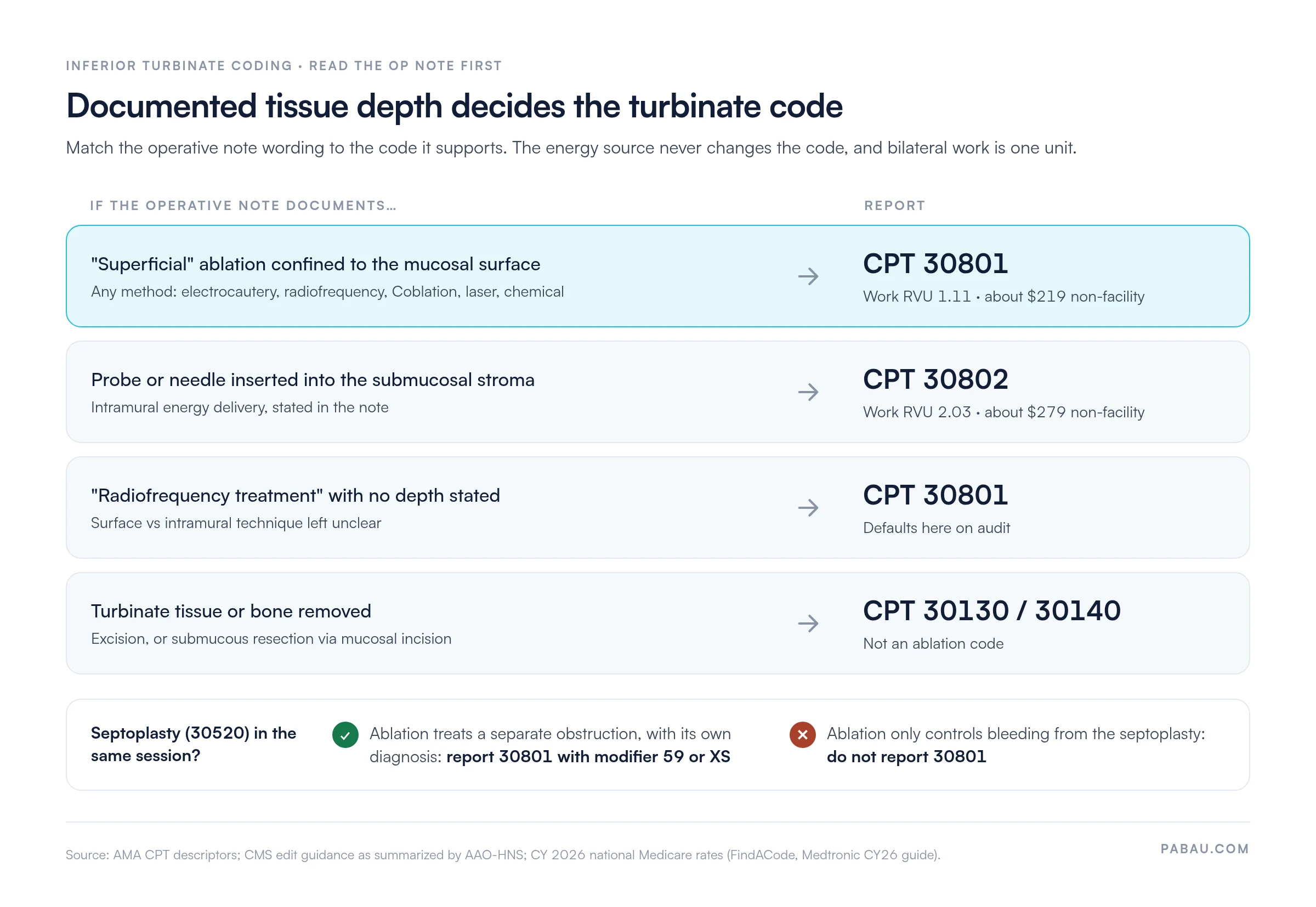
The turbinate code family spans four CPT codes plus several adjacent ENT codes that affect bundling and sequencing decisions. Coders working on ENT claims need to know when each code applies and when two codes may be reported together.
Septoplasty is reported with CPT 30520, and CMS applies a modifier-indicator edit to that pair with 30801. Report both only when the turbinate ablation treats a separate obstruction, with a different diagnosis linked to each code. Append modifier 59 (or XS) to 30801 in that case.
Do not report 30801 when the ablation only controls bleeding from the septoplasty, as AAO-HNS coding guidance explains. CPT 31231 (diagnostic nasal endoscopy) is generally bundled into 30801 when performed in the same session for visualization rather than as a standalone diagnostic study.
Medical necessity for CPT Code 30801 must be established by a diagnosis that links turbinate hypertrophy to documented functional airway impairment. Payers will deny claims where the ICD-10 code alone does not explain why conservative treatment was insufficient.
Documentation must connect the ICD-10 code to the specific functional complaint, typically nasal airway obstruction confirmed by physical examination, nasal endoscopy, or acoustic rhinometry. The chart must also show that conservative treatment failed before the procedure was indicated. Four to six weeks of nasal corticosteroids or antihistamines is commonly required by payer policies, so confirm the duration in your MAC’s LCD.
A clean claim for CPT Code 30801 requires the operative note to satisfy three documentation layers: Pre-operative necessity, intraoperative technique, and post-operative plan. Missing any one of these triggers the most common denial categories for turbinate ablation claims.
Practice software such as Pabau lets you build pre-operative and operative note templates that capture these elements by default. Its claims management software then bills from that complete record, so coders chase fewer missing details before submission.
Ensuring the operative note states “superficial” explicitly protects against audit reclassification to 30802. This is the single documentation element that most separates a payable 30801 claim from a denied or downcoded one. Submitting through a clean claim submission workflow that validates required fields before transmittal reduces post-submission denial exposure significantly.
Build a CPT 30801 operative note macro in your EHR that auto-populates the phrase ‘superficial mucosal ablation confined to the inferior turbinate surface layer.’ That single phrase is the difference between a paid 30801 claim and a 30802 audit flag. Review every operative note against this checklist before submission.
Medicare covers CPT Code 30801 when medical necessity is established. Medicare coverage depends on each MAC’s Local Coverage Determinations and billing articles. Search the CMS Medicare Coverage Database for your jurisdiction’s turbinate-ablation policy.
Reviewing medical billing compliance protocols for each MAC jurisdiction before submitting turbinate claims reduces the risk of non-coverage denials. MAC LCDs are updated periodically; always confirm the current version applies to the date of service.
Commercial insurers generally mirror Medicare LCD criteria but may add prior authorization requirements. Aetna, Cigna, and UnitedHealthcare each maintain medical policies for nasal turbinate procedures.
Prior authorization for CPT 30801 varies by plan. Some plans auto-approve with the correct diagnosis, while others require clinical notes showing treatment failure. Verify prior authorization requirements before scheduling the procedure to avoid a non-covered-service denial.
Medicare reimbursement for CPT Code 30801 is calculated from the Relative Value Unit (RVU) scale published annually in the Medicare Physician Fee Schedule (MPFS). Rates differ between facility and non-facility settings. Use the CMS Physician Fee Schedule lookup to obtain the exact current rate for your locality.
The national figures above are for general reference. Your payment depends on the conversion factor for the applicable year and your Geographic Practice Cost Index (GPCI) locality. Use the FastRVU 2026 RVU lookup to calculate your location-adjusted rate.
Submitting 30802 when only superficial ablation was performed creates an overpayment as well as an audit risk, and overpayments trigger repayment demands. Accurate code selection also supports better revenue cycle management, because your reporting reflects the procedures you performed.
CPT Code 30801 includes both unilateral and bilateral performance within its descriptor. Because bilateral work is already incorporated into the code, modifier -50 (bilateral procedure) is not typically appended. Appending -50 can make the payer process the claim as if two separate procedures were performed. That may cause the payer to reject or adjust the claim.
When CPT 30801 is performed on only one side, document laterality clearly in the operative note. Some MACs request documentation confirming unilateral performance to match the single-unit claim, particularly if the diagnosis codes suggest bilateral turbinate hypertrophy.
CPT Code 30801 denials cluster around five root causes, and each has a specific documentation or workflow fix. Pabau sends US claims electronically through Claim.MD, which runs claim and eligibility checks before a claim reaches the payer.
Structured denial management workflows track denial codes per CPT code. They help ENT practices spot patterns, such as a spike in J34.3 medical necessity denials, before revenue suffers. Cross-referencing denial patterns against denial codes in medical billing provides a framework for auditing root causes systematically.
Run a quarterly audit of all 30801 claims denied in the previous 90 days. Sort by denial reason code (CO-50 for medical necessity, CO-4 for modifier issues). Claims denied CO-50 usually point to a missing conservative treatment failure note. Fix the documentation template first, because it addresses the most common cause.
Many ENT practices code turbinate ablation from a free-text operative note, then key the claim into a separate billing tool. The depth wording, the laterality and the conservative-treatment history stay in the chart while the claim goes out without them.
Pabau keeps the operative note templates, the patient record and the claim together. Your surgeon documents “superficial” ablation in a structured note, and the claim is built from the same record. US claims go out electronically through Claim.MD, with eligibility checks before the visit and ERA remittances posted back afterward.
Coders then spend less time chasing missing documentation, and the practice can see why each 30801 claim was paid or denied.

Pabau sends US claims electronically through Claim.MD, with eligibility checks and ERA remittances, so your ENT practice submits cleaner claims and gets paid faster.

CPT 30801 pays reliably when the operative note does three jobs. It states “superficial” mucosal ablation, confirms laterality, and links back to a documented trial of conservative treatment.
Build that wording into a note template before the next turbinate case, and hold any claim where the depth is left unstated. A few extra seconds of charting cost far less than an upcoding review or a repayment demand.
Book a demo to see how Pabau links operative notes to clean CPT 30801 claims for your ENT practice.

Performing intramural ablation instead? CPT code 30802 covers submucosal turbinate ablation and the documentation that supports it.
Removing turbinate bone as well? CPT code 30140 explains submucous resection of the inferior turbinate.
Billing a nasal endoscopy the same day? CPT code 31231 sets out when diagnostic nasal endoscopy is reported on its own.
Looking to understand the full ENT billing workflow? What is medical billing explains the end-to-end claims lifecycle from patient encounter through ERA posting.
Want to reduce your overall denial exposure? Superbill creation and submission covers how structured superbills capture the documentation elements that prevent common denial triggers.
CPT Code 30801 covers superficial cautery or ablation of the inferior turbinate mucosa, performed unilateral or bilateral. Any method qualifies, including bipolar electrocautery, radiofrequency ablation, Coblation, and laser. The code captures procedures that treat only the surface mucosal layer without penetrating the submucosal stroma.
CPT 30801 covers superficial mucosal ablation. CPT 30802 covers intramural ablation, where a needle or probe delivers energy within the submucosal stroma below the mucosa. The clinical distinction is tissue depth, and the operative note must specify which technique was used. Billing 30802 without documentation of intramural delivery is an audit risk.
CPT 30801 covers both unilateral and bilateral performance within a single code. Report it once per session regardless of whether one or both sides were treated. Modifier -50 is not typically appended because bilateral is already in the descriptor. Appending it may cause the payer to reject or adjust the claim.
Yes, Medicare covers CPT Code 30801 when medical necessity is documented under the applicable MAC Local Coverage Determination. Requirements typically include a confirmed diagnosis of inferior turbinate hypertrophy (J34.3), documented nasal airway obstruction, and failed conservative treatment with nasal corticosteroids or antihistamines. Four to six weeks of that treatment is commonly required by payer policies, so confirm it in your MAC’s LCD.
Yes, radiofrequency ablation is an accepted method under CPT 30801 when it treats the mucosal surface layer. If the RF probe is inserted into the submucosal stroma for intramural delivery, CPT 30802 applies instead. The technique performed and the tissue depth reached must be documented in the operative note to support whichever code is selected.
Only when the turbinate ablation treats a separate obstruction, with a different diagnosis linked to each code. Append modifier 59 (or XS) to 30801, because CMS applies a modifier-indicator edit to this pair. Do not report 30801 when the ablation only controls bleeding from the septoplasty. Diagnostic nasal endoscopy (CPT 31231) is generally bundled into 30801 when performed in the same session for visualization rather than as a distinct diagnostic service.
The primary ICD-10 code is J34.3 (hypertrophy of nasal turbinates). Supporting codes include J34.89 (other specified disorders of nose), J30.0 (vasomotor rhinitis), and J30.1-J30.9 (allergic rhinitis variants). Documentation must connect the diagnosis to functional nasal airway obstruction and failed conservative management.