EHR ROI: How to calculate and maximize your return
EHR ROI is the financial return a practice earns on its electronic health record...

Last Updated: Oct 15, 2026

Denial management in healthcare is the systematic process of investigating, resolving, appealing, and preventing denied insurance claims.
A rejection is caught before the payer adjudicates the claim, while a denial arrives after a coverage decision.
Optum measured hospital denials at 12% of claims in 2023, and HFMA puts the target under 5%.
Optum found 84% of denials potentially avoidable, yet HFMA cites figures of up to 65% never resubmitted.
Software that posts remittances automatically, with the CARC reason attached, turns denial management into a worklist you clear.
Denial management in healthcare is the systematic process of investigating, resolving, appealing, and preventing denied insurance claims. Most guides on the subject assume a denials team. This one assumes the denials team is you, or a practice manager who also answers the phone. If your practice also offers cash-pay cosmetic visits, our comparison of the best medical spa software covers charting and checkout for those too.
That distinction matters because the arithmetic is unforgiving at small volumes. MGMA puts the average cost of reworking one claim at $25.20. The Optum 2024 Revenue Cycle Denials Index found hospital denials running at 12% of claims in 2023, up from 9% in 2016.
Run those two numbers together. A practice sending 300 claims a month can expect around 36 denials and roughly $900 of rework, every month, before anyone has appealed anything.
Denial management is the work of finding out why a payer refused to pay. You fix what can be fixed, and appeal what should not have been refused. The fourth part is prevention, and that is where the money is. Recovering a denial pays you once. Removing its cause pays you every month afterward.
A rejection and a denial are different events. A rejection fails a front-end check at your medical claims clearinghouse, before the payer adjudicates. No decision was made, so there is nothing to appeal. You correct the field and resubmit.
A denial arrives after adjudication. The payer tells you why with a claim adjustment reason code, known as a CARC, on the remittance.
There is no official taxonomy here, which is why the answer varies by source. The split billing teams actually work with is hard, soft, and clinical.
A fourth label cuts across all three. A preventable denial is one your own process caused. Optum found 84% of denials potentially avoidable, so most of what lands on your desk belongs in that group.
Registration and eligibility errors are the single biggest cause, at 24.33% of denials in 2023. Optum also found that 44% of all denials originate at the front end, before a clinician has coded anything. The shares below are its 2023 averages, drawn from roughly 124 million hospital claim remits.
| Cause | Share of denials | Where to fix it |
|---|---|---|
| Registration and eligibility | 24.33% | Front desk. Check coverage at booking and again on arrival. |
| Missing or invalid claim data | 15.89% | Claim scrubbing, before the file leaves your system. |
| Authorization and pre-certification | 12.80% | Booking. Hold the appointment until the authorization is on file. |
| Medical documentation requested | 12.08% | Charting. Sign the note before the claim goes out. |
| Service not covered | 9.67% | Benefit check. Quote a cash price instead of billing. |
| Medical necessity | 6.76% | Coding. Bill from the diagnosis the note supports. |
Three more causes sit outside that top six and hurt small practices out of proportion to their volume. Duplicate claims happen when a resubmission goes out without being flagged as a replacement. Encounter characters cause the same confusion, because S40.022A on a later visit tells the payer the injury is new.
Coordination-of-benefits denials happen when a secondary plan is billed as though it were primary. Timely filing denials happen when nobody was watching the clock. Those are hard denials, so the revenue is simply lost.
The process is identify, categorize, resolve, appeal, and prevent. Run every denial through all five. The first four recover the claim in front of you, and the fifth is what makes next month’s list shorter.
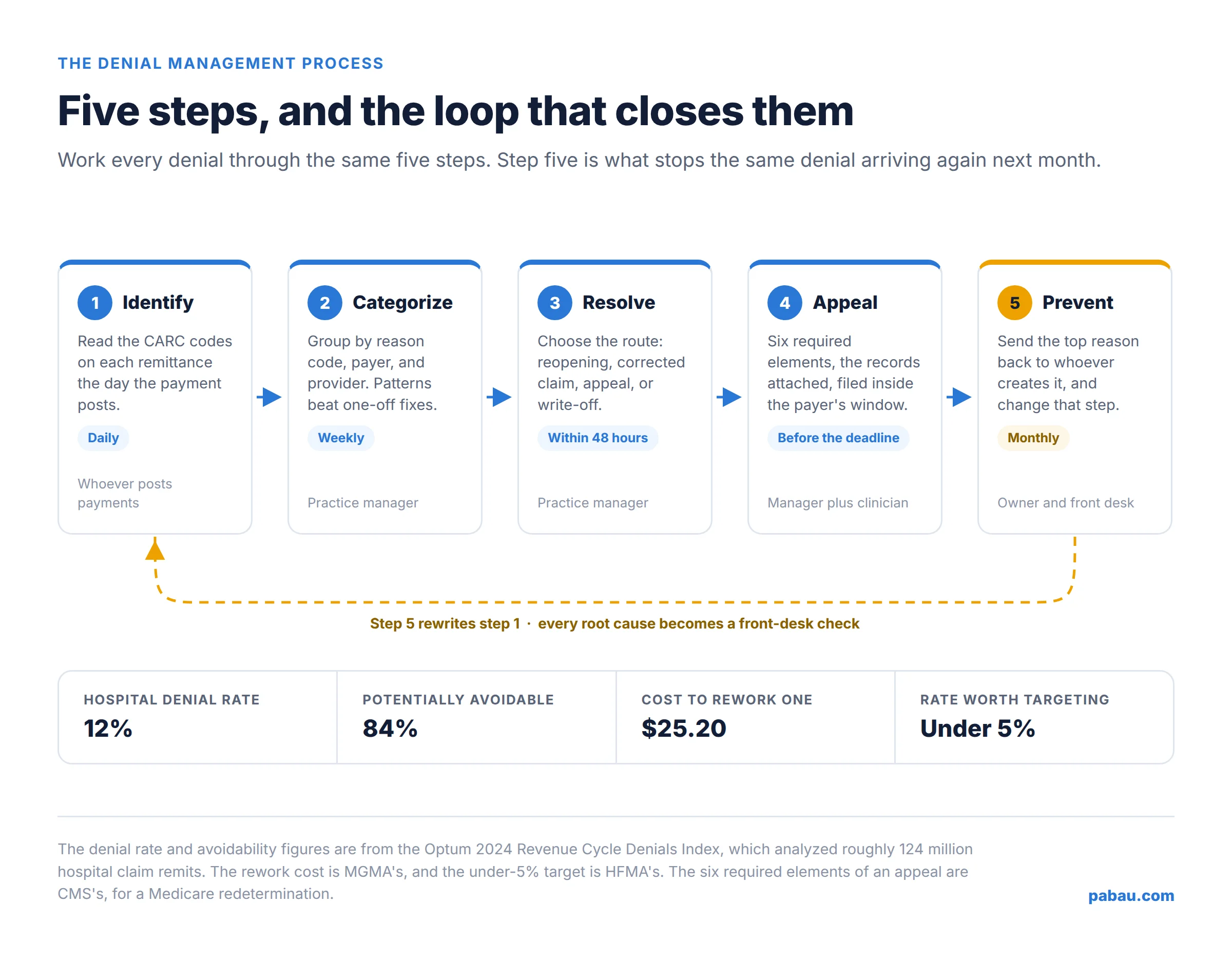
Open every electronic remittance advice, or ERA, on the day the payment lands. Read the CARC code on each line the payer did not pay. Month-end is too late, because appeal windows are already running.
In a practice with no billing department, this belongs to whoever posts payments. It is a daily task of a few minutes, not a project. What you want at the end of it is a list of denied claims with a reason against each one.
Sort the week’s denials three ways: by CARC code, by payer, and by the provider who delivered the service. Patterns show up in minutes and single claims never do.
One eligibility denial is bad luck. Nine of them against the same plan means your front desk has the wrong member ID format, or that plan changed its rules. The categorization is what turns 36 separate problems into two or three fixable ones. Behavioral health denials cluster the same way, often against one plan’s rules for the F30-F39 range.
The reason code decides the route, and there are four. Small clerical errors go through a reopening. Wrong claim data goes out as a corrected claim. A coverage or necessity decision you disagree with goes to appeal. Anything you cannot win gets written off, with the reason logged.
Getting this choice right matters more than it looks. CMS does not process minor errors and omissions through the appeals process at all, so an appeal on a typo is time you have donated.
A corrected claim goes out on a fresh 837 file carrying frequency code 7 and the original claim number. That is what stops the payer denying it a second time as a duplicate.
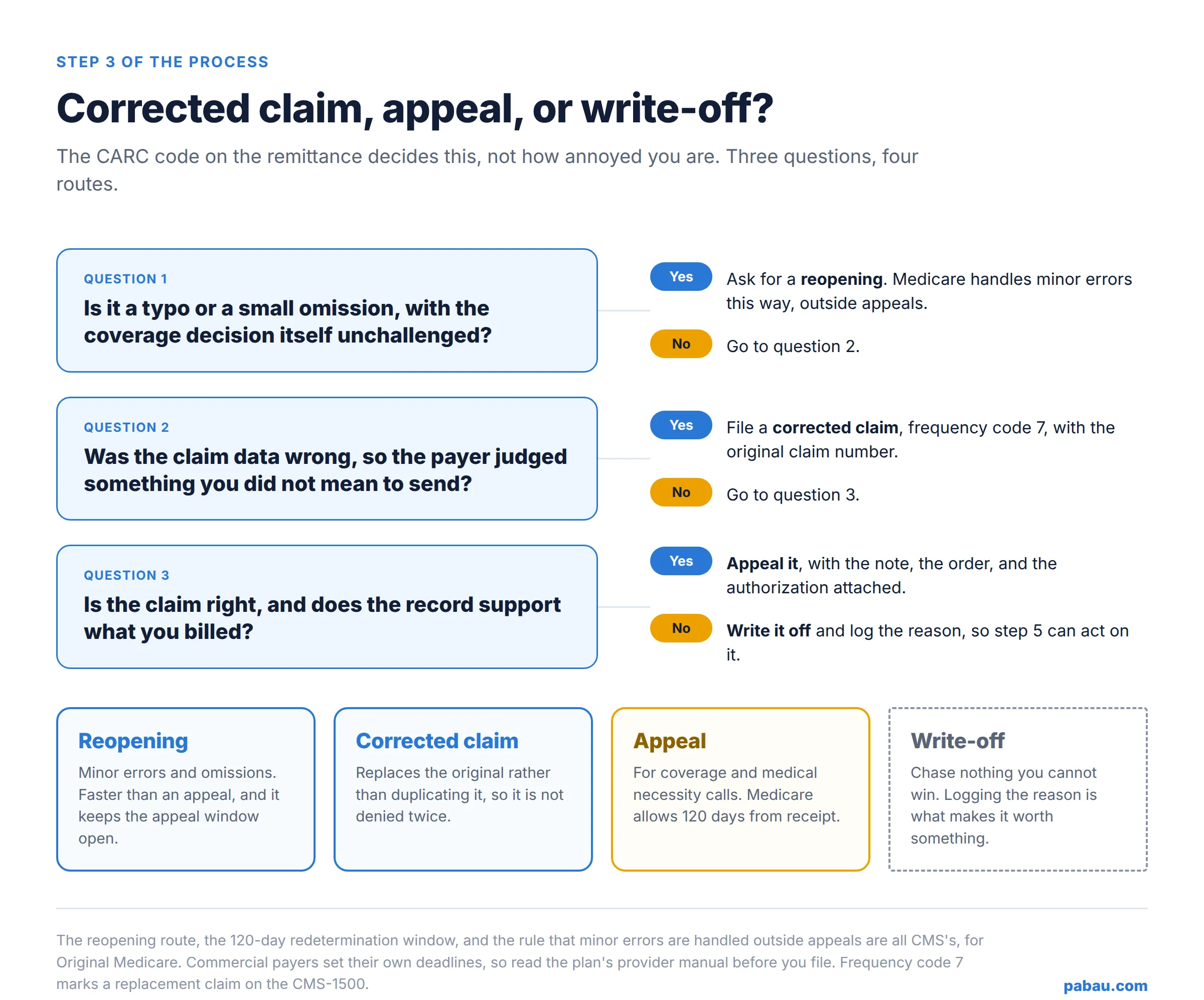
An appeal has to identify the patient, the exact service in dispute, and the reason the denial is wrong. It also has to arrive before the deadline. For Original Medicare, a first-level redetermination must be filed within 120 days of receiving the initial determination.
CMS requires six things in a written redetermination request:
Attach every document that supports the argument. Commercial payers set their own windows and forms, so read the plan’s provider manual before you write. Aftercare claims need the history spelled out, so a Z48.811 appeal should carry the operative report too. Phototherapeutic keratectomy appeals turn on the plan’s medical policy, since S0812 is covered only for listed corneal conditions.
It is worth the effort. Premier’s 2024 survey of providers found that 54.3% of denials by private payers were eventually overturned and paid.
Once a month, take your top two denial reasons and change the step upstream that produced them, rather than getting better at reworking them. This is the only step that lowers the denial rate.
Prevention is concrete work with a named owner. An eligibility pattern becomes a rule at the front desk. An authorization pattern becomes a field on the booking screen. A necessity pattern becomes a line the clinician adds to the note. Write the change down, then check the same report next month to see whether it held. Claim submission, eligibility and remittance are three stages, and medical claims software carries a claim across all three.
Five numbers tell you whether denial management is working. Here they are with their formulas and published benchmarks, so you can hold your own figures against something real. The targets come from HFMA’s revenue cycle KPIs, MGMA, Premier, and the Optum index.
| Metric | How to calculate it | Benchmark | Source |
|---|---|---|---|
| Initial denial rate | Denied claim dollars divided by claim dollars submitted, same period | Under 5% is optimal. The industry average is 5% to 10%, and Optum measured 12% across hospitals. | HFMA, Optum |
| Clean claim rate | Claims accepted by the payer divided by claims submitted | 98% | HFMA |
| Appeal overturn rate | Denials overturned divided by denials appealed | 54.3% of private-payer denials were eventually overturned and paid | Premier, 2024 survey |
| Cost to rework one denied claim | Staff time plus resubmission cost, divided by denials worked | $25.20 on average, and $43.84 per claim where providers fight the denial | MGMA, Premier |
| Time from denial to resolution | Days from the denial remittance date to a zero balance on the claim | Resolve 85% of denials within 30 days | HFMA |
Two more figures put those benchmarks in context. Optum found 84% of denials potentially avoidable, with 22% of those not recoverable once they happen. HFMA also cites figures of up to 65% of denied claims never being resubmitted at all. That is the number to worry about first.
If your denial rate sits above 10%, the fix is upstream, not in the appeal queue. Pull the top three CARC codes and check whether they are front-end causes. If your never-resubmitted share is the problem instead, you have a workflow problem rather than a quality one, and a daily remittance review closes it.
The rate is also worth reading in dollars as well as claim counts. HFMA and its Claim Integrity Task Force define the standard denial metrics both ways. A low count of very expensive denials can still sink a month.
Prevention beats rework on economics alone, because a clean claim costs nothing to fix. Given that 44% of denials start at the front end, most of the work sits with the front desk rather than the biller. Coding still carries its share, and ICD-10 N06.0 is correct only once the record names the histologic lesion.
Two more coding patterns are worth naming. N75.9 says the record never pinned down the Bartholin gland condition, so those claims need a pre-bill documentation review. Bundling edits are the second pattern. A catheter code billed next to 51700 is among the pairs payers reject, because placing that catheter belongs to the bladder irrigation.
Your denial profile also depends on what you treat. Visit limits and medical necessity drive most of the volume in physical therapy practices. Units billed under 97110 are the line payers count hardest there. Prior authorization does the same in hormone replacement therapy clinics. Here is the checklist that covers the six causes in the table above.
None of this needs a billing department. It needs the checks to live in the software your team already opens every morning, so nobody has to remember them.
Most of the pain in denial management is archaeology rather than decision-making. You log into payer portals to find out what happened, then cross-reference a bank deposit against a spreadsheet. Practice management software like Pabau removes that step, so the denial arrives already labeled.
ERAs flow back automatically from the payer and settle each claim to Paid or Denied, with the payment matched into billing. Denial reasons attach to the claim as CARC codes, so step one of the process is reading a screen you are already on.
Resolution runs from the same record. Corrected claims, voids, secondary claims, and appeals all start from the claim itself. Every action lands on that claim’s activity history, so when a payer asks what you sent and when, the answer is one click away.
Real-time eligibility checks run from the client card before the visit, which is where the biggest denial category gets prevented. Claims reach thousands of US payers through our Claim.MD integration.
Denials stop being a monthly investigation. They become a worklist you clear before lunch.

Pabau posts payer remittances automatically, settles each claim to Paid or Denied, and attaches the denial reason as a CARC code. Corrected claims, voids, and appeals all run from the same record, with a full activity history behind them.

The practices that get good at denials are the ones that stop treating each one as an exception and start reading them as data. A denial is a payer telling you, in a standardized code, exactly which part of your process failed. That is free information, and it arrives every week.
You do not need a denials team to act on it. You need the remittance read the day it posts, the reason codes grouped once a week, and one upstream change a month. That is a couple of hours of attention against a 12% denial rate and $25.20 a claim in rework.
The trade-off worth remembering is that recovery has a ceiling and prevention does not. Chase the appeals you can win, but spend your best hour on the cause. Book a demo to see how Pabau settles claims, attaches denial reasons, and runs corrections and appeals from one record.

Want the whole picture around denials? What is revenue cycle management (RCM)? places denial work inside the full revenue cycle.
Suspect the documentation is what keeps failing? Medical billing compliance covers the rules that decide whether a claim survives review.
Getting denied because you are out of network? How to get credentialed with insurance companies walks through enrollment payer by payer.
Deciding where your claims get routed? Claim.MD clearinghouse reviews one of the clearinghouses US practices send the most claims through.
Billing patients who claim reimbursement themselves? Superbill template gives you the document out-of-network patients submit to their own insurer.
There are five. Identify the denial from the remittance, categorize it by reason code and payer, then resolve it with a correction or an appeal. File that appeal inside the payer’s deadline, and prevent the cause from recurring. The first four recover the claim. The fifth lowers your denial rate.
Hard, soft, and clinical. A hard denial cannot be reversed by fixing paperwork, so the revenue is lost. A soft denial can be corrected and resubmitted for payment. A clinical denial turns on medical necessity or level of care, and is argued with documentation. There is no official taxonomy, so other sources split them differently.
Claim adjustment reason code 4 means the procedure code is inconsistent with the modifier used, or a required modifier is missing. It is a data problem rather than a coverage decision, so it is usually resolved with a corrected claim rather than an appeal. Check the modifier against the procedure code and the payer’s own policy.
CO 252 means an attachment or other documentation is required before the payer can adjudicate the claim. The accompanying remark code tells you which document is missing. Send what is asked for rather than appealing, because nothing has been decided yet.