HCPCS code T2043: Hospice continuous home care billing guide
HCPCS code T2043 pays for hospice crisis care by the hour HCPCS code T2043 is th...

Last Updated: Oct 7, 2026
H2014 is the HCPCS Level II code for skills training and development, per 15 minutes.
Let Pabau's smart automation suggest the right codes, reduce claim denials, and keep your practice compliant—effortlessly.
Automate repetitive tasks and focus on what matters most—your patients.
Reduce coding errors and ensure compliance with the latest regulations.
Clean claims, fewer denials, and faster reimbursements.
Powerful insights and reporting to help your practice thrive.
HIPAA compliant SOC 2 certified GDPR-compliant Trusted by 4,000+ clinics worldwide

HCPCS Code H2014 covers skills training and development services billed in 15-minute increments under Medicaid and select state programs.
H2014 has been flagged in fraud, waste, and abuse audits for high-volume billing. Rigorous session-by-session documentation is essential.
Medicare generally does not reimburse H2014. Coverage depends on state Medicaid policy and payer contracts, and prior authorization is often required.
Practice management software like Pabau helps behavioral health practices track H2014 units, attach session notes, and reduce claim errors before submission.
The official long descriptor, as maintained by the Centers for Medicare and Medicaid Services (CMS), reads: “Skills training and development, per 15 minutes.” The short descriptor is “Skills train and dev, 15 min.”
Services billed under H2014 teach and reinforce behavioral health skills, functional life skills, and adaptive skills for individuals living with mental health disorders or substance use disorders. The goal is to build practical capacity for:
H2014 falls under the HCPCS Level II category of Other Mental Health and Community Support Services, as classified by AAPC. Programs assessing substance use severity alongside skills training may use an opioid risk tool during intake.
The code was added to the HCPCS set on April 1, 2003. It carries action code N (no maintenance), meaning the descriptor has remained unchanged since its original effective date. For billing purposes, each billable unit equals one 15-minute block of direct service time.
Billers sometimes search for this as the “H2014 CPT code,” but it’s a HCPCS Level II code, not a Current Procedural Terminology (CPT) code. The American Medical Association maintains CPT codes, while CMS maintains HCPCS Level II codes for services CPT doesn’t cover. The descriptor and 15-minute unit rules stay the same regardless of which name your team uses for it.
Eligible provider types for HCPCS Code H2014 vary by state Medicaid program and payer contract. The code does not carry a single nationally mandated provider type restriction, which is why practices must verify eligibility with each payer before billing. That said, the following provider categories commonly appear on state Medicaid fee schedules for H2014:
In Arizona, the AHCCCS behavioral health billing requirements specify which credential levels can bill H2014 under each managed care contract. California’s DHCS ECM and Community Supports guidance similarly defines qualified provider types for H2014 billing within its Enhanced Care Management program. Scope of practice varies materially by state licensure, so practices operating across multiple states should confirm requirements for each jurisdiction.
Community mental health centers billing H2014 across multiple staff often start by comparing behavioral health software built for this workflow. Programs treating substance use disorders alongside skills training may also find an alcohol withdrawal care plan template useful for standardizing clinical protocols.
Supervision requirements also differ. Some states require that paraprofessional-delivered sessions be conducted under real-time or same-day clinical oversight. Others accept general supervision with documented treatment plans. Check your state Medicaid provider manual before billing H2014 with non-licensed staff. Using compliance management software that tracks provider credentials and supervision status can prevent costly claim rejections tied to eligibility mismatches.
Run an eligibility check against your state Medicaid fee schedule before billing H2014 with any new provider type. Pull the provider’s NPI and credential level and confirm both appear on your state’s approved provider taxonomy list. A single unverified credential level can trigger retroactive claim reviews across all sessions billed under that provider.
The best medical practice management tools let you standardize how unlisted and miscellaneous codes get documented.
Documentation is the single biggest risk area for HCPCS Code H2014. Because the code is billed in 15-minute units and sessions can run for an hour or more, payers scrutinize both total unit counts and the clinical justification for each unit billed.
A session note that says “client worked on life skills for 60 minutes” will not support four units of H2014. Each note must demonstrate medical necessity at the session level. Structured formats such as SOAP notes (subjective, objective, assessment, plan) or DAP (data, assessment, plan) notes help capture every required element. Documentation must also separate structured skill-building from general socialization, because a note describing unstructured activity with no therapeutic goal will be denied.
Pabau’s digital forms and clinical notes tools let practices build structured session note templates that capture all required H2014 elements. A behavior tracking sheet can standardize how staff record skill progress across sessions. Providers fill in each field at point of care rather than reconstructing sessions from memory, which strengthens both documentation quality and audit defensibility.
The AI-powered clinical documentation feature can transcribe and structure session notes automatically, reducing time spent on admin after each appointment.
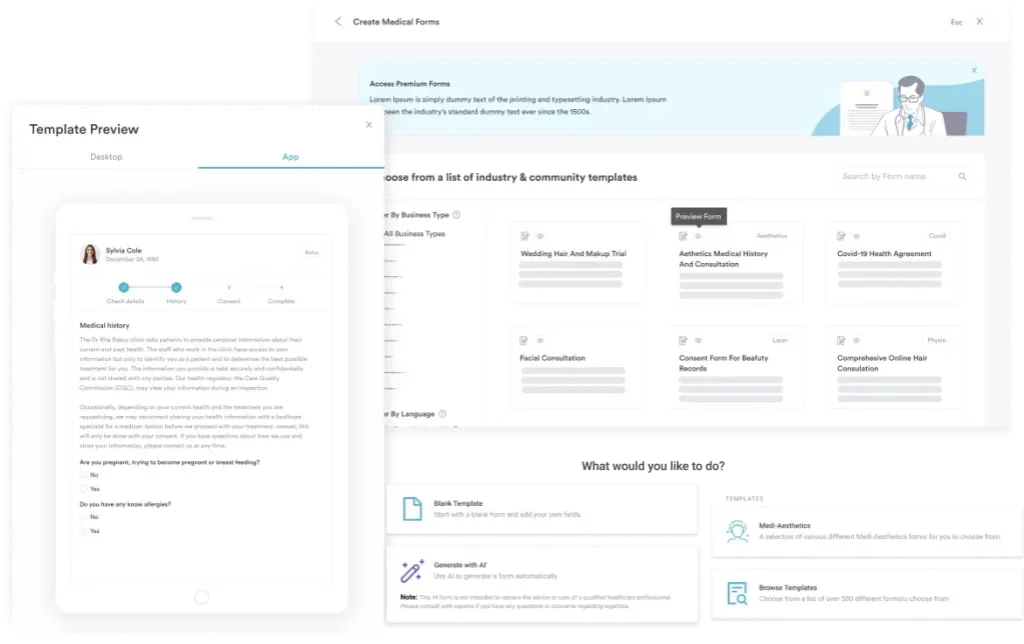

Pabau helps behavioral health practices build compliant session note templates, track provider credentials, and submit H2014 claims with the documentation payers require. See how it works for your practice.

Modifiers tell payers how, where, or by whom a service was delivered. For HCPCS Code H2014, modifier applicability is almost entirely payer- and program-specific, so the table below should be confirmed against your specific state Medicaid or managed care contract before use.
H2014 modifiers usually signal the provider’s credential level, the treatment setting, or the program type. Beyond the credential and setting modifiers in the table below, some states use program-type modifiers such as HE (mental health program), HF (substance abuse program), or HA (child and adolescent program). Whether H2014 can be billed for group services, including applied behavior analysis, is payer- and state-specific. Where group billing is permitted, the group-setting modifier HQ applies alongside any required credential modifiers. State-defined modifiers in the U1-U9 range carry no national meaning, so confirm each one against your payer’s guidance. The CARC denial code list is short enough to learn, and most rework traces to a handful of entries.
Several HCPCS Level II codes serve overlapping populations and are frequently confused with H2014. Understanding the distinctions reduces the risk of billing the wrong code for the service delivered.
Audit your H2014 claims quarterly against H2017 and H2015. Payers sometimes flag practices that bill H2014 across every session without ever using the per-diem or psychosocial rehabilitation variants. If your program model involves full-day or structured milieu services, the adjacent codes may be clinically more accurate and will hold up better in a utilization review.
H2014 does not carry a fixed national reimbursement rate. Rates are set by each state Medicaid program and may be further modified by managed care contracts. The CMS fee schedule tool can show Medicare-based values as a reference point, but Medicare coverage for H2014 is uncertain.
Coding reference resources commonly flag H2014 as a code that Medicare may or may not reimburse, reflecting payer-by-payer variation. Confirm any reimbursement target directly with the payer rather than treating a CMS fee schedule rate as guaranteed. Commercial and private insurers generally don’t reimburse skills training under H2014, so coverage concentrates in state Medicaid and Medicaid managed care organizations. For a primer on how payers set rates.
A February 2024 Cotiviti Fraud, Waste, and Abuse Insights report flagged HCPCS Code H2014 for suspicious high-volume billing. The report identified providers submitting implausibly large numbers of H2014 units per member per day, in some cases exceeding what a single provider could physically deliver in a work day.
Payers responded by adding pre-payment edits and triggering retrospective audits on high-volume H2014 billers. Because H2014 runs through Medicaid, inflated unit counts can also create exposure under the False Claims Act, which carries steep penalties for inaccurate claims to federal healthcare programs.
Practices billing H2014 legitimately need to protect themselves from audit exposure. The most common triggers include:
Using claims management software with built-in unit count validation helps catch billing errors before submission. Practices should also run internal audits on a rolling basis, comparing billed units against documented session times to confirm they match. The shift to digital documentation is particularly valuable here. Structured electronic notes create a clean audit trail that reconstructed paper records cannot match.
Prior authorization requirements for H2014 vary significantly by payer. Many Medicaid managed care organizations require authorization for ongoing H2014 services after an initial number of sessions, typically tied to the treatment plan review cycle. Some require authorization for each authorization period; others use open-ended authorizations with utilization management edits applied retrospectively.
Practices should build a prior authorization tracking workflow into their billing process. An automated workflows tool can flag upcoming authorization expiry dates and prompt staff to submit renewal requests before sessions fall outside the authorized period. Sessions delivered without an active authorization are rarely recoverable through appeals, regardless of the clinical justification.
For practices new to billing this code or transitioning staff, a consistent submission workflow reduces errors across the board. Below is a typical H2014 billing sequence:
Practices using behavioral health EMR software built around these workflows can run this process end-to-end within a single platform, reducing the manual handoffs between clinical documentation and billing that create errors.
Each H2014 claim should link to the presenting condition’s ICD-10 diagnosis code to support medical necessity. Common pairings include anxiety disorder codes and substance use disorder codes such as F10.
HCPCS Code H2014 is one of the behavioral health sector’s most audited codes precisely because it is also one of the most widely used. High unit counts, credential variability, and state-to-state Medicaid policy differences create compounding compliance risk for practices that rely on manual processes and retrospective documentation.
Pabau’s claims management software gives behavioral health teams structured session note templates, unit count validation, and authorization tracking in one platform, reducing the missing documentation that drives H2014 denials and FWA exposure. To see how it fits your practice’s billing workflow, book a demo.

Coding a specific ADHD subtype? ADHD combined type coding guide This guide covers billing for ADHD combined type, the subtype that requires documenting both inattentive and hyperactive-impulsive symptoms.
Coding autism spectrum diagnoses linked to H2014 claims? F84.0 covers the autistic disorder code and its documentation requirements.
Coding ADHD without a confirmed subtype? ADHD unspecified type coding guide This guide explains why coders should avoid defaulting to the unspecified ADHD code when a more specific one fits.
HCPCS Code H2014 is a Level II HCPCS billing code for “Skills training and development, per 15 minutes.” It covers services that teach functional life skills, adaptive skills, and behavioral health skills to individuals with mental health disorders or substance use disorders, billed in 15-minute units under Medicaid and select state programs.
Bill H2014 by documenting total session minutes, calculating units (each 15 minutes equals one unit), applying applicable modifiers (U6 for California DHCS day habilitation, HN/HO/HP for credential level, HQ for group setting), and submitting with an active prior authorization and a session note that ties the service to a current treatment plan goal.
Medicare generally does not reimburse H2014. Coverage is primarily through state Medicaid programs and Medicaid managed care organizations. Some Medicare Advantage plans may include behavioral health community support services, but coverage varies significantly by plan. Always verify with the payer before billing.
H2014 covers skills training and development; H2017 covers psychosocial rehabilitation services. Both are billed per 15 minutes, but the clinical focus differs. H2014 targets specific skill acquisition for daily living and community integration. H2017 is more broadly defined for psychosocial rehabilitation and may be used by different program types depending on the payer’s policy.
H2014 has been identified in Cotiviti FWA reports for implausibly high billing volumes per member per day. Payers look for unit counts that exceed the documented session time, missing treatment plans, and session notes that appear templated across dates. Practices can reduce audit risk by validating unit counts against documented minutes before claim submission and maintaining detailed, individualized session records.
H2014 is a HCPCS Level II code, not a CPT code. It is maintained by CMS, while CPT codes are maintained by the American Medical Association. Many billers search for the H2014 CPT code out of habit, but the correct classification is HCPCS Level II for skills training and development at 15 minutes per unit.
H2014 is not an ABA-specific code. It describes skills training and development. Some payers report certain ABA-related skills services under H2014, but eligibility depends on the payer and state, including whether group delivery is allowed and which modifiers apply. Where group billing is permitted, the HQ group-setting modifier applies alongside any required credential modifiers.
H2014 covers skills training and development, while H2019 covers therapeutic behavioral services. Both are billed per 15 minutes, but H2019 targets structured behavioral intervention, often for children and adolescents, whereas H2014 builds daily living, social, and adaptive skills. Payer policy determines which code fits a given service.