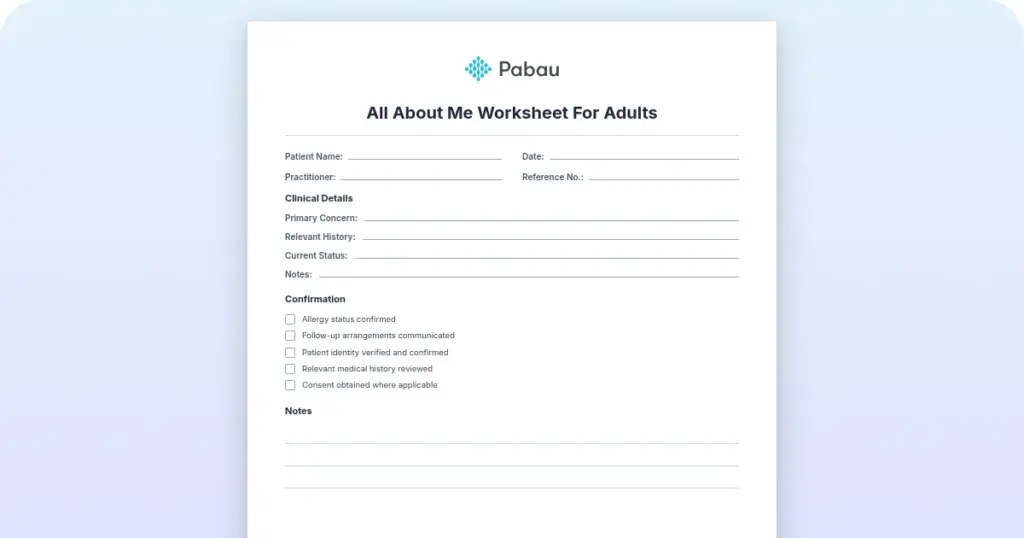
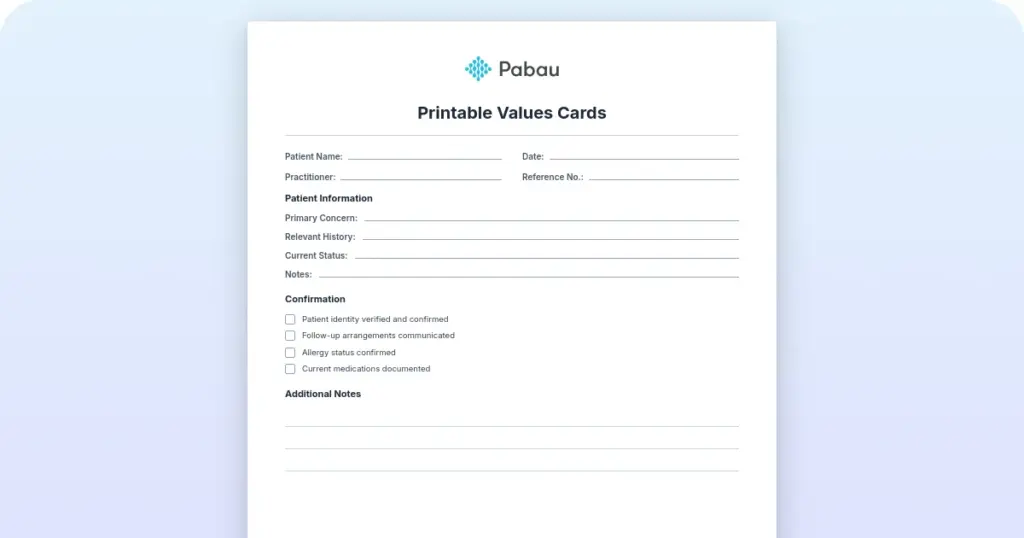
Reflection questions: 14 examples and a free template
Reflection questions are open-ended prompts that guide a person through structur...

8
Last Updated: Oct 16, 2026

Behavior tracking sheets are structured tools that record specific behaviors over time, enabling clinicians to identify patterns, measure progress, and adjust treatment plans based on objective data.
There are five primary data collection methods: frequency, duration, interval recording, ABC data collection, and point sheets. Each serves different clinical goals and behavior types.
Systematic tracking supports IEP documentation, RTI referrals, BIP implementation, and compliance with IDEA and Behavior Analyst Certification Board (BACB) standards for ABA practitioners.
Practice management software like Pabau replaces paper tracking with HIPAA-compliant digital forms and client records, streamlining behavior data capture and improving clinician efficiency and client engagement.
A collection of ready-to-use behavior tracking sheet templates covering frequency recording, duration tracking, interval recording, ABC data collection, and daily behavior monitoring for clinical and therapeutic settings.
Download templateTracking behavioral change is fundamental to therapy, coaching, and special education. Yet many clinicians still rely on memory, rough notes, or inconsistent tallies. That data can’t withstand scrutiny when Individualized Education Program (IEP) paperwork is due, insurance companies ask for evidence, or clinical supervisors request objective metrics.
Behavior tracking sheets solve this. They transform subjective impressions into measurable, defensible records that show exactly what a client did, how often it happened, and whether treatment is working.
This guide walks you through five data collection methods, explains which sheet type fits which behavior, and shows how to integrate tracking into your weekly practice workflow. Whether you work with children in school settings, adults in mental health therapy, or clients receiving Applied Behavior Analysis (ABA) services, you’ll find ready-to-use templates and practical guidance for each.
Clinicians and therapists often ask: Which method should I use? How do I set up data collection so it doesn’t disrupt sessions? How do I explain it to parents and clients? These templates and this guide answer those questions with concrete workflows you can implement immediately.
A behavior tracking sheet is a structured form that records observations of specific client behaviors over a defined period. Rather than relying on memory or vague narrative notes, tracking sheets provide a systematic way to count, time, or describe behavior as it occurs, creating an objective baseline and ongoing progress record.
In clinical practice, behavior tracking sheets serve multiple purposes:
These sheets are used across mental health therapy, school psychology, special education, ABA clinics, coaching practices, and occupational therapy.
A therapist might track panic attacks per week. A special educator might record off-task behavior during math instruction. An ABA practitioner might document the antecedents and consequences of self-injurious behavior. Each uses the same fundamental principle: systematic, objective observation creates actionable data.
Unlike structured clinical evaluation templates that capture comprehensive intake information, behavior tracking sheets focus solely on tracking specific behaviors over time. This narrow focus makes them lightweight, easy to use in real-time, and highly useful for progress monitoring throughout treatment.
Implementation follows five steps: define the target behavior, choose a data collection method, set up a tracking routine, record data in real time, and review the data weekly to adjust as needed. Each step has a specific purpose and common pitfalls to avoid.
The same weekly rhythm works for what the patient records themselves. A weekly wellness planner holds their goals for the week and open write-in boxes for how it went.
A common mistake is tracking too many behaviors at once. Start with one or two target behaviors so data collection does not become burdensome. Once those are established, you can add more.
The method you choose determines how accurately your data reflects the behavior and how easy tracking is to sustain in a busy practice. Here are the five most common approaches, when to use each, and what each reveals.
Frequency works when behaviors have a clear start and stop. Duration captures how long a behavior persists. Interval recording is ideal when you cannot count individual occurrences. For example, a child is either “on-task” or “off-task” at any given moment, and you check every 10 minutes.
ABC methods reveal the function a behavior serves, which is essential for designing interventions that work.
Mental health practices typically manage tools like this inside an EMR built for mental health.
Behavior tracking sheets are standard tools across multiple healthcare and education settings. School psychologists use them during RTI (Response to Intervention) evaluations to document baseline behavior and response to targeted interventions. Special education teachers track target behaviors outlined in IEPs to show progress toward annual goals.
ABA therapists and behavior analysts use tracking data to demonstrate treatment fidelity and client progress.
Mental health therapists track symptoms (panic attacks, depressive episodes, anxiety episodes) to measure treatment effectiveness. Coaching practitioners document behavioral changes in their clients (exercise frequency, habit compliance, communication improvements). Occupational therapists track sensorimotor behaviors and functional independence to support clinical decision-making. Pediatric and family medicine practices use behavior tracking during developmental evaluations and ADHD assessments.
The common thread: whenever clinicians need objective evidence of behavioral change, tracking sheets provide it. Insurance companies, school districts, and families all expect this documentation.
Objective decision-making. Tracking sheets replace opinion with data. Instead of “the client seems better,” you have “frequency of target behavior decreased from 12 per session to 4 per session over six weeks.” This clarity drives treatment adjustments.
Legal and compliance documentation. Schools, insurance companies, and regulatory bodies require objective evidence of progress. Behavior tracking sheets satisfy Individuals with Disabilities Education Act (IDEA) documentation requirements, support BIP implementation verification, and provide audit trails for compliance reviews.
Improved client and family engagement. When parents see specific data showing improvement, they feel more confident in the treatment and are more likely to follow through with home strategies. Transparent, data-driven progress conversations build trust.
Faster intervention adjustments. Weekly review of tracking data prevents months of ineffective treatment. If an intervention isn’t working, you change course within days, not after six months of sessions.
Multi-setting consistency. When parents, teachers, and therapists all use the same behavior definition and tracking method, consistent data flows across home, school, and practice. This reveals whether behaviors are context-specific or pervasive.
Staff training and fidelity. Written tracking protocols ensure that all staff (clinicians, aides, teachers) collect data the same way. This protects the validity of your data and makes supervision conversations concrete.
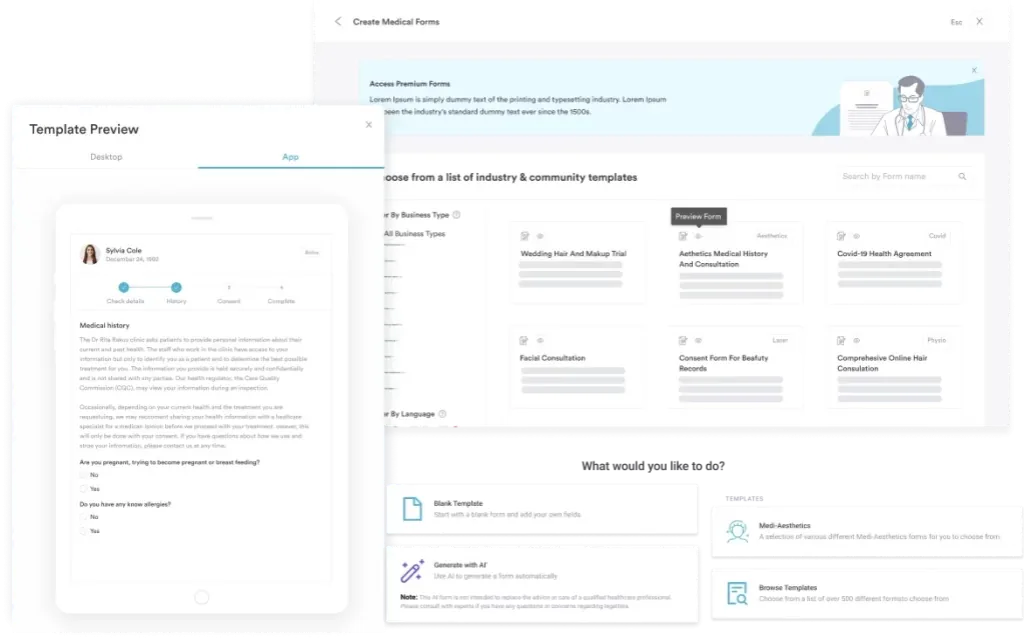
Digital behavior tracking through patient intake software reduces paper clutter, eliminates lost or incomplete sheets, and automatically summarizes data for graphing and reporting.
Define your target behavior so clearly that a stranger could watch the client and reliably identify when it occurs. Avoid words like ‘rude,’ ‘defiant,’ or ‘disruptive.’ Instead, write what you see and hear: ‘rolls eyes, turns away, says no.’ This eliminates observer disagreement and protects the integrity of your data.
Behavior tracking sheets directly support IEP goal progress monitoring. Each IEP goal that addresses behavior (e.g., “Client will raise hand before speaking in group settings, 80% of opportunities per session”) needs objective measurement. Your behavior tracking sheet becomes the evidence of progress toward that goal.
When you write your behavior tracking sheet, align the target behavior and measurement method with the IEP annual goal. If the goal specifies “frequency,” track frequency. If the goal is about “duration of engagement,” use a timer.
This alignment ensures your tracking data directly answers the question: “Is the child making progress on this IEP goal?”
Share tracking data at IEP review meetings every quarter. Show graphs, tallies, and trend lines. Celebrate improvements and revise strategies if progress is slow. Documenting progress with SOAP notes alongside your tracking data creates a complete evidence package that parents and school teams trust.
Behavior change sticks when parents reinforce it at home. Share simplified versions of your behavior tracking sheet with families. Show them exactly which behavior you are tracking, why it matters, and how they can count the same behavior at home.
For example, a therapist tracking “hand-raising” at school and a parent tracking the same behavior during dinner-table conversations both use the same definition and the same tally method. When data comes in from both settings, you see whether the child is generalizing the skill or only performing it in one context.
Family engagement in therapy progress tracking increases session attendance, homework compliance, and real-world behavior change. Parents who understand and contribute to tracking feel invested in the outcome.

Transition from paper behavior tracking sheets to secure, HIPAA-compliant digital forms integrated with your client records. Pabau’s digital forms and automated workflows eliminate manual data entry and keep behavior progress visible to your entire team.

Start small. Track one or two behaviors, not five. Once you establish a routine with one behavior, adding more is easy.
Use consistent definitions. Write the target behavior in one sentence on every form you distribute. Do not vary the wording, or observers will record different things.
Graph your data. A picture is worth 1,000 words. Simple line graphs showing behavior frequency over weeks or months are far more powerful than raw numbers. Clients, parents, and team members all understand a graph immediately.
Build in a consistency check. Every few weeks, have two staff members independently track the same client during the same session. Compare tallies. If they match closely (within 10%), your system is reliable. If not, re-clarify definitions and re-train.
Review weekly. Do not wait for monthly or quarterly reports. Look at data every week so you can spot trends early and adjust interventions quickly.
Document format changes. If you change how you measure a behavior (switching from frequency to duration, for example), note the date clearly on your tracking sheet. This prevents data confusion when you look back months later.
Behavior tracking sheets are the bridge between clinical intuition and objective evidence. They show families that treatment works, give teams the data to make smart adjustments, and create the documentation that schools, insurance companies, and regulators expect. The templates above give you five proven tracking methods. Choose the one that fits your behavior and clinical question.
The hardest part is starting. Print a tracking sheet, define your target behavior clearly, and collect data for one week. You will be surprised at how patterns emerge. See how Pabau’s digital forms streamline this workflow so tracking happens seamlessly during sessions, not as an afterthought on your desk.

Helping a client manage anxiety-driven concerns? circle of control worksheet helps clients sort concerns into what they can control, influence, or must accept.
Running an ADHD clinic? ADHD clinic software integrates symptom tracking, rating scale administration, and progress monitoring into one dashboard.
Need a standardized assessment tool? Vanderbilt ADHD rating scale walks through one of the most common behavior screening tools for clinicians.
Teaching a client about conditioning principles? classical conditioning worksheet walks psychology students through NS, UCS, UCR, CS, and CR with written scenarios.
Managing a patient through alcohol withdrawal? Alcohol withdrawal care plan gives you a structured CIWA-Ar assessment template for documenting nursing care.
Screening for substance use risk? Opioid risk tool helps you assess and document a patient’s risk level before prescribing.
Coaching clients rather than running therapy sessions? coach planner template gives coaches a ready-to-use form for session notes, goals, and billing tracking.
A behavior tracking sheet is a structured form that records specific client behaviors over time using objective methods like frequency counts, duration measurements, interval sampling, or ABC (antecedent-behavior-consequence) notation. It transforms subjective impressions into measurable data that shows progress and informs treatment decisions.
The five main methods are: frequency (counting occurrences), duration (timing how long a behavior lasts), interval recording (marking presence/absence in time blocks), ABC data (documenting triggers and consequences), and point sheets (rating behavior categories on a scale). Choose the method based on whether the behavior is discrete or continuous and what clinical question you need answered.
Write a clear, observable description that anyone could follow. Avoid vague terms like ‘disruptive’ and instead describe what you see and hear: ‘rolls eyes when given directions,’ ‘calls out without raising hand,’ ‘leaves seat without permission.’ The definition must be specific enough that two observers would reliably agree on whether the behavior happened.
Use frequency recording for behaviors with a clear start and end that happen multiple times (hand-raises, interruptions, task refusals). Use duration recording when you care about how long a behavior lasts, such as tantrum length, time spent focused on homework, or length of conversation engagement.
Review your tracking data every week. Weekly review allows you to spot trends early, adjust interventions quickly, and celebrate improvements with clients and families. Do not wait for monthly or quarterly summaries to examine progress. Weekly review turns data into action.
Yes. Align your behavior tracking sheet directly with the target behavior and measurement method specified in the IEP. Track the same behavior and metric throughout the school year so you have clear, quarterly data on progress toward the annual goal. Present graphed data at IEP review meetings to document progress or request goal adjustments.