







HCPCS Code V2513: Contact lens, gas permeable, extended wear, per lens
HCPCS Code V2513: Official descriptor and code definition HCPCS Code V2513 sits ...

Last Updated: Sep 25, 2026

The best behavioral health practice management software for most US practices is SimplePractice. More solo therapists and small counseling groups run it than any other platform here. TherapyNotes takes the lead where in-network claims drive the revenue. Practice management software like Pabau fits multi-discipline teams running therapy, psychiatry, and wellness on one client record.
Behavioral health practices stall when the operational layer around the clinical work breaks down. Claims sit unsubmitted for weeks. No-shows drain revenue quietly, and progress notes get typed late at night instead of between sessions.
This guide compares seven platforms on the criteria that decide a behavioral health shortlist. Those are clinical documentation, HIPAA and 42 CFR Part 2 compliance, billing, telehealth, scheduling, and client engagement. Every price below comes from the vendor’s own pricing page, checked in September 2026.
According to SAMHSA’s National Survey on Drug Use and Health, roughly 59 million US adults experienced a mental illness in 2023. Demand has kept climbing into 2026. Picking the right mental health EMR now shapes how many clients a practice can serve. It also shapes how sustainable the work feels for the clinicians delivering it.

1. SimplePractice — fastest setup and the widest adoption among solo US therapists and small counseling groups.
2. TherapyNotes — deepest in-network claims workflow, with note templates written for behavioral health.
3. Pabau — best for practices running therapy, psychiatry, and wellness on one client record.
4. Valant — specialty psychiatry EHR with measurement-based care and EPCS prescribing built in.
5. TheraNest — lowest sustained price for a growing group practice that bills insurance.
6. ICANotes — point-and-click narrative notes for clinicians who would rather click than type.
7. Carepatron — free HIPAA-aligned workspace for solo cash-pay counselors and coaches.
Here is how the seven platforms stack up across the criteria most behavioral health practices weigh first. Ratings and review counts come from Capterra, checked in September 2026.
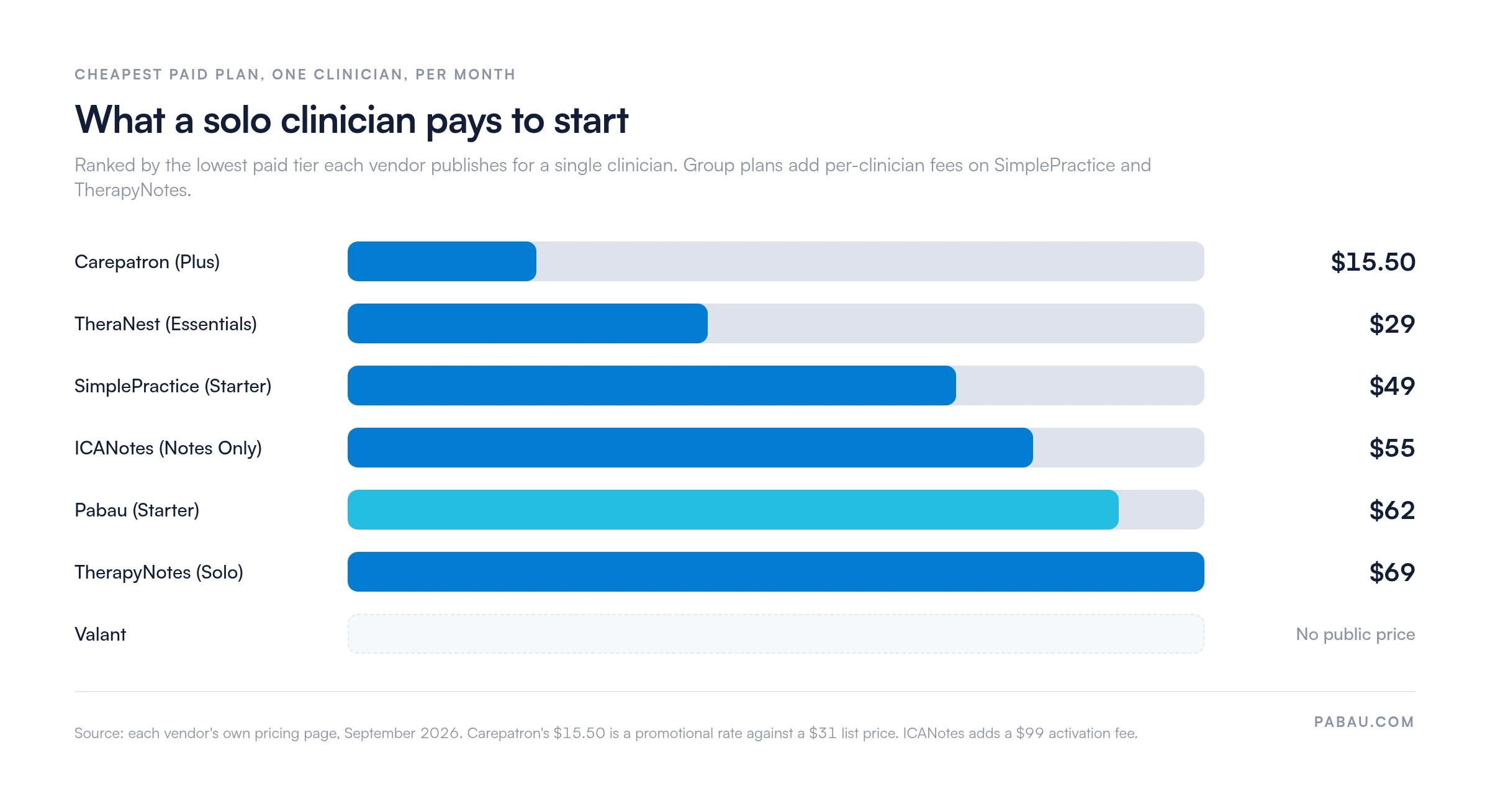
Price is where the field spreads out fastest. The chart below lines up the cheapest paid plan each vendor publishes for a single clinician.
The fastest route from signup to a first paid telehealth session for a solo therapist.
SimplePractice is the most widely adopted platform in US solo private practice mental health. Its 2,819 Capterra reviews run roughly three times deeper than any other platform here. That volume is the clearest signal of category fit on this list.
It is built for the workflow of an individual therapist, or a small group running cash-pay or modest claims volume. The user experience reflects that focus.
The interface is the cleanest in this category. Booking, telehealth, secure messaging, intake, and credit-card billing are all one click apart. SimplePractice’s documentation library includes prebuilt mental health templates. Wiley Treatment Planners are built into the Essential and Plus plans at no extra cost, with objectives and interventions already written.
| Plan | Price | Users | Key inclusions |
|---|---|---|---|
| Starter | $49/month | 1 clinician | Scheduling, notes, client portal |
| Essential | $79/month | 1 clinician | Adds telehealth and Wiley Treatment Planners |
| Plus | $99/month | 1 clinician | Adds insurance claims and group features |
| Plus, each extra clinician | $74/month | 2 to 5 clinicians | $72 at 6 to 15, $69 at 16+ |
Group practices pay the Plus rate for the first clinician and a per-seat fee for everyone after. The bill climbs with headcount.
Onboarding speed and product polish. A solo licensed therapist can be live with bookings, intake, and a first telehealth session in under a day. Customer support reviews are strong on G2 and Capterra, and the product team ships consistent quality-of-life updates.
Per-clinician pricing scales poorly for group practices beyond five clinicians. Cross-discipline workflows like ABA, psychiatry medication management, or integrated wellness are limited. Practices that prescribe controlled substances should confirm EPCS support before they commit. Customization of forms and clinical templates is shallower than dedicated EHRs like Valant or ICANotes.
Solo licensed therapists, counselors, and social workers in the US. Small group practices of two to five clinicians focused on outpatient mental health. Clinicians who prioritize ease of use over depth of customization.
The deepest insurance billing workflow here, wrapped in an interface that shows its age.
TherapyNotes is the platform US behavioral health clinicians most often name when insurance billing is the primary concern. It was built from the ground up for behavioral health rather than retrofitted from a generalist EHR. That shows in the depth of its claims handling and note templates.
Note templates include psychiatry intake, therapy progress notes (DAP and SOAP), termination notes, and treatment plans, each with diagnostic codes and Medicaid-friendly documentation prompts. ERA posting and clearinghouse integration are mature, and claim scrubbing reduces rejection rates compared with general-purpose tools.

| Plan | Price | Users | Key inclusions |
|---|---|---|---|
| Solo | $69/month | 1 clinician | Notes, scheduling, telehealth |
| Group | $79/month | First clinician | Adds group scheduling and supervision |
| Group, each extra clinician | $50/month | Additional clinicians | Same feature set |
| Enterprise | Custom quote | Large teams | Custom terms and onboarding |
TherapyNotes raised these rates in its December 2025 update. Telehealth and electronic claims still carry transaction fees on top of the base plan.
Behavioral health billing depth. If your practice’s revenue depends heavily on in-network claims, TherapyNotes’ claim scrubbing and ERA workflow shorten the receivable cycle. Documentation templates fit how psychiatrists and therapists write notes. TherapyFuel, its native AI scribe, drafts notes and treatment goals inside the same platform.
The interface feels dated compared with SimplePractice and Pabau. Telehealth and electronic claims carry transaction fees on top of the base plan, so the headline price understates the bill. Multi-discipline practices that also offer non-billable wellness services will find the rigid behavioral health framing limiting.
US behavioral health practices billing insurance heavily, including community mental health agencies and Medicaid-heavy group practices. Psychiatry-led practices that want strong documentation prompts. Clinicians who prefer function over polish.
Pabau Scribe writes the session note straight into the client record that already holds the appointment.
Pabau is an all-in-one platform built for practices that run more than one type of behavioral health service under the same roof. A psychology group that also delivers psychiatry, ABA, or wellness coaching does not need three disconnected systems.
Pabau centralizes scheduling, clinical documentation, billing, telehealth, and client communications in one environment. Role-based access controls mean every clinician sees only what their license allows. Therapy and counseling providers can see how Pabau’s therapy practice management software handles scheduling and client care for that specialty.
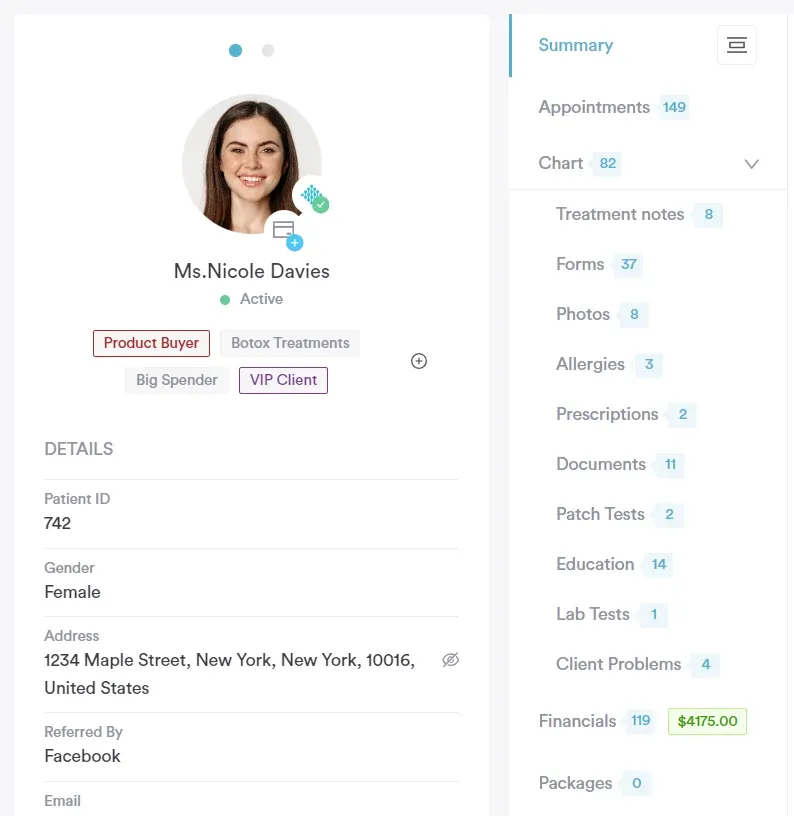
Where Pabau stands apart is clinical documentation. Pabau Scribe, our AI scribe, listens during sessions and generates structured SOAP, DAP, or BIRP notes automatically. Treatment summaries and follow-up tasks arrive ready for the clinician to review and sign. For therapists losing 45 to 60 minutes per client to post-session admin, that changes how the day ends.
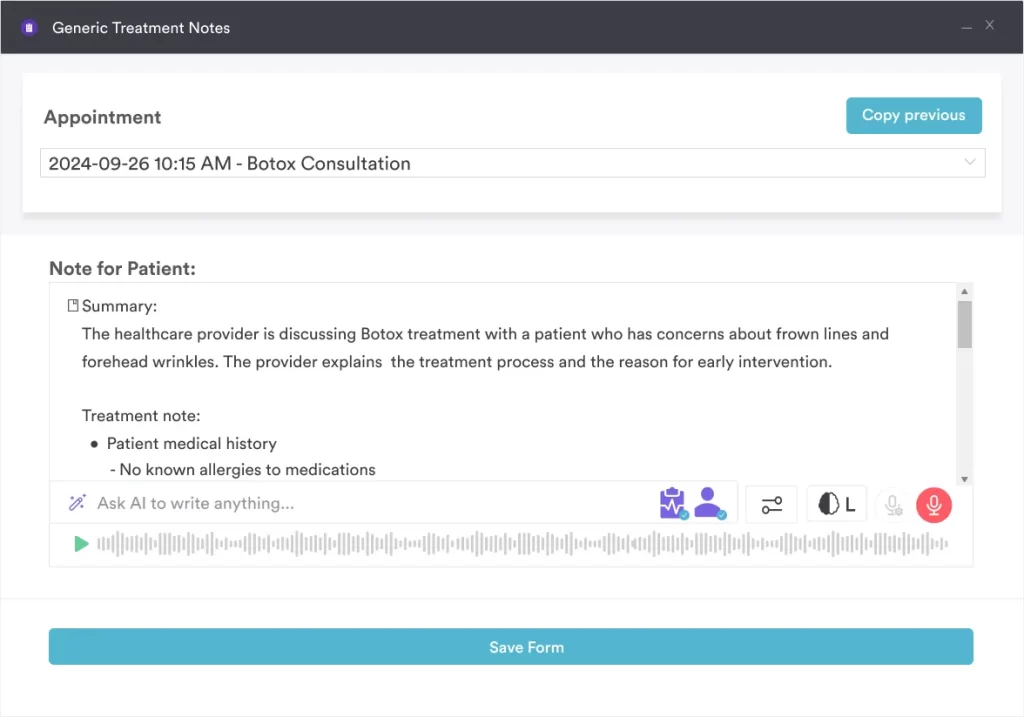
Beyond AI documentation, Pabau’s custom form builder lets practices create discipline-specific templates. Intake, consent, screening, and progress notes can differ across counseling, psychiatry, and integrated care. Multi-location scheduling, automated waitlists, and recurring appointment patterns map cleanly onto how a behavioral health calendar runs.
Screening instruments sit alongside those templates. Our toxic personality screening form, for example, has respondents rate 14 statements across self-reflection, interpersonal relationships, and emotional regulation, then totals each section separately.
| Plan | Price | Users | Key inclusions |
|---|---|---|---|
| Starter | From $62/month | 1 user | Full feature set, up to 100 clients |
| Solo | Custom quote | 1 user | Full feature set, unlimited clients |
| Team to Group | Custom quote | 2 to 15 users | Full feature set, unlimited clients |
| Enterprise | Custom quote | 16+ users | Full feature set, multi-location support |
Every plan carries every feature, and the quote moves with user count and location. Ask for the price band that matches your headcount in 18 months, not the one you have today.
Pabau holds a 4.7/5 rating on Capterra from 651 verified reviews. Practices consistently highlight the depth of customization across forms and workflows, the reliability of the appointment engine, and the time saved on clinical documentation. Reviewers occasionally note that the breadth of features takes time to learn fully, which is the trade-off of an all-in-one platform.
Behavioral health practices that combine therapy with psychiatry, ABA, or integrated wellness services. Group practices ready to scale beyond five clinicians. Multi-location operators who need one calendar and one client record across sites. Practices that want AI documentation built into the platform rather than bolted on through a third party.
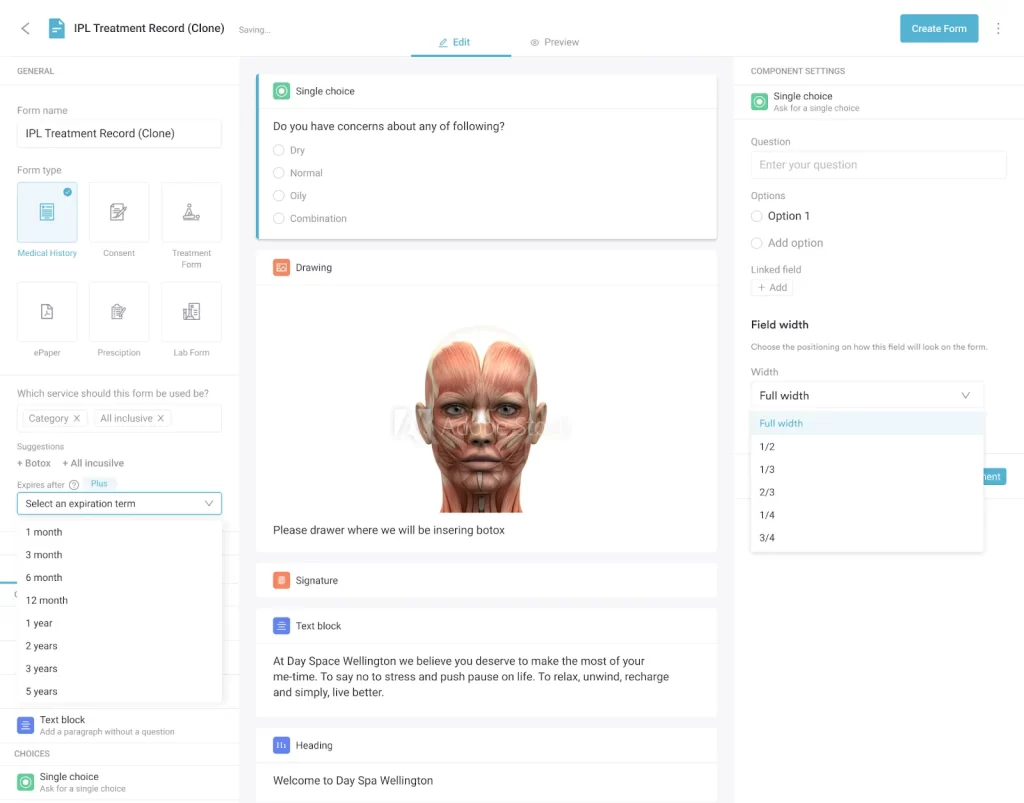
A specialty psychiatry EHR with measurement-based care built in, priced only by quote.
Valant is a specialty behavioral health EHR aimed at group psychiatry practices and community mental health organizations. It is heavier than SimplePractice or TherapyNotes by design, with measurement-based care and outcomes tracking built in.
The Mobile Notes feature lets clinicians document on a phone between sessions. The Measurement-Based Care suite ships PHQ-9, GAD-7, and other instruments that auto-score and surface trends in the chart. E-prescribing with EPCS is integrated for psychiatrists.

| Plan | Price | Users | Key inclusions |
|---|---|---|---|
| Every tier | Contact sales | Per provider | No published pricing |
| Implementation | Contact sales | Per practice | Quoted separately from the subscription |
Valant publishes no prices, so the quote depends on provider count and add-ons such as outsourced billing. Ask for the implementation fee in writing before you compare it with anything else here.
Group psychiatry, community mental health, and substance use programs that need measurement-based care and structured outcomes reporting for funders or accreditation. EPCS prescribing is mature, and telehealth is native rather than a bolt-on.
Onboarding is slow, the interface is dense, and small practices often find the system over-engineered for their needs. Reviewer ratings on G2 and Capterra sit below the cleaner SaaS competitors in this list. Customers cite the learning curve and support response times as friction points.
Group psychiatry practices, community mental health centers, and SUD programs that need outcomes measurement, EPCS prescribing, and structured reporting. Practices that have the operational capacity to run a heavier EHR.
Most of what a small group practice needs, at the lowest sustained price in this list.
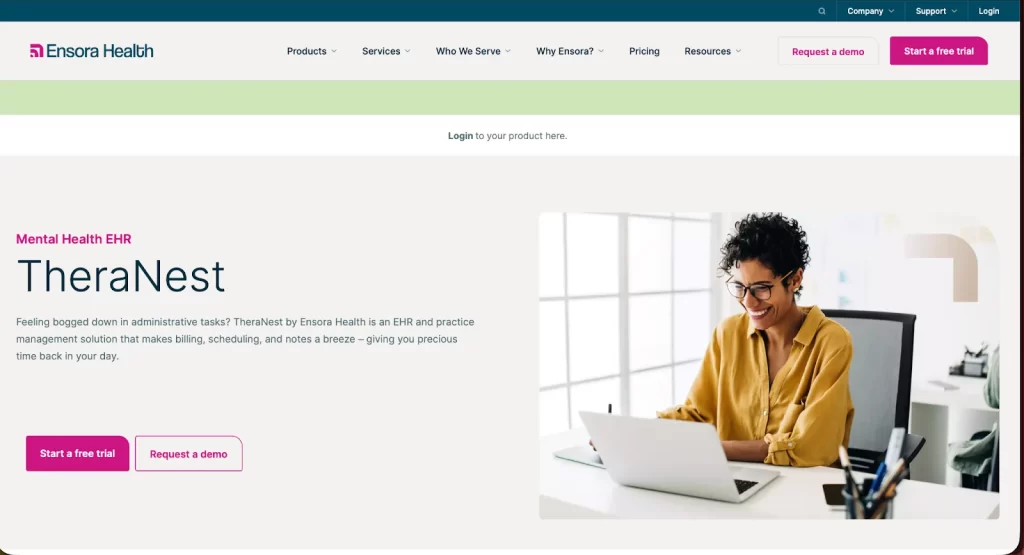
TheraNest, now sold under the Ensora Health brand, sits between the polished SaaS of SimplePractice and the heavier EHRs like Valant. Its appeal is straightforward: a usable platform with most of the features mental health teams need, priced lower than the leaders.
The note library covers a wide set of mental health templates, with Wiley Practice Planner integration on the top Premier tier. Group scheduling, billing, and claims processing all sit in the platform, priced per therapist each month.
| Plan | Price | Users | Key inclusions |
|---|---|---|---|
| Essentials | $29/month | Per therapist | Scheduling, client portal, intake forms |
| Advanced | $59/month | Per therapist | Adds online booking, messaging, unlimited telehealth |
| Premier | $89/month | Per therapist | Adds billing automation and Wiley Practice Planner |
Every TheraNest tier is priced per therapist, so the monthly bill tracks headcount. Annual billing shaves a month off each tier.
The lowest entry price here apart from Carepatron. Supervision and intern workflows are useful for training clinics. Wiley integration cuts treatment-plan writing time on the Premier tier.
The interface feels older than SimplePractice or Pabau. Reviewer feedback on support response is mixed. There is no native AI documentation.
Budget-conscious group practices, training clinics with supervision and intern workflows, and small agencies that want claims processing without a specialty EHR’s price tag.
Point-and-click narrative notes for clinicians who would rather click than type.
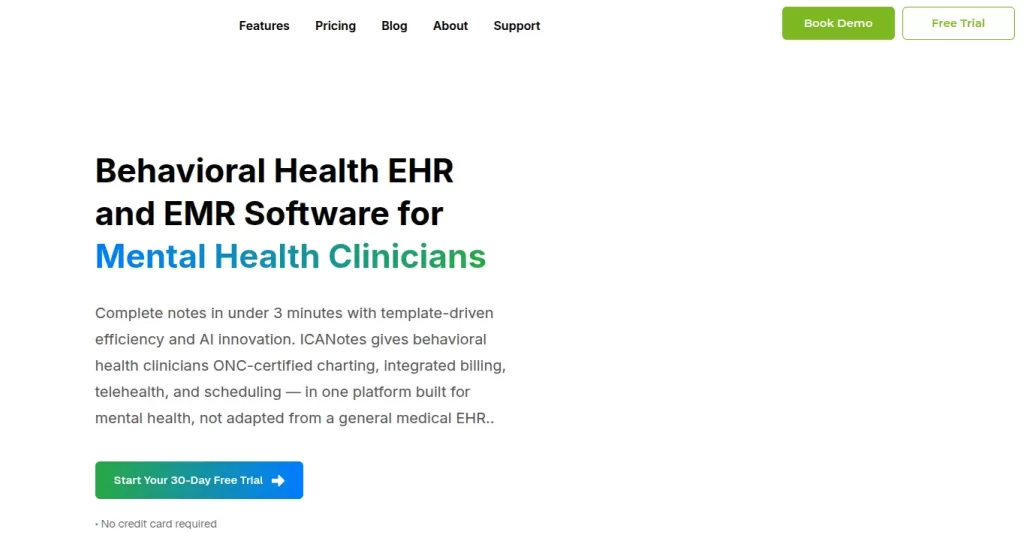
ICANotes is a behavioral health EHR built around documentation. Its signature feature is a point-and-click narrative note system that builds structured paragraphs from clinical button selections. It appeals to clinicians who find free-text note writing slow.
The platform covers psychiatry, therapy, and addiction medicine documentation with sub-specialty templates, including admission notes for inpatient and residential settings. E-prescribing, scheduling, and billing are available, though the documentation engine is the core selling point.
| Plan | Price | Users | Key inclusions |
|---|---|---|---|
| Notes Only | $55/month | 1 full-time clinician | Unlimited notes, non-prescribers only |
| Non-Prescribing | $75/month | 1 full-time clinician | Adds scheduling, messaging, billing |
| Prescribing | $213/month | 1 full-time clinician | Adds e-prescribing, medication management, labs |
| Part-time plans | $35 to $138/month | 1 part-time clinician | Monthly note caps apply per tier |
Part-time clinicians pay less but work to a monthly note cap. Both prescribing plans add a $99 activation fee, and telehealth is a $20 per user add-on.
Documentation speed for clinicians who hate typing. Clinical depth for inpatient, residential, and addiction medicine. Strong audit trails for accreditation and Medicaid reviews.
The interface looks dated and the click-driven note workflow takes time to feel natural. Telehealth is not as polished as competitors. Reporting and analytics are limited compared with newer platforms.
Behavioral health clinicians who prioritize narrative note depth, addiction medicine and inpatient programs, and Medicaid-heavy practices that face frequent documentation audits.
A free, HIPAA-aligned workspace that covers notes and scheduling, but not US claims.
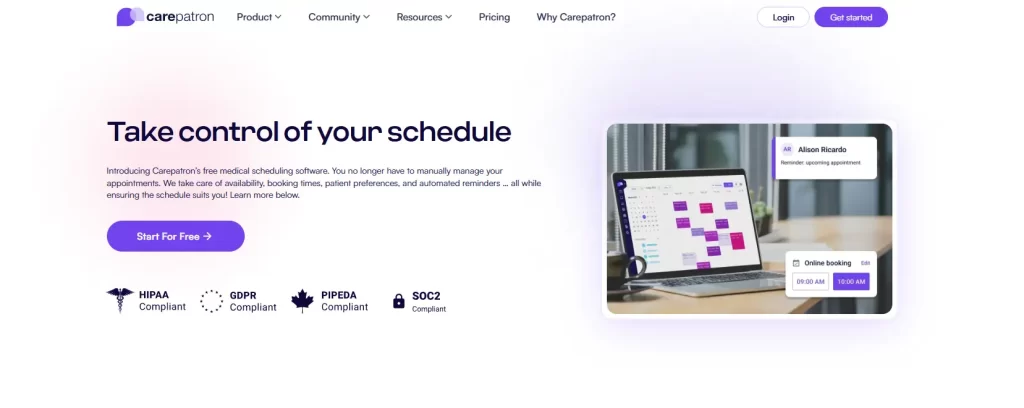
Carepatron is the lightest platform on this list. It targets solo cash-pay clinicians, coaches, and small wellness practices that want HIPAA-aligned essentials without the cost or complexity of a full EHR.
The free tier covers scheduling, a client portal, notes, telehealth, and Stripe-based payments. Paid tiers add team workflows, custom branding, and integrations. It is closer to a digital workspace than a traditional behavioral health EHR.
| Plan | Price | Users | Key inclusions |
|---|---|---|---|
| Free | $0/month | Per user | Unlimited clients, telehealth, client portal, AI note taker |
| Plus | $15.50/month | Per user | Adds unlimited storage, group scheduling, advanced workflows |
| Advanced | $19.50/month | Per user | Adds roles and permissions, white labeling, onboarding manager |
Those Plus and Advanced rates are promotional, at half price for six months. The list prices are $31 and $39 per user, so budget for the step up.
Free tier and very low-cost paid tiers. Clean modern interface. Strong template library for clinicians who want pre-built intake and progress note forms.
Limited insurance billing depth, no native clearinghouse integration in the US, and shallow reporting. Group practice features are weaker than dedicated behavioral health platforms.
Solo cash-pay therapists and counselors, coaches, and small wellness practices. Clinicians starting a private practice who want a free starting point before committing to a paid platform.
Platform choice looks straightforward on a feature matrix, then gets complicated the moment a practice’s own workflow enters the conversation. A solo counselor in Brooklyn runs almost none of the same operations as a 15-clinician psychiatry group in Phoenix. Use these five criteria to narrow the field before scheduling demos.
Finish with one practical check. Book demos with your two shortlisted platforms and bring your most complex scheduling or documentation scenario. Watch who solves it live, and who promises a workaround on the roadmap.
Most multi-discipline practices end up with three systems. The therapy side runs on one EHR, psychiatry prescribes in another, and the wellness arm books through a separate calendar. Reception re-keys the same client three times, and nobody can answer a simple question about capacity.
Pabau holds one client record for all of it. The appointment, the intake form, the progress note, and the invoice sit on a single timeline. Role-based access keeps each clinician to what their license allows, so a coach never opens a psychiatry chart.
Pabau Scribe drafts the SOAP, DAP, or BIRP note while the session is still fresh. The clinician reviews it, signs, and the note lands in the record that already holds the next appointment. Practices running that loop stop paying for documentation with their evenings.

Pabau Scribe drafts the session note, and integrated telehealth, reminders, and multi-discipline forms handle the rest of the operational layer. Book a demo and walk through your hardest scheduling or documentation scenario.

Behavioral health practices plateau when administrative work outpaces clinical capacity. Claims sit unsubmitted. Notes get typed late. Schedulers spend their afternoons playing phone tag with no-shows.
Match the platform to the bottleneck rather than to the feature list. Solo therapists and small counseling groups start fastest on SimplePractice. Practices whose revenue rides on in-network claims should shortlist TherapyNotes. Multi-discipline teams running therapy, psychiatry, and wellness together get more from one shared client record.
Whichever way you lean, price the platform at the headcount you expect in 18 months, not the one on payroll today. To see how Pabau handles a multi-discipline behavioral health workflow, book a demo and bring the scheduling scenario you find hardest.

Struggling to fill your appointment book? Behavioral health marketing strategies covers ways to reach the people who need care and never receive it.
Shortlist focused on mental health-specific tools? The top 7 mental health software guide compares additional US-focused platforms alongside the seven covered here.
Evaluating EHRs specifically rather than full practice management? The best EHR software for mental health narrows the lens to clinical documentation systems.
SimplePractice is the strongest all-round choice for solo US therapists and small counseling groups, and it carries the deepest adoption in the category. TherapyNotes leads on insurance billing depth for practices billing in-network. Pabau suits multi-discipline teams combining therapy, psychiatry, and integrated wellness, with AI-native documentation through Pabau Scribe.
Behavioral health practice management software includes note templates such as SOAP, DAP, and BIRP that match therapy and psychiatry workflows. It also carries billing tuned for behavioral health payers, plus stricter handling of substance use records under 42 CFR Part 2. A general EHR optimizes for primary or specialty medical care and rarely covers these documentation and compliance requirements out of the box.
Entry pricing for one clinician runs from $15.50 a month on Carepatron to $69 on TherapyNotes. SimplePractice starts at $49, TheraNest at $29, ICANotes at $55, and Pabau at $62. Group pricing adds per-clinician fees on SimplePractice, TherapyNotes, and TheraNest. Valant publishes no prices and quotes per provider.
All seven platforms in this comparison provide HIPAA-aligned features including encryption, audit trails, and a Business Associate Agreement. Compliance is not binary, so review each vendor’s BAA terms, access controls, and breach notification commitments before signing. Practices handling substance use disorder records must also confirm 42 CFR Part 2 segmentation and consent handling. Those rules are stricter than HIPAA on disclosure controls.
All seven platforms here include native HIPAA-aligned video sessions tied to scheduling and client records. Valant runs Valant Telehealth inside its MIYO patient portal, with Zoom and doxy.me as optional add-ons. Where telehealth is a primary delivery channel, test video quality and the waiting room experience during demos.
For psychiatry-led group practices and community mental health centers, Valant offers the deepest specialty workflow with EPCS prescribing and measurement-based care. TherapyNotes is a strong alternative for psychiatry-heavy practices that prioritize billing and want a lighter EHR. Pabau fits psychiatry combined with therapy, ABA, or wellness services under one platform.