CPT code 93503: Swan-Ganz catheter billing and modifiers
CPT code 93503: Official descriptor and procedure overview In the AMA CPT code s...

Last Updated: Oct 23, 2026
Billable Code Specific Code
M45.6 is the billable ICD-10-CM code for ankylosing spondylitis lumbar region.
Let Pabau's smart automation suggest the right codes, reduce claim denials, and keep your practice compliant—effortlessly.
Automate repetitive tasks and focus on what matters most—your patients.
Reduce coding errors and ensure compliance with the latest regulations.
Clean claims, fewer denials, and faster reimbursements.
Powerful insights and reporting to help your practice thrive.
HIPAA compliant SOC 2 certified GDPR-compliant Trusted by 4,000+ clinics worldwide

ICD-10 code M45.6 is the billable ICD-10-CM diagnosis code for ankylosing spondylitis of the lumbar region, valid for FY2026 claims.
The FY2026 edition took effect on October 1, 2025. Always confirm the current fiscal year before you submit.
Using M45.9 for unspecified site when the lumbar region is documented is a common and auditable coding error.
Non-radiographic axial spondyloarthritis has its own codes inside M45, the M45.A series, so M46.x is the wrong destination.
Practice management software like Pabau ties the documented spinal region to the claim, so specificity errors surface before submission.
M45.6 is valid for use in FY2026 claims and became effective on October 1, 2025 under the CMS annual ICD-10-CM update. The code comes from the International Classification of Diseases, 10th Revision, Clinical Modification. That US adaptation is maintained jointly by CMS and the National Center for Health Statistics under HIPAA.
Ankylosing spondylitis (AS) is a chronic inflammatory arthritis that mainly affects the axial skeleton. The lumbar spine is one of the most common sites of clinical involvement. That makes M45.6 one of the most frequently used codes in the M45 category. Below is the at-a-glance reference for this code.
Ankylosing spondylitis is a seronegative spondyloarthropathy marked by chronic inflammation of the spinal and sacroiliac joints. It leads to progressive ankylosis, or fusion, of vertebral segments over time. The lumbar spine is often the first or most prominently affected region. Patients present with inflammatory back pain that is worse at rest and improves with movement.
Region coding matters because AS can affect several spinal segments, and payers expect the submitted code to match the documented site. A note that says only “ankylosing spondylitis” leaves the coder with no basis for anything more specific than M45.9. For physical therapy EMR users treating musculoskeletal patients, region-specific documentation from the referring clinician is what drives accurate code selection.
Key clinical indicators that support the M45.6 diagnosis:
HLA-B27 positivity appears in roughly 90% of AS patients, according to the NIH’s StatPearls review. Its presence supports the diagnosis but does not replace physician documentation of confirmed AS in the lumbar region. A coder cannot infer M45.6 from a positive marker alone.
ICD-10 Code M45.6 sits within the M45 category, which covers ankylosing spondylitis across all spinal regions. The parent code M45 is not billable on its own. Coders select the 4th-character subcode that matches the documented spinal region. The CDC/NCHS ICD-10-CM web tool lists every valid M45 code for the current fiscal year.
When AS affects both the lumbar region (L1-L5) and the lumbosacral junction, the correct code shifts to M45.7. When documentation confirms involvement at multiple distinct spinal levels, M45.0 applies. M45.9 covers an unspecified site only, never a site that is known but left out of the note.
The M45 category also carries the M45.A series for non-radiographic axial spondyloarthritis, added effective October 1, 2021. Those codes follow the same regional pattern, so M45.A6 is the lumbar entry. They are not interchangeable with M45.6, which requires radiographic AS.
Payers expect the clinical record to substantiate every element of a submitted diagnosis code. For M45.6, the documentation must establish both the diagnosis and the anatomical site. Maintaining structured client records with diagnosis-specific fields reduces the risk of medical necessity denials.
The AAPC ICD-10-CM coding guidelines reinforce one rule above all others. The physician must document both the confirmed diagnosis and the affected region, and coders cannot infer either element.
Practices running practice management software can build note templates with a mandatory diagnosis and site field. That prompts clinicians to capture what coders need, which cuts query volume and shortens billing cycles.
ICD-10-CM uses two types of excludes notes, and they carry different coding implications. Getting them wrong produces unbundling errors or false claim submissions. Using compliance management tools inside your EHR helps flag excludes conflicts before submission.
For the M45 category, the key Excludes1 note covers arthropathy in Reiter’s disease (M02.3-). Coders must not assign M45.6 alongside reactive arthritis codes when the spondylitis is attributable to Reiter’s disease rather than primary AS. If the record describes both conditions at different anatomical sites, query the physician before proceeding.
Non-radiographic axial spondyloarthritis (nr-axSpA) is not coded to M45.6, but it does sit inside the M45 category. ICD-10-CM added dedicated M45.A subcodes for it, effective October 1, 2021, running from M45.A0 through M45.A9. For lumbar nr-axSpA, that code is M45.A6. Reaching for M46.x instead is a coding error, not a conservative choice.
Coding audits for ankylosing spondylitis claims surface the same mistakes again and again. The list below reflects patterns that show up in rheumatology audits and in wider medical billing reviews. Catching them before submission is faster than appealing a denial.
Run a quarterly audit on your M45.x submissions. Pull every claim coded M45.9 and cross-check it against the clinical note. Any case with a documented spinal site should be recoded to the region-specific M45.x variant. That one correction resolves most specificity-related denials in rheumatology billing.
Practices that keep legacy claims data or process late submissions for prior periods sometimes need to cross-reference ICD-9-CM against ICD-10-CM. The General Equivalence Mappings (GEMs), documented by ResDAC, provide the official crosswalk framework. ICD-10-CM offers greater anatomical specificity than ICD-9-CM, so the conversion is approximate.
ICD-9-CM 720.0 mapped to every ankylosing spondylitis diagnosis without distinguishing spinal level. Under ICD-10-CM, that single code fans out across ten M45 subcodes based on the documented site. When converting legacy records, review the original clinical note to assign the right regional subcode. Defaulting to M45.9 without that review is inaccurate.
Ankylosing spondylitis rarely presents in isolation. Coders working with AS patients meet co-occurring and differential diagnoses, from degenerative disease such as M17.5 to systemic inflammatory conditions such as M35.2.
For practices that run on sports medicine software, musculoskeletal comorbidities are especially common. The same patient may carry an inflammatory diagnosis and a mechanical injury, and each documented condition gets its own code.
Accurate diagnosis coding starts in the clinical note, long before a claim is submitted. When documentation is structured and linked to billing, what the physician records and what the coder submits stay in step. Practice management software like Pabau is built for that handoff. Checking insurance eligibility before the visit catches terminated coverage while the appointment can still be rescheduled.
Pabau’s claims management software connects clinical documentation to the billing workflow, so fewer manual handoffs sit between the note and the claim. Practices can build condition-specific note templates that prompt clinicians to record the affected spinal region alongside the confirmed diagnosis. Coders working on M45.6 claims then have what they need without raising a query.
For a lumbar AS workup, that detail is what supports the site-specific code later.
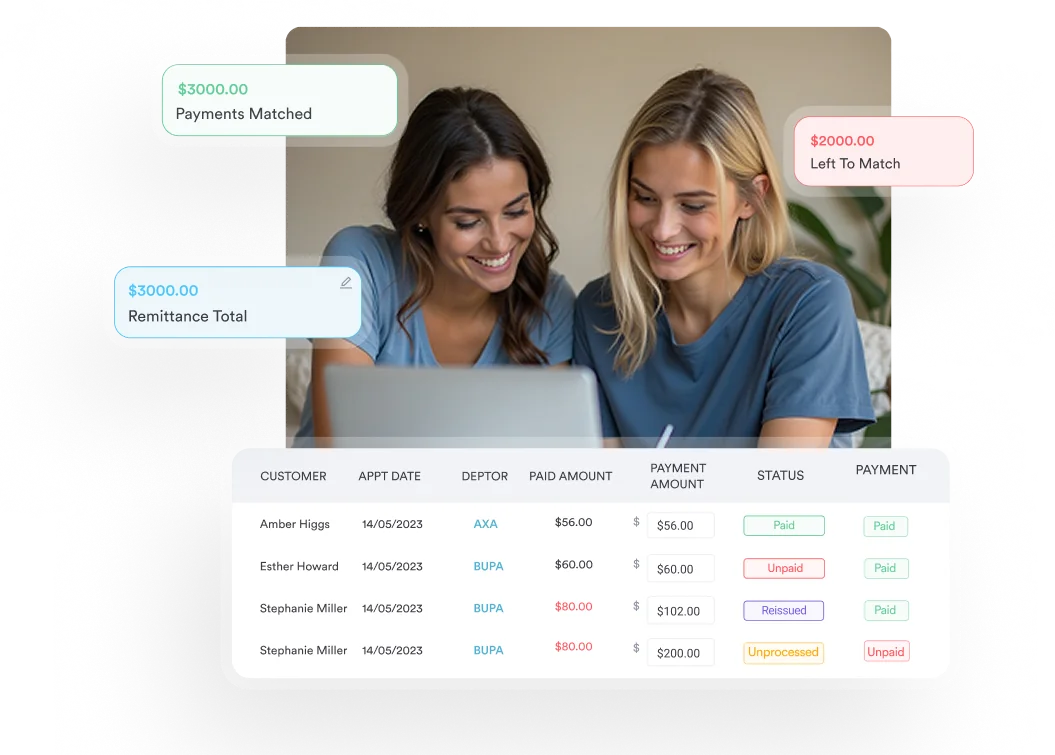
For rheumatology and musculoskeletal practices managing chronic conditions like AS, the returns compound over time. Fewer denials, faster resubmissions, and cleaner audit trails all follow from one accurate note.
Build a lumbar AS note template with a mandatory field for spinal region. A rheumatologist who records ‘ankylosing spondylitis, lumbar spine affected’ in a structured field gives the coder everything M45.6 needs, with no query. One template, zero ambiguity.

Connect clinical documentation to billing in one platform. Reduce M45.6 denials with structured note templates and integrated claims management.

The only thing standing between M45.6 and a denial is a note that names both the diagnosis and the lumbar spine. Build that habit into the record and code selection takes care of itself.
If your practice codes AS regularly, start with the note template rather than a tighter review step. A mandatory site field costs a clinician two seconds and saves the coder a query. Book a demo to see how Pabau links lumbar AS documentation to the claim that follows.

Coding another systemic inflammatory diagnosis? M31.0 walks through hypersensitivity angiitis and the documentation payers expect on vasculitis claims.
Need the necrotizing vasculopathy codes? M31.8 sets out what belongs in the other specified category and what does not.
Separating degenerative arthritis from inflammatory disease? M18.4 explains secondary osteoarthritis coding at the first carpometacarpal joints.
Documenting a lumbar or sacral nerve injury? S34.5XXA covers initial-encounter coding for the lumbar, sacral, and pelvic sympathetic nerves.
Seeing jaw involvement in a spondyloarthritis patient? M27.9 explains when an unspecified jaw diagnosis is defensible.
ICD-10 Code M45.6 is the billable ICD-10-CM diagnosis code for ankylosing spondylitis of the lumbar region. It is valid for FY2026 claims, became effective October 1, 2025, and falls under Chapter 13 of ICD-10-CM (diseases of the musculoskeletal system, M00-M99).
Yes. M45.6 is a billable and specific ICD-10-CM code valid for use in FY2026 diagnosis and reimbursement submissions. It requires physician documentation of confirmed ankylosing spondylitis with the lumbar region identified as the affected site.
M45.6 specifies ankylosing spondylitis of the lumbar region. M45.9 is used only when no spinal site has been documented. When the lumbar region is recorded in the clinical note, M45.6 is the correct code. Using M45.9 for a documented lumbar case is a common specificity error that invites payer scrutiny.
The physician must explicitly document a confirmed ankylosing spondylitis diagnosis and identify the lumbar spine as the affected region. Supporting evidence such as imaging findings, HLA-B27 status, or inflammatory markers strengthens the clinical record but does not replace the diagnostic statement.
No. Ankylosing spondylitis with radiographic confirmation maps to M45 codes, including M45.6. Non-radiographic axial spondyloarthritis has its own subcodes inside M45, the M45.A series, with M45.A6 covering the lumbar region. Verify the physician’s documented imaging evidence before selecting M45.6.
The closest ICD-9-CM equivalent is 720.0 (Ankylosing spondylitis). ICD-9-CM did not distinguish between spinal regions, so a single code mapped to all AS diagnoses. Under ICD-10-CM, 720.0 converts to multiple M45 subcodes depending on the documented spinal site. Converting legacy claims requires reviewing the original clinical note rather than defaulting to M45.9.