Mental health self-care checklist
A mental health self-care checklist is a structured daily tool for tracking the ...

6
Last Updated: Oct 20, 2026

The opioid risk tool (ORT) is a validated, self-report screening instrument that estimates how likely a patient is to misuse opioids when prescribed them for chronic pain.
The original ORT scores risk as 0-3 (low), 4-7 (moderate), and 8 or higher (high); the revised ORT-OUD simplifies this to ≤2 (low) and ≥3 (high) for opioid use disorder specifically.
Administer the ORT at the initial visit before starting or continuing opioid therapy, and record the score in the patient’s chart for continuity and compliance.
Practice management software like Pabau lets clinicians capture, score, and track opioid risk tool results inside the patient record, so screening history stays with the rest of the chart over time.
Opioid Risk Tool template
A validated, self-report questionnaire that helps clinicians identify patients at risk for opioid misuse. Covers family history, personal substance-use history, age, and psychological factors, with built-in scoring and interpretation guidance. Download the PDF and use it at intake.
Download templateThe opioid risk tool (ORT) is a short, self-report questionnaire that scores a patient’s likelihood of misusing opioids before you start or continue opioid therapy for chronic pain. It takes about a minute to complete and sorts patients into low, moderate, or high opioid risk so you can match monitoring to the person in front of you.
This guide covers how to administer the opioid risk assessment tool, how to read each scoring band, when to reassess, and how the ORT compares with other opioid screening tools. Download the free PDF template above, then use the sections below to put it to work.
The opioid risk tool is a validated screening instrument that clinicians use to assess the likelihood a patient will develop opioid abuse or addiction when prescribed opioids for chronic pain, including conditions billed under M47.9 or M81.6.
Developed by Lynn R. Webster, MD, this ORT screening tool has become a standard in pain management, primary care.
The tool evaluates several risk factors at once: personal and family history of substance abuse, age, a history of preadolescent sexual abuse, psychological conditions (depression, anxiety, bipolar disorder, OCD, ADHD), and current alcohol or drug use. Scoring these domains sorts patients into low, moderate, or high-risk groups. That risk category then informs prescribing decisions and how closely you monitor.
The original opioid risk tool differs from the revised opioid risk tool (ORT-OUD), developed in 2019 to predict opioid use disorder specifically in patients with chronic non-malignant pain. Both versions remain in use, so knowing which one you are scoring matters, particularly as clinical guidelines increasingly recommend validated screening before opioid therapy.
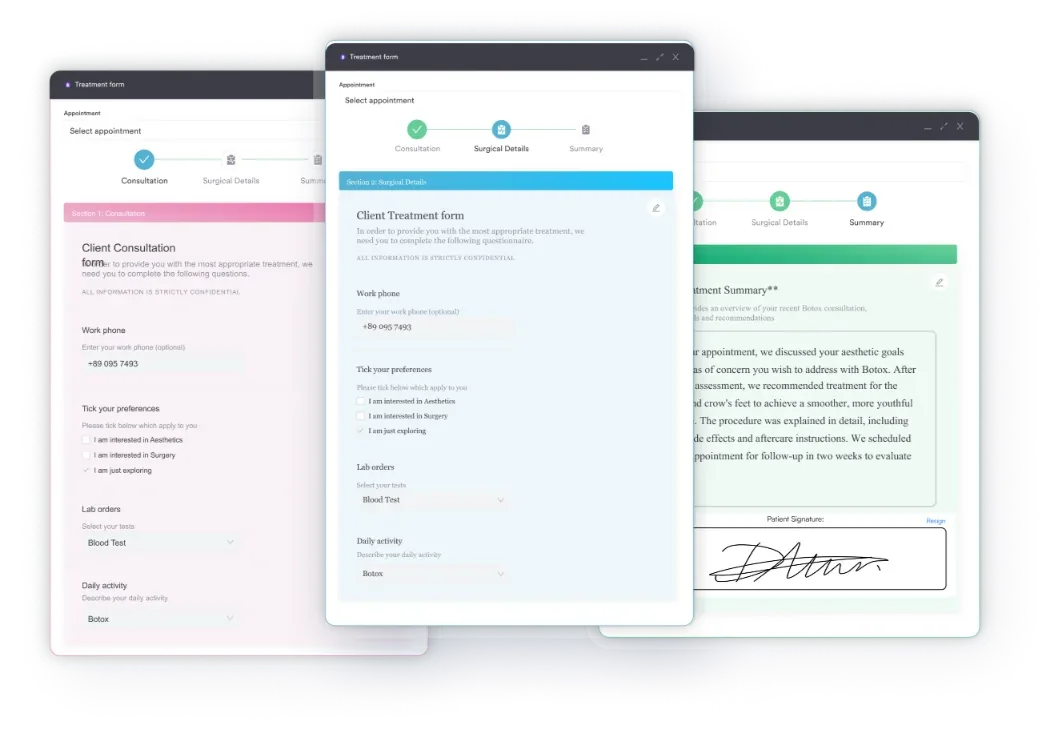
Administering the opioid risk tool through digital intake forms keeps assessment consistent and the results documented. The ORT is a self-report questionnaire, so patients can complete it on paper, a tablet, or an online form before the visit. The process breaks into five steps that fit clinical workflow:
Correct scoring is what makes the screen useful, because the same number drives different clinical responses. The original ORT uses three risk bands, and each ORT score maps to a different level of oversight:
The revised ORT-OUD simplifies the ORT score into two categories: 2 or lower is low risk for opioid use disorder, and 3 or higher is high risk. This version was designed specifically to predict OUD, which makes it useful in specialist settings focused on opioid use disorder prevention and treatment.
Both versions share a key limit: the ORT is a screening aid, not a diagnostic test. It cannot diagnose opioid use disorder. It flags patients who warrant closer monitoring or further evaluation, so read every result alongside patient history, behavioral observations, and other clinical markers.
A high opioid risk tool score is not a reason to withhold pain treatment. Patients who screen high still need effective analgesia. The score signals a need for closer monitoring, non-opioid or multimodal options where they fit, and, in some cases.
Pairing this scale with digital measurement tracking turns individual scores into longitudinal trend lines your whole team can read. A private practice seeing clients weekly needs the last note available before the next appointment starts.
Initial opioid consultation: Administer the ORT before writing the first opioid prescription. This baseline assessment guides the whole treatment relationship and signals to the patient that risk screening is part of standard care.
Dose escalation: If a patient requests a higher dose or has been on stable therapy for months, re-administer the ORT to catch new risk factors, such as mood changes, increased alcohol use, or new psychiatric symptoms. Document the comparison between the baseline and current scores.
Annual comprehensive review: Even low-risk patients benefit from annual ORT readministration as part of routine pain management renewal.
Telehealth and remote intake: The ORT suits automated intake workflows in telehealth settings. Patients complete the questionnaire digitally before the visit, and you review and discuss results during the consultation, saving time and keeping screening consistent across providers.
Several validated opioid screening tools exist for misuse and opioid use disorder. Knowing the differences helps you pick the right instrument for your patient population and clinical setting:
The ORT remains the most widely used initial opioid misuse screening tool thanks to its brevity, strong validation, and ease of use in busy settings. Many practices still pair it with SOAPP-R or DIRE for moderate and high-risk patients to build a more granular risk profile.

Pabau’s digital forms and integrated clinical records make it easy to administer, score, and track opioid risk assessments. Capture ORT results at intake, generate compliant documentation, and follow each patient’s risk over time, all in one platform.

The opioid risk tool is an evidence-based screen that helps you identify patients at elevated risk for opioid abuse or addiction before therapy starts. Administer it at the initial visit and track scores over time, and you can make safer prescribing decisions and set monitoring intensity to match each patient’s risk.
Consistent documentation and workflow are what turn a one-off screen into ongoing safety. Building opioid risk screening into your clinical record system keeps scores captured, retrievable, and useful for long-term care. Download the free opioid risk tool template above and start folding systematic risk screening into your pain management practice.

Screening for social isolation as well? UCLA loneliness scale template gives you a structured way to screen for and document loneliness during intake.
Guiding clients through a tough financial decision? Want vs need worksheet helps clients separate what matters from what does not before spending.
Need a mindfulness tool for high-risk clients? Wise Mind Worksheet guides clients through a foundational DBT mindfulness skill for clearer decision making.
The opioid risk tool is a validated screening instrument used to assess the risk that a patient will develop opioid abuse or addiction when prescribed opioids for chronic pain. Clinicians administer it before opioid initiation to guide prescribing decisions and monitoring intensity, sorting patients into low, moderate, or high-risk categories.
On the original ORT, a score of 8 or higher indicates high risk for opioid abuse. High-risk patients need enhanced oversight, such as frequent follow-ups, urine drug screening, and consideration of non-opioid alternatives. The revised ORT-OUD uses a simpler threshold: a score of 3 or higher indicates high risk for opioid use disorder.
Clinicians sum points from five domains: family history, personal substance-use history, age, preadolescent sexual abuse history, and psychological conditions. The original ORT uses three categories: 0-3 (low), 4-7 (moderate), and 8+ (high). Each band guides monitoring intensity and prescribing decisions, and the result should be documented in the patient’s medical record.
Yes. The original ORT has been validated across multiple clinical settings and patient populations, and its reliability is well established in peer-reviewed literature. The revised ORT-OUD was published in The Journal of Pain in 2019 and has shown good predictive validity for opioid use disorder in chronic pain populations.
The original ORT uses a three-category system (0-3 low, 4-7 moderate, 8+ high) and assesses general opioid abuse risk. The revised ORT-OUD simplifies scoring to two categories (2 or lower low, 3 or higher high) and was designed to predict opioid use disorder in chronic pain patients. The ORT-OUD is useful in specialist pain and addiction medicine settings.
Yes. The ORT is a self-report questionnaire, so patients can complete it on paper, a tablet, or an online form. Clinicians then review and discuss the results during the consultation. Digital intake forms improve patient engagement and keep screening results documented in the medical record.
It depends on the version. On the original ORT, a score of 3 falls in the low-risk band (0-3). On the revised ORT-OUD, a score of 3 or higher signals high risk for opioid use disorder. Confirm which version the form uses before acting on the number.
There is no CPT code specific to the ORT. Administering a standardized risk-assessment instrument like it is often reported with CPT 96160 (patient-focused health risk assessment with scoring and documentation), but the correct code and coverage depend on your payer and documentation. Check payer policy before billing.