ICD-10 Code S42.444P: Medial epicondyle fracture, right humerus
ICD-10 Code S42.444P: full descriptor and code validity ICD-10 Code S42.444P car...

Last Updated: Oct 13, 2026
Billable Code Specific Code
H16.9 is the billable ICD-10-CM code for unspecified keratitis.
Precision matters throughout ophthalmic coding. Unspecified codes like H18.9 face the same payer scrutiny as keratitis, and the documentation standards below apply to both.
Let Pabau's smart automation suggest the right codes, reduce claim denials, and keep your practice compliant—effortlessly.
Automate repetitive tasks and focus on what matters most—your patients.
Reduce coding errors and ensure compliance with the latest regulations.
Clean claims, fewer denials, and faster reimbursements.
Powerful insights and reporting to help your practice thrive.
HIPAA compliant SOC 2 certified GDPR-compliant Trusted by 4,000+ clinics worldwide

ICD-10 Code H16.9 is a billable diagnosis code for unspecified keratitis (corneal inflammation where no specific subtype is documented)
Use H16.9 only when clinical findings do not support a more specific keratitis code. Payers may audit for specificity
Unlike most H16 subcodes, H16.9 carries no laterality digit, which can trigger payer edits when used with unilateral procedure codes
Practice management software like Pabau tracks claim status and reconciles payments, helping ophthalmic practices catch and resolve H16.9 denials faster
ICD-10 Code H16.9 represents unspecified keratitis, classified under the broader H16 category (Keratitis) within chapter H00-H59 of the ICD-10-CM tabular list, which covers diseases of the eye and adnexa.
Keratitis is inflammation of the cornea, the transparent front surface of the eye. The “unspecified” designation means the clinical record does not identify the keratitis type with enough detail to assign a more specific subcode.
Per the CDC/NCHS ICD-10-CM web tool, H16.9 is a billable/specific code effective for dates of service on or after October 1, 2015, when the United States transitioned from ICD-9-CM to ICD-10-CM under HIPAA mandate. It maps directly from the ICD-9-CM predecessor code 370.9 (Unspecified keratitis).
According to the WHO ICD-10 browser, keratitis (H16) broadly encompasses all non-ulcerative inflammatory conditions of the cornea. H16.9 sits at the end of the category as the residual code when no subtype applies. Clinicians and coders should treat it as a coding option of last resort, not a default.
This is where practices lose the most claims. Most H16 subcodes require a laterality digit (1 = right eye, 2 = left eye, 3 = bilateral), as established in the American Academy of Ophthalmology’s coding guidance. H16.9, however, carries no laterality extension. It is a five-character code with no further specificity options.
That shape is not unique to ophthalmology. M85.2 is billable on the same terms, with no site digit, no laterality, and no seventh character to add.
The conflict arises when H16.9 is submitted alongside a unilateral procedure code. Certain payer edits flag diagnosis codes that lack laterality when paired with eye-specific procedure codes that inherently imply one or both eyes.
Some MACs and commercial payers apply diagnosis-to-procedure consistency edits, which are separate from unit-based Medically Unlikely Edits (MUEs), that flag laterality mismatches between the diagnosis and the billed procedure. An H16.9 on a claim for a right-eye slit-lamp examination can result in a medical necessity request or outright denial.
Document the affected eye explicitly in the clinical note even when the diagnosis is unspecified. Phrases like ‘keratitis, right eye, etiology undetermined’ preserve laterality context for audit review and support a future corrected claim if the denial is based on a laterality mismatch.
There are legitimate scenarios where H16.9 is the correct choice. Use it when all of the following apply:
Applying H16.9 at a first visit with pending cultures, then updating to a specific subcode at follow-up, is clinically and coding-defensible. Using H16.9 indefinitely across repeat visits for the same episode is not.
The H16 category contains seven subcategories, each covering a clinically distinct presentation. Coding to the highest level of specificity is required under ICD-10-CM Official Guidelines, so understanding what each subcode covers is essential for any practice billing corneal conditions.
H16.8 and H17.9 illustrate the point: once a corneal presentation is documented well enough to move past “unspecified,” one of those codes usually applies instead of H16.9.
Note that H16.1 is itself a partially unspecified code. The subcode H16.10 (Unspecified superficial keratitis) is more specific than H16.9 because it identifies the inflammation as superficial.
If the slit-lamp confirms that inflammation is limited to the epithelium or Bowman’s layer, H16.10 with the appropriate laterality digit is more defensible than H16.9. The same principle governs H57.9: the record must support whatever level of specificity is claimed, whatever the underlying diagnosis.
The same specificity expectations apply throughout ophthalmology billing. Payers scrutinize other catch-all diagnoses just as closely, from H50.9 to H57.00. Each invites the same documentation questions that H16.9 does.
Documentation failures are the leading cause of H16.9 post-payment audits. Payers reviewing H16.9 claims look for three things in the clinical record:
Objective confirmation means documenting slit-lamp findings with specificity:
The digital intake forms and structured clinical templates inside an EHR make this level of detail easier to capture consistently across providers.
The explanation of “unspecified” needs to appear in the note itself, not just in the code selection. “Etiology pending culture” or “patient unable to provide full history at this encounter” are acceptable documentation phrases. “Keratitis, NOS” without context is not.

Practices using electronic patient records with structured ophthalmology templates capture these details far more consistently. Free-text notes without a standardized structure are more likely to miss the elements payers expect during a retrospective review.
Solid documentation at your practice also reduces rework when a denial request arrives weeks after the encounter.
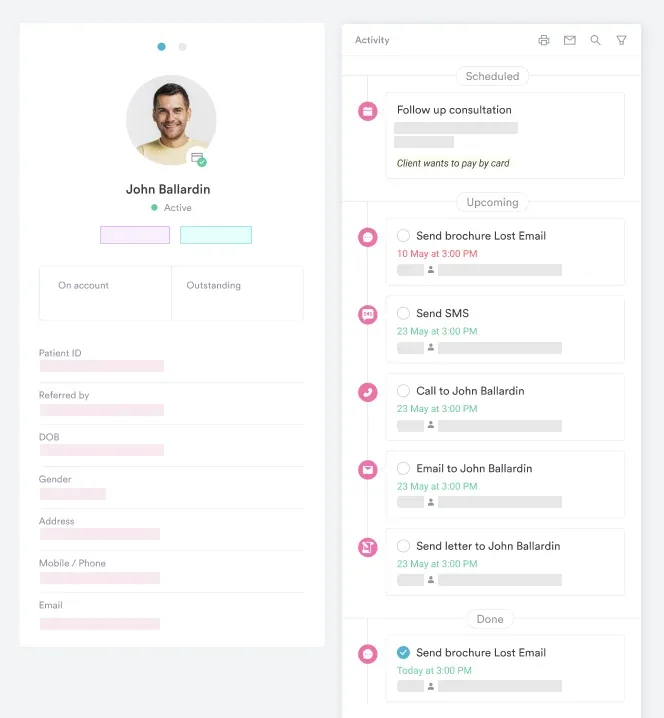

Pabau’s claims management tools help ophthalmic and skin care practices track claim status, reconcile payments, and keep the documentation trail that supports audit review.

Most of these presentations arrive in general practice first, where GP software handles triage, coding, and referral in one flow.
H16.9 groups into MS-DRG 124 (Other disorders of the eye with MCC or thrombolytic agent) under CMS DRG v43.0. This grouping applies primarily to inpatient facility claims, which are uncommon for uncomplicated keratitis. Most ophthalmic practices submitting H16.9 are on professional claims (CMS-1500 or electronic 837P equivalents), where MS-DRG assignment does not apply.
For outpatient and office-based encounters, reimbursement is driven by the Evaluation and Management (E/M) or ophthalmic examination CPT code billed, not by the ICD-10 diagnosis code alone. H16.9 supports medical necessity for the visit and the level of service documented.
A high-complexity E/M visit requires that the diagnosis justify the complexity of decision-making. An unspecified keratitis with pending cultures and a referral order typically qualifies for moderate or high complexity, supporting a 99214 or 99215 depending on documentation.
The same medical-necessity logic applies to other unspecified ophthalmic codes such as H40.9, where the diagnosis must justify the billed level of service.
This documentation-to-code matching standard isn’t unique to ophthalmology. Procedure claims for skin lesion excisions such as 11641 and drug injections such as J1940 face the same specificity expectations from payers.
According to the CMS ICD-10 codes page, ICD-10-CM is required for all covered entity claims under HIPAA for dates of service on or after October 1, 2015. Practices that have not transitioned fully to ICD-10-CM, or that maintain ICD-9 legacy code habits, remain at risk for claim rejection at the payer edit level before adjudication even begins.
The American Academy of Ophthalmology has published guidance on denial patterns tied to unspecified corneal codes. Practices report three recurring denial triggers when submitting H16.9:
Manual review of every H16.9 claim for these three patterns is time-consuming. Automating the routine parts of claims handling reduces how often errors slip through, and tracking claim status as claims move through the payer cycle makes it easier to catch a stalled or rejected H16.9 claim before it ages into a write-off.
For practices managing HIPAA-compliant practice management, integrating claim scrubbing into the pre-submission workflow is a baseline operational requirement.
Run a monthly coding audit on all H16.9 claims from the prior period. Filter for claims where H16.9 appears at the second or third visit for the same episode. These are the highest-risk claims for retrospective audit because they suggest the provider did not refine the diagnosis as clinical information became available.
Keratitis frequently presents alongside other anterior segment conditions. Knowing which adjacent codes combine correctly with H16.9 and which create conflicts is essential for clean claim submission. The same combination-coding logic applies to adjacent unspecified codes such as H11.9 and H35.9, where the record needs to show the conditions are clinically distinct rather than components of the same keratitis episode.
The AAPC Codify ICD-10-CM lookup includes crosswalk data showing these combination coding relationships. Practices can also reference the AAPC’s etiology-manifestation coding guidance when an infectious organism has been confirmed, since the infectious disease code typically takes sequencing priority over the corneal manifestation code.
For practices using compliance management tools built into their practice management platform, role-based access and time-stamped documentation help keep the audit trail behind each claim intact, even when multiple codes are involved.

A clean H16.9 claim follows a predictable workflow from encounter documentation through submission. Practices that have structured this workflow reduce their denial rate on unspecified corneal codes.
Ophthalmic and dermatology practices handling a high volume of corneal diagnoses benefit from skin clinic software that links diagnosis codes to templates, automates pre-submission edits, and maintains an audit trail across the episode of care.
H16.9 is a legitimate ICD-10 code, but its utility is narrow: it applies when corneal inflammation is confirmed and the subtype is genuinely undetermined at the time of the encounter. Over-reliance on it across follow-up visits, or using it as a default when more specific H16 subcodes apply, creates audit risk and denial exposure.
Pabau’s claims management software helps ophthalmic and multi-specialty practices validate membership numbers and authorization codes, reconcile payments, and track claim status from submission through resolution, cutting down how long an H16.9 denial sits unworked. To see how Pabau handles ophthalmic billing workflows, book a demo.

Coding a scurvy diagnosis? ICD-10 code E54 guide This guide covers billable status, Type 1 Excludes notes, and documentation requirements for ascorbic acid deficiency.
Coding a dietary calcium deficiency? ICD-10 code E58 guide This guide explains how E58 differs from metabolic or endocrine causes of low calcium.
Coding a dietary selenium deficiency? ICD-10 code E59 guide This guide covers E59, the billable code for dietary selenium deficiency, including Keshan disease.
ICD-10 Code H16.9 is the billable diagnosis code for unspecified keratitis, representing corneal inflammation where the clinical presentation does not support a more specific keratitis subtype under the H16 category. It is valid for dates of service on or after October 1, 2015, under the US ICD-10-CM coding system mandated by HIPAA.
No. H16.9 does not carry a laterality extension, unlike most other H16 subcodes which require a digit for right eye (1), left eye (2), or bilateral (3). This absence can create payer edit conflicts when H16.9 is submitted alongside a procedure code that implies a specific eye, so laterality should still be documented in the clinical note even when H16.9 is the selected code.
Use H16.9 only when corneal inflammation is confirmed on examination but the specific subtype genuinely cannot be determined at the encounter, typically when culture or laboratory results are pending. At follow-up, once results are available, the code should be updated to the most specific H16 subcode supported by the findings.
Generally no. H16.22x (keratoconjunctivitis sicca) is more specific than H16.9 and supersedes it when the clinical presentation matches dry eye-related corneal inflammation. Reporting both for the same clinical episode and the same eye can trigger NCCI bundling edits. Use the more specific code when the keratitis type has been identified.
H16.9 groups under MS-DRG 124 (Other disorders of the eye with MCC or thrombolytic agent) under CMS DRG v43.0. This applies to inpatient facility claims. Most ophthalmic practices submit H16.9 on professional claims where MS-DRG assignment is not relevant to reimbursement calculation.