HCPCS Code G0163: Skilled nursing observation and assessment
What is HCPCS Code G0163? HCPCS Code G0163 is a deleted Level II code for skille...

Last Updated: Oct 15, 2026

CPT code 92002 describes an intermediate ophthalmological examination for a new patient, with initiation of a diagnostic and treatment program.
92002 applies to a focused exam addressing a specific complaint; CPT 92004 is the comprehensive equivalent requiring evaluation of the complete visual system.
Documentation must capture the history, examination elements, and the initiation of a diagnostic or treatment plan – without this, the claim is vulnerable to audit.
Pabau’s claims management software helps ophthalmology and optometry practices structure documentation, reduce claim errors, and track eye exam billing codes across payers.
CPT code 92002 is a billable code that covers an intermediate ophthalmological examination for a new patient, including the initiation of a diagnostic or treatment program. It applies to problem-focused visits that address a specific complaint rather than a full evaluation of the visual system. This guide covers the documentation, modifiers, and billing rules for CPT 92002 claims.
CPT code 92002 is officially defined by the American Medical Association (AMA) as: “Ophthalmological services: medical examination and evaluation with initiation of diagnostic and treatment program; intermediate, new patient.” It sits within the General Ophthalmological Services range (92002–92014), which covers four core exam types for both new and established patients at intermediate and comprehensive levels.
Two terms define what makes this code billable. “Intermediate” means the visit is problem-focused — it addresses a specific complaint, condition, or finding rather than a general survey of the whole visual system.
“New patient” means the individual has not received professional services from the ophthalmologist or optometrist (or any member of the same group practice) within the previous three years.
This phrase is the most audited element of 92002. It does not mean the physician simply orders a test. It means the visit must result in a plan – either a diagnostic workup or a treatment approach initiated during that encounter.
Documenting “follow up in six weeks” without a plan does not meet the threshold. The record should state the clinical reasoning behind the plan.
The intermediate-vs-comprehensive distinction is a common source of coding errors in ophthalmology practices. Getting this wrong means either under-billing (using 92002 when 92004 is justified) or over-billing (using 92004 without documenting a complete visual system evaluation).
| Code | Level | Patient status | Key requirement |
|---|---|---|---|
| 92002 | Intermediate | New patient | Problem-focused exam addressing a specific complaint; initiation of diagnostic/treatment plan |
| 92004 | Comprehensive | New patient | General evaluation of the complete visual system; may not be performed in a single session |
| 92012 | Intermediate | Established patient | Problem-focused exam; continuation or initiation of diagnostic/treatment plan |
| 92014 | Comprehensive | Established patient | General evaluation of the complete visual system for established patient |
The American Academy of Ophthalmology (AAO) notes that a comprehensive exam (92004) constitutes a “single service entity” but need not be completed in one session. For 92002, the scope is narrower by design: the visit targets a defined complaint rather than a full system review.
A common scenario: a new patient presents with sudden floaters and reduced visual acuity in one eye. The ophthalmologist performs a dilated fundus exam, checks intraocular pressure, and documents a plan for further imaging. That is 92002 territory.
If the same patient also received a full refraction, biomicroscopy, and a complete ocular history review spanning all subsystems, 92004 may be appropriate instead – but the documentation must support that level.
Ophthalmologists and optometrists can bill either eye visit codes (92002-92014) or evaluation and management codes (99202-99215) for the same encounter – but not both on the same day for the same condition without a modifier. According to the UTHealth Medical School Healthcare Billing Compliance office, the provider should select whichever code set is “most appropriate” for the service rendered.
In practice, the choice depends on what the visit actually involved.
Federally Qualified Health Centers (FQHCs) follow different rules. They bill encounter-based rather than service-by-service, which affects how eye visit codes are applied. The HCPCS T1015 billing guide for FQHCs, RHCs, and CHCs outlines the distinctions for vision services specifically.
Check your local coverage determinations (LCDs) before assuming 92002 is covered for a given diagnosis. Some payers restrict eye visit codes to certain ICD-10 conditions, and commercial policies (BCBS, Aetna, UnitedHealthcare) often differ from Medicare rules. Reviewing LCDs upfront prevents costly rework after claim submission.
For flat-fee practices, software built for direct primary care tracks these services without generating insurance claims.
Thin documentation is the primary cause of 92002 downcodes and audit findings. Using clinical documentation tools that structure notes around the required elements helps practices avoid this consistently. Practices managing complex documentation workflows may also find the CPT 66999 guide for unlisted anterior segment procedures a useful reference for edge-case ophthalmology billing. Here is what the medical record must contain.
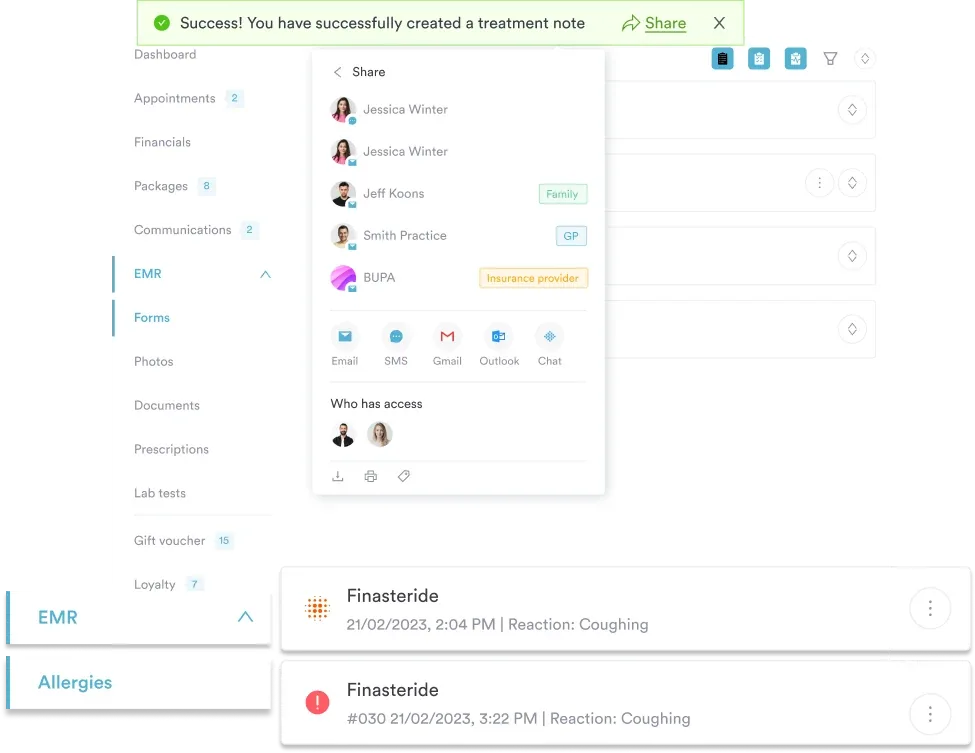
Structured note templates.
Indirect ophthalmoscopy performed without a drawing may not be billed separately from 92002-92014, according to CMS Medicare Coverage Database Article A57071. It is considered part of the general ophthalmological exam. Practices that bill indirect ophthalmoscopy separately alongside 92002 will face bundling edits.
Acceptable places of service for 92002 include: office (POS 11), assisted living facility (POS 13), urgent care (POS 20), inpatient hospital (POS 21), outpatient hospital (POS 22), and the emergency department. Billing 92002 from a telehealth encounter requires verifying current payer-specific telehealth policies, as applicability varies by plan and changes annually.
Modifiers signal payers that special circumstances apply to an otherwise standard claim. Several modifiers commonly appear with 92002; using the wrong one — or omitting a required one — is a denial trigger.
For a comparison of how modifiers work in a different visit context.

| Modifier | When to use with 92002 |
|---|---|
| -25 | Significant, separately identifiable E/M service performed by the same physician on the same day as a procedure. Use when an E/M code is billed alongside a minor procedure on the same day – not for pairing 92002 with another eye visit code. |
| -57 | Decision for surgery made during the E/M service. Applies when a decision to perform a major surgical procedure (90-day global) is made at the same visit. Not common with 92002 in routine settings. |
| -GY | Item or service statutorily excluded from Medicare coverage. Use when billing a non-covered service (such as routine refraction) to a Medicare patient so the patient can be billed directly. |
| -52 | Reduced services. The service was reduced or eliminated at the physician’s discretion. Use when the full 92002 service was not provided but partial documentation exists. |
| -RT / -LT | Right or left side. Used by some payers when the exam was limited to one eye due to trauma or condition. Not universally required; verify payer policy. |
Commercial payers sometimes have modifier requirements that differ from Medicare. BCBS plans, for example, may require different modifier combinations for bilateral eye procedures. Always verify payer-specific rules before relying on Medicare guidelines as a universal standard.

Pabau helps ophthalmology and optometry practices track exam codes, structure clinical notes, and submit cleaner claims. See how it works for eye care practices.

Every 92002 claim requires at least one ICD-10-CM diagnosis code to establish medical necessity. Payers use the diagnosis code to determine whether the exam was appropriate for the condition billed. Selecting a vague or mismatched code is one of the most common reasons 92002 claims receive additional documentation requests.
For an example of how ICD-10 codes are paired with procedure codes in another specialty.
Common ICD-10 pairings for CPT 92002 include:
For diagnosis-specific coding depth, see the ICD-10 code H25.9 guide for age-related cataract and the ICD-10 code H42 guide for glaucoma tied to an underlying systemic disease.
The diagnosis code must match the documented chief complaint and exam findings. Billing 92002 with a diagnosis of “routine eye exam” (Z01.00, Z01.01) is a compliance risk because routine screenings are typically not medically necessary eye visits and may not be covered by medical insurers. Confirm with each payer whether the presenting diagnosis supports coverage under their policy.
Build a short reference list of your ten most common 92002 ICD-10 pairings and cross-check it against your top payer LCDs annually. This simple step catches diagnosis-code mismatches before claims go out the door and prevents retroactive audits from flagging patterns of miscoding.
Medicare reimbursement for CPT 92002 is determined annually through the CMS Physician Fee Schedule (PFS). Because rates change each January and vary by geographic location (based on the Geographic Practice Cost Index), stating a single dollar figure without citing the current year and locality is misleading.
To find the current reimbursement amount for your practice’s ZIP code, use the CMS PFS look-up tool and enter code 92002 with your MAC jurisdiction. For a quick RVU-based estimate, the FastRVU 2026 RVU lookup tool provides Work RVU, Practice Expense RVU, and Malpractice RVU values with the Medicare conversion factor applied.
For context on how 92002 compares within the code family:
Commercial payers negotiate their own fee schedules, which may be higher or lower than Medicare. Practices contracting with multiple plans should maintain a payer-specific fee schedule matrix for the 92002-92014 family rather than assuming Medicare rates apply universally.
Locality adjustments change reimbursement across every CPT code family, so annual verification applies regardless of specialty. The CPT 99283 emergency department visit billing guide and the CPT 99424 principal care management guide both show how geographic factors change the final payment amount.
Most ophthalmology encounters involve additional services that may be separately billable — or may be bundled. Knowing the boundaries prevents both missed revenue and compliance exposure. For a comparable bundling discussion in another procedure area.
Practices that also dispense corrective lenses following an exam should reference the HCPCS V2103 billing guide for single vision spherocylinder lenses.
| CPT code | Description | Relationship to 92002 |
|---|---|---|
| 92004 | Comprehensive ophthalmological exam, new patient | Higher-level alternative; requires complete visual system evaluation |
| 92012 | Intermediate ophthalmological exam, established patient | Established patient equivalent of 92002 |
| 92014 | Comprehensive ophthalmological exam, established patient | Highest-level eye exam code; established patients only |
| 92015 | Refraction | Separately billable; not covered by Medicare (bill with GY modifier for Medicare patients) |
| 92250 | Fundus photography | Separately billable when documented as medically necessary; verify LCD |
| 92134 | OCT of retina/optic nerve | Separately billable with appropriate diagnosis; common add-on to 92002 visits |
Refraction (CPT 92015) is the most common bundling question. Medicare explicitly excludes refraction as a covered benefit, meaning it cannot be billed to Medicare as a covered service.
Practices may bill the patient directly for refraction, but the claim to Medicare should use modifier GY so the beneficiary’s cost-sharing is documented correctly. Commercial plans vary – many do cover refraction, particularly when a change in prescription is documented.
The Office of Inspector General (OIG) has historically flagged ophthalmology as a specialty with elevated billing risk. Eye visit codes — particularly the pattern of always billing 92004 or 92014 (the comprehensive codes) regardless of actual exam scope — appear frequently in OIG work plans.
Billing accuracy is a core HIPAA compliance obligation, not just data privacy. See HIPAA compliance for medical offices for a broader overview. Growing your ophthalmology patient base also requires clean billing records .
Three audit red flags specific to 92002:
Practices that use automated billing workflows to flag documentation issues before submission catch these systematically. The AAPC Codify CPT lookup is a useful reference for checking correct code descriptors and associated guidelines before billing.
CPT code 92002 requires documentation that justifies the problem-focused scope and demonstrates a treatment or diagnostic plan was initiated. The most preventable denials come from mismatched diagnosis codes, missing plan documentation, and incorrect code selection between 92002 and 92004. Electronic claims leave the practice as an 837 file, so a coding error becomes a rejection at the clearinghouse.
For practices exploring structured patient handouts as part of their documentation workflow. Reviewing the HCPCS J1306 billing guide also illustrates how initiation-of-treatment documentation requirements apply beyond ophthalmology.
Pabau’s claims management tools help ophthalmology and optometry teams structure clinical records to meet payer requirements and submit cleaner claims. To see how Pabau handles eye care billing workflows, book a demo.
Pabau’s billing code library is updated regularly. Recently published coding guides include ICD-10 code B80 for enterobiasis.

Billing in-lab sleep studies too? Polysomnography billing guide covers CPT code 95810 for attended in-laboratory sleep studies monitoring four or more physiologic parameters.
Looking for billing guidance on specialty diagnostic codes? ICD-10 documentation for infectious disease diagnoses covers the same diagnosis-pairing principles that apply across medical specialties.
Billing CPAP titration studies too? CPAP titration billing guide covers CPT code 95811 for attended polysomnography with CPAP initiation, including split-night sleep studies.
CPT code 92002 is an intermediate ophthalmological examination for a new patient, which includes a medical history, focused eye exam, and the initiation of a diagnostic or treatment program. It covers problem-oriented visits for new patients rather than comprehensive visual system evaluations.
92002 is an intermediate exam focused on a specific complaint, while 92004 is a comprehensive exam covering the entire visual system. 92004 requires documentation of a general evaluation of all ocular subsystems; 92002 requires only a problem-focused exam with a plan for that specific condition.
Use eye visit codes (92002-92014) when the visit centers on an ophthalmological examination using standard eye exam components such as slit lamp, tonometry, ophthalmoscopy, or refraction. Use E/M codes (99202-99215) when the visit is medically driven with complex decision-making, such as managing a systemic disease affecting the eye. Both cannot be billed for the same condition on the same day without modifier 25.
The most common modifiers are -25 (separately identifiable E/M service on the same day as a procedure), -GY (non-covered Medicare service billed to patient directly), -52 (reduced services), and -57 (decision for surgery). Bilateral eye modifiers (-RT/-LT) may also be required by some commercial payers. Always verify modifier requirements with each payer before billing.
Medicare payment rates for 92002 are updated annually and vary by geographic location. Use the CMS Physician Fee Schedule look-up tool at cms.gov with your MAC locality to find the current non-facility and facility rates. Rates change each January 1, so always verify the current year’s figures before quoting a reimbursement amount.
An intermediate eye exam (92002) is a problem-focused ophthalmological visit that addresses a specific complaint or condition – not a full survey of the entire visual system. It must include a relevant history, a focused examination, and initiation of a diagnostic or treatment program. The key distinction from a routine exam is that medical decision-making and a clinical plan are required.
Both describe an intermediate, problem-focused eye exam at the same clinical level. The split is patient status: 92002 applies to a new patient, while 92012 applies to an established patient seen by the practice or group within the previous three years. The established-patient code is generally reimbursed at a slightly lower rate.
A routine vision screening is not billed with 92002. Refraction is reported with 92015, and many payers cover annual vision checks under codes such as S0620 and S0621 rather than the medical eye visit codes. Reserve 92002 for a complaint-driven visit with a documented diagnostic or treatment plan, since billing a routine screening as a medical eye exam is a common medical-necessity denial.