Patient financing: How to offer it and stay compliant
Patient financing lets patients spread the cost of treatment over weeks or month...

Last Updated: Oct 7, 2026
Digital patient intake forms are the registration, medical history and consent documents a practice sends patients to complete online before a first appointment. They replace the clipboard at the front desk, and the re-typing that follows it.
Switching from paper is the easy half. The completed form arriving before the patient does is the harder half, and it decides whether the switch saves anyone time.
This guide covers what to put on the form, how to build one, and how to keep it HIPAA compliant. It also sets out the Pre-Visit Form Sequence, a five-step routine for getting forms completed ahead of the visit.

Digital patient intake forms collect registration, medical history and consent before a first appointment, so the visit starts with the record already filled in.
Patients abandon forms that arrive at the wrong moment, ask for documents they cannot find, or cannot be saved halfway.
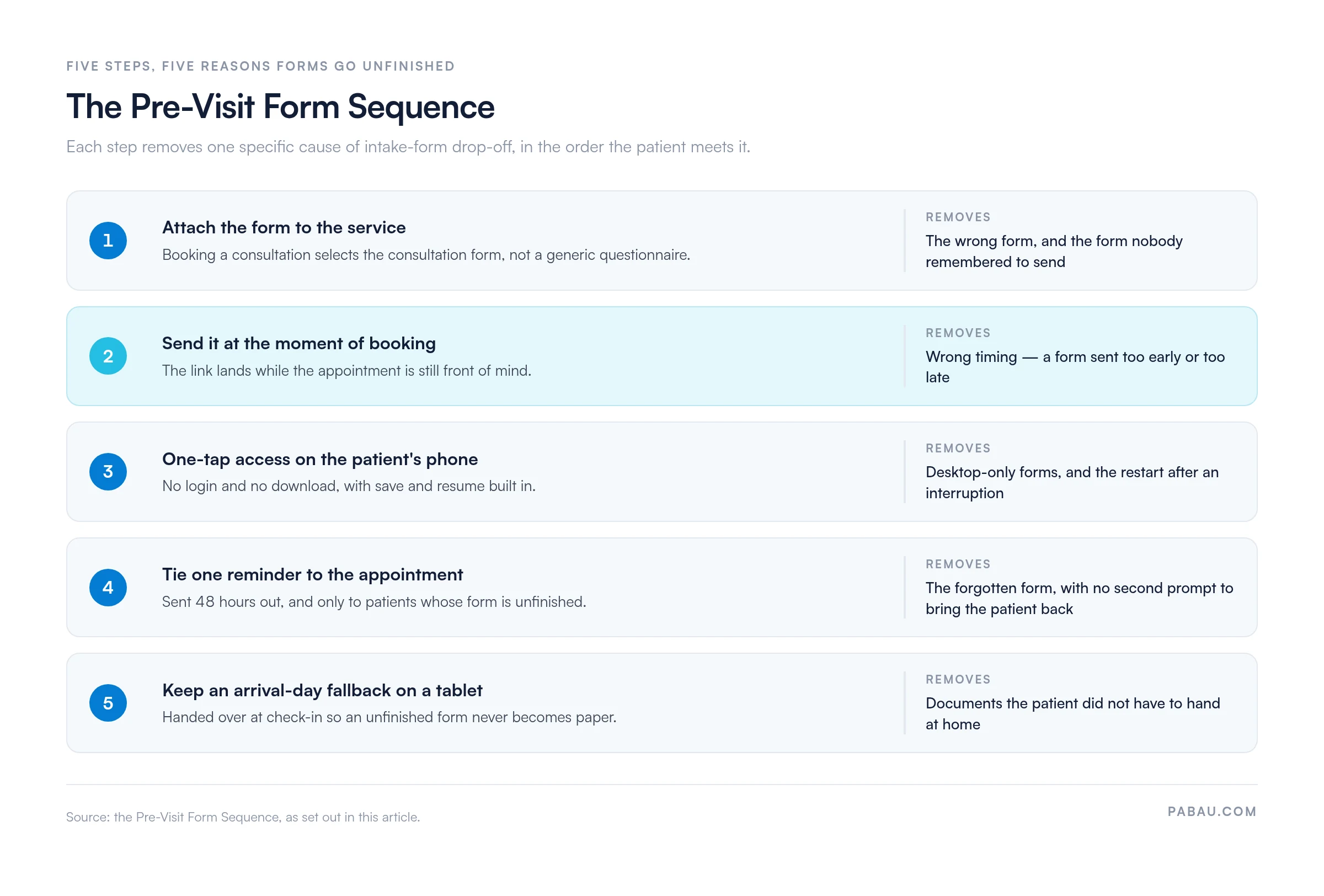
The Pre-Visit Form Sequence has five steps, and each one removes a specific reason patients give up on the form.
A compliant form needs a signed business associate agreement, encryption, role-based access, an audit trail and a documented retention period.
Answers should file onto the patient record automatically, because re-keying a digital form recreates the paper workload.
Patient intake forms are the documents a practice collects before a first appointment: registration and demographics, medical history, and consent to the treatment being booked.
Together these three documents are the medical paperwork a new patient clears before treatment. Every answer on them counts as protected health information, known as PHI, from the moment the patient hits submit.
Digital intake forms move data entry from the front desk to the patient, so answers arrive typed, complete and already attached to the patient record.
| What happens on paper | What happens digitally | What the front desk gets back |
|---|---|---|
| Manual data entry. A staff member retypes every answer into the system after the visit. | The patient types the answers once, on their own device. | The admin time goes back into the schedule. |
| Transcription errors. Typos creep in while reception answers phones and greets arrivals. | Answers reach the record exactly as the patient entered them. | Fewer corrections, and a medication list worth trusting. |
| Illegible handwriting. Allergies and drug names get guessed at from a patient’s writing. | Typed text, plus drop-downs for the answers that matter clinically. | No call back to the patient to confirm what a word said. |
| Lost or damaged forms. Paper gets misfiled, left in a treatment room, or lost in a move. | Submissions store against the patient record and stay backed up. | A signed consent that can be found during an audit. |
| Chasing missing documents. Reception phones or emails repeatedly for an insurance card and ID. | The patient uploads photos of documents with the rest of the form. | One follow-up instead of three, and a shorter check-in. |
| First impression at the door. The first ten minutes of a visit go on a clipboard. | The patient arrives already registered and starts on time. | A calmer waiting room and appointments that run to schedule. |
Patients abandon online intake forms that arrive at the wrong moment, ask for documents they cannot find, or will not work on a phone. Two more causes finish the job. A form that cannot be saved halfway forces a restart, and a form with no reminder behind it simply gets forgotten.
In practices we onboard, the unfinished forms are usually the right forms sent at the wrong moment. These five drop-off causes account for most of the submissions that never land.
To have new patients complete consultation forms digitally before a first visit, attach the form to the service so booking sends it automatically. The Pre-Visit Form Sequence builds on that first step. Each of its five steps removes one of the drop-off causes above, in the order the patient meets it.
The order matters more than the tooling. The sequence exists so patients complete forms in the window where they are most willing to, rather than in your waiting room.
A digital intake form needs nine sections: personal details, demographics, medical history, current medication, past treatments, lifestyle, payment details, document uploads and a signature.
Use the medical history checklist below when you build a form or audit the one you already send. It runs in the order a patient meets it, so the quick questions come first and the clinical ones follow.
Two of the nine carry most of the clinical weight. Medication and past treatments are where contraindications surface, so make both required rather than optional. A history collected this way also gives the practitioner what they need to write a plan of care.
To create a digital intake form, start from your paper form, map each question to a record field, then test it on a phone.
Here is how to create a digital intake form in seven steps, in the order that keeps rework to a minimum.
Step two is the one that decides whether the switch pays off. When a submitted answer writes straight onto the patient record, nobody re-keys it, and the practitioner opens one screen before the appointment. When it arrives as an email attachment instead, you have rebuilt the paper workflow with extra steps.
That mapping is what separates patient intake software from a general-purpose form builder. A form builder collects answers. A practice system files them. It also holds the visit notes, which is why clinical notes software belongs on the same record.
A new patient should complete five documents before treatment: registration, a medical history, treatment-specific consent, photo consent where relevant, and the payment and cancellation policy.
US practices add a few forms on top of those five, and aesthetic practices add a screening step. The table shows the full set, who completes each form, when it goes out and what it writes to the chart.
| Form | Who completes it | When it is sent | What it writes to the chart |
|---|---|---|---|
| New patient registration | Patient | At booking | Name, date of birth, contact details, emergency contact and preferred contact method |
| Medical history | Patient, then re-confirmed at each return visit | At booking, then before each repeat visit | Conditions, allergies, current medication and past treatments, flagged for the practitioner |
| Informed consent | Patient, after the practitioner explains the treatment | At booking for that service | A signed, dated consent naming the procedure, its risks and its aftercare |
| HIPAA privacy-notice acknowledgment | Patient | Before or at the first visit | A dated acknowledgment that the patient received your notice of privacy practices |
| Insurance capture | Patient | At booking | Insurer, policy number and photos of the insurance card and ID |
| Photo consent (aesthetics) | Patient | With the treatment consent, signed separately | Clinical photo permission, with marketing use recorded as a second, separate permission |
| Screening questionnaire | Patient | Before treatments with known contraindications | Yes or no answers, such as pregnancy or recent medication, reviewed before treating |
| Payment and cancellation policy | Patient | At booking, before any deposit | A signed acknowledgment of the deposit and late-cancellation terms |
The privacy row is a HIPAA requirement in its own right. Under 45 CFR 164.520, a direct treatment provider must make a good-faith effort to get the patient’s written acknowledgment of the notice. If none comes back, the rule asks you to document the effort and the reason it failed.
Send the whole set as one form rather than eight links. A patient asked to open several separate links rarely finishes the last one. A typical bundle is registration, medical history and consent, sent as a single link the moment the patient books. If you are building the set from scratch, a new patient questionnaire covers the first two documents.
Digital patient intake forms stay HIPAA compliant when the vendor signs a business associate agreement, data is encrypted, access is role-based and views are logged.
Six controls cover that baseline in practice. Check every form vendor against them, because a “HIPAA compliant” badge on a homepage proves none of them.
Compliance is only half the reason to keep these forms current. Consent is a process rather than a signature, and the record has to show the discussion happened. The same standard runs through nursing documentation, where what was recorded, when, and by whom decides how a record holds up.
Without documented consent, a complaint becomes your word against the patient’s. A record of what was explained, what the risks were and what the patient agreed to is what settles it. Some insurance policies also require that record before they will cover a claim. A signed HIPAA authorization form sits alongside it and governs who you may share records with.
An out-of-date form carries its own risk. A patient who has developed an allergy, started a new medication or become pregnant since their last visit is a contraindication waiting to be missed. Re-confirming medical history at each visit costs a minute and prevents an adverse reaction.
Med spas run one consent per treatment rather than one per patient, because every service carries its own risks, aftercare and photo requirements.
That is the main difference between digital consent forms in aesthetics and in general practice. A patient booked for filler signs a filler consent. The same patient booked for a chemical peel six weeks later signs a peel consent. Three habits do most of the work.
None of this is optional on a regulated treatment, and none of it holds up on paper once a practice passes a few hundred patients. The batch number in particular has to be searchable, because a product recall is a question about which patients received which lot.
A free template is the fastest starting point, and adapting one beats opening a blank form builder. Each of ours already carries the sections a practice uses, in the order a patient reads them.
A new client intake form covers registration, medical history and consent in one document. The template is written for a first appointment, so you can send it as a single link rather than three.
Adapt rather than adopt. Delete the questions your services never need, then add the ones your state or your insurer requires. Map each field to your patient record before the form goes live. More intake and consent templates are linked further down, including versions for counseling, admissions and family medical history.
Pabau, the practice software we build, handles the form-sending steps of this sequence for you. Nobody at reception has to remember to send each form. The result is a front desk that checks who still owes a form, instead of handing out clipboards.

In Pabau, each service carries its own form. When a patient books a consultation through online booking, the consultation form goes out with the confirmation, and no staff member has to send it.
The Client Portal lets patients complete and edit their forms from their own device, at any hour. A patient who remembers a medication at 10PM can add it then, rather than at the front desk the next morning.
Submitted answers write straight onto the client card, so nobody retypes them. Practitioners open one screen before the appointment and see the history, the medication list and the signed consent together. Form capture software is built for that one job, moving an answer from a patient onto a record without a retype.
Care Pathways in Pabau GO, our iOS app for practitioners, shows each patient’s pre-appointment steps as a checklist. Your team can see whose forms and consents are still outstanding before the day starts. A tablet at the front desk then covers the arrival-day fallback in step five.
Plenty of patient check-in software handles arrivals well and still cannot tell you who never opened the form. Knowing that at 8AM is what turns a rushed check-in into a normal one.

Pabau attaches each form to the service, sends it at the moment of booking, and files the answers straight onto the client card. Your front desk stops chasing paperwork and starts the day knowing who is ready.

Going digital is the easy half of this, and it is the half every vendor sells. The sequence that gets the form back is what decides whether the switch saves anyone time.
Start with the step you are missing today. Sending the form at booking feels like the job is finished, so the reminder is usually the one left out.
One trade-off is worth remembering. A shorter form gets completed more often than a thorough one. Cut the questions you have never read back, and keep the ones that would stop a treatment. Book a demo to see how Pabau sends, chases and files digital patient intake forms, so your front desk stops sending them by hand.

Need the history section to go deeper? Family medical history form gives you the inherited-risk questions most intake forms leave out.
Writing consent wording from scratch? Medical consent form for adults sets out the risk, aftercare and signature sections a consent needs.
Running a talking-therapy practice? Counselor intake form swaps the clinical history for presenting concerns, risk screening and goals.
Intake that has to double as an assessment? Admissions assessment intake evaluation covers the structured evaluation an admitting clinician has to record.
Dental practice building a first-visit pack? Dental medical history forms add the medication and bleeding-risk questions dentistry needs.
A digital intake form is an online version of the paperwork a practice collects before a first appointment. Patient intake forms cover registration, medical history and consent. A digital one sends the answers straight to the patient record instead of to a filing cabinet.
Intake is the process of registering a new patient and collecting their information before treatment starts. Intake covers the medical paperwork, the identity and insurance checks, and the consent signed before a first appointment. Done well, it ends with a complete patient record and a practitioner who has read it.
Work through the form in one sitting, with your medication list and insurance card next to you. A new patient should complete registration, a full medical history, treatment consent and the payment policy before the first appointment. Answer the medication and allergy questions in full, because those answers change what a practitioner can safely do.
Judge consultation form features on four points: forms attached to each service, conditional logic, e-signature, and answers filing onto the patient record without re-keying. Pabau covers all four. Its Care Pathways checklist in Pabau GO, our iOS app, also shows which patients still owe a form.
Free intake forms are available from the template libraries that practice software companies publish, including Pabau’s. The templates section above links a new patient questionnaire and a new client intake form you can adapt. Before using any free form, delete the questions you never read back and map each field to your patient record.
A common example is a new-patient bundle sent at booking, combining registration, a medical history questionnaire and a treatment consent signed on the patient’s phone. The answers file onto the patient record before the visit. A med spa might add photo consent and a pregnancy screening question to the same online intake form.