ICD-10 Code Z74.8: Other problems related to care provider dependency
ICD-10 Code Z74.8: Definition and code details ICD-10 Code Z74.8 is the billable...

Last Updated: Oct 19, 2026
Billable Code Specific Code
H18.9 is the billable ICD-10-CM code for unspecified disorder of cornea.
Per the Centers for Medicare and Medicaid Services (CMS), a core ICD-10-CM guideline requires coders to assign the most specific code the documentation supports. H18.9 fits only when the record cannot justify a more specific H18.x code.
H18.9 sits within the following ICD-10-CM classification hierarchy:
This hierarchy confirms that H18.9 is classified under eye and adnexa diseases, not musculoskeletal or systemic disorders. For ophthalmologists and optometrists, this placement matters when linking the diagnosis to associated procedure codes. The same H15-H22 block also contains related entries such as H18.10 (bullous keratopathy, unspecified eye) and H22 (disorders of iris and ciliary body), which coders consult when the corneal picture overlaps with adjacent structures.
Let Pabau's smart automation suggest the right codes, reduce claim denials, and keep your practice compliant—effortlessly.
Automate repetitive tasks and focus on what matters most—your patients.
Reduce coding errors and ensure compliance with the latest regulations.
Clean claims, fewer denials, and faster reimbursements.
Powerful insights and reporting to help your practice thrive.
HIPAA compliant SOC 2 certified GDPR-compliant Trusted by 4,000+ clinics worldwide

H18.9 (Unspecified disorder of cornea) is a billable ICD-10-CM diagnosis code valid for the 2026 code year.
Use H18.9 only when clinical documentation does not support a more specific H18.x code — payers may flag unspecified codes without adequate documentation.
The most common audit risk: applying H18.9 when a diagnosable condition such as keratoconus (H18.6) or Fuchs dystrophy (H18.51) is clearly supported by the clinical record.
Pabau’s claims management software and digital forms help ophthalmology practices document corneal diagnoses accurately and reduce claim denials for unspecified codes.
H18.9 is confirmed as a fully billable diagnosis code for the 2026 code year. Multiple authoritative coding databases, including the CDC/NCHS ICD-10-CM web tool, confirm this status. Payers will accept H18.9 on a claim as long as the clinical record justifies its use.
The code covers a broad range of presentations where a specific corneal disorder cannot be determined from available documentation. Known clinical synonyms and inclusions associated with H18.9 include:
These synonyms help coders identify when H18.9 may apply based on the phrasing in physician notes. A synonym in the chart does not automatically justify H18.9 if a more specific underlying diagnosis appears elsewhere in the record.
Coders should review the full encounter note, not just the chief complaint line, when assigning this code.
Run a quarterly audit of all encounters coded H18.9 in your practice. Filter claims where H18.9 appears alongside a corneal procedure code. If the procedure note describes a specific pathology (keratoconus, Fuchs dystrophy, bullous keratopathy), the diagnosis code should match that pathology. Catching this discrepancy before a payer audit saves time and protects revenue.
The H18 parent category contains many specific subcategories, each describing a distinct corneal condition. H18.9 should be the last resort, not the default.
The specificity rule is clear: assign the code that most accurately reflects the condition documented. Here is a reference of common H18.x codes and when each applies:
One important distinction: H18.89 (Other specified disorders of cornea) and H18.899 (Other specified disorders of cornea, unspecified eye) are frequently better choices than H18.9.
If the clinician documents a specific named condition but no exact ICD-10 code exists for it, H18.89 with laterality is more accurate than the fully unspecified H18.9. Preferring “other specified” over “unspecified” applies across ICD-10-CM, not only in ophthalmology.
H18.89 requires that the clinician has identified a specific named disorder even if the ICD-10 system has not assigned it a unique code. H18.9 applies only when the condition is genuinely uncharacterized or when the documentation provides no basis for any more specific assignment. When in doubt, query the treating physician before defaulting to H18.9.

Pabau’s claims management and digital documentation tools help ophthalmology practices capture the clinical detail needed to code accurately — so H18.9 is used only when it should be.

When using H18.9, the clinical record must demonstrate that specificity was genuinely unavailable at the time of the encounter. Claim denials for unspecified codes typically result from documentation that does not support the code selected.
Strong documentation for H18.9 includes the following elements:
Practices using structured patient record management templates in their EHR will find that prompting clinicians for laterality and exam findings at the point of care reduces undercoding significantly. Documentation shortfalls almost always originate during the encounter, not during coding.
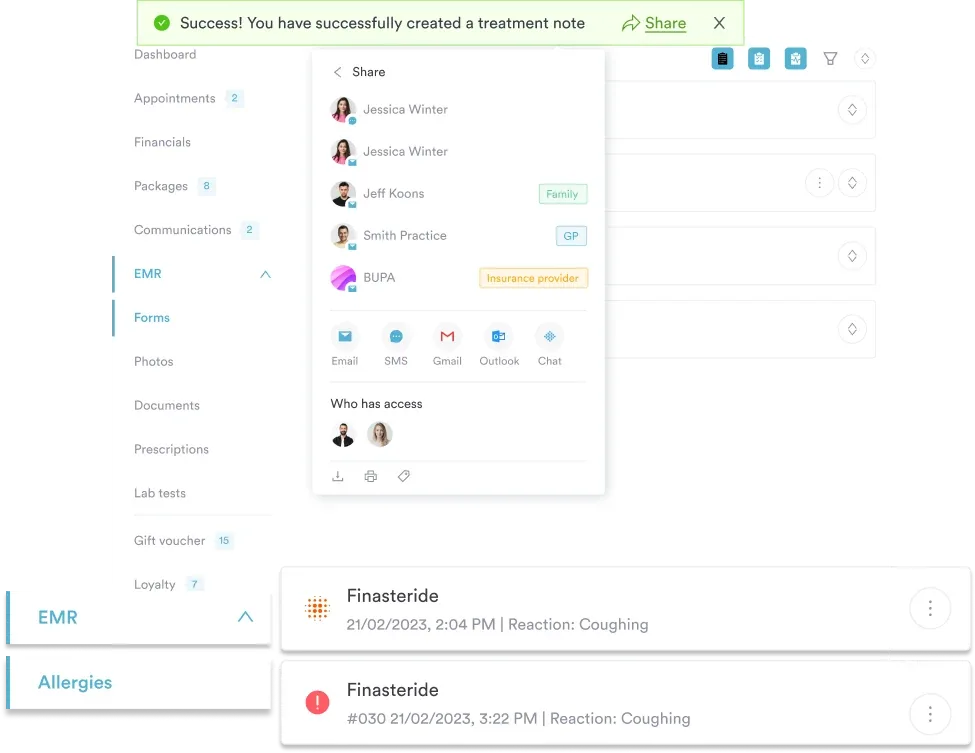
Build a corneal exam documentation template that includes mandatory fields for laterality, slit-lamp findings, and diagnostic workup status. When clinicians complete these fields, coders have the data they need to assign a specific H18.x code. H18.9 should appear far less often in a well-templated workflow.
Inside software built for GPs, eye and ear diagnoses route to the right specialist with history attached.
Understanding adjacent codes prevents both undercoding (H18.9 when a specific code applies) and overcoding (a specific code when H18.9 is genuinely correct). The following codes frequently appear alongside or in place of H18.9 in ophthalmology billing:
Practices migrating legacy claims data or reconciling older records may need the ICD-9-CM equivalent. The standard crosswalk maps ICD-9-CM code 371.9 (Unspecified corneal disorder) to H18.9.
This crosswalk is commonly cited in coding references, though CMS advises verifying against the General Equivalence Mappings (GEMs) files for research and claims reconciliation purposes, as GEMs mappings can be one-to-many.
For historical billing analysis or payer appeals involving pre-2015 claims, confirming this crosswalk against the official GEMs files is the safest approach. When coding current encounters, only the ICD-10-CM code set applies. Practices running ophthalmology ICD-10 coding workflows should ensure their EHR is updated to the 2026 code set before filing claims for FY2026 encounters.
The American Health Information Management Association (AHIMA) and CMS both stress that unspecified codes carry a higher audit scrutiny burden than specific codes. Using H18.9 is not improper when clinically justified, but it invites payer review if it appears frequently in a single provider’s claims data. The same specificity expectations apply to neighboring unspecified eye codes, including H01.9 (unspecified inflammation of eyelid).
Three audit patterns associated with H18.9:
UK private practices face the same pairing test under a different code set. A lamellar corneal graft bills as CCSD code C4620, which insurers expect to carry a specific corneal diagnosis.
Maintaining HIPAA-compliant practice software with complete encounter-level records is the most effective defense against these audit patterns. The ability to produce documentation showing why H18.9 was appropriate at each specific visit is what converts a potential denial into an upheld claim. Practices strengthening their revenue workflow can review how medical billing works and compare the best medical billing software for US practices to keep unspecified-code denials in check.
Practices that use digital clinical forms for their ophthalmology encounters can build corneal-specific intake and exam templates that consistently capture the documentation elements payers expect. When the record is complete, coding decisions are defensible.

Coding accuracy in ophthalmology depends on the quality of clinical documentation captured at the point of care. Pabau supports this through structured digital forms, a comprehensive client record system.
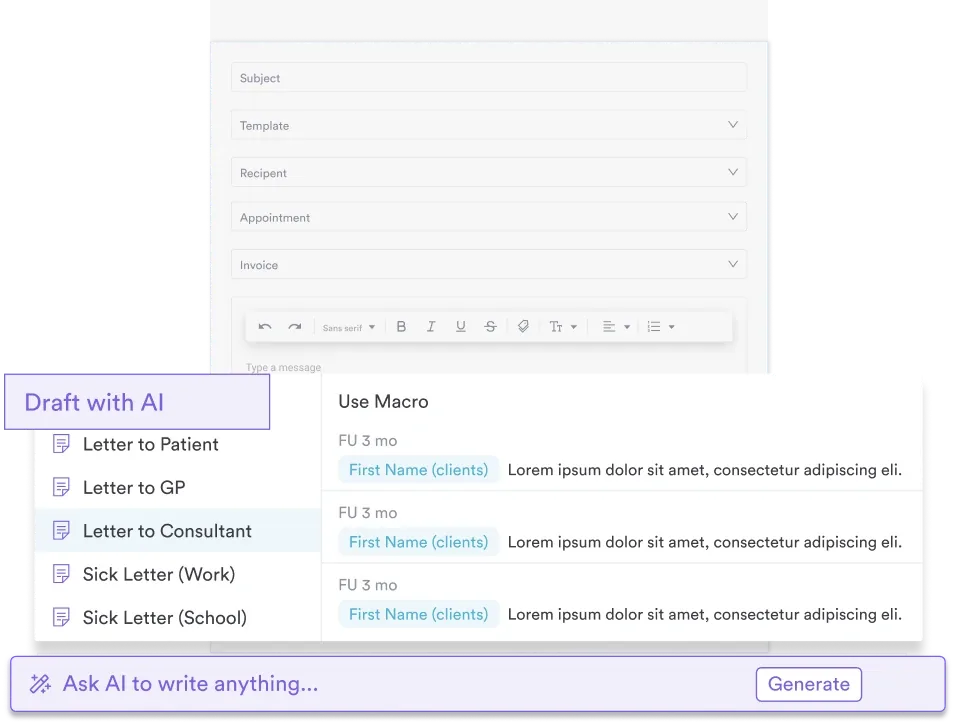
When a clinician sees a patient with an uncharacterized corneal presentation, Pabau’s documentation workflow ensures laterality, slit-lamp findings, and diagnostic workup notes are captured in structured fields rather than buried in free text. This matters at coding time: a coder reviewing a structured record can assign the right H18.x code; a coder reviewing an unstructured note often defaults to H18.9 because the information is not easily retrievable.
Pabau’s claims management software integrates the documentation and billing workflows so that diagnosis codes are linked to procedure codes within the same encounter record. This reduces the risk of submitting H18.9 alongside a procedure that implies a known pathology. For practices managing high patient volumes, pairing this with a structured workflow also supports accurate coding of adjacent conditions — such as unspecified disorder of eyelid (H02.9) or other keratitis (H16.8) — that frequently appear in the same ophthalmology encounter. Electronic claims leave the practice as an 837 file, so a coding error becomes a rejection at the clearinghouse.
ICD-10 code H18.9 serves a legitimate clinical purpose when documentation genuinely cannot support a more specific corneal diagnosis. The coding risk lies in using it when a more specific code is warranted.
Ophthalmology practices that build structured documentation workflows reduce their H18.9 usage naturally, because the clinical detail needed to assign specific H18.x codes gets captured at every encounter. Pabau’s digital forms, client records, and claims management tools make this structured approach practical.
To see how Pabau handles corneal diagnosis documentation end-to-end, explore our practice management software or book a demo.

Coding a cystic fibrosis complication? ICD-10 code E84.8 guide This guide covers E84.8, the billable child code for cystic fibrosis with other manifestations under the non-billable E84 parent.
Coding a dehydration diagnosis? ICD-10 code E86.0 guide This guide covers E86.0 dehydration coding and its common pairing with CPT codes for IV hydration and E&M visits.
H18.9 is the ICD-10-CM diagnosis code for Unspecified disorder of cornea. It is a billable terminal code within the H18 (Other disorders of cornea) category, used when clinical documentation does not support a more specific corneal disorder code. It sits within the H15-H22 block (Disorders of sclera, cornea, iris and ciliary body) under chapter H00-H59 (Diseases of the eye and adnexa).
Yes, H18.9 is a fully billable ICD-10-CM diagnosis code confirmed valid for the 2026 code year. Payers will accept it on a claim when clinical documentation supports its use. However, because it is an unspecified code, it carries higher audit scrutiny than more specific H18.x codes and may be questioned by payers if it appears frequently without adequate documentation justification.
H18.9 applies only when the clinical record genuinely cannot support a more specific diagnosis. If the clinician documents a specific named condition (keratoconus, Fuchs dystrophy, bullous keratopathy, corneal degeneration), that condition should be coded with its specific H18.x code. H18.9 is appropriate during early evaluation when diagnostic workup is pending and findings are nonspecific.
The ICD-9-CM legacy equivalent for unspecified corneal disorder is 371.9. Standard crosswalk references map 371.9 directly to H18.9, though practices are advised to verify against the CMS General Equivalence Mappings (GEMs) files for research or claims reconciliation purposes, as GEMs can produce one-to-many mappings.
The H18 category includes H18.0 (corneal pigmentations and deposits), H18.1 (bullous keratopathy), H18.2 (corneal edema), H18.3 (changes in corneal membranes), H18.4 (corneal degeneration), H18.5 (hereditary corneal dystrophies including H18.51 for Fuchs), H18.6 (keratoconus), H18.7 (corneal deformities), H18.89 (other specified disorders), and H18.9 (unspecified). Coders should review the full category before assigning H18.9. For context on how unspecified codes are handled in related ICD-10 chapters.
Fuchs dystrophy is coded to H18.51 (endothelial corneal dystrophy), but billing requires the laterality-specific fourth digit: H18.511 for the right eye, H18.512 for the left eye, or H18.513 for bilateral disease. H18.9 should not be assigned when Fuchs dystrophy is documented, since a specific code already exists for it.
Epithelial basement membrane dystrophy, also known as map-dot-fingerprint dystrophy for the pattern it produces on slit-lamp exam, is coded to H18.52 (epithelial corneal dystrophy) with a laterality-specific fourth digit: H18.521 (right eye), H18.522 (left eye), or H18.523 (bilateral). ICD-10-CM does not carry a separate code for the clinically distinct Meesmann corneal dystrophy — both are coded to the same H18.52 family.