Mental health self-care checklist
A mental health self-care checklist is a structured daily tool for tracking the ...

5
Last Updated: Oct 20, 2026

An anxiety nursing care plan is a structured clinical document using NANDA-I diagnosis to guide systematic, evidence-based care for patients with anxiety disorders.
Assessment frameworks like GAD-7 and HAM-A, combined with nursing diagnosis criteria, identify anxiety severity and guide targeted interventions.
Nursing interventions include therapeutic communication, relaxation techniques, coping education, and safe medication management — each with documented clinical rationales.
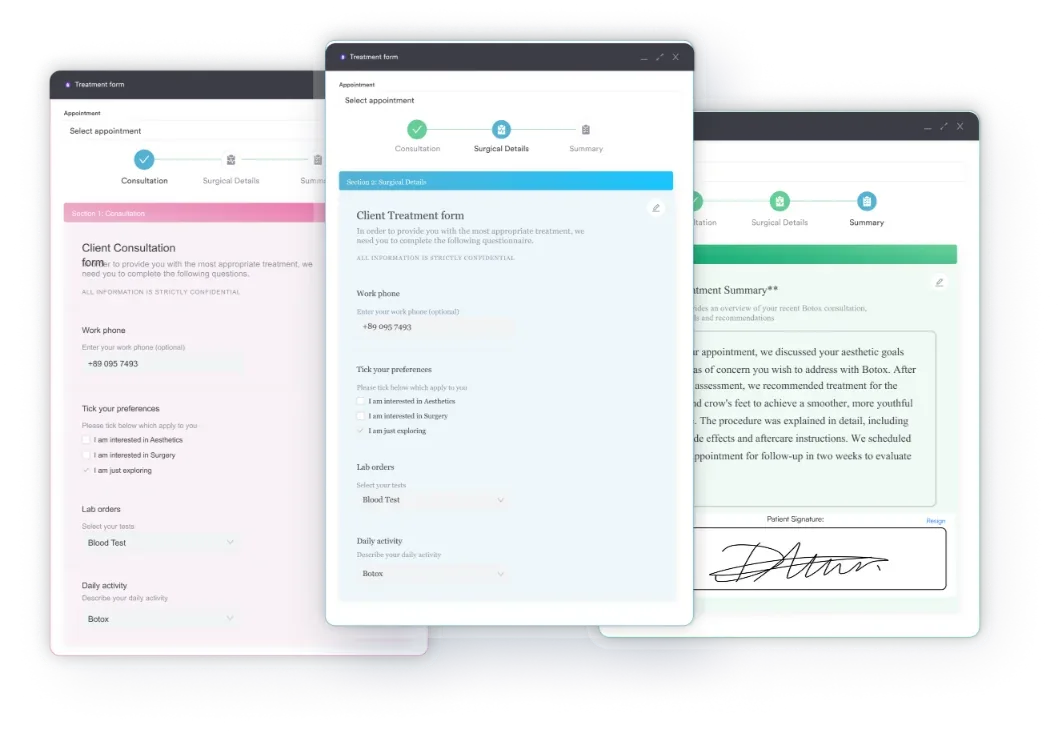
Digital forms and client records in practice management software like Pabau help nurses document assessments, track interventions, and monitor patient progress in one secure system.
A comprehensive nursing care plan template covering NANDA-I diagnosis, patient assessment, evidence-based interventions with clinical rationales, measurable outcomes, and specialized variations for different anxiety presentations in clinical and mental health settings.
Download templateApproximately 40 million adults in the United States experience anxiety disorders each year, yet only about 37% receive treatment, according to the Anxiety and Depression Association of America. Nurses are often the first clinicians to assess and respond to anxiety, whether in hospitalized patients, emergency departments, or outpatient settings.
A structured anxiety nursing care plan ensures your clinical responses are evidence-based, clearly documented, and focused on measurable patient outcomes. This guide walks you through building a nursing care plan for anxiety step by step, from initial assessment through evaluation, and includes a worked example plus a free template you can download and adapt.
An anxiety nursing care plan is a systematic clinical document that outlines how you will assess, intervene, and evaluate care for a patient experiencing anxiety.
It uses the NANDA-I (North American Nursing Diagnosis Association International) standardized framework to document the patient’s anxiety, the factors contributing to it, and the specific interventions you’ll use to help them manage it and reach measurable outcomes.
The plan serves three purposes:
HIPAA-compliant documentation is essential. Every assessment, intervention.
Unlike a vague statement like “patient is anxious,” a nursing care plan specifies exactly what anxiety looks like in this patient (physiological, emotional, and behavioral signs), what triggered or worsened it, and precisely which nursing actions will reduce it. This specificity transforms anxiety from a nebulous problem into a manageable clinical focus.
Creating an effective anxiety nursing care plan follows five operational steps that mirror the nursing process. Each step builds on the previous one, and each must be documented in your clinical record system.
The anxiety nursing care plan is a living document, not a one-time form. Revisit it at every shift, compare it against the patient’s response, and adjust it based on what’s working.
Anxiety nursing care plans are essential in six clinical settings:
A structured anxiety nursing care plan delivers four key advantages for clinical teams and patient outcomes.
Clinical accuracy and consistency. Anxiety manifests differently in each patient – one person trembles and withdraws, another becomes irritable and hyperalert. A care plan tailored to this patient’s specific anxiety presentation ensures your interventions match what this patient needs, not a generic “anxious patient” stereotype. Every team member reads the same plan and delivers consistent care across shifts.
Evidence-based decision-making. The rationales you document for each intervention force you to ground care in pathophysiology, psychology, or clinical research.
This transforms vague actions like “reassure the patient” into specific, defensible interventions, such as “provide calm, unhurried presence to reduce sympathetic nervous system activation” or “teach diaphragmatic breathing to engage the parasympathetic response.” This evidence trail also protects you legally, since you can demonstrate that care met the standard of clinical practice.
Regulatory and documentation compliance. A formal anxiety nursing care plan satisfies Joint Commission standards, CMS documentation requirements, and state nursing board expectations. It also supports a patient-centered care approach, so anxiety doesn’t go unaddressed because no clinician owned responsibility for it.
Measurable patient outcomes. By setting specific, observable goals, you create accountability. You’ll know if the plan is working within 24-48 hours, and if not, you can pivot quickly. This measurement also provides data you can present to healthcare teams during rounds or discharge planning.
The foundation of any care plan is the nursing diagnosis. NANDA-I lists several anxiety-related diagnoses, each with specific defining characteristics and related factors.
Primary diagnosis: Anxiety (NANDA 00146). This is the most common anxiety diagnosis in clinical practice. The diagnosis label “Anxiety” is paired with related factors (what triggered or worsened the anxiety) and defining characteristics (the signs and symptoms the patient exhibits). For billing and coding purposes.
Your anxiety assessment must document which characteristics you observe. For example: “Anxiety related to anticipated surgery as evidenced by verbalization of fear (‘I’m terrified of anesthesia’), elevated blood pressure (148/92), rapid breathing (24 breaths/min), and inability to sleep.”
Anxiety severity classification. Nursing practice recognizes four levels of anxiety, drawn from Peplau’s framework: mild (physical tension, heightened alertness), moderate (shakiness, rapid speech, facial tension), severe (inability to focus, pacing, chest pain, nausea), and panic (terror, loss of control, potential for harm). Match the severity level to the intensity of your interventions, since a patient in panic needs a nurse’s constant presence rather than a teaching handout.
Use the psychiatric assessment process to systematically gather this data. Ask open-ended questions: “What worries you most right now?” “When did you first feel this way?” “What helps you when you’re anxious?” Document the patient’s exact words when possible – direct quotes carry more weight than paraphrasing.
Evidence-based nursing interventions for anxiety fall into three categories: Psychosocial, behavioral, and pharmacological support.
Psychosocial interventions calm the nervous system and validate what the patient is experiencing.
Behavioral interventions work through the body to calm the mind.
Pharmacological support. If the patient is prescribed anxiolytics (benzodiazepines, SSRIs, or buspirone), administer as ordered and monitor for efficacy and side effects. Medications reduce the neurochemical drivers of anxiety, and your assessment of therapeutic response informs treatment adjustments by the prescriber.
Never withhold prescribed anxiolytics because you believe “the patient should handle this without medication.” Anxiety is a physiological state, and medication is a legitimate treatment tool.
Your care plan must define measurable outcomes that prove anxiety has improved. Short-term outcomes (achievable in 24-48 hours) guide immediate interventions. Long-term outcomes (achievable over days or weeks) guide discharge planning.
Example short-term outcomes:
Example long-term outcomes:
At every shift or patient contact, reassess anxiety against these outcomes. Document exactly what you observe: “Patient practiced diaphragmatic breathing for 5 minutes. Respiratory rate decreased from 24 to 18 breaths per minute. Patient reported anxiety at 5/10 versus 8/10 at the start of shift.”
If the patient isn’t meeting the outcomes, revise the interventions. Try a new technique, involve psychiatry sooner, or reassess for barriers you may have missed.
If the patient is also being treated for depression, that condition carries its own care plan. A nursing plan for depression is built on the same five steps, so the structure carries across.
Seeing the pieces assembled makes the framework concrete. The worked example below is a complete anxiety nursing care plan for a patient whose anxiety is related to hospitalization, the scenario nurses on medical and surgical units encounter most. Adapt the diagnosis, goals, and interventions to your own patient rather than copying it verbatim.
Capturing the GAD-7 score, interventions. The free template above expands this format to other presentations, including perioperative and generalized anxiety.

Digital forms and client records help you document assessments, track interventions, and measure outcomes – all in one HIPAA-compliant system.

While the core nursing process remains constant, anxiety presentations vary by context. Three specialized variations appear frequently in clinical practice.
Perioperative anxiety (pre- and post-operative). Surgical anxiety peaks the night before and the morning of surgery. Pre-operative anxiety increases anesthesia complications and post-operative pain. Your care plan includes:
Post-operative anxiety often stems from pain, emergence confusion, or loss of control. Interventions focus on pain management, clear communication, and gradual orientation to surroundings.
Hospitalization-related anxiety. Anxiety tied to hospitalization, intensive care, or terminal illness requires existential reassurance alongside symptom management. Your care plan emphasizes: Explaining procedures and environment in understandable terms, allowing family presence, maintaining some patient control (choice of meal time, visiting hours when possible), and connecting the patient with chaplaincy or spiritual support if desired.
GAD is chronic, pervasive worry not tied to a single event.
Nursing care plans for GAD focus on skill-building over weeks or months, including:
Clinical documentation standards require that each session documents progress on these skills, not just “patient attended therapy.”
A nursing care plan is only effective if it’s communicated to and followed by the entire healthcare team. Store your plan in clinical documentation systems where all clinicians can access it.
Document not only the plan itself, but also your assessments, interventions, and evaluations at every patient contact. Use standardized language, like NANDA diagnoses, NIC interventions, and NOC outcomes, so meaning stays clear across disciplines.
Standardized handoff formats like SBAR or I-PASS keep this information consistent from one shift to the next. If patient education is part of the plan, a nursing teaching plan keeps that documentation just as consistent.
During handoffs, highlight the anxiety care plan: “Mr. Chen’s anxiety is related to fear of the ICU environment. He’s responding well to calm presence and breathing techniques. Respiratory rate down from 26 to 20. Continue the plan. Reassess at 1600 hours.” This ensures continuity and prevents any clinician from working independently of the plan.
An anxiety nursing care plan transforms vague anxiety into a manageable, evidence-based clinical focus. Using NANDA diagnosis, standardized assessment tools, specific outcomes, and documented rationales, you provide care that’s legally defensible, clinically sound, and centered on what the patient needs.
Whether you’re managing pre-operative anxiety, supporting a patient in crisis, or helping someone with chronic generalized anxiety disorder, a structured care plan guides you and your team toward measurable progress.
Download the template above, adapt it to your patient’s presentation, and document your progress systematically. A thoughtful, evidence-based approach to anxiety care improves both patient outcomes and your confidence in delivering it.
Ready to streamline anxiety care documentation in your practice? Therapy practice management software like Pabau helps you store care plans, track interventions, and measure outcomes in one secure system.

Is your EHR built for behavioral health? Behavioral health practice management EHR explains what sets a behavioral health EHR apart from a general-purpose platform.
Explaining CBT’s core model to a client? Cognitive triangle illustrates how thoughts, feelings, and behaviors connect in Beck’s cognitive therapy model.
Bridging the wait between diagnosis and treatment? Coping skills for depression outline evidence-based strategies that help patients regulate emotion and interrupt rumination.
The NANDA-I diagnosis is “Anxiety (00146)” – documented as “Anxiety related to [specific cause] as evidenced by [specific signs/symptoms].” For example, “Anxiety related to fear of surgery as evidenced by verbalized worry, elevated heart rate, and insomnia.” The diagnosis must be specific to your patient, not generic.
Fear is a response to a known, identifiable threat (fear of surgery, fear of needles). Anxiety is a response to an unknown or internal threat and often lacks a specific cause (generalized worry, sense of impending doom). Both use similar care plans, but the related factors differ. Interventions for fear focus on education and reassurance. Interventions for anxiety focus on coping skill-building.
Reassess anxiety at every shift or patient contact (minimum once per 8 hours in acute care, at every therapy session in outpatient settings). Compare current anxiety level against baseline. If anxiety is worsening or outcomes are not met, revise the plan within 24 hours. If anxiety is improving, continue interventions and plan discharge education.
Short-term goals are achievable within 24-48 hours (e.g., “patient will report reduced anxiety” or “patient will identify two coping strategies”). Long-term goals span days to weeks and often align with discharge (e.g., “patient will independently use coping strategies” or “patient will engage with follow-up mental health referral”). Both must be specific and measurable.
No. Each patient’s anxiety is unique – triggered by different factors and expressed differently. A generic template saves time, but you MUST customize the related factors, defining characteristics, and interventions to match THIS patient. Skipping this personalization reduces the plan’s effectiveness and fails to meet the standard of individualized care.
First, reassess whether the diagnosis is correct – is this truly anxiety or could it be delirium, pain, hypoxia, or withdrawal? Second, verify that interventions are being delivered consistently. Third, add new interventions or increase frequency. Fourth, involve psychiatry or mental health specialists. Finally, document your clinical reasoning and all attempted interventions. Never assume the patient “won’t respond” without systematically testing evidence-based options.
Use the NANDA-I diagnosis “Anxiety related to unfamiliar hospital environment and threat to health status as evidenced by verbalized worry, restlessness, and elevated heart rate.” Orient the patient to the unit, explain each procedure before it happens, teach diaphragmatic breathing, and administer anxiolytics as prescribed. Reassess the patient’s anxiety each shift against their baseline.
Teach diaphragmatic breathing, grounding techniques, and progressive muscle relaxation, and help the patient name two adaptive strategies they can reach for before anxiety escalates. Pair these with cognitive-behavioral techniques like challenging catastrophic thoughts, light physical activity, and limiting caffeine. Document which skills the patient uses and how their anxiety responds.
Work through five steps: complete a standardized assessment with the GAD-7 or HAM-A, select a NANDA-I nursing diagnosis, set SMART goals with measurable outcomes, choose evidence-based interventions with documented rationales, then evaluate progress at every shift and revise as needed. Record each step in the patient’s clinical documentation.