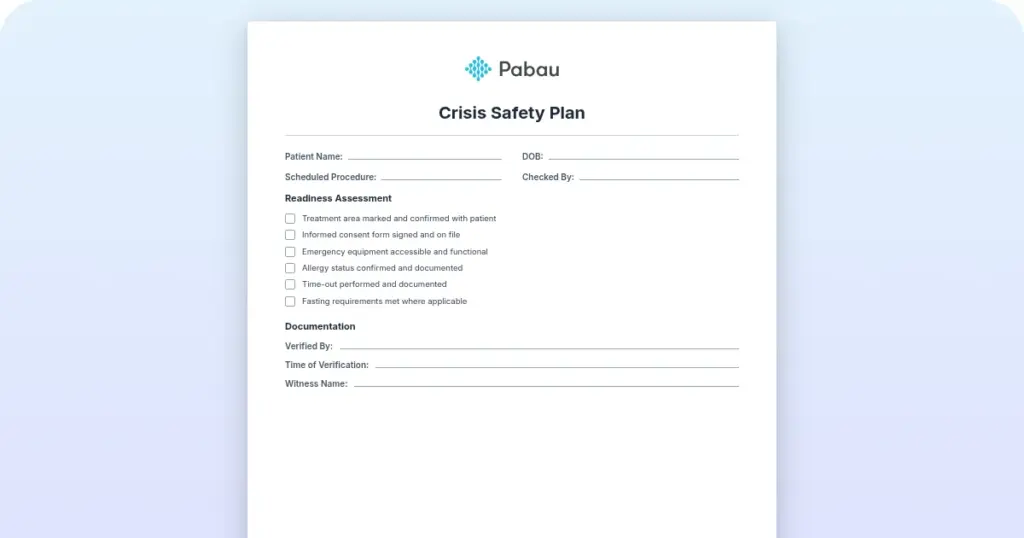
Crisis safety plan template
A crisis safety plan is a short, personalized written plan that a patient and cl...

1
Last Updated: Oct 19, 2026

A nursing teaching plan is a structured educational document that guides patient learning and promotes self-care management.
Core components include patient assessment, learning objectives, teaching methods, and evaluation of understanding.
The nursing process framework (assessment, planning, implementation, evaluation) underpins effective teaching plan development.
Pabau’s digital forms and clinical notes features streamline documentation of teaching plans and patient education outcomes.
A structured template for developing personalized patient education strategies, setting learning objectives, selecting appropriate teaching methods, and evaluating patient understanding to improve health outcomes and promote self-care management.
Download templateA nursing teaching plan turns an informal bedside conversation into a structured teaching session you can document and measure. A well-built nursing teaching plan template keeps every patient education encounter consistent, whether you’re teaching a newly diagnosed diabetic to inject insulin or preparing a post-surgical patient for discharge.
This guide covers what an effective plan includes, the six components your template needs, and a fully worked nursing teaching plan example you can adapt. Download the free template above, then follow the five steps below.
A nursing teaching plan is a documented strategy that outlines how a nurse will educate a patient about a health condition, procedure, medication, or lifestyle change. It is grounded in the nursing process, the systematic approach of assessment, diagnosis, planning, implementation, and evaluation that guides professional nursing care.
A worksheet that lays out the five ADPIE steps puts that same framework into a form you can fill in for each patient.
Unlike informal bedside conversations, a teaching plan is intentional and structured. It answers specific questions: What does the patient need to learn? What is their current knowledge level? What teaching methods work best for them? How will you know learning occurred? The answers become the foundation for measurable patient education that meets Joint Commission standards for patient rights and education compliance.
Teaching plans serve multiple audiences. Nursing students use them to fulfill clinical course requirements and prepare for NCLEX-RN competencies. Practicing nurses apply them to discharge teaching, chronic disease management, and medication education. Nurse educators use them as frameworks for training both patients and staff. The core principle is the same across all contexts: intentional, documented, evaluated patient learning.
A practical nursing teaching plan follows five operational steps that map directly to the nursing process:
Before writing a single objective, determine what the patient already knows, their health literacy level, language barriers, cultural beliefs, and learning preferences. Document physical capabilities (vision, hearing, motor skills) that influence teaching method selection. This assessment informs everything that follows.
Write clear, measurable goals using action verbs: “Patient will list three signs of hypoglycemia” or “Patient will demonstrate proper injection technique.” Objectives should align with Bloom’s taxonomy levels (knowledge, comprehension, application, analysis, synthesis, evaluation) to scaffold learning from simple recall to complex decision-making.
Choose strategies that match the patient’s learning style and the objective’s complexity. Verbal instruction works for simple facts; demonstration + teach-back method works for procedural skills; written materials support recall; video or visual aids engage different learners. Document which methods you’ll use and why.
Deliver the planned education using the documented methods. The teach-back method — asking the patient to explain concepts back to you — confirms understanding in real time. Based on patient responses, adjust your pacing and depth accordingly, and note any barriers or breakthroughs as you proceed.
Observe the patient performing the skill, or ask them to verbalize key concepts. Document whether objectives were met, partially met, or not met. Note what the patient missed and plan follow-up teaching. Evaluation informs discharge or transition-of-care decisions.
This five-step cycle turns a template from a checkbox exercise into a working clinical tool. Practice management software like Pabau keeps the completed plan in the patient’s permanent record, so it stays accessible at future visits and education carries across care episodes instead of restarting each time. Features like Pabau Scribe, our AI scribe, cut the documentation time after each teaching session.
Nursing students and educators. The teaching plan is a required competency in pre-licensure and graduate nursing programs. Clinical instructors use it to assess whether students can apply the nursing process, set realistic goals, and evaluate outcomes, which are all NCLEX-RN core competencies. Students often ask that same instructor for a nursing program recommendation letter.
Acute care nurses. Hospital discharge teaching for post-operative patients, medication adherence for patients with heart failure, and diet education for patients with diabetes all benefit from a documented plan. It lowers readmission risk and sends the patient home with written summaries and clear next steps.
Community health and home care nurses. Home-based patients often have limited access to repeat education. Having a detailed teaching plan with documented baseline assessment and specific objectives ensures the visit is productive and the plan can be transferred to the next clinician or referred to the patient’s primary care provider.
Specialty nurses (oncology, renal, orthopedics). Complex conditions require layered education. Teaching plans help oncology nurses break down chemotherapy side-effect management into achievable objectives, or help renal nurses scaffold dialysis self-care education across multiple visits.
Practices using software for managing patients retrieve past forms in seconds during consultations.
Improves patient outcomes. Patients who receive structured, documented education show higher medication adherence, faster recovery, fewer complications, and better self-management of chronic conditions. A teaching plan ensures learning is intentional, not incidental.
Supports regulatory compliance. Joint Commission, CMS Conditions of Participation, and state boards of nursing expect documentation of patient education. A teaching plan with documented assessment, objectives, methods, and evaluation creates the audit trail that satisfies compliance reviews and reduces liability exposure.
Prevents repeated and missed teaching. When a teaching plan is documented in the patient record, the next nurse or provider sees what was taught, how the patient responded, and what follow-up is needed. That stops redundant teaching and builds on prior sessions.
Develops critical thinking skills. Writing objectives, selecting methods, and evaluating outcomes requires nurses to think beyond task completion. This reflective process strengthens clinical judgment and supports lifelong learning habits essential for professional nursing practice.
Use the teach-back method at the end of every teaching interaction. Ask the patient, ‘Tell me in your own words what you’ll do when you get home’ or ‘Show me how you’ll use this inhaler.’ This single check turns one-way instruction into confirmed understanding and is recommended by the Agency for Healthcare Research and Quality (AHRQ) and health literacy organizations.
The NANDA nursing diagnosis “Knowledge Deficit” (now more accurately termed “Deficient Knowledge”) is one of the most common diagnoses nurses write when a patient needs education. A teaching plan addresses it directly by spelling out exactly what the patient doesn’t yet know and how you will teach it.
Effective objectives follow the SMART principle: Specific, Measurable, Achievable, Relevant, and Time-bound. Instead of “Patient will understand medication,” write “Patient will state the name, dose, and twice-daily timing of metformin before discharge” (specific, measurable, achievable, relevant to their diabetes management, timebound). This clarity guides both teaching and evaluation and becomes the standard by which you determine if the plan succeeded.
Link each objective to the patient’s broader health goal. For a diabetic patient, medication education serves blood-sugar control. Wound care education for a post-surgical patient serves infection prevention. Connecting diagnosis, objective, and outcome this way is the essence of patient-centered care and what regulators expect to see in clinical documentation.
A complete nursing teaching plan contains six core sections:
Comprehensive teaching plans prevent the common pitfall of teaching without measuring whether learning actually occurred. By documenting each component, you create a reusable framework for future patient education in the same specialty and support patient engagement through documented education summaries that patients can review post-discharge.
A generic teaching plan template works for most situations, but condition-specific examples help nurses visualize how to apply it in real practice. For hypertension education, objectives might focus on recognizing symptoms, understanding medication adherence, sodium reduction, and home blood pressure monitoring. For wound care education post-surgery, objectives center on dressing changes, infection signs, activity restrictions, and when to call the provider. For diabetes education, objectives span blood-glucose monitoring, carbohydrate counting, sick-day management, and foot inspection.
The template structure stays constant. Only the content and examples change. Adapting a template you already trust stops you from rebuilding a plan for every patient and makes sure no essential topic is skipped. Many organizations keep specialty addendums (a cardiac discharge teaching plan, a chemotherapy education checklist) built on the same framework.
Most templates you find online are blank. Here is a completed one, so you can see how each component reads when it’s filled in for a specific patient: a 58-year-old newly diagnosed with type 2 diabetes, being prepared for discharge.
Notice that the evaluation row records a partially met objective rather than a clean pass. That is what makes a teaching plan a clinical record and not a formality. It tells the next nurse exactly what to reinforce, and it’s the detail auditors look for.

Pabau’s integrated digital forms and clinical notes help you create, document, and evaluate patient teaching plans without duplicating work across disparate systems.

A well-designed template is only useful if nurses actually use it, so it has to fit existing workflows. Electronic health records (EHRs) with built-in teaching plan templates reduce the mental load. The plan is already structured, so the nurse fills in patient-specific details, selects from dropdown lists of common objectives, and documents evaluation in real time rather than after the fact.
The teach-back method, recommended by the Agency for Healthcare Research and Quality (AHRQ), becomes part of the evaluation step. Rather than asking “Do you understand?”, teach-back asks the patient to explain the concept or perform the skill. This real-time feedback adjusts your pacing and reveals misunderstandings while there’s still time to reteach before discharge or the end of the visit.
Documentation that is easy to access supports continuity. When the teaching plan lives in a shared clinical record alongside the patient’s problem list and medications, the next nurse or provider knows exactly what was taught and can build on it rather than repeat it. This efficiency and safety benefit compound across multiple visits or transitions of care.
A structured nursing teaching plan transforms patient education from an informal conversation into a measurable clinical intervention. By assessing learning needs, setting specific objectives, selecting evidence-based methods, and documenting evaluation, nurses ensure that teaching is intentional and that learning actually occurred. This approach improves patient compliance, reduces readmissions, and meets regulatory standards for patient education compliance.
Using a ready-made template removes guesswork and keeps teaching consistent across your unit or practice. Whether you’re a nursing student fulfilling a course requirement, a staff nurse discharging a patient, or a nurse educator training others, a solid teaching plan template is a practical tool that saves time while elevating the quality of patient education. Book a demo with Pabau to see how digital forms and clinical documentation features can streamline the creation and evaluation of nursing teaching plans within your clinical workflow.

Want to spend less time typing notes? medical dictation tools explains 5 benefits of speech recognition technology for documenting patient encounters.
Looking for a faster note format? SOAP notes guide shows how SOAP notes compress documentation time and structure clinical encounters.
Admitting a new patient to your ward? admission nursing note template covers patient identification, medical history, vital signs, and care planning for intake.
A care plan addresses all of a patient’s health needs across every domain. A teaching plan is a single intervention within that care plan focused specifically on patient education — it identifies what the patient doesn’t understand and documents how the nurse will teach it.
It depends on the topic and patient. Brief medication counseling may take 15 to 20 minutes. Comprehensive discharge teaching can span 45 to 60 minutes across one or more visits. Document the time spent for compliance purposes.
Reassess for underlying barriers — low health literacy, pain, anxiety, or the wrong teaching method. Simplify the objective if needed, switch your approach, and document the modification and reason for the change.
Documented patient education is mandated by the Joint Commission, CMS, and state nursing boards. A completed teaching plan is the clearest evidence that structured, evaluated education took place.
Yes. The assess-objectives-teach-evaluate structure works across all settings and age groups. Customize the content and vocabulary to suit each population while keeping the same framework.