CPT Code 98981: RTM Treatment Management Billing Guide
CPT code 98981: Definition and official descriptor CPT code 98981 is an add-on c...

Last Updated: Nov 9, 2026
T2022 is the HCPCS Level II code for case management, per month. State Medicaid agencies use it to pay for coordinating a member's services across a calendar month, and Medicare does not pay it.
Under the national descriptor, one unit covers one month, so a month bills once however many contacts it took. The unit is earned by meeting the state's minimum contact standard, recorded in the case notes. Billers also confuse T2022 with T2023, targeted case management per month, and with the 15-minute codes T1016 and T1017.
Let Pabau's smart automation suggest the right codes, reduce claim denials, and keep your practice compliant—effortlessly.
Automate repetitive tasks and focus on what matters most—your patients.
Reduce coding errors and ensure compliance with the latest regulations.
Clean claims, fewer denials, and faster reimbursements.
Powerful insights and reporting to help your practice thrive.
HIPAA compliant SOC 2 certified GDPR-compliant Trusted by 4,000+ clinics worldwide

HCPCS code T2022 is the state Medicaid code for case management, per month, and Medicare does not pay it.
One unit covers one calendar month, so the month bills once however many contacts the case manager logs.
States set the contact standard that earns the unit, such as Indiana’s monthly case note and a face-to-face visit every 90 days.
T2023 bills targeted case management per month, while T1016 and T1017 bill case management in 15-minute units.
In Pabau, the practice software we build, case notes, appointments and claims share one patient record, so each billed month traces back to its contacts.
HCPCS code T2022 is a Level II code that state Medicaid programs use to pay for case management, billed per month. Its official CMS descriptor is: Case management, per month. One unit covers a calendar month of coordinating a member’s care, not a single visit or call.
Under CMS’s HCPCS Level II coding system, T2022 sits in the T1000-T5999 range of national codes established for state Medicaid agencies. These T-codes are not payable by Medicare and do not appear on the Medicare Physician Fee Schedule. Each state decides whether it covers T2022, which program uses it, and what it pays.
Case management under T2022 means assessing what a member needs, arranging services, and checking that those services arrive. It is common in home and community-based services (HCBS) waivers under section 1915(c) of the Social Security Act. Those waivers fund community care for people who would otherwise need institutional care.
The table below summarizes the administrative attributes of HCPCS code T2022 as published in the CMS HCPCS Level II code set.
Check the current-year status of T2022 and its neighbors in the CMS quarterly HCPCS file before each new plan year.
T2022 pays for the coordination around a member’s services, not the services themselves. The monthly rate covers the case manager’s work across the month, whatever mix of visits, calls and meetings that took.
The services a case manager arranges carry their own codes. Assisted living arranged through a waiver, for example, bills per diem under HCPCS code T2031. Financial management for a member who self-directs has its own line as well, under code T2040.
A child’s community-based wrap-around program is another such service. Its child and family team coordination is paid in that program’s per diem under H2022, not as a separate monthly T2022 unit.
Covered under T2022:
Not covered under T2022:
The last exclusion catches agencies that grow into case management. Under 42 CFR 441.301(c)(1)(vi), a provider of HCBS for a member cannot also provide that member’s case management. The exception applies only where the state shows no other willing and qualified entity serves the area.
T2022 and T2023 both bill case management by the month. T2023 is targeted case management, a state plan benefit for a population the state defines under section 1915(g) of the Social Security Act. T2022 is the general code, which states such as Indiana use for waiver case management.
The 15-minute codes split the same work by time. T1016 bills case management in 15-minute units, and HCPCS code T1017 bills targeted case management the same way. HCPCS code T2024 covers service assessment and plan of care development under a waiver, which some states pay separately.
Two questions place a service in the right code. Is it targeted case management, and does your state pay it by the month or by the quarter hour?
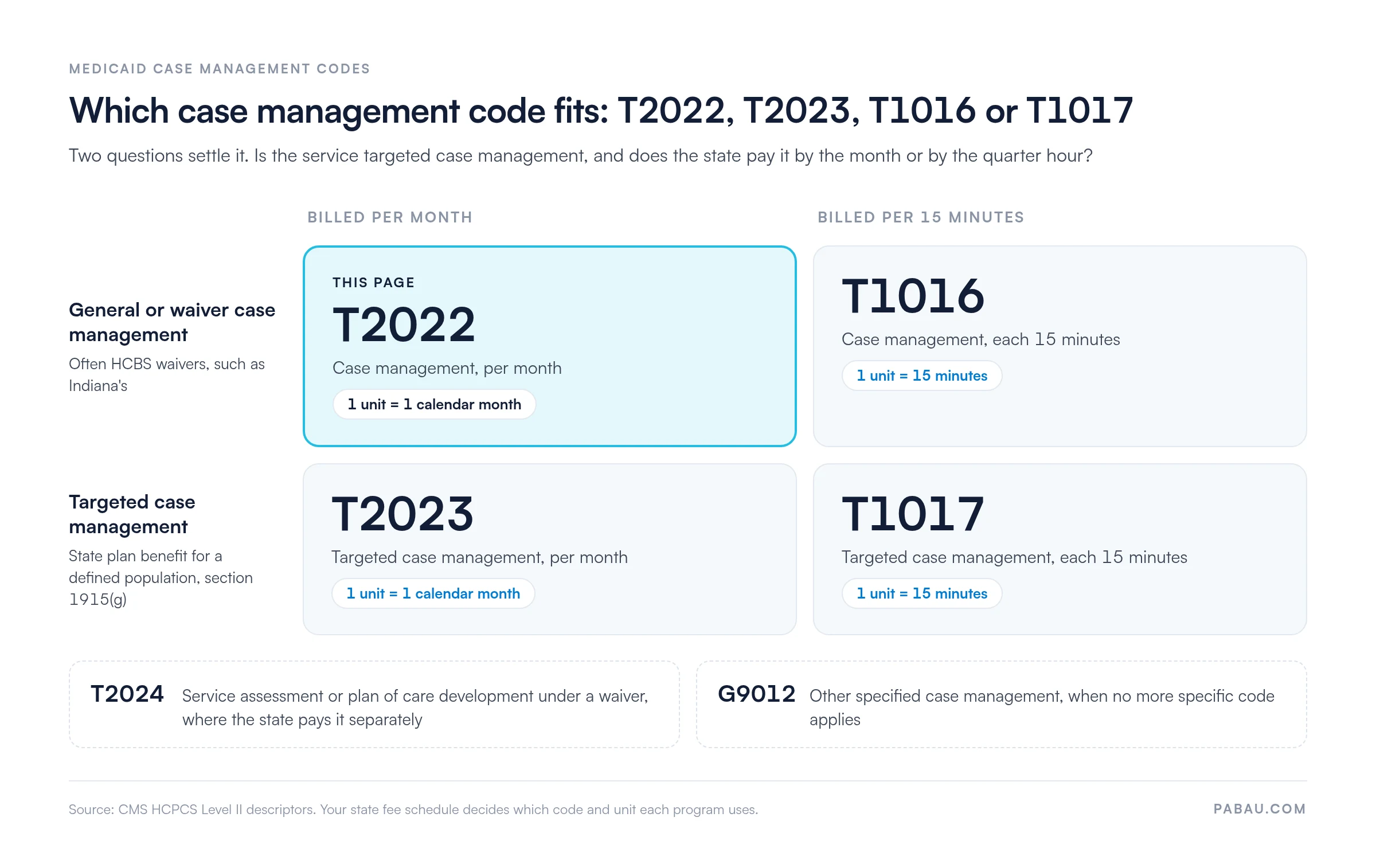
Pick the code your state’s fee schedule lists for the program, not the one whose wording fits best. A state that publishes T1017 for its targeted case management can deny T2023 for the same service.
Before billing T2022, find the program’s row in your state fee schedule and copy the code, modifiers and unit exactly. Indiana, for example, bills waiver case management as T2022 with modifiers U7 and U5, one unit per month.
States use T2022 wherever they pay case management, or a related coordination service, as a flat monthly fee. Indiana’s DDARS HCBS waiver provider module, published September 24, 2026, shows how one state does it:
The last row shows why the national descriptor is only a starting point. Indiana bills one T2022 service in quarter hours, despite the per-month wording. The state fee schedule sets the unit and the modifiers, so read both columns before you count units.
Accurate T2022 billing depends on the unit, the service dates, the place of service and any state modifiers. Each field is checked on its own, so one error can deny a month that was fully worked.
A second unit for the same member and month usually reads as a duplicate. Months that start or end mid-enrollment follow state rules, so check those rules before billing a partial month.
HCPCS modifiers U1 through UD are reserved for each state Medicaid program to define. The same modifier can mean different things in two states, so never copy modifiers from another state’s guidance.
Most states require case management to appear in an approved service plan or authorization before the first month is billed. Some waivers authorize it inside the plan itself, while others issue a separate approval.
The authorization for a T2022 month typically rests on three layers:
Running insurance eligibility verification at the start of each month catches a lapsed waiver enrollment before a full month of work goes unpaid.
Because the unit is a month, an auditor asks one question about each claim. What happened with this member in this month? A month with no qualifying contact on file cannot support a unit, however much work went on around it.
Indiana’s standard shows what a state can require. Case managers there enter a case note for each encounter, at least one per month. They also meet the member face to face at least every 90 days.
Required documentation typically includes:
Keep these records exportable by member and month, because that is how an auditor will request them. Medical billing compliance controls make that request a report rather than a search.
T2022 claims still carry an ICD-10-CM diagnosis, usually the condition that qualifies the member for the program. Case management is not tied to one diagnosis, so the code follows the waiver population.
Cross-check each pairing against the full ICD-10-CM codes index and your state’s program criteria. The diagnosis on the claim should match the one in the member’s eligibility assessment.
T2022 has no national rate, because Medicare does not price T-codes. Each state Medicaid program or managed care organization sets its own monthly rate. Indiana’s current waiver module, for example, pays $189.56 a month for waiver case management.
To find the current T2022 rate for your state:
Check each remittance advice against the published rate. A monthly code underpaid by a few dollars repeats for every member, every month.
T2022 denials cluster around the monthly unit. Most trace back to a month with no qualifying contact, a duplicate unit, a lapsed enrollment, or the wrong payer.
Sorting T2022 denials by root cause shows which workflow fix pays first. When the same reason repeats across a billing cycle, the process is producing it. A structured denial management workflow turns that pattern into a fix.
Run a no-contact report two business days before month-end. Any member without a signed case note for the month can still get a contact before the unit is lost.
Many case management agencies track monthly contacts in one place and bill in another. The case note sits in a spreadsheet or paper file, and the claim is built from memory at month-end.
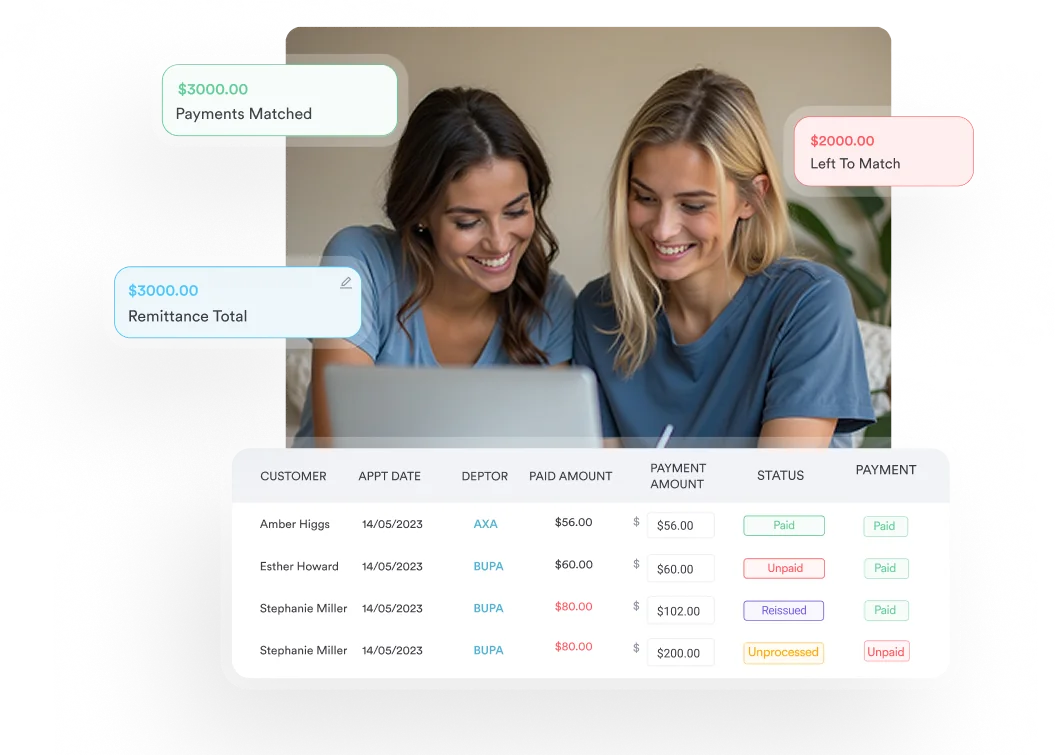
Pabau keeps case notes, appointments and claims on the same patient record. Its claims management software builds the T2022 claim from that record, so you can check each billed month against the contacts behind it.
Scheduling covers the other end of the month. Booking each member’s monthly contact and any required face-to-face visit in Pabau’s calendar shows who is still due before the month closes.
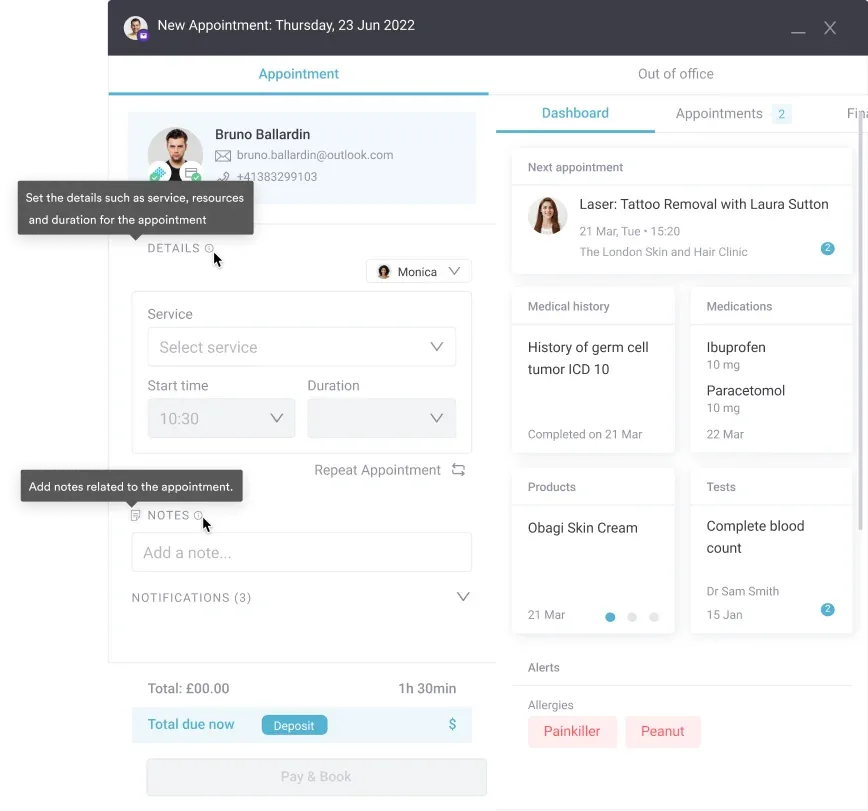

Pabau keeps case notes, appointments and claims on one patient record. Each T2022 month traces back to a documented contact before the claim leaves your agency.

HCPCS code T2022 looks simple, one unit for one month of case management. The work sits in proving that the month happened, under your state’s contact standard, for an enrolled member, on an authorized plan.
Treat the state fee schedule as the source of truth for the unit and the modifiers. Then close each month only when its case note is signed. Billing in that order turns most T2022 denials into scheduling problems you can see coming.
Book a demo to see how Pabau ties monthly case notes to T2022 claims for Medicaid case management teams.

Need to understand how clean claims reduce denial rates? Submitting clean claims walks through the components of a complete claim and what payers check at adjudication.
Decoding a T2022 remittance? Denial codes in medical billing maps CARC and RARC codes to the fix each one needs.
Want to understand the billing cycle end to end? Revenue cycle management explains how claims move from service delivery to payment posting.
Building the claim from the encounter record? What a superbill includes lists the fields a payer expects before it will adjudicate a claim.
New to Medicaid billing? What is medical billing covers how codes, claims and payers fit together.
HCPCS code T2022 is the Level II code for case management, per month. It is a T-code established for state Medicaid agencies, so Medicare does not pay it. States use it to pay for coordinating a member’s services across a calendar month.
T2022 is billed per month under its national descriptor, one unit for each calendar month of case management. A state can define another unit in its fee schedule. Indiana, for example, bills integrated health care coordination under T2022 in 15-minute units. Time-based case management otherwise bills under T1016.
Both codes bill case management per month. T2023 is targeted case management, a state plan benefit for a population the state defines under section 1915(g) of the Social Security Act. T2022 is the general case management code, often used for waiver case management. Use the code your state’s fee schedule lists for the program.
No. T2022 is one of the T-codes established for state Medicaid agencies, and Medicare does not pay them. A T2022 claim sent to Medicare or a commercial plan usually denies with CARC 96. RARC N130 often comes with it, pointing to the plan’s benefit restrictions.
A T2022 claim needs a dated case note for the billed month and a current service plan that authorizes case management. It also needs proof the member was enrolled on the service dates. Many states require face-to-face contact at set intervals as well, such as every 90 days in Indiana.
Usually not for the same case management activity. T1016 bills case management in 15-minute units, and T2022 bills the same service as a monthly unit. Billing both for one member and period typically reads as overlap, so check your state’s rules before submitting.
T2022 has no national rate, because each state Medicaid program sets its own. Indiana’s waiver module lists $189.56 per month for case management on its Family Supports and CIH waivers. Check your own state’s fee schedule for the current rate.