EHR ROI: How to calculate and maximize your return
EHR ROI is the financial return a practice earns on its electronic health record...

Last Updated: Oct 15, 2026

Revenue cycle management is the process of tracking and collecting the money from every patient encounter, from booking through to final payment.
The cycle runs in seven steps: registration, eligibility, coding, claim submission, payment posting, denial management, and patient collections.
Every practice has a revenue cycle whether or not anyone manages it, and a solo practice has the same seven steps as a hospital.
Healthy practices sit at 30 to 40 days in accounts receivable, with a 98% clean claim rate and a net collection rate above 95%.
Software automates the administrative steps, so a small team can run the whole cycle without a billing department.
Revenue cycle management (RCM) is the process of tracking and collecting the money from every patient encounter, from booking through to final payment. It covers the administrative, clinical, and billing work that turns a booked appointment into cash in your account. If your practice adds cosmetic services, our medical spa software comparison covers the charting and checkout tools that cash-pay work needs.
The phrase sounds like a hospital department with its own floor of the building. At a small practice it is something much smaller. It is the path one appointment’s money takes to reach your bank account.
Every step on that path either moves the money forward or loses some of it. At your scale, whatever gets lost comes straight out of your own income.
This guide walks the seven steps in order, with a sourced number on what each one costs when it goes wrong. Then we follow a single $150 visit from booking to bank, twice. Each step also links to a deeper guide on that part of the cycle.
The revenue cycle has seven steps. They are scheduling and registration, eligibility verification, care documentation and coding, charge capture and claim submission, payment posting, denial management, and patient collections. They run in that order, for every insured visit, at every size of practice.
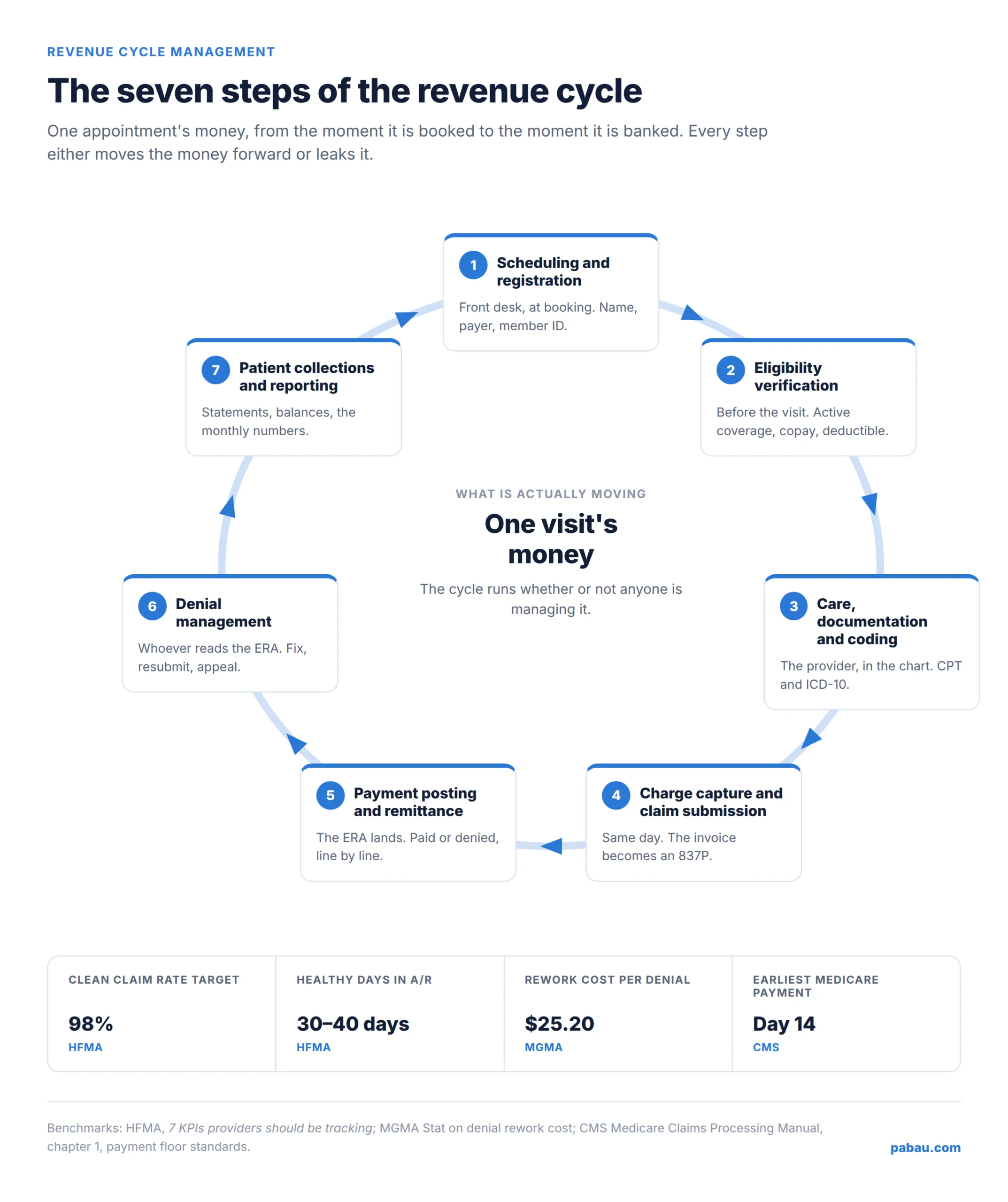
Registration captures who the patient is and who is paying, at the moment the appointment is booked. That means legal name, date of birth, payer, member ID, and group number, keyed correctly the first time.
At a small practice this is the front desk, often between phone calls. It looks like the least financial step in the cycle, and it shapes more claims than it gets credit for.
A mistyped member ID produces a rejection rather than a denial, so the claim never reaches adjudication at all. CMS is explicit that rejected claims are not considered as received until they are resubmitted as corrected claims. Your filing clock keeps running the whole time, and Medicare allows 12 months from the date of service.
This is why a clean claim is a front-desk achievement rather than a billing one.
Eligibility verification confirms, before the visit, that the patient’s coverage is active and that it pays for what you are about to do. It also tells you the copay, the deductible position, and whether the service needs prior authorization. For a pelvic health practice billing a course of visits, it can also show how many visits the plan covers. Rehabilitation after a knee sprain coded S83.512D runs into those caps regularly.
This is the highest-leverage step in the cycle, and the first one dropped when the schedule is full. Registration and eligibility together cause 24% of denials, the largest single share in Optum’s 2024 denials index of roughly 124 million hospital claim remits.
Skipping it costs you twice. You lose the copay you could have collected at the desk. You also buy a denial that somebody has to work later. The denial codes that come back from a coverage problem are among the most common in medical billing.
Coding turns the treatment you delivered into the CPT and ICD-10 codes a payer can price. The chart is what makes that possible, because a code with no documentation behind it is a code you cannot defend. A lesion destruction billed as 17271 needs the lesion’s size and site written down.
At a small practice the provider is also the coder. Nobody reviews the note before the claim leaves the building.
This step fails quietly. A denial announces itself, but a visit you documented thinly and coded conservatively simply pays less. An open fracture coded S92.311B pays differently from a closed one, and only the note decides which. Nothing on your denial report will ever tell you about revenue you never billed.
A superbill is the clearest way to see this step on one page. It is where a visit’s codes come together before medical billing starts.
Charge capture turns the coded visit into a billable charge, and submission sends it to the payer as an electronic claim. For an outpatient practice that claim is an 837P, the electronic form of the the electronic form of the CMS-1500.
Claims usually travel through a clearinghouse, which checks them for errors and routes each one to the right payer. HFMA puts the target clean claim rate at 98%.
The channel alone changes when you get paid. Medicare may not pay a clean electronic claim before the 14th day after receipt, and a paper claim not before the 29th. That is 15 days of your own money, decided by nothing but how the claim was sent.
Payment posting records the payer’s decision against the claim, line by line. It arrives as an electronic remittance advice, or ERA, which says what was allowed, what was paid, what the patient owes, and what was denied.
This is the least glamorous step and the one where practices lose the thread. If nobody posts the ERA, nobody knows which claims were denied. A denial you never read is a denial you never work.
HFMA reports that up to 65% of denied claims are never resubmitted. Very little of that is a decision. Most of it is a claim that dropped out of sight.
Denial management is the work of finding denied claims, fixing what caused them, and getting them paid. Each denial arrives with a claim adjustment reason code, or CARC, naming the cause. A wrong seventh character is a common one, since S42.256D claims routine healing at a follow-up visit.
At a small practice this is a weekly habit rather than a department. Someone opens the denials, sorts them by reason code, and works the ones worth working.
The arithmetic is what makes it worth the hour. Take a practice filing 300 claims a month at $110 a claim, with denials running at 7%, the middle of HFMA’s industry range. That is 252 denials a year, and about $6,400 of rework at MGMA’s average of $25.20 per claim.
The rework is the cheap part. If up to 65% of denials are never resubmitted, this practice also abandons around 164 claims a year. At $110 each, that is roughly $18,000 of billed work it stops chasing.
Together that is about $24,000 a year on $396,000 of billed work. Optum’s finding that 84% of denials are potentially avoidable means most of it never had to happen.
Patient collections is the last mile of the cycle. You bill the patient for whatever insurance did not cover, then follow up until the balance reaches zero. Reporting is what tells you whether the other six steps are working.
Patient money is the hardest money in the cycle to collect, and the benchmarks admit it. HFMA wants under 10% of total accounts receivable aged past 90 days, but allows up to 30% for self-pay. A course of care after S82.845D can leave a patient balance building across several visits.
The fix is mostly upstream. A copay collected at the desk is collected. The same $20 chased by mail three weeks later is a maybe.
Here is the same $150 visit twice. Once through a cycle that works, and once through a cycle with one step missing. The dollar amounts are illustrative, and the days and the rework cost are sourced.
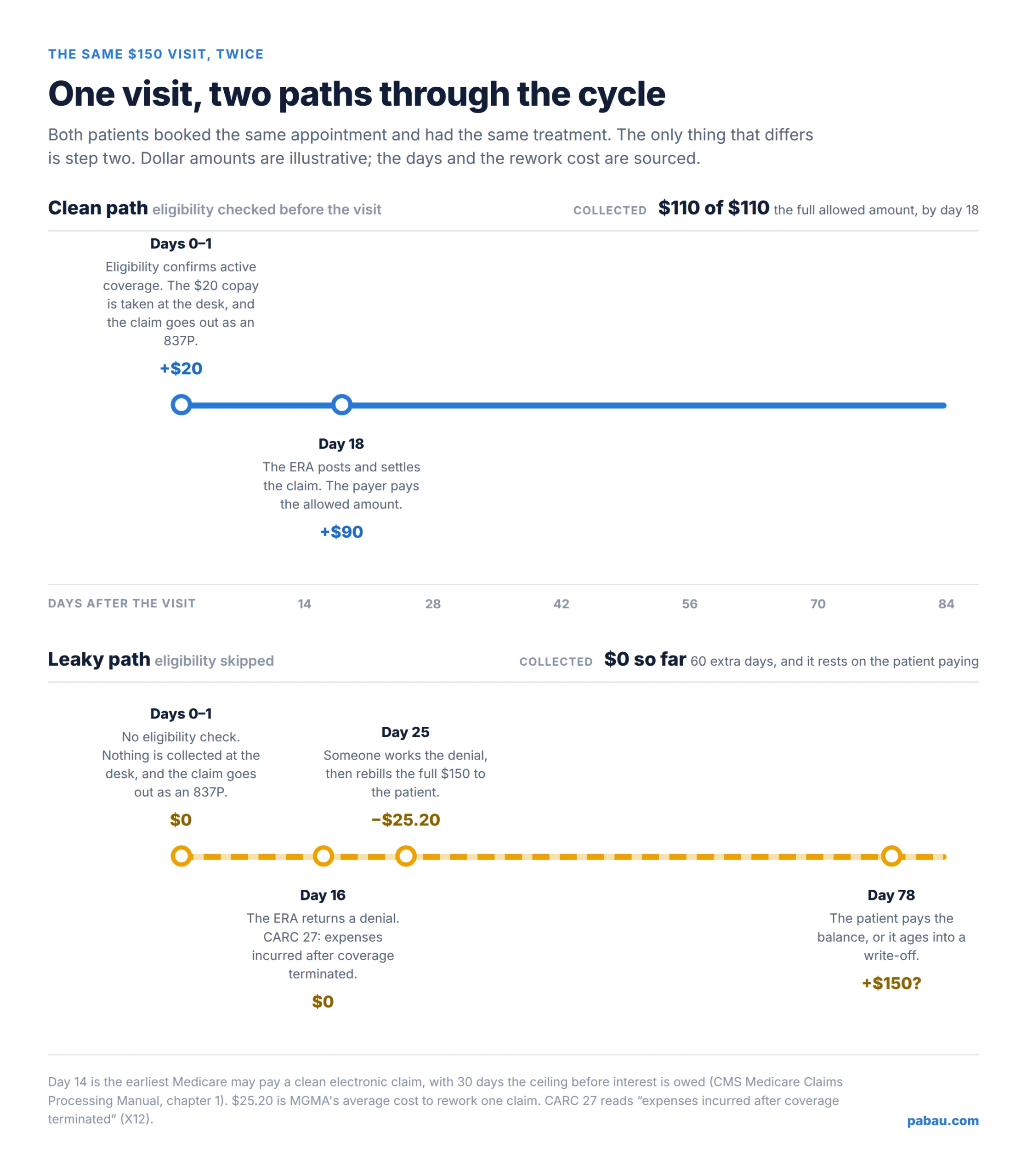
A patient books a $150 office visit. At registration the front desk captures the payer and member ID. An eligibility check comes back active, with a $20 copay and the deductible already met.
The patient pays the $20 at the desk. The provider documents and codes the visit, and the claim goes out the same day as an 837P. Anything given in the room, such as J0280, travels on that same claim.
This payer’s contracted allowed amount for the visit is $110. On day 18 the ERA posts and the payer pays $90, which is the allowed amount minus the copay you already took.
The $40 between your $150 fee and the $110 allowed amount is a contractual write-off, not a loss. You agreed to it when you signed the contract. You collected $110 of $110, and the claim spent 18 days in accounts receivable.
Same patient, same visit, same $150 fee. Nobody runs the eligibility check, because the day is full and the check takes a phone call.
The coverage terminated at the end of last month. Nobody knows that, so nothing is collected at the desk.
The claim goes out on day 1. On day 16 the ERA returns it denied, carrying CARC 27, “expenses incurred after coverage terminated”. The payer pays nothing.
On day 25 someone works the denial and finds there is nothing to fix. There is no coverage to bill, so the balance moves to the patient. That rework costs $25.20.
With no payer contract in play, the patient owes your full $150 rather than a $20 copay. A statement goes out, then another. If the patient pays on day 78, this visit collected more than the clean path did.
That last line is the important one. The leaky path has the higher sticker price and the worse outcome.
Everything now depends on a patient agreeing to a $150 bill they never expected, weeks after a visit they believed was covered. Some pay. Some do not, and the balance ages quietly into a write-off.
The clean path collected a smaller number with near-certainty on day 18. The leaky path is holding a bigger number, a collection risk, and 60 extra days of your money sitting somewhere other than your account.
Multiply that by the share of your schedule nobody verified this week. That is what revenue cycle management is for.
Five numbers cover it. Track days in accounts receivable, clean claim rate, net collection rate, initial denial rate, and the share of A/R aged past 90 days. The healthy ranges below are HFMA’s.
| Metric | How to work it out | Healthy range | First fix when it is off |
|---|---|---|---|
| Days in A/R | Current receivables, net of credits, divided by average daily charges | 30 to 40 days | Start with your oldest bucket, not your newest claims |
| Clean claim rate | Claims accepted by the payer divided by claims submitted | 98% | Fix the registration data, where most rejections begin |
| Net collection rate | Payments, net of credits, divided by charges net of contractual adjustments | 95% minimum, 97% to 99% optimal | Work the denials you currently write off by default |
| Initial denial rate | Denied claim dollars divided by submitted claim dollars | Under 5% optimal, 5% to 10% industry average | Sort denials by CARC and fix the top reason first |
| A/R over 90 days | Share of total accounts receivable aged past 90 days | Under 10%, up to 30% for self-pay | Call the aged balances before they become write-offs |
One target sits underneath all five. HFMA also expects 85% of denials resolved within 30 days. A denial still sitting at 60 days is usually a denial that will never be paid. Long-tail orthopedic claims age fastest, and a malunion coded S72.059P often follows months of earlier billing.
If you only track one number, track days in accounts receivable. It moves whenever any of the other four break, which makes it the smoke alarm for the whole cycle.
There are three ways to run the cycle, and all three are legitimate. You can hire a biller, or pay a billing service a percentage of what it collects. You can also run it yourself on software that automates the administrative steps.
| Approach | What it typically costs | Fits when |
|---|---|---|
| Outsourced billing service | 4% to 10% of collections, most commonly 5% to 7% | You have real claim volume, a complex specialty, or no appetite to own billing |
| In-house biller | $50,250 median salary, about $72,000 fully loaded | Volume keeps one person busy and you want the work in the building |
| Software-run in-house | A practice management subscription, with no percentage of collections | The owner or manager runs billing alongside other work |
Outsourcing is priced as a share of what the service collects for you. Published rates start at about 3% of collections and run to 10%. Physicians themselves report paying 4% to 10%, with most landing between 5% and 7%.
Small practices sit at the expensive end of that range. Below 4% usually buys a thinner service. The 7% to 10% band is what smaller practices pay, or what full coding and denial management cost.
An in-house biller is a fixed cost instead of a variable one. Medical records specialists earned a median $50,250 in May 2024, according to the Bureau of Labor Statistics. Benefits add roughly 30% of total compensation for private-sector workers, so one biller costs about $72,000 a year.
That gives you a crossover point you can work out on paper. A service charging 6% costs $72,000 once you are collecting $1.2 million a year. Below that figure the service is cheaper than the salary. Above it, the biller is.
Most single-location practices never reach that line. A solo practice collecting $400,000 would pay a service around $24,000, and no full-time biller is worth hiring for that volume. That is why the third option fits so many of them.
Outsourcing still wins in specific cases. Think of an ADHD practice facing constant prior authorization work, or a practice opening a second location. An owner who genuinely will not do the weekly denial review should pay someone who will. A service that collects 5% more than you would has already paid for itself.
A cash-pay practice already has a revenue cycle. It has two steps. The patient books, and the patient pays before they leave.
Taking insurance adds the other five overnight. Eligibility, coding, claim submission, payment posting, and denial management all arrive together, on the day your first payer contract goes live. Waiver programs add a layer again, because a per diem code such as T2012 bills by the day.
Build them in order rather than all at once.
Expect your numbers to look bad for a quarter. A first-year insurance practice with a 15% denial rate is still learning which of the seven steps it has not built yet.
Most small practices run the cycle across several tools. The calendar is one system, the chart another, the invoice a third. The claim lives in a portal that knows nothing about any of them. Every step re-enters data the last step already had.
Practice management software like Pabau puts the seven steps on one record. The appointment, the chart, the invoice, and the claim all belong to the same client, so nothing gets retyped between them.
Eligibility runs in real time from the client card, before the visit rather than after the denial. The claim is generated from the invoice as a CMS-1500 or 837P and submitted through our Claim.MD integration to thousands of US payers. Built-in CPT and ICD-10 catalogs mean the codes come from a list rather than from memory.

Remittances then close the loop on their own. ERAs settle claims automatically to Paid or Denied and match the payments into billing, so posting stops being a task somebody has to remember. When a claim is denied, the reason arrives as a CARC code attached to that claim, with its full activity history beside it.
So the seven steps stop being seven tools. You read one screen that already knows what happened, which is as close to a billing department as most small practices need.

Pabau checks eligibility from the client card, builds claims from the invoice, and settles ERAs against them automatically. Denial reasons land on the claim itself, so a small team can run all seven steps without a billing department.

Revenue cycle management is the difference between the revenue you earned and the revenue you collected. Those two numbers are never identical. The distance between them is the part you control.
At hospital scale that distance is a performance metric. At your scale it is your salary. The worked example above put about $24,000 a year of largely avoidable loss on a practice billing under $400,000.
None of the seven steps is difficult. What makes the cycle leak is that every step belongs to somebody who is also doing something else. That is an argument for automating the administrative steps, not for hiring a department.
Start with eligibility. It is the cheapest step to fix and the most expensive one to skip. Book a demo to see how Pabau runs eligibility, claims, remittances, and denials on a single client record.

Where do most denials start? What is a medical claims clearinghouse? explains the checks a claim passes before a payer sees it.
Ready to work the denials you already have? Denial management in healthcare walks the five-step process at small-practice scale, with the benchmarks for each.
Not in network yet? How to get credentialed with insurance companies covers the paperwork and the timelines before your first claim can be paid.
Need to read the payer’s reply? What is an electronic remittance advice? shows how to read an ERA line by line.
Coding thoracic spondylosis without complications? Thoracic spondylosis coding guide explains when the fully specified code is the right choice over a complicated alternative.
The seven steps are scheduling and registration, eligibility verification, care documentation and coding, charge capture and claim submission, payment posting, denial management, and patient collections. They run in that order for every insured visit. Some sources split them into more steps or fewer, but the sequence is the same.
The RCM process is the sequence one patient encounter’s money follows, from the appointment being booked to the balance reaching zero. It combines administrative work like registration and eligibility, clinical work like documentation and coding, then the billing work of claims, remittances, denials, and patient statements.
A revenue cycle manager owns the numbers for the whole cycle, from registration accuracy through to collections. They usually manage the billing staff doing the work. Most small practices do not have one. At that scale the role is split between the owner, the front desk, and the software. Automating the routine steps matters more than the job title.
Think of it as following one appointment’s money. Somebody books, you check their insurance, you treat them, and you code what you did. Then you send a claim, the payer pays part of it, and you bill the patient for the rest. Revenue cycle management is making sure nothing goes missing along the way.
No, medical billing is one part of revenue cycle management. Billing covers preparing and submitting claims and chasing payment. The revenue cycle starts earlier, at scheduling and eligibility, and ends later, with collections and reporting. Much of what decides whether a claim gets paid happens before billing begins.