CPT Code 98981: RTM Treatment Management Billing Guide
CPT code 98981: Definition and official descriptor CPT code 98981 is an add-on c...

Last Updated: Nov 9, 2026
H2022 is the HCPCS Level II code for community-based wrap-around services, per diem.
It covers intensive, individualized support that a child and family team plans and delivers in the community. It typically serves children and youth with serious emotional disturbance and their families. H2022 bills one unit per day of service under state Medicaid programs, which set eligibility, rates and limits. It is not a Medicare benefit.
Let Pabau's smart automation suggest the right codes, reduce claim denials, and keep your practice compliant—effortlessly.
Automate repetitive tasks and focus on what matters most—your patients.
Reduce coding errors and ensure compliance with the latest regulations.
Clean claims, fewer denials, and faster reimbursements.
Powerful insights and reporting to help your practice thrive.
HIPAA compliant SOC 2 certified GDPR-compliant Trusted by 4,000+ clinics worldwide

H2022 bills community-based wrap-around services at one unit per service day, not in 15-minute units.
State Medicaid programs set H2022 eligibility, rates and limits. Medicare does not pay for H-series codes.
Wrap-around services typically support children and youth with serious emotional disturbance and their families through one team-built plan of care.
Duplicate same-day units, lapsed prior authorization and missing modifiers are common H2022 denial triggers.
In Pabau’s claims management software, the authorization code follows the appointment to the claim, and each case shows approved sessions used.
HCPCS code H2022 is the Level II code for community-based wrap-around services, billed per diem. Its official descriptor reads “Community-based wrap-around services, per diem,” and its short descriptor is “Com wrap-around sv, per diem.” The code belongs to the H-series of HCPCS Level II codes, which state Medicaid agencies use for behavioral health services. Individual state Medicaid programs, not CMS, set its coverage, rates and qualifying criteria.
One unit of H2022 equals one day of service for one member. A day with a long family team meeting and a day with a short home visit each bill as a single unit. Either way, the day must meet the state’s definition of a billable service day. States that pay the same service by time use H2021, its 15-minute counterpart.
Wrap-around is a care-planning process rather than a single therapy. A child and family team builds one individualized plan that pulls together clinical treatment, natural supports and community services. Billing it cleanly means keeping clinical notes, authorizations and claims in step.
H2022 covers intensive, individualized support delivered in the community rather than in a hospital or residential setting. Most programs serve children and youth with serious emotional disturbance (SED) who are at risk of out-of-home placement, along with their families. Eligibility criteria, age limits and covered activities are defined in each state’s Medicaid provider manual.
The boundary with neighboring services decides which code goes on the claim:
Cross-agency coordination that serves the wrap-around plan is already paid inside the H2022 per diem day. Stand-alone case management for the same member is a separate claim, billed monthly under T2022. Where the state pays that case management by the quarter hour, the claim uses T1016 instead.
H2022 is most often confused with its 15-minute counterpart, H2021, and with other H-series behavioral health codes. The table compares each one by descriptor, billing unit and key differentiator. A unit or service-type mismatch is one of the quickest ways to trigger an automated denial.
Eligible rendering providers vary by state. Wrap-around programs are usually run by agencies that the state Medicaid program or its managed care plans have certified or contracted. Teams commonly include a facilitator or care coordinator and family and youth support partners, working under licensed clinical supervision.
Checking each rendering provider’s credentials against the state’s list before billing removes a common denial cause before it reaches the payer.
The service follows the family. Common places of service are the home (POS 12), a school (POS 03) and other community settings (POS 99). Some states also accept office-based delivery (POS 11). A POS code outside the approved list leads to denial, so confirm it before you bill from a new setting.
Every H2022 unit needs records showing the day’s service was medically necessary, delivered by a qualified provider and tied to the plan of care. A record missing any of these elements puts the payment at risk in an audit.
Per diem billing moves the documentation question from minutes to the service day. The record must show that a billable wrap-around service happened on that date, what it was and which plan goal it served. Keep the notes to the HIPAA standards that apply to behavioral health records.
Required documentation elements for H2022:
Modifiers on H2022 claims tell the payer about the program, the population and the team model. A missing required modifier usually leads to denial, and a wrong one can trigger an audit flag or overpayment recovery. States publish their own required combinations, so treat this table as a starting point.
H2022 is a Medicaid code. Medicare Part A and Part B do not cover H-series codes, and standard commercial plans rarely cover wrap-around services. Medicaid managed care organizations (MCOs) working under state contracts often administer the benefit and add their own criteria.
Knowing the medical billing fundamentals specific to Medicaid matters here, because the rules differ from Medicare fee-for-service billing. Depending on the state, wrap-around may be funded through the Medicaid state plan, a home and community-based services waiver or a children’s behavioral health program. Check your state Medicaid provider manual rather than relying on another state’s guidance.
Many state Medicaid programs and MCOs require prior authorization (PA) before H2022 services begin. PA problems are a frequent denial trigger, because a claim without an active authorization is rejected regardless of documentation quality.
Maintaining Medicaid billing compliance means tracking authorization dates, authorized days and renewal windows. A PA request for wrap-around services typically includes:
If a PA lapses mid-episode, service days after the end date are denied even when the notes are complete. Track used days against authorized days so the renewal goes in before the count runs out.
H2022 rates come from individual state Medicaid fee schedules, and there is no single national rate. A per diem rate covers a full day of wrap-around support, so it does not compare unit for unit with a 15-minute code. Some states pay one daily rate, while others vary it by intensity tier, region or modifier.
For the current rate in your state, consult your state Medicaid agency’s fee schedule directly. Rates update at least annually and sometimes more often.
H2022 denials cluster around a predictable set of causes. The table maps each one to the claim field to review and the corrective action. Fixing causes at the workflow level lowers the denial rate faster than appealing claims one at a time. Denial management workflows that group H2022 rejections by cause make these patterns visible.
H2022 needs a qualifying behavioral health diagnosis plus evidence that the young person meets the state’s serious emotional disturbance criteria. The ICD-10-CM code on the claim must match the diagnosis in the plan of care and the authorization. Payers cross-check the two, and a mismatch leads to denial even when the record is otherwise complete.
These ICD-10-CM categories commonly appear on wrap-around claims for children and youth. The list is not exhaustive, so confirm covered diagnoses in your state’s Medicaid provider manual.
Clean H2022 claims need four data points to agree: One unit per service day, correct modifiers, a valid authorization and a matching diagnosis. Manual claim entry makes it easy for one of them to drift. Claims management software that carries the authorization code from the appointment to the claim reduces that risk.
Each of those checks lives in a specific field on the claim form, and the map below shows which denial follows when one is wrong.
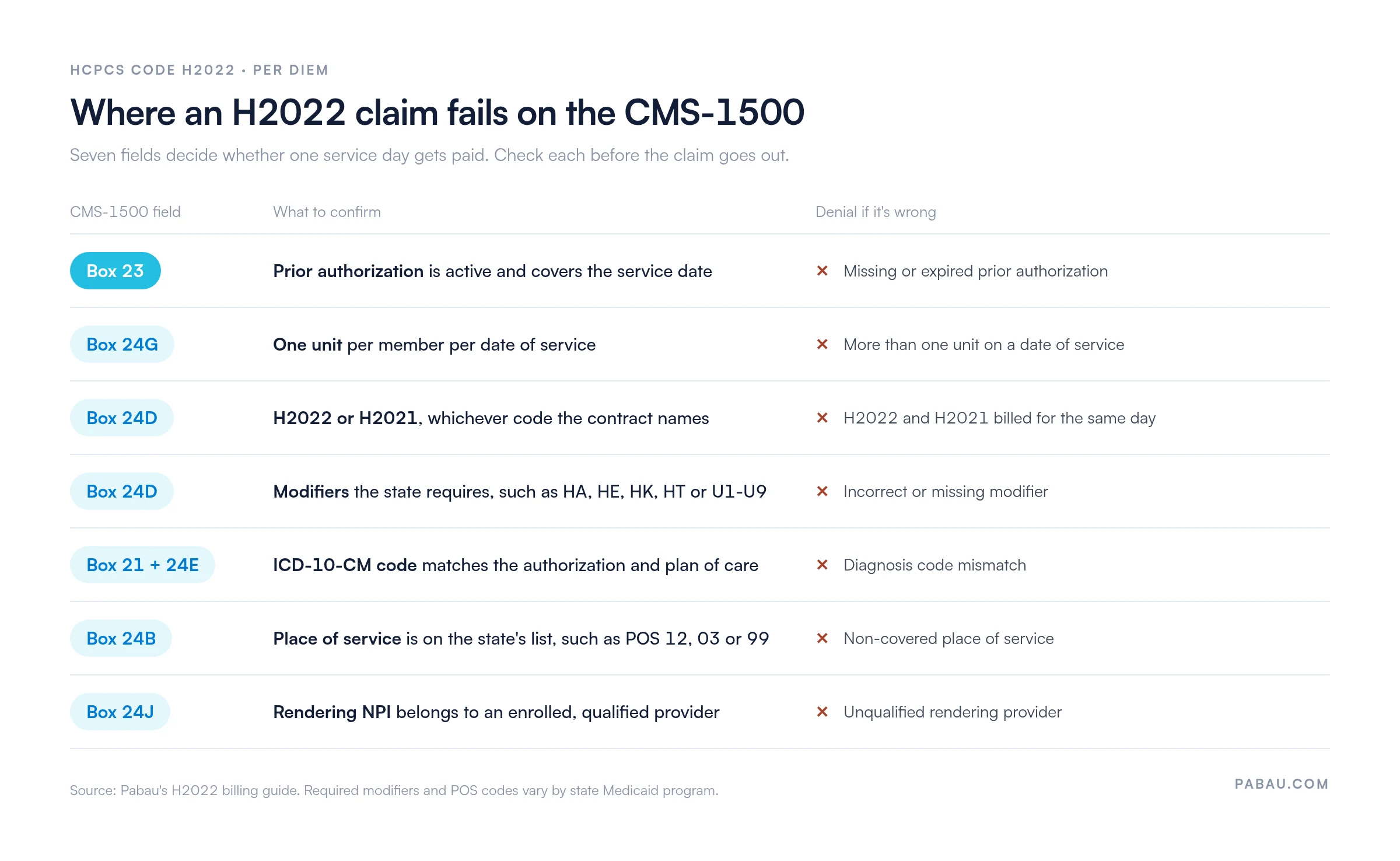
The billing workflow for H2022 on a CMS-1500 form or 837P electronic claim follows these steps:
Before submitting an H2022 claim, run a three-point check. (1) Confirm the authorization is active and the service date falls within the authorized period. (2) Confirm the date has a signed note and carries only one unit. (3) Confirm the modifiers match your state Medicaid provider manual for this program. All three must pass before the claim leaves your system.
When authorizations sit in a spreadsheet and claims are keyed by hand, the authorization number on a claim can drift from the approved one. A per diem program feels that quickly, because every day billed outside the authorization is a denied unit.
In Pabau, the authorization code entered on a patient’s case follows each appointment through to the claim. The case also shows how many approved sessions have been used, so billing staff can see when a renewal request is due.
CMS-1500 claims then go to payers through Claim.MD. Wrap-around teams billing across several staff and locations can use Pabau to standardize the path from service note to claim.
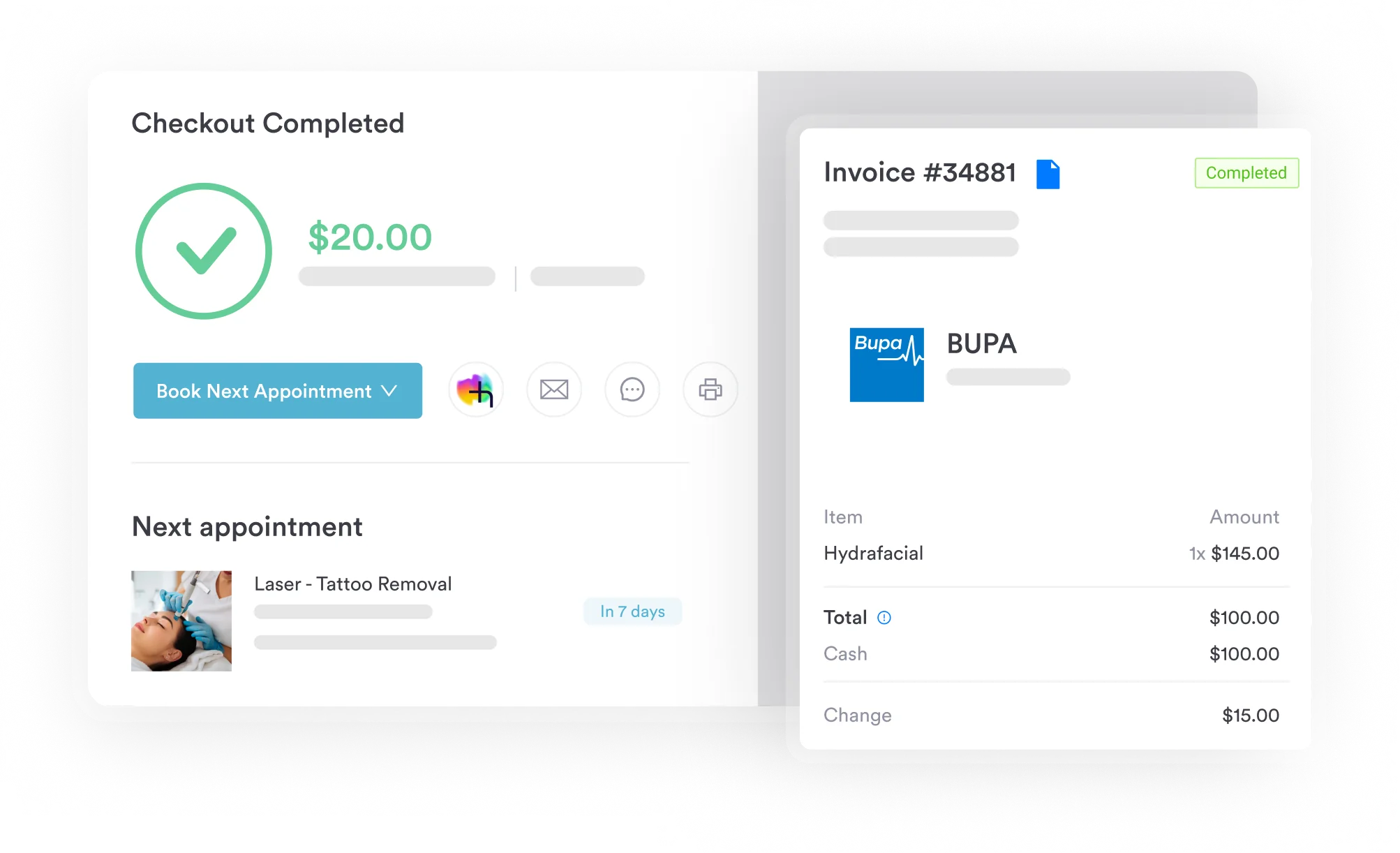

Pabau carries each authorization code from the appointment to the claim and shows approved sessions used on the case. CMS-1500 claims go to payers through Claim.MD.

H2022 denials are largely preventable. Lapsed authorizations, duplicate same-day units and missing modifiers cause many of them, and each one starts in the billing workflow rather than in clinical care. A process that checks all three before submission protects the per diem revenue a wrap-around program depends on.
Pabau’s claims management software carries the authorization code from each appointment to the claim and shows approved sessions used on the case. CMS-1500 claims then go out through Claim.MD, so the authorization on the claim matches the one on file.
Book a demo to see how Pabau tracks wrap-around authorizations from the first appointment to the submitted claim.

Need to understand how behavioral health claims move from session to payment? Revenue cycle management in healthcare walks through the end-to-end billing process for outpatient and community behavioral health practices.
Concerned about documentation audits? Medical billing compliance covers what Medicaid auditors look for in behavioral health records and how to prepare.
Billing therapeutic behavioral services for the same youth? HCPCS code H2020 explains the per diem code for therapeutic behavioral services and how it is billed.
Sending a wrap-around authorization request? Medical prior authorization form gives you a ready-made request to send to the payer.
HCPCS code H2022 covers community-based wrap-around services, billed per diem under state Medicaid programs. It pays for intensive, individualized support coordinated by a child and family team, usually for youth with serious emotional disturbance and their families. Crisis intervention, peer support and stand-alone case management are billed under separate codes.
No. H2022 is a Medicaid code, and Medicare does not pay for H-series HCPCS codes, which state Medicaid agencies use for behavioral health services. Appealing a Medicare denial for H2022 will not succeed. Standard commercial plans also rarely cover it outside Medicaid managed care contracts.
There is no national rate for H2022. Each state Medicaid fee schedule sets its own per diem rate, and some states vary it by intensity tier, region or modifier. Check your state Medicaid agency’s current fee schedule for the figure that applies to your program.
H2022 and H2021 describe the same community-based wrap-around services, but H2022 bills one unit per day and H2021 bills per 15 minutes. Each state chooses which model its program uses, or defines when each applies. Billing the code your contract does not name is a common cause of denial.
Billing H2022 requires a current individualized plan of care and a dated note for each billed day. Each note links to a plan goal, records the family’s or youth’s response and carries the rendering provider’s signature and credential. Where prior authorization applies, the authorization number appears on the claim and in the record.
One. H2022 is a per diem code, so each member can have one unit per date of service, however many contacts the team makes that day. States and MCOs may also cap the number of authorized days per month or per authorization period.