EHR ROI: How to calculate and maximize your return
EHR ROI is the financial return a practice earns on its electronic health record...

Last Updated: Oct 15, 2026

Insurance eligibility verification confirms that a patient’s coverage is active, and what it will pay, before you deliver care.
Registration and eligibility problems are the single largest root cause of claim denials in Optum’s national index.
A complete check captures active status, network status, copay, deductible remaining, coverage for the planned service, and prior-authorization rules.
The electronic mechanism is the 270/271 pair: you send a question, and the plan sends back a structured answer in seconds.
Real-time checks run from the client record replace portal logins and hold music, and the result stays on the file.
Insurance eligibility verification is the process of confirming that a patient’s coverage is active, and what that coverage will pay, before you deliver care. It is a front-desk job with a billing consequence. Front-desk teams juggling cosmetic bookings alongside insured visits can weigh top med spa software against pure billing tools before deciding.
Skip it and the news arrives late. The claim goes out, the payer denies it weeks later, and by then the patient has been treated and gone home. Optum’s 2024 Revenue Cycle Denials Index, built from around 124 million hospital claim remits, puts registration and eligibility at 24% of denials. That is the largest single root cause in the index. A clean claim needs the code, the modifiers and the diagnosis to agree, which is the check claim submission software runs. A clean claim needs the code, the modifiers and the diagnosis to agree, which is the check claim submission software runs.
The same analysis found only 21% of those denials were straightforwardly recoverable. Another 28% were not recoverable at all. A denial you can rework costs staff time, and the payer’s timely filing limits cap how long you have. One you cannot rework costs the whole visit.
Providers report the same pressure from their own side of the desk. In Experian Health’s 2025 State of Claims survey, 32% named incomplete or inaccurate patient registration data among their top causes of denials.
This guide covers what a complete check captures, how to run one step by step, and a checklist your front desk can work from. It also explains the 270/271 transaction behind every electronic check, in plain English.
A complete check answers far more than “is the policy live?”. It confirms the plan is active on the date of service and that you are in network. It also tells you what the patient owes, and whether the specific service is covered.
Each layer denies claims on its own. An active policy with an unmet deductible still leaves you collecting from the patient.
A plan that covers chiropractic care may still cap the visits it pays for in a year. An out-of-network visit pays at a different rate, and the patient may need a superbill to claim it back themselves.
Here is what sits inside a full check:
Two terms get used interchangeably and should not be. An eligibility check confirms coverage and the headline financials. A verification of benefits, usually shortened to VOB, digs into what the plan pays for a named service, and under what conditions.
| Eligibility check | Full verification of benefits | |
|---|---|---|
| What it answers | Is coverage active, and what does the patient owe? | Will this plan pay for this specific service? |
| How it runs | Electronic 270/271, back in seconds | Phone call, or a detailed portal session |
| When to use it | Every patient, every visit | New treatment plans, high-cost or borderline services |
| What you get | Status, network, copay, deductible, out-of-pocket | All of that, plus limits, exclusions, and authorization rules |
| Your evidence | Trace number on the response | Representative’s name, call reference, and date |
You verify a patient’s insurance by capturing the card at booking and running an electronic check before the visit. Confirm coverage for the specific service, then record the result on the file. Six steps, in order:
Every check should leave the same ten fields on the client record. If one of them is missing, the check is not finished. Here is the capture list, with the reason each item earns its place:
Print it, tape it to the desk, or build it into your intake screen. The value comes from consistency. The same fields get captured for every patient, by everyone on the team.
Real-time means the plan answers in seconds over a direct data connection, rather than a staff member logging into a portal or waiting on hold. The mechanism behind it is a pair of standard files, the 270 and the 271.
The 270 is the question. It carries who you are, who the patient is, the date of service, and which service types you are asking about. It travels to the plan through a clearinghouse, and the 271 comes back as the plan’s structured answer.
Both are HIPAA-mandated standards, which is why one check works across thousands of plans. CMS adopted the X12 270/271 pair for eligibility inquiry and response, so every covered health plan has to support it.
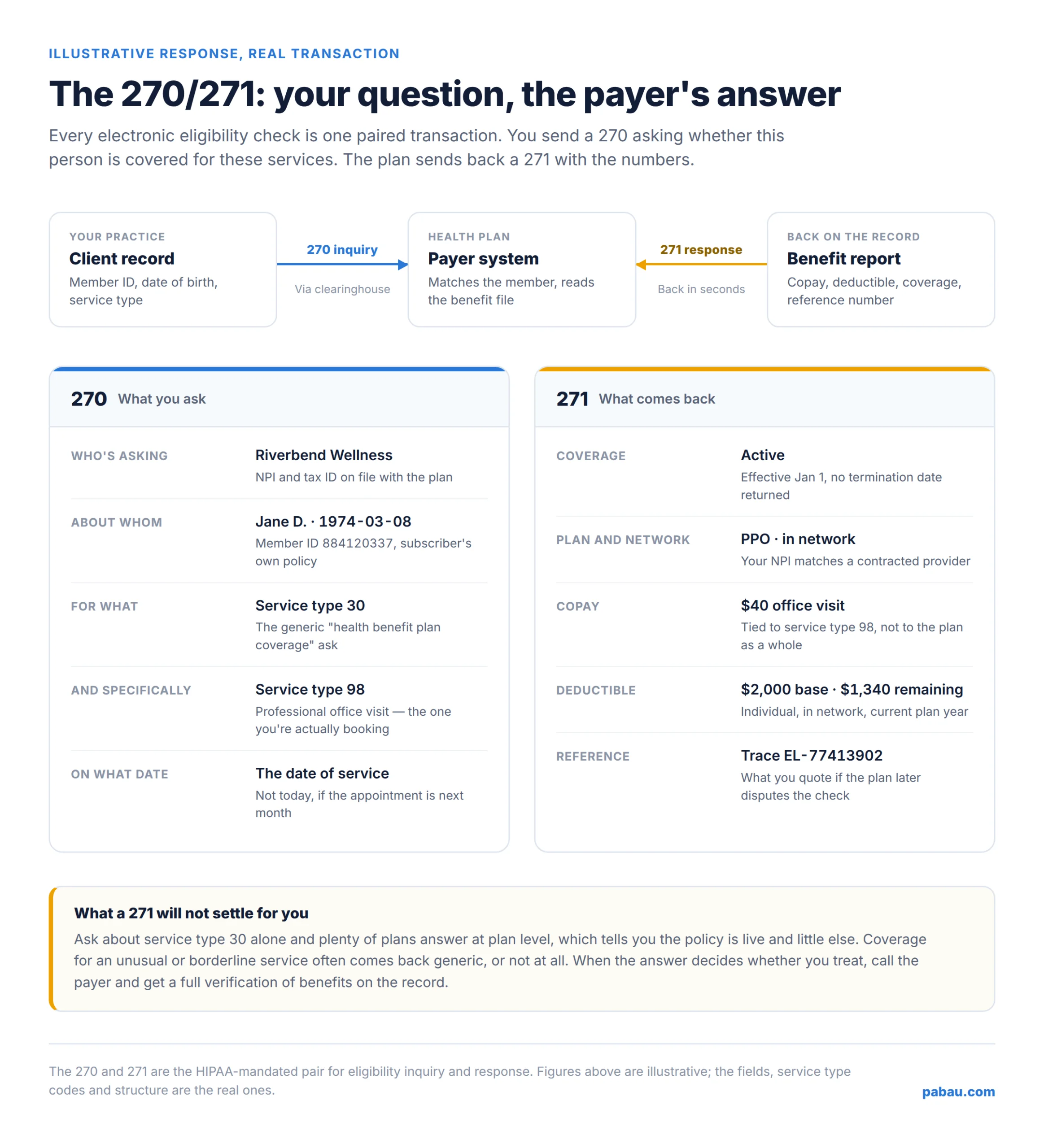
Now the honest part. A 271 is only as specific as the question you asked and the payer answering it.
Send the generic inquiry, service type code 30, and many plans answer at plan level. You learn the policy is active and get the headline financials. You do not learn much about the treatment you had in mind.
CAQH CORE operating rules require plans to return copay, coinsurance, and remaining deductible for a defined set of service type codes. Outside that set, what comes back varies by payer. Some return useful detail, and some return boilerplate. Durable equipment usually sits in the vague half, so a home suction pump under K0743 needs a call.
So treat the 271 as a fast first pass rather than the final word. When coverage for a specific service decides whether you treat, call the plan and get a full verification of benefits. An orthotic addition such as L0859 earns that call, because plans price each component separately. Note the representative’s name, the date, and the call reference.
Practices that offer both aesthetic and medical services have a harder eligibility problem than most. The same appointment book holds treatments no plan will ever pay for, and treatments plans often will.
Botulinum toxin for frown lines is cosmetic, and no plan covers it. Botulinum toxin for chronic migraine is a medical claim with its own authorization pathway. The injection looks similar. The coverage question is completely different.
Medical weight management works the same way. Some plans cover the consultation and exclude the medication. Some cover both, subject to documented clinical criteria. Some carve weight management out of the policy entirely.
This is exactly what coverage-by-service-code exists for. Coverage attaches to the plan rather than the treatment name, so it shifts by plan, by patient, and by year.
Here is how one visit plays out. A patient books a weight management consultation and asks whether insurance covers it.
The front desk runs an eligibility check naming the service type, not just the plan. The 271 comes back with active coverage, a $50 specialist copay, and $900 of deductible remaining. On weight management specifically, it says nothing.
That silence is the signal to call. The plan confirms the consultation is covered under the specialist benefit, and that the medication sits under a pharmacy benefit the practice does not bill. Authorization applies to the medication, not the visit.
The patient now hears one clear answer before they arrive. The visit costs the copay, the deductible still applies, and the prescription is a separate conversation with their plan. Nobody is surprised at checkout, and the claim goes out clean.
Good insurance eligibility verification software removes the portal logins without removing the detail. Five things separate the tools that manage that from the ones that just tell you a policy is active.
Eligibility is the first money step in revenue cycle management. The tool you pick should pass what it finds to the steps that follow it.
Most front desks run this check somewhere else. Staff sign into a payer portal, then copy what comes back onto the file by hand. Some plans get a phone call instead.
Practice management software like Pabau handles it from the client card. Real-time eligibility checks run through our Claim.MD integration. The response comes back as a full benefit report covering copays, deductibles, and coverage by service code.
The result is tied to the client record, so the numbers are on the file before the patient walks in. Your front desk collects the right amount at check-in, instead of discovering the deductible when the denial lands.
The same integration sends claims to thousands of US payers as an 837 file. Electronic remittance advice files, known as ERAs, then settle those claims automatically when payment comes back. Booking, check, claim, and payment stay in one system.

Pabau runs real-time eligibility checks from the client card and returns a full benefit report with copays, deductibles, and coverage by service code. Your front desk collects the right amount at check-in.

Eligibility is the cheapest denial you will ever prevent. Thirty seconds before the visit costs less than thirty days of rework after it, and rework only helps when the denial is recoverable at all.
Practices that get this right lean on prevention rather than denial management after the fact. Every booking triggers a check, every check leaves the same fields on the record, and the front desk knows what to collect.
Start with the checklist and the timing. Get the same fields captured for every patient, at booking and again before the visit, then automate the part your team is doing by hand. Book a demo to see how Pabau checks coverage from the client card before the patient arrives.

Want to see where this check sits in the bigger picture? What is revenue cycle management? maps every step from booking to a paid claim.
Found a service that needs approval first? The prior authorization process takes over from the eligibility check.
Still getting denials you did not prevent? Denial codes in medical billing decodes the code on the remit and what to do next.
Want the clearinghouse side of the transaction? Claim.MD clearinghouse review explains how your checks and claims reach the payer.
Need the rules your billing has to follow? Medical billing compliance covers the laws, the common violations, and a checklist to download.
Insurance eligibility verification is the process of confirming that a patient’s health plan is active, and what it will pay, before care is delivered. It covers network status, copay, deductible, coverage for the planned service, and any prior-authorization requirement.
Capture both sides of the insurance card at booking, then run an electronic eligibility check naming the service type you are booking. Re-run it one to three days before the visit. Record the copay and remaining deductible on the client file, and flag any authorization the plan requires.
At minimum, ten fields. Payer and plan, member ID and group number, and the subscriber’s relationship to the patient. Then effective and termination dates, network status, copay, and deductible remaining. Finally coverage for the specific service, prior-authorization rules, and any secondary coverage. Keep the reference number of the check as evidence.
The 270 is the standard electronic file asking a health plan whether a patient is covered, and for which services. The 271 is the plan’s structured answer, returning coverage status, benefits, and a trace number. Both are HIPAA-mandated standards adopted by CMS.