

HCPCS code E0198: Water pressure pad billing guide
HCPCS code E0198 is a water pad for a standard mattress HCPCS code E0198 is the ...

Last Updated: Oct 13, 2026
Billable Code
T2031 is the HCPCS Level II code for assisted living; waiver, per diem. It is a state Medicaid waiver code, so Medicare never pays it, and one unit covers one calendar day of service.
Billers new to waiver coding confuse T2031 with T2016 (residential habilitation, per diem) because the descriptors sound alike. The populations and program eligibility are different. Missing prior authorization, incomplete daily service logs, and the wrong place of service code cause most T2031 denials.
Let Pabau's smart automation suggest the right codes, reduce claim denials, and keep your practice compliant—effortlessly.
Automate repetitive tasks and focus on what matters most—your patients.
Reduce coding errors and ensure compliance with the latest regulations.
Clean claims, fewer denials, and faster reimbursements.
Powerful insights and reporting to help your practice thrive.
HIPAA compliant SOC 2 certified GDPR-compliant Trusted by 4,000+ clinics worldwide

HCPCS code T2031 covers assisted living waiver services billed per diem under state Medicaid HCBS 1915(c) waivers, not Medicare
One unit equals one per diem day; prior authorization and an active waiver enrollment are required before billing
Missing daily service notes or an expired individualized service plan are the leading causes of T2031 claim denial
Reimbursement rates are state-set and vary widely; check your state Medicaid fee schedule, not a national Medicare rate table
Pabau’s claims management software tracks per diem units and flags incomplete documentation before submission
HCPCS code T2031 is a Level II code for assisted living services provided under a Medicaid waiver program. It is billed per diem, one unit for each day delivered. Its official CMS descriptor is: Assisted living; waiver, per diem.
T2031 belongs to the T2012-T2041 waiver services range within HCPCS Level II. T-series codes are state Medicaid-only codes, meaning they are not payable by Medicare and are not included in the Medicare Physician Fee Schedule. Every aspect of T2031 billing, from rate-setting to prior authorization requirements, is governed by each state’s Medicaid agency under federal HCBS waiver authority.
According to CMS’s HCPCS Level II coding system, T-codes capture state Medicaid waiver services. Those services have no equivalent in the CPT or Medicare HCPCS J/G-code sets. The assisted living waiver framework T2031 describes falls under 1915(c) of the Social Security Act. That section lets states waive standard Medicaid requirements, so people who would otherwise need nursing facility care can be served in the community.
The table below summarizes the key administrative attributes of HCPCS code T2031 as published in the CMS HCPCS Level II code set.
Coders can verify the current-year status of T2031 and adjacent codes using the AAPC HCPCS Level II code lookup. That tool mirrors the CMS Alpha-Numeric HCPCS file.
T2031 captures supervised residential care delivered in an assisted living facility when that placement is funded through a state Medicaid HCBS waiver. The per diem rate bundles a defined set of services into a single daily payment. Understanding what is and is not included prevents unbundling errors, which are a frequent denial trigger.
Covered under T2031:
Not covered under T2031:
Billing room-and-board costs within the T2031 per diem is one of the most audited unbundling errors in assisted living waiver claims. Keep the two cost streams on separate ledgers, and record which services the waiver actually pays for on each billed day. That record is what an auditor asks for first.
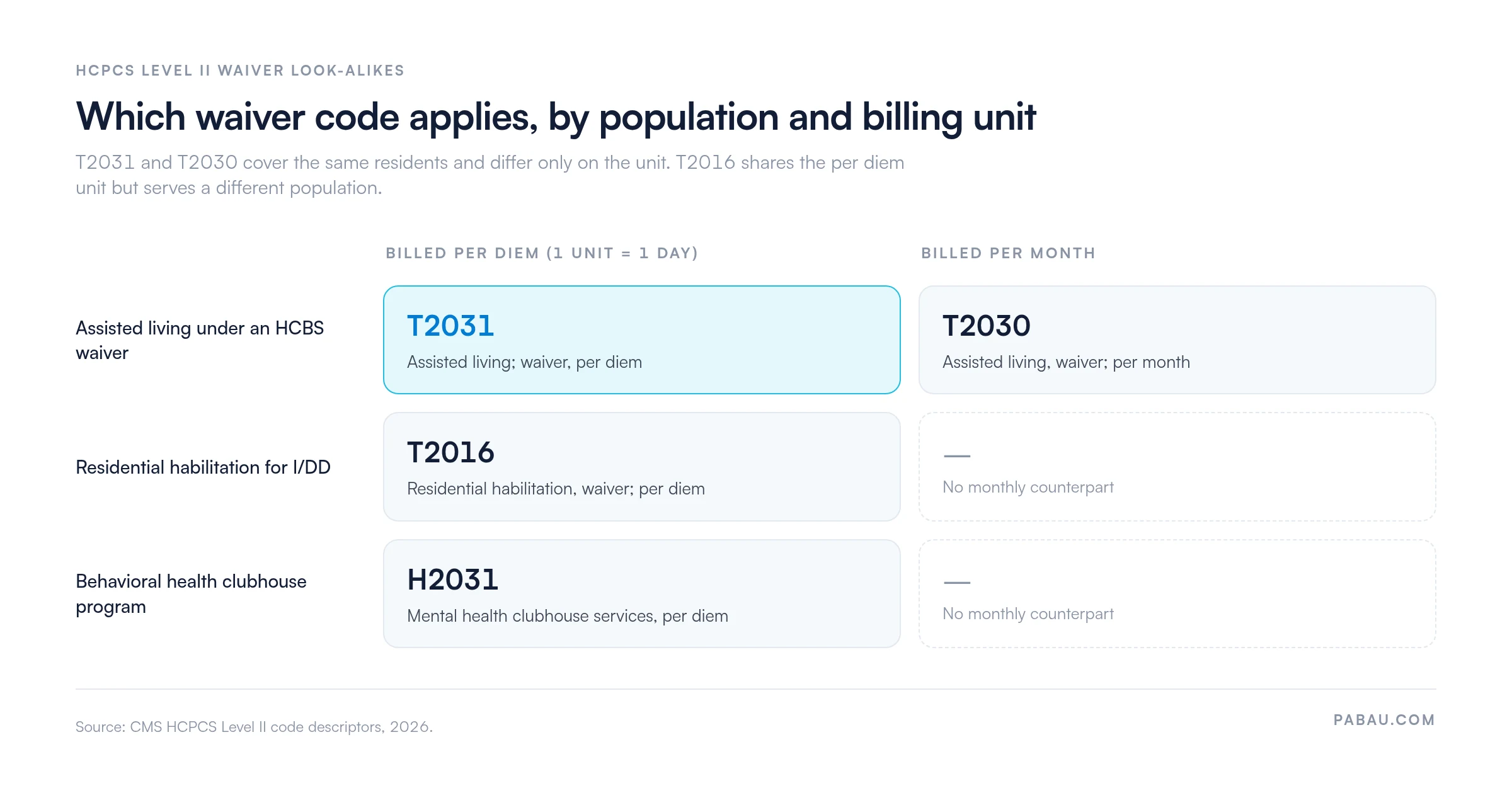
T2030 covers the same assisted living population as T2031, but it is billed per month rather than per day. The per diem code for residential habilitation is T2016, which serves individuals with intellectual and developmental disabilities. Picking the wrong code from this group leads to denial or audit scrutiny.
Daytime habilitation for that I/DD population is a separate service, billed under HCPCS code T2020, per diem. The same T2012-T2041 range also holds time-based codes, such as HCPCS code T2027, billed per 15 minutes rather than per diem.
The T2031 and H2031 mix-up is worth flagging on its own. H2031 is an H-series code for Medicaid mental health clubhouse services. T2031 is a T-series waiver code for assisted living residential care. The populations, program structures, and billing rules are separate. Verify the code series letter before submitting. The grid below sets out which code applies, by population and by billing unit.
T2031 is used by state HCBS waivers operating under 1915(c) authority that cover assisted living as a waiver service. Not every state includes assisted living in its waiver portfolio, and those that do may use state-specific billing codes alongside or instead of T2031. Coders must verify their state Medicaid billing manual before using this code.
Two states show how this plays out:
States that do not include assisted living as a covered waiver service will not recognize T2031 on claims at all. Always cross-reference the CMS list of covered HCPCS codes with your specific state Medicaid agency’s fee schedule and billing manual.
Accurate T2031 billing depends on correctly reporting units, selecting the right place of service code, and applying any state-required modifiers. Each of these fields is independently auditable. An error in any one can trigger a denial, even when the service was properly authorized and delivered.
Modifiers for T2031 vary widely by state. Some states require modifiers to indicate the level of care or provider type; others do not require any modifier at all. Never apply a modifier to T2031 based on another state’s rules or a generic coding reference. Never leave a required modifier blank because you assume it is optional. Confirming modifier requirements in writing from your state Medicaid billing manual protects against both over-billing and under-billing errors.
Check your state Medicaid billing manual before submitting any T2031 claim. Modifier requirements, place of service codes, and maximum authorized units all vary by state waiver program. A claim submitted with a modifier required in California but absent in Indiana will be denied regardless of how thorough the documentation is.
Prior authorization is required for T2031 in most state Medicaid waiver programs before any services can be rendered and billed. Submitting T2031 claims without active, current authorization is the fastest path to denial, and retroactive authorization is rarely granted under waiver program rules.
The T2031 authorization process typically involves three layers:
Robust insurance eligibility verification processes, run at enrollment and before each billing period, catch lapses in waiver authorization before a claim goes out. A verification step that confirms active waiver status and authorization dates prevents the most common prior-auth denial.
Incomplete documentation is the leading cause of T2031 claim denial. State Medicaid auditors reviewing assisted living waiver claims expect a specific set of records.
An expired ISP, a day without a service note, or a missing level-of-care assessment all read the same way to an auditor. Each one means the service was not shown to have been delivered as billed.
Required documentation typically includes:
The records behind a T2031 claim must be stored, accessed, and transmitted under the security standards Medicaid auditors expect. HIPAA-compliant claim transmission using the 837P or 837I transaction set is a prerequisite for electronic T2031 submission.
T2031 claims must include a supporting ICD-10 diagnosis code that establishes medical necessity for the assisted living waiver level of care. The diagnosis must reflect the clinical condition documented in the individual’s level-of-care assessment. No ICD-10 code list is exhaustive here. The diagnosis must justify why the individual needs supervised residential care rather than a lower level of service.
Cross-check every diagnosis you pair with T2031 against the full ICD-10-CM codes index. Then confirm against the NLM’s HCPCS Level II code API and your state’s clinical criteria that the diagnosis supports the level of care claimed. The diagnosis on the claim must match the diagnosis in the level-of-care assessment on file.
T2031 reimbursement rates are not set by a national Medicare fee schedule. Because T-codes are state Medicaid-only codes, every state Medicaid program sets its own per diem rate for T2031 through a cost-based or negotiated methodology. Two programs in neighboring states billing under the same HCPCS code T2031 may receive substantially different daily rates.
To find the current T2031 per diem rate for your state:
Read the remittance advice on paid T2031 claims to check that your state Medicaid program or MCO applied the published per diem rate. Catching a rate discrepancy early stops it compounding across several billing periods.
T2031 denial patterns cluster around four root causes: Lapsed authorization, documentation failures, billing mechanics errors, and provider enrollment issues. Each has a distinct fix.
Categorizing T2031 denials by root cause lets a billing team see which process change will pay for itself first. When the same denial reason repeats across a billing cycle, the workflow itself is producing it, not a single careless claim.
Run a lapsed-authorization report before closing each billing period. Flag any T2031 claim where the billed date falls within seven days of an authorization expiry. Catching lapsed authorizations before submission prevents the most common and hardest-to-appeal denial category for assisted living waiver codes.
Assisted living waiver billing is documentation-intensive by design. State auditors expect daily service logs for every billed unit, active authorization records, and a current ISP on file. Manual tracking across paper logs and spreadsheets creates the conditions that produce the denial patterns described above.
Purpose-built billing software takes on four parts of T2031 billing that paper tracking handles badly:
Practice management software like Pabau runs these workflows for practices and long-term care billing teams. Its claims management software cuts the manual steps between service delivery and clean claim submission. Automated per diem unit tracking plus built-in documentation prompts covers the two denial categories behind most T2031 rejections.
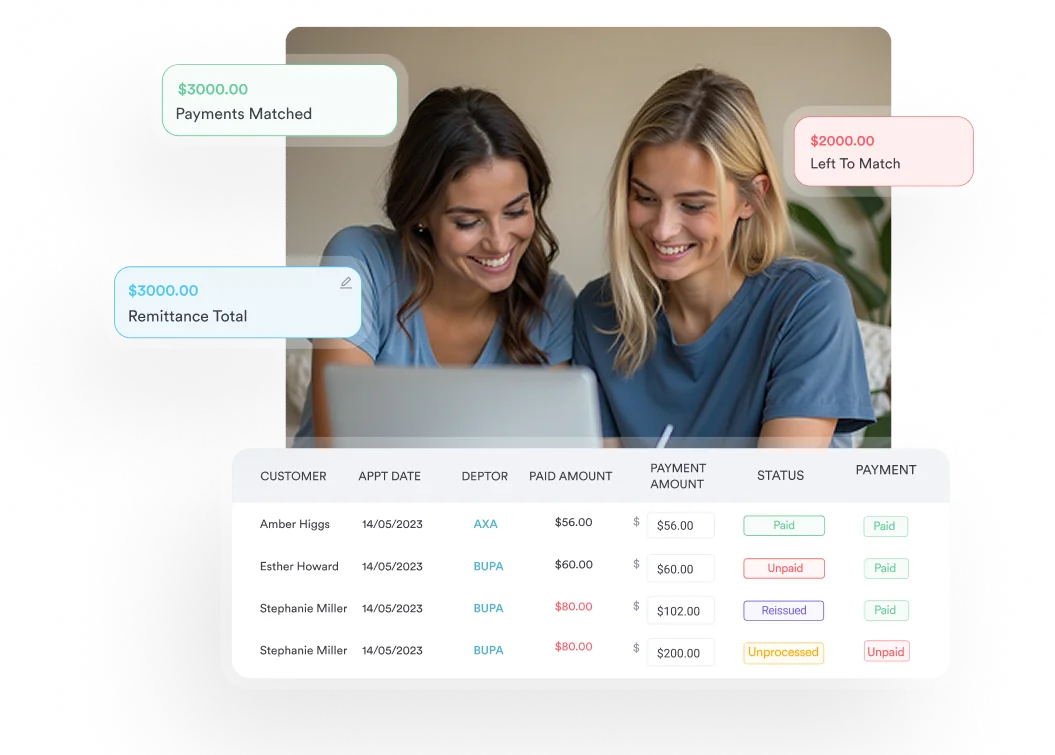
Practices running several waiver programs or provider locations gain most from centralizing T2031 records in one platform. Documentation, authorization records, and claims history sit together, so an auditor’s first request is already answered. Book a demo to see how Pabau handles assisted living and waiver billing workflows.

Pabau tracks per diem units against the authorized service period and flags a missing daily note before the claim leaves your practice. Assisted living waiver teams spend less time reworking rejected claims.

HCPCS code T2031 is a simple per diem code wrapped in layers of authorization, documentation, and state variation. The denials it produces are workflow problems rather than coding errors. Missing authorization records, incomplete daily service notes, and unit overruns all start upstream of the claim.
Fixing them means owning the sequence rather than the code: Confirm the authorization, log the day, then bill it. A practice that gets that order right rarely has to argue a T2031 claim twice.
Book a demo to see how Pabau tracks per diem units and authorization dates for assisted living waiver billing.

Need to understand how clean claims reduce denial rates? Submitting clean claims walks through the components of a complete claim submission and what payers check at adjudication.
Looking for a denial management framework? Denial management in healthcare covers how to categorize, track, and appeal denied claims systematically.
Want to understand the billing cycle end to end? Revenue cycle management explains how claims move from service delivery to payment posting.
Building the claim from the encounter record? What a superbill includes lists the fields a payer expects before it will adjudicate a claim.
Need the compliance trail behind a waiver claim? Medical billing compliance sets out the records and controls state auditors look for.
HCPCS code T2031 is the Medicaid Level II code for assisted living services provided under a state HCBS waiver. Its official descriptor is “Assisted living; waiver, per diem.” It is a T-series code, meaning it is payable only by state Medicaid programs and not by Medicare.
T2031 is billed per diem. One unit equals one calendar day of assisted living waiver services. Hourly billing does not apply to this code. Services are captured as a daily rate, whatever the hours of direct assistance provided that day.
T2031 covers assisted living under an HCBS waiver and is billed per diem, one unit for each day of service. T2030 covers the same assisted living population, but it is billed per month rather than per day. The per diem code for residential habilitation is T2016, which serves individuals with intellectual and developmental disabilities (I/DD).
Yes, in most state Medicaid waiver programs. Prior authorization for T2031 requires active waiver enrollment, a completed level-of-care determination, and an approved individualized service plan before services begin. Billing without current authorization is the most common cause of T2031 denials and rarely qualifies for retroactive approval.
Modifier requirements for T2031 are state-specific and are not universally standardized. Some states require modifiers to indicate provider type or level of care; others require none. Always consult your state Medicaid billing manual or managed care organization contract before appending or omitting a modifier on T2031.
Required documentation includes proof of active waiver enrollment and a current signed individualized service plan (ISP). You also need daily service notes for each billed day, a current level-of-care assessment, and provider licensure records. Missing any one of these during an audit results in claim recoupment.



