CPT code 33234: Pacemaker lead removal billing guide
CPT code 33234: Official descriptor and code placement CPT code 33234 is the cod...

Last Updated: Nov 26, 2026
T2023 is the HCPCS Level II code for targeted case management; per month. State Medicaid programs use it to pay for a month of case management. It serves a group the state plan defines, such as adults with serious mental illness.
One unit covers one calendar month of assessment, care planning, referral and linking, and monitoring. Medicare does not pay T-codes, so each state's Medicaid program sets the rate and the rules.
Let Pabau's smart automation suggest the right codes, reduce claim denials, and keep your practice compliant—effortlessly.
Automate repetitive tasks and focus on what matters most—your patients.
Reduce coding errors and ensure compliance with the latest regulations.
Clean claims, fewer denials, and faster reimbursements.
Powerful insights and reporting to help your practice thrive.
HIPAA compliant SOC 2 certified GDPR-compliant Trusted by 4,000+ clinics worldwide

HCPCS Code T2023 describes targeted case management billed per calendar month, so one unit equals one month of service.
T2023 is a Medicaid code that traditional Medicare does not pay, so it never belongs on a Medicare claim.
Each monthly claim rests on an individualized service plan, a medical necessity record, and a log of the month’s case management contacts.
State Medicaid agencies and managed care plans set the rate, the eligible groups, and any prior authorization rule.
T1017 bills targeted case management in 15-minute units, so check which unit your state pays before you choose between the two codes.
HCPCS Code T2023 is the Level II code state Medicaid programs use to pay for targeted case management, one unit per calendar month. Targeted case management is a Medicaid service defined in federal rule 42 CFR 440.169. States may offer it to groups named in their state plan. The official descriptor is Targeted case management; per month.
T2023 sits in the T-code range of HCPCS Level II. The Centers for Medicare and Medicaid Services (CMS) maintains that code set for items and services outside CPT. Key facts about the code:
Because T2023 is a T-code, each state Medicaid agency decides how it is used. Reimbursement rates, prior authorization requirements, and eligible provider types are set at the state level rather than by CMS. Check every rule against your state’s Medicaid provider manual.
Targeted case management under T2023 has four core components in the federal definition. Each one connects a member with services rather than delivering treatment directly.
A qualified provider carries out these activities or supervises them. The member does not need to be present for every contact. Federal rules let case managers speak with family members and other providers about the member’s care.
Several service types fall outside HCPCS Code T2023. Billing them under this code is a common source of audit findings and claim denials.
When in doubt, check your state Medicaid program’s targeted case management manual. Definitions of excluded services vary by state.
States authorize T2023 for Medicaid members whose needs require coordination across several providers or systems. The qualifying groups vary by state, but they commonly include:
Document medical necessity for each member. States may also limit T2023 to members of specific waiver programs, so eligibility can differ widely from one state to the next.
Each state Medicaid program decides who can bill HCPCS Code T2023. These provider types are commonly eligible, depending on state enrollment rules:
Individual practitioners must be enrolled with their state Medicaid program, and some states require a taxonomy code that reflects the case management role. Confirm enrollment before the first T2023 claim, because an unenrolled provider NPI is a common denial reason for this code.
Before billing T2023 for the first time, pull your NPI record from NPPES. Confirm that your enrolled specialty and taxonomy code match what your state Medicaid program requires of targeted case management providers. A mismatch gets the claim denied, and correcting an enrollment record takes time.
State Medicaid agencies and managed care organizations set T2023 rates, and no single national fee schedule exists. Rates vary by state, by program, and sometimes by modifier. The table below shows the main ways a rate is set, and your state’s current fee schedule holds the figure you bill against.
Look up the operative 2026 rate in your state Medicaid fee schedule, or in your MCO contract for managed care members. Medicare does not price T-codes, so the Medicare Physician Fee Schedule returns no value or benchmark for T2023.
Each monthly T2023 claim needs a record showing medical necessity and the case management activities performed that month. Most state Medicaid programs ask for these elements:
Keeping medical billing compliance for T2023 means producing these records on demand during a Medicaid audit. Electronic storage with date-stamped entries makes that request quick to answer.
Prior authorization (PA) rules for T2023 vary by state Medicaid program and by managed care organization. No universal rule says PA is or is not required.
Ask your state Medicaid program or MCO provider relations team whether PA applies before you submit the first T2023 claim. A claim billed without a required authorization may not be correctable on appeal.
T2023 is billed on a CMS-1500 claim form, or its electronic equivalent, the 837P, at 1 unit per calendar month. These steps produce a clean claim:
A superbill for case management that pre-fills T2023, the unit, and a documentation checklist cuts keying errors at month end.
Add a modifier to T2023 when the payer or state program needs more detail about how the service was delivered. Common modifiers include:
Confirm modifier requirements with your Medicaid payer before appending one. A wrong or unneeded modifier can delay payment on an otherwise clean T2023 claim.
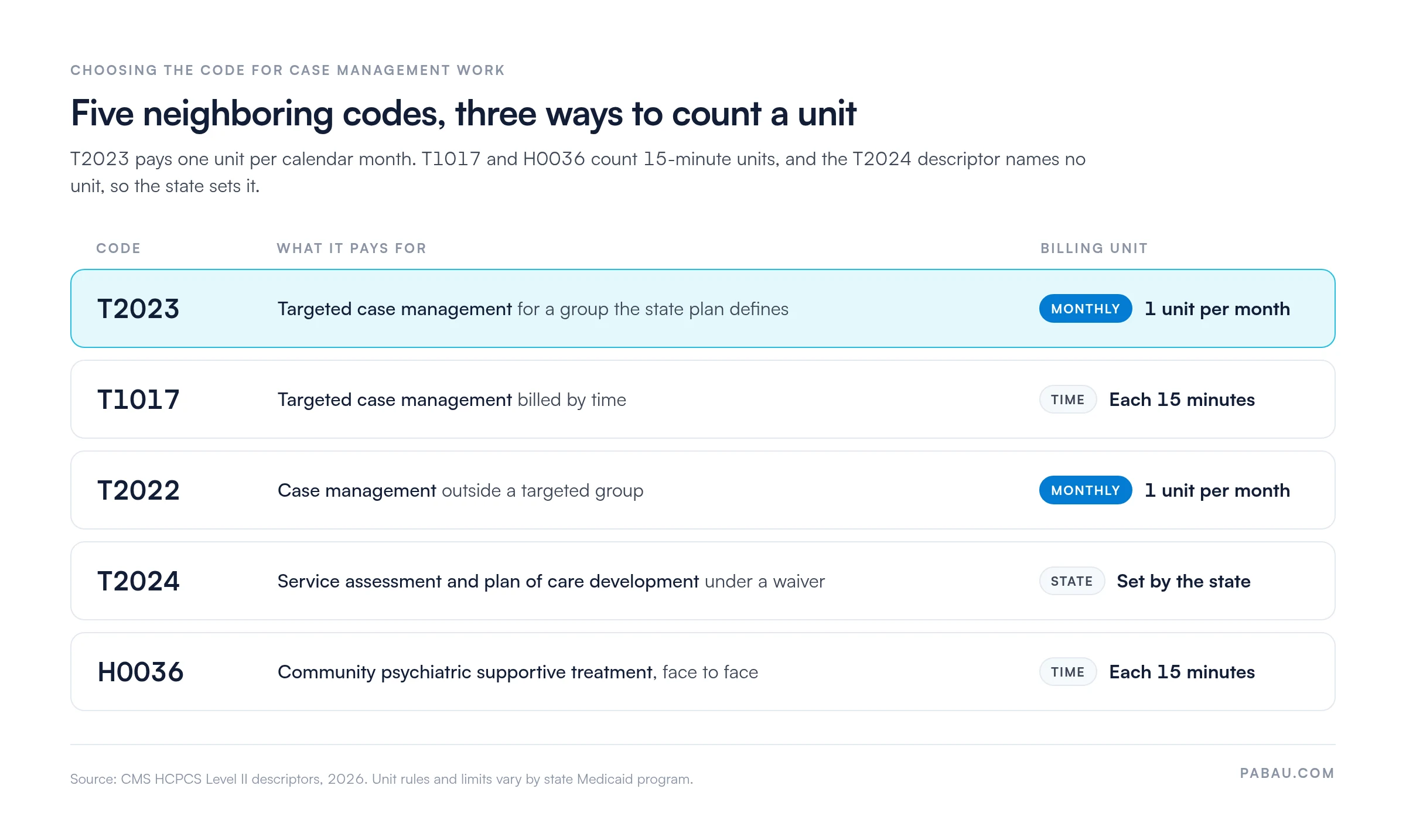
Several HCPCS codes describe case management or related support, and they count units differently. The table below shows when T2023 applies and when a neighboring code fits better.
The unit is the first thing to settle. Some states pay targeted case management as T1017 in 15-minute units, while others pay a monthly rate under T2023. Case management for members outside a targeted group goes to T2022.
T2023 denials usually trace back to missing documentation or to a billing rule that differs by payer. The table pairs each common denial reason with its fix, and the medical billing denial codes guide explains the remittance codes behind them.
Most of these denials are caught before submission. A short denial management routine at month end checks each claim against the table above.
Run a pre-submission check each month. Confirm every T2023 claim has an active ISP, a matching authorization number, and a completed monthly summary note before the batch goes out. Those three checks catch the most common causes of T2023 denials.
No. Traditional Medicare does not cover T2023. CMS set aside the T-code range for state Medicaid agencies, and Medicare does not price or pay these codes under Part A or Part B.
For members enrolled in both Medicare and Medicaid, bill T2023 to Medicaid only. Medicare does not cross over T-code claims. Sending T2023 to Medicare produces a denial and, if repeated, can be flagged as a compliance issue.
T2023 works differently from one state Medicaid program to the next. The same code can carry a different rate, population, and paperwork depending on where the provider is enrolled.
Your state Medicaid provider manual is the authoritative source for T2023 billing, and MCO rules sit in each plan’s provider manual. The AAPC HCPCS code lookup shows the full descriptor while you check your state’s rules.
Monthly case management billing usually means chasing the same three items each month: the authorization, the summary note, and the claim. Pabau, a practice management platform with US insurance billing, keeps them on the patient’s record and case.
The authorization code, its dates, and its sessions are recorded on the patient’s case, and Pabau warns your team when one is missing. Through Pabau’s claims management, you submit CMS-1500/837P claims through Claim.MD, check eligibility, and post electronic remittances. Payer lists come from the clearinghouse, so confirm your state Medicaid plan is on it.
The result is a month-end batch built from records your team already keeps, so a T2023 claim leaves with its authorization number attached.

Pabau records each authorization code on the patient’s case and submits your claims through Claim.MD. Your team sees the authorization and claim status side by side at month end.

Before the first T2023 claim, confirm two facts with your state. Does it pay targeted case management monthly or in 15-minute units, and does it require prior authorization? Those answers decide the code, the claim schedule, and the paperwork for every month after.
After that, the monthly claim depends on records written during the month, not at billing time. A signed ISP and a summary note that ties the month’s contacts to the member’s goals hold up on audit. A reconstructed note is weaker evidence, and the denial or recoupment costs the whole month’s rate.
Book a demo to see how Pabau keeps authorizations and Medicaid claims on one patient record.

Need to understand clean claim requirements for Medicaid? Clean claim fundamentals covers the elements every Medicaid claim must include before submission.
Looking for a primer on the HCPCS lookup process? Medical billing workflows explained walks through how HCPCS codes move from service delivery to payer payment.
Want to reduce claim denial rates across your practice? Denial management in healthcare outlines the most effective strategies for tracking and appealing denied claims.
HCPCS Code T2023 covers one month of targeted case management under Medicaid. The month’s work spans assessment, care planning, referral and linking, and monitoring and follow-up, which includes coordinating care across providers. Direct therapy, transportation, and purely administrative tasks are excluded.
The billing unit for T2023 is one calendar month of targeted case management. Billing more than 1 unit per month is a coding error and will generate a denial. States that pay by time use T1017, which counts 15-minute units.
Eligible providers commonly include licensed clinical social workers, licensed professional counselors, registered nurses in a case management role, and behavior analysts. Community mental health centers and enrolled case management agencies often qualify too. Each state Medicaid program sets eligibility, so check your state’s provider manual before billing.
The GT modifier applies when case management contacts took place by telehealth, subject to your state’s telehealth policy. U-series modifiers (U1-U9, UA-UD) are state-defined and may show population type. HF applies in some substance abuse programs and HK in some mental health programs. Confirm required modifiers with your Medicaid payer before appending any.
Common denial reasons include a missing or unsigned ISP, an unenrolled provider NPI, and missing prior authorization. Others are an overlapping service billed in the same month, thin medical necessity documentation, and more than 1 unit per month. A pre-submission checklist prevents most of them.