EHR ROI: How to calculate and maximize your return
EHR ROI is the financial return a practice earns on its electronic health record...

Last Updated: Oct 15, 2026

A clean claim carries no errors or missing information, so the payer can process it without coming back to you for anything.
Clean claims are cheaper as well as faster. Submitting one electronically costs a practice $3.05 in staff time, while one manual status check costs $13.80.
Your clean claim rate is claims accepted on first submission divided by claims submitted, and HFMA puts the target at 98%.
In state insurance law, clean claim is a defined term. State prompt-pay rules only start the insurer’s payment clock once your claim is clean.
Claim scrubbing is the mechanism that gets you there, catching data and coding errors before the payer ever sees the claim.
A clean claim has no errors or missing information, so the payer can pay it on first submission without asking you for anything else. Billing managers at multi-service practices can start with our review of medical spa software when picking a system for the cosmetic side. Medicare puts it more precisely. A clean claim is one it doesn’t need to investigate or develop outside its own operation, according to CMS claim status guidance.
Every claim that isn’t clean charges you twice. Once in delay, because the money arrives weeks later than it should have. Once in staff time, because somebody has to work out what went wrong and send it again. Both halves are measurable, and both are avoidable.
The term does double duty, which is why advice on it gets confusing. It’s a billing standard your team works to. It’s also a defined phrase in state insurance law that decides when an insurer has to pay you. This guide covers both, plus the rate to aim for and the scrubbing process that gets you there.
A claim is clean when every field a payer needs is present, accurate, and consistent with the rest of the claim. Nothing on it triggers a request for more information, and nothing on it breaks a coding rule. A urinalysis billed against R31.9 is consistent in that sense, because the reason matches the test. Work through the list below before you submit, because each item stops a specific failure.
One thing that list can’t do is guarantee payment. Clean describes the claim, not the coverage decision. A flawless claim for a service the plan excludes still comes back denied, and that’s a benefits problem rather than a billing one. An unspecified diagnosis such as R51.9 can pass every format check and still fail on necessity.
Lab codes carry the same risk. Documented abdominal pain supports 83690, while routine screening with no symptoms is not covered.
In most states, “clean claim” is a defined term in insurance regulation. It’s the trigger that starts the clock an insurer has to pay you within. Send something less than clean and the deadline never begins, so the delay is legally yours rather than theirs. The exact wording varies by state, and so do the deadlines.
Washington’s rule is a good example of the shape. Under WAC 284-170-431, a clean claim has no defect or impropriety, including any missing substantiating documentation, that prevents timely payment. Carriers must pay 95% of their monthly volume of clean claims within 30 days. Unpaid clean claims older than 61 days accrue interest at 1% per month.
Florida attacks the same problem from the completeness angle. Florida Statute 627.6131 only counts a billing instrument as a claim once it carries all mandatory entries on the CMS-1500 data set. From that point the insurer has 20 days to pay, deny, or contest an electronic claim. Paper claims get 40 days.
Federal programs work the same way. Medicare owes interest on any clean claim it hasn’t paid within 30 calendar days.
Medicaid agencies must pay 90% of clean claims from practitioners within 30 days, and 99% within 90 days, under 42 CFR 447.45. Look up your own state’s rule before you chase a late payer, because the deadlines and the interest differ.
Your clean claim rate is the share of claims accepted on first submission. Divide claims accepted by claims submitted in the same period. The clean claim ratio is the same number under another name. HFMA puts the target at 98%, which means roughly one claim in 50 coming back for work.
| Metric | How to work it out | Benchmark | Source |
|---|---|---|---|
| Clean claim rate | Claims accepted on first submission ÷ claims submitted | 98% | HFMA |
| Denial rate | Denied dollars ÷ dollars submitted | Under 5%; 5% to 10% is average | HFMA |
| Days in A/R | Receivables net of credits ÷ average daily charges | 30 to 40 days | HFMA |
| Days to payment | Set by rule for a clean electronic Medicare claim | Day 14 at the earliest, interest owed after day 30 | CMS |
Measure it monthly, and measure it per payer. A practice-wide 94% can easily be one plan running at 70% while everything else runs clean. That usually points at enrollment or eligibility rather than training. Per-payer numbers matter most where one insurer dominates the schedule, as Medicare does in many podiatry practices.
Three levers move the number. Eligibility checks before the visit, scrubbing before submission, and coding accuracy in the note itself. They’re worth pulling because the cost sits on the other side. The 2024 CAQH Index puts a practice’s cost per electronic claim at $3.05, against $6.33 to submit one manually. Chasing a claim by phone costs $13.80 a time.
On timing, a clean electronic Medicare claim can’t be paid before day 14, because CMS holds every clean claim for a waiting period. Paper claims wait until day 29. Commercial payers vary, but the state windows above give you the outer edge.
Claim scrubbing is the automated check that runs a claim against coding rules and payer requirements before you submit it. A claim scrubber is the software doing that work, usually built into your practice management or billing system. Anything it flags, you fix while the claim is still yours.
Scrubbers vary, but the checks are broadly the same:
Unit limits only help if you know what the code counts. A lead investigation billed under T1029 is paid per dwelling, so one claim covers every child living at that address.
Two more examples show how narrow those rules can be. Simple bladder irrigation is one unit per session under 51700, however many passes it takes. A needle biopsy of the thyroid also bundles into a total thyroidectomy billed as 60240 when both happen at the same encounter.
Manual review still has a place. A person catches what a rule set can’t, like a note that doesn’t support the level of service billed. Neurology claims show it, where a G40 code has to match the seizure type the note describes. What it can’t do is keep up. CMS revises its coding edits quarterly, so a hand-maintained checklist goes stale within a few months of being written.
A scrubber report names the claim, the field it objected to, the rule that fired, and how serious it is. Errors block submission. Warnings let the claim through and tell you it’s a gamble. A missing LT or RT on a wrist arthroplasty like 25441 is an error rather than a warning. Here’s what a typical run looks like on four flagged lines.
| Flagged field | What the report says | What it means | The fix |
|---|---|---|---|
| Member ID | Invalid format for this payer | The ID doesn’t match the pattern the plan issues | Recheck the card and the eligibility response, then re-enter it |
| Procedure codes | Procedure-to-procedure edit on this pair | The two codes aren’t payable together as billed | Add the appropriate modifier if the documentation supports separate services, or drop the line |
| Units | Units exceed the limit for this code | You billed more units than the code allows for one date | Correct the entry, or split it across dates if the record supports that |
| Diagnosis | Diagnosis does not support this procedure | The ICD-10 code on the claim isn’t the one the note justifies | Pull the diagnosis from the clinical record rather than retyping it |
Fix those four and the claim goes out. Warnings are where unspecified codes sit, so a line carrying B00.9 leaves flagged rather than blocked. That’s checkpoint one of three, and the three are easy to mistake for one. Your scrubber, the front-end edits downstream, and the payer’s own adjudication each read different rules. Each also reports back in its own way, on its own timescale.
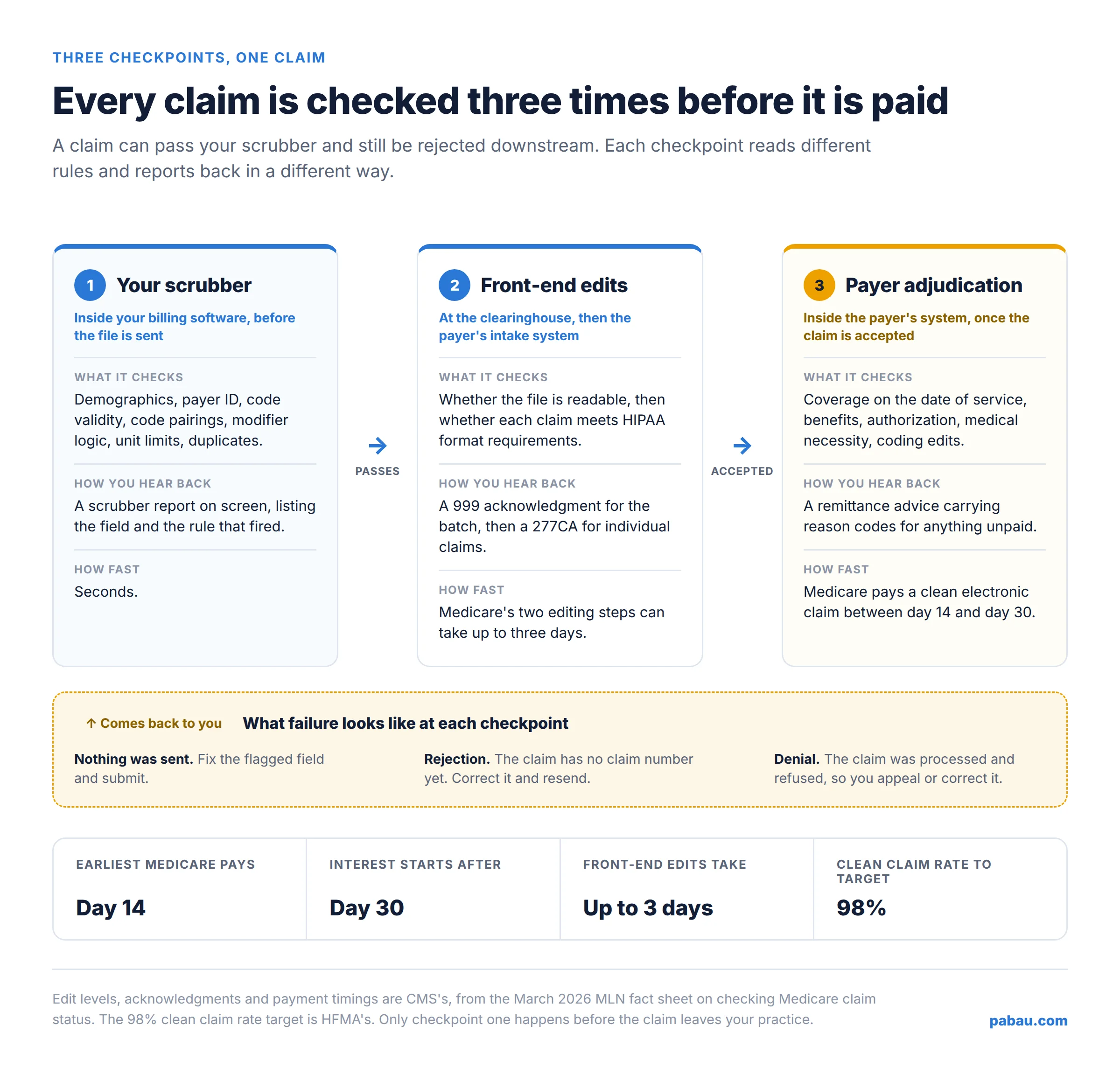
Checkpoint two is the front-end edits, run by your clearinghouse and then the payer’s intake system. Medicare’s version runs in two stages. The first asks whether the claim file is readable and answers with a 999 acknowledgment. The second checks each claim against format requirements and answers with a 277CA.
Both stages together can take up to three days. CMS asks you not to resubmit while a claim is still in editing, because that creates a duplicate. A claim rejected here never got a claim number, so there’s nothing to appeal. You correct it and send it again.
Checkpoint three is adjudication, where the payer reads the accepted claim against coverage, benefits, authorization rules, medical necessity, and its own coding edits. What comes back is an electronic remittance advice with reason codes. This is where a claim that passed everything upstream can still lose, and it’s a decision rather than a formatting problem. Fee schedules change and payer rules move, so practices check both inside their insurance claims software before submitting. Fee schedules change and payer rules move, so practices check both inside their insurance claims software before submitting.
That’s why a claim can clear one checkpoint and fail the next. Your scrubber can’t see a patient’s benefit design, and a clearinghouse edit says nothing about whether the plan covers the service. A restless legs claim under G25.81 can clear both and still meet a step-therapy rule.
Insurers on HealthCare.gov denied 19% of in-network claims in 2024, and KFF found a quarter of those denials were administrative. That quarter is the part your workflow reaches, and the part denial management is built to shrink.
The three levers that move a clean claim rate usually live in three different places. Eligibility sits in a payer portal, codes in a lookup table, validation in whatever the biller does last. Practice management software like Pabau puts them in one workflow, so the checks happen where the claim is built.
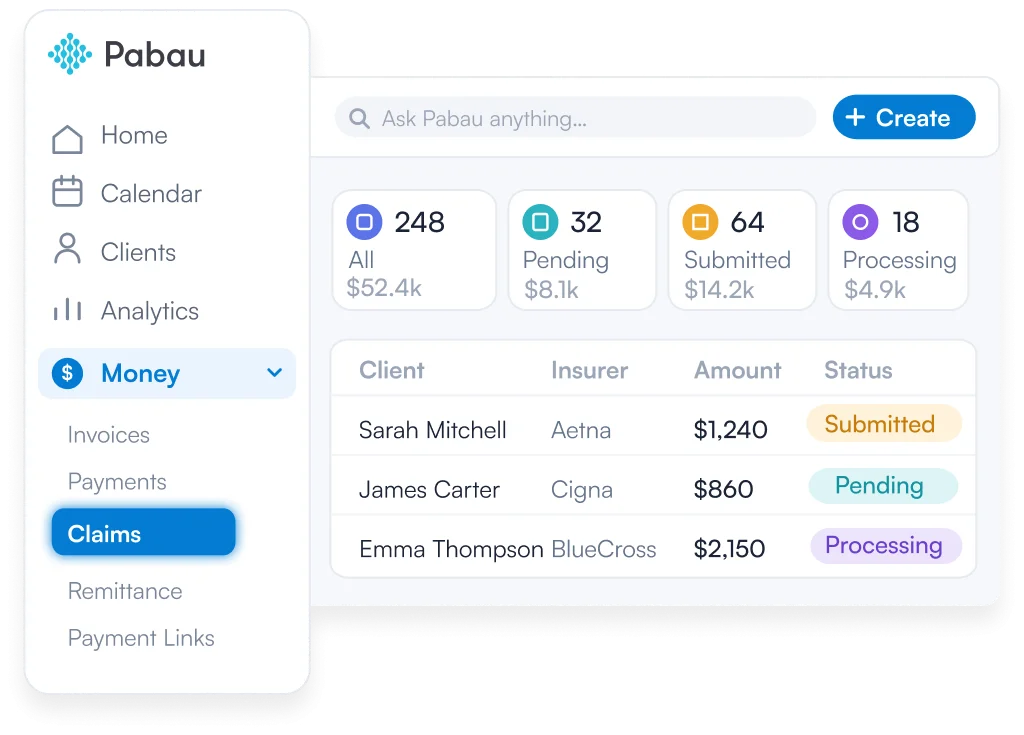
Eligibility runs in real time from the client card, returning a full benefit report before the visit rather than a yes or no after it. Procedure and diagnosis codes come from built-in CPT and ICD-10 catalogs. Diagnoses populate automatically from a client’s active Problems, so the claim matches the record.
Claims are then validated before submission through our Claim.MD integration, which reaches thousands of US payers. When something does come back rejected or denied, it lands on the claim record with the reason and the activity history attached. Nobody has to open a portal to find out what happened.

Pabau checks eligibility in real time from the client card, builds claims from your CPT and ICD-10 catalogs, and validates them before submission through Claim.MD. Rejections come back to the claim record with the reason, so your team fixes them in one place.

A high clean claim rate comes from the workflow rather than from one talented biller. Coverage gets confirmed before the visit, codes come from the record, and something checks the claim before it leaves. Build those three habits in and the rate looks after itself.
Start by measuring what you have, per payer, for a single month. The distance between your worst plan and your best one tells you more than any benchmark. It usually points at one habit rather than ten. Fix that, then check the number again.
One distinction is worth keeping. Scrubbing prevents rejections, not denials. No amount of validation makes a payer cover a service it excludes, so keep the two problems in separate piles. Book a demo to see how Pabau validates claims and returns rejections to the claim record for your team.

Want the whole path a claim travels? What is a medical claims clearinghouse? follows one claim from your invoice to the payer and back as a remittance.
Need the form behind the fields? CMS-1500 form walks the boxes whose mandatory entries decide whether a claim counts as clean.
New to the medical billing process? What Is Medical Billing? covers what medical billing is, from patient registration through claim submission to payment posting.
Not billing insurers directly yet? What is a superbill? explains the document out-of-network patients use to claim reimbursement themselves.
Shopping for software that scrubs claims? Best medical billing software US compares seven platforms on billing, claims, and integrations.
HFMA puts the target at 98%, meaning roughly one claim in 50 comes back for rework. Anything under 95% is worth investigating payer by payer, because a low practice-wide figure is usually one plan rather than a general problem. Measure it monthly so a change in a payer’s rules shows up quickly.
For Medicare, a clean electronic claim cannot be paid before day 14, and CMS owes interest if it is not paid within 30 calendar days. Paper claims wait until day 29. Commercial timelines are set by state prompt-pay rules, which typically run from 20 to 45 days once the claim is clean.
The clean claim ratio is another name for the clean claim rate. It is the number of claims accepted on first submission divided by the number of claims submitted in the same period, expressed as a percentage. Some systems report it as first-pass yield, which is the same calculation again.
A scrubbing error is a problem your scrubber found on a claim before submission, reported with the field and the rule that caught it. Common ones are an invalid member ID format, two procedure codes that cannot be billed together, and units above the limit for a code. Another frequent flag is a diagnosis that does not support the procedure billed.
A claim scrubber verifies patient and insured details, payer routing, code validity, code pairings, modifier logic, unit limits, diagnosis-to-procedure match, duplicates, and payer-specific edits. It cannot verify coverage decisions. Whether the plan pays for the service is settled at adjudication, after the claim has been accepted.