CPT Code 98981: RTM Treatment Management Billing Guide
CPT code 98981: Definition and official descriptor CPT code 98981 is an add-on c...

Last Updated: Nov 9, 2026
T2040 is the HCPCS Level II code for financial management, self-directed, waiver; per 15 minutes.
It pays the financial management services (FMS) entity that runs payroll, employer tax filings and budget tracking for Medicaid participants who hire their own workers. Each state sets the billing unit, so one state may pay per 15 minutes while another pays a monthly fee per participant.
Let Pabau's smart automation suggest the right codes, reduce claim denials, and keep your practice compliant—effortlessly.
Automate repetitive tasks and focus on what matters most—your patients.
Reduce coding errors and ensure compliance with the latest regulations.
Clean claims, fewer denials, and faster reimbursements.
Powerful insights and reporting to help your practice thrive.
HIPAA compliant SOC 2 certified GDPR-compliant Trusted by 4,000+ clinics worldwide

T2040 is the HCPCS code for financial management services (FMS) in self-directed Medicaid waiver programs, billed per 15 minutes.
FMS covers payroll, employer tax filings, worker paperwork and budget tracking for participants who hire their own support workers.
T2041 is supports brokerage, the coaching side of self-direction. Bill it separately, and never fold it into a T2040 line.
Many states replace the 15-minute unit with a monthly fee per participant, so the state billing manual decides the unit.
Every T2040 claim needs an authorized service plan, an active self-direction enrollment and FMS records that match the billed units.
HCPCS code T2040 carries the official CMS descriptor “Financial management, self-directed, waiver; per 15 minutes.” It sits in the T2000-T2999 range of HCPCS Level II codes, which state Medicaid agencies use for home and community-based services (HCBS) waiver billing.
Medicare does not accept T-codes, and they do not appear on the physician fee schedule. According to the CMS HCPCS overview, CMS maintains the HCPCS Level II set, and the T-codes within it serve state Medicaid billing.
Self-direction lets a Medicaid participant hire, schedule and manage their own support workers. That makes the participant, or their representative, an employer with payroll and tax duties. The FMS entity carries out those duties on their behalf, and T2040 is how it bills for that work.
T2040 covers the administrative and fiscal support that keeps a self-directed budget running. The FMS entity works behind the participant, not alongside them in their home. Covered activities typically include:
Eligibility requires Medicaid enrollment, an active waiver or state plan benefit that offers self-direction, and a service plan that authorizes FMS. The participant must also have chosen to self-direct some or all of their services.
T2040 pays for managing the money, not for the services the money buys. The following sit outside its scope under standard Medicaid waiver principles. State plans vary, so confirm each point in the relevant state billing manual every contract year:
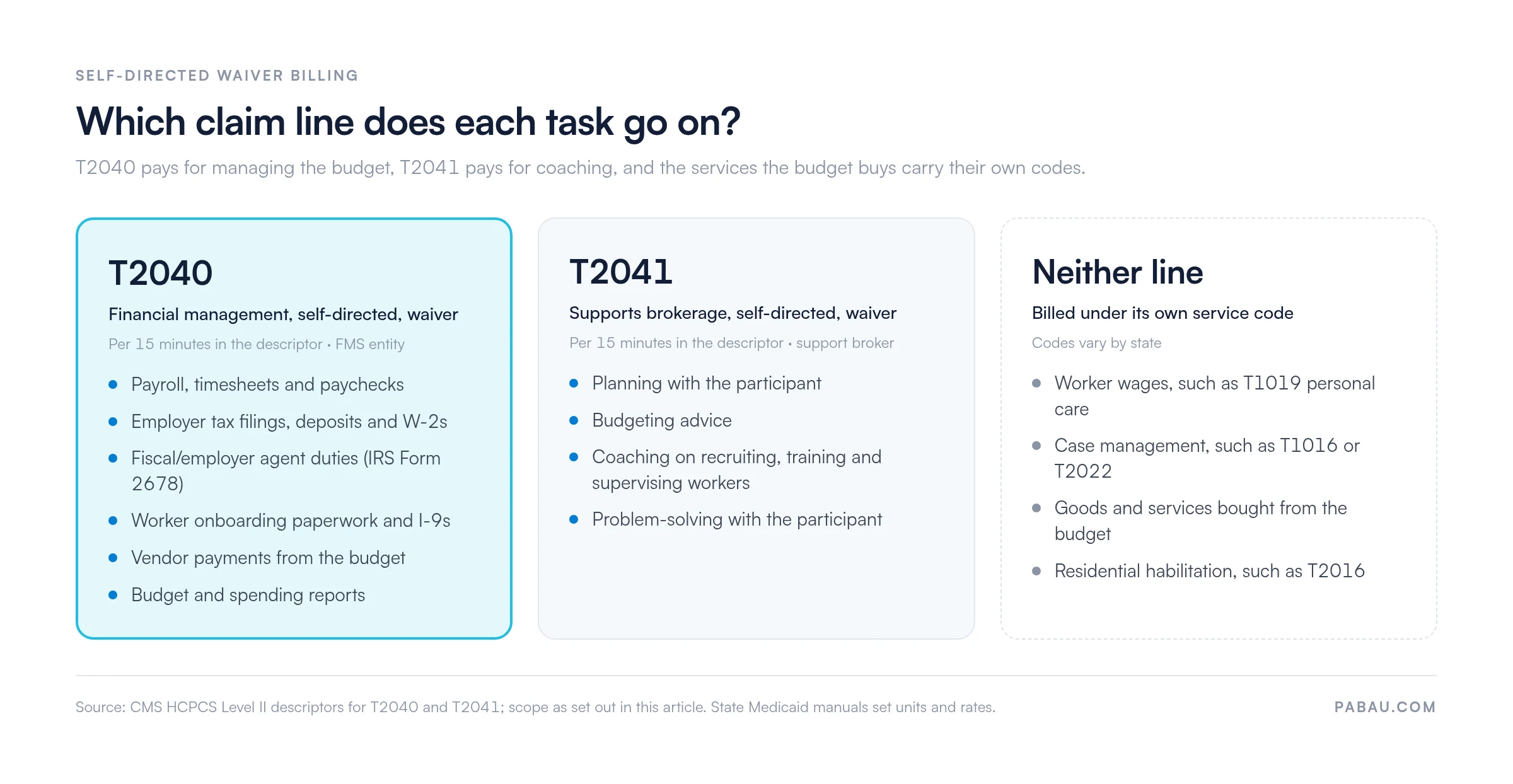
T2040 is financial management, and T2041 is supports brokerage. Both are self-directed waiver services billed per 15 minutes, which is why they get swapped. The test is simple: T2040 handles money and employer paperwork, while T2041 helps the participant make and carry out decisions.
A participant can receive both services in the same month, and many do. Each line then needs its own authorization and its own records. Some states require that the FMS entity and the support broker be separate organizations, to keep budget control apart from budget advice.
The diagram below sorts common tasks into T2040, T2041 and the service codes that sit outside both.
The descriptor for HCPCS code T2040 says “per 15 minutes,” but each state Medicaid plan sets the unit it pays. This is the most state-variable part of T2040 billing. Misreported units are a leading cause of recoupment in HCBS audits, so confirm the unit in your state billing manual before the first claim.
Billing unit structures seen across state Medicaid plans for T2040:
Place of service: FMS is delivered away from the participant, so states set the place of service code in their own billing rules. Use the code your state Medicaid manual names, because a mismatch can trigger an automatic denial. Understanding medical billing fundamentals helps billing staff work through these state-level rules with more confidence.
Most state Medicaid programs authorize T2040 through the participant’s service plan and budget, rather than through a standalone request. Medicaid managed care organizations (MCOs) may add their own authorization step on top. Never assume authorization status, and verify it with the payer before the billing period begins.
The authorization process for FMS typically involves these steps:
When an MCO manages the waiver, its rules may be stricter than the state baseline. Confirm whether the claim needs the state authorization, the MCO approval or both numbers.
Documentation for T2040 proves two points: that the participant was actively self-directing, and that the FMS work billed was done. Auditors should be able to match each claim line to records without asking for more. Strong billing compliance best practices at the record-keeping stage prevent the most common recoupment findings.
Records an FMS entity should hold for each participant and billing period:
Retention periods are set by state Medicaid rules and the provider agreement, commonly 5 to 7 years. Payroll and tax records may also carry their own IRS retention periods, so keep whichever is longer.
Reconcile T2040 units against payroll every month before you submit. Pull five participants at random and check that each one was active, authorized and had payroll or budget activity in the period. A missing authorization caught before submission takes minutes to fix. The same error found at audit can mean a full recoupment.
HCPCS code T2040 denial patterns are consistent across state Medicaid programs. Most are mechanical, so a check against the authorization and enrollment records before submission catches them. The table below maps the most frequent denial causes to corrective actions.
Structured denial management workflows sort T2040 rejections by root cause, such as an expired authorization or the wrong unit type. Billing managers can then fix a pattern before it spreads across a billing cycle.
T2040 appears wherever a state offers self-direction and pays for FMS as a billable service. The most common home is a 1915(c) HCBS waiver with a self-direction option. States can also offer self-direction under 1915(j) self-directed personal assistance services, 1915(k) Community First Choice and 1115 demonstrations.
The populations served vary widely. Self-direction is offered in waivers for older adults, people with physical disabilities and people with intellectual and developmental disabilities. The FMS function is the same in each: Payroll, taxes and budget tracking for a participant who employs their own workers.
The key question is how the state funds FMS. CMS allows states to furnish FMS either as a waiver service or as an administrative activity. Only the first route produces a T2040 claim. Check the state’s waiver application or billing manual before you set up FMS billing in a new state.
No other aspect of T2040 billing varies more between states than the unit and the rate. The table below summarizes the variables that differ by state Medicaid plan. It is not a fee schedule, because rates change with each state budget cycle, so verify current figures against the state agency’s published fee schedule.
FMS entities often serve participants in more than one state. Build each state’s T2040 rules into the billing system as a separate payer rule set. Applying a 15-minute rule to a monthly-fee state, or the reverse, produces errors that surface only at audit.
Check the AAPC Codify HCPCS lookup and your state Medicaid billing manual each fall, when CMS releases the annual HCPCS update. T-codes occasionally receive descriptor revisions, and states often change FMS rates or units at the start of a new waiver year.
In most FMS teams, the evidence behind a T2040 claim lives in several places. Enrollment forms sit in one folder, authorizations in another and claims in a third. Billing staff then rebuild the link between them by hand at month end.
Pabau, the practice management platform we build, keeps client records, signed forms and claims together. Digital forms capture signed agreements and enrollment details in the same record. Pabau’s claims management software then tracks each claim from submission to payment.
At month end, billing staff check each claim against the forms behind it in one place. Every Pabau subscription includes the full feature set, so forms, billing and reporting work from the same data.

Pabau keeps client records, signed forms and claims together, so month-end checks happen in one place rather than across three folders.

HCPCS code T2040 pays the FMS entity for running a participant’s budget, not for the care that budget buys. Before the first claim in a new state, check its billing manual for two answers. Does it pay per 15 minutes or per month, and does it fund FMS as a billable service at all?
Most other T2040 denials start as record-keeping errors, from an expired authorization to wages on an FMS line. Those errors are cheapest to fix in the records, which is where Pabau starts. Book a demo to see how it keeps client records, forms and claims together.

Need a framework for reducing claim denials across your billing team? Denial management in healthcare covers root-cause categorization, appeal workflows, and how to build a denial reduction program that sticks.
Want to understand the broader billing compliance landscape for HCBS providers? Billing compliance best practices outlines the audit triggers, documentation standards, and payer rules that apply across Medicaid programs.
New to Medicaid billing fundamentals? What is medical billing explains the end-to-end claims process – from service delivery through payment posting – in plain language for practice and program administrators.
Billing the coaching side of self-direction? HCPCS code T2041 covers supports brokerage, the companion service that is billed on its own line next to T2040.
HCPCS code T2040 covers financial management services (FMS) for participants in self-directed Medicaid waiver programs. FMS includes payroll, employer tax filings, worker paperwork, vendor payments and budget reporting. It does not cover the workers’ wages, supports brokerage (T2041) or residential habilitation.
The official descriptor says per 15 minutes, but many states pay FMS as a monthly fee per participant instead. Some add a one-time enrollment fee. Check your state Medicaid billing manual before submitting, because the wrong unit is a leading cause of recoupment.
T2040 is financial management: Payroll, taxes and budget tracking for a self-directing participant. T2041 is supports brokerage: Helping the participant plan, recruit and manage workers. Both are self-directed waiver services billed per 15 minutes, and each needs its own authorization and records.
Keep the self-direction enrollment record, the service authorization and the worker files for each participant. Add payroll and tax records and the budget reports sent to the participant and state. States that pay per 15 minutes also expect start and end times for FMS activity.
In most states, FMS must be authorized in the participant’s service plan and budget before you bill it. Medicaid managed care organizations may add their own approval step. Track authorization end dates so no claim falls outside the approved period or unit cap.
Yes. T2040 can appear alongside the services it pays for, such as personal care, and alongside T2041 supports brokerage. Each line needs its own authorization and its own records. Never bill worker wages or broker time on the T2040 line.