CPT Code 98981: RTM Treatment Management Billing Guide
CPT code 98981: Definition and official descriptor CPT code 98981 is an add-on c...

Last Updated: Nov 9, 2026
T2038 is the HCPCS Level II code for community transition, waiver; per service. State Medicaid agencies use it to pay one-time set-up costs when a person moves from a nursing facility or other institution into their own home.
Those costs include moving expenses, security and utility deposits, essential household furnishings, and cleaning or pest eradication. Medicare does not cover T-codes, so each state sets its own rate, cap, and prior authorization rule. T2038 is billed per service or per occurrence, not as a recurring support service.
Let Pabau's smart automation suggest the right codes, reduce claim denials, and keep your practice compliant—effortlessly.
Automate repetitive tasks and focus on what matters most—your patients.
Reduce coding errors and ensure compliance with the latest regulations.
Clean claims, fewer denials, and faster reimbursements.
Powerful insights and reporting to help your practice thrive.
HIPAA compliant SOC 2 certified GDPR-compliant Trusted by 4,000+ clinics worldwide

HCPCS code T2038 is “Community transition, waiver; per service.” It is a Medicaid-only T-code for one-time set-up costs when a person leaves an institution for their own home.
Covered costs include moving expenses, security and utility deposits, essential household furnishings, and cleaning or pest eradication, within the limits of each state waiver.
T2038 is billed per service or per occurrence, never in 15-minute units. Each state sets its own rate, per-service limit, and lifetime cap.
Ongoing community support and personal care belong to other codes, and room and board fall outside the waiver altogether.
Pabau, the practice software we build, tracks each authorization code, its dates, and its sessions on the case, and warns you when one is missing.
HCPCS code T2038 is a T-series code in HCPCS Level II, the part of the CMS HCPCS code set for items and services outside CPT. T-codes exist for state Medicaid agencies, and Medicare fee-for-service does not recognize them.
The official long descriptor is “Community transition, waiver; per service.” It pays the one-time costs of setting up a home for a Medicaid waiver participant who is leaving a nursing facility or other institution. The table below sets out the code details.
CMS publishes quarterly HCPCS updates that can add, revise, or retire T-codes. Check T2038 against the current CMS Alpha-Numeric HCPCS file before each claim cycle, especially at the start of a new year.
T2038 pays for the goods and services a person needs to set up a home after leaving an institution. It applies when a waiver participant moves from a nursing facility, hospital, or other institutional setting into a private residence. The person must be responsible for their own living expenses there, and each cost has to appear in their transition or service plan.
Included costs (subject to state waiver definitions):
Exclusions:
Because each state writes its own service definition, a cost one state pays under T2038 may be excluded in another. Check the waiver definition before the purchase is made, not after.
No single national program sits behind T2038. States authorize community transition services in their own home and community-based services (HCBS) waivers, and each one sets its own limits. The examples below show how far those rules vary.
CMS approves each state waiver under Section 1915(c) of the Social Security Act. The approved waiver sets the service definition, the provider qualifications, and the billing codes, including whether T2038 is used at all.
Correct claim structure for HCPCS code T2038 depends on three rules that your state Medicaid management information system (MMIS) controls. They are how a unit is defined, which modifiers are accepted, and which place-of-service (POS) codes apply.
T2038 is a per-service code. One unit is one transition service or purchase as your state defines it, and some states call it per occurrence. It is not a time-based code, so never convert hours or minutes into units. Your state billing manual decides whether several purchases go on separate lines or on one line.
Modifier rules for T2038 are state-specific and enforced by the MMIS. Common patterns include:
Never apply a modifier your state MMIS does not recognize for T2038. An unrecognized modifier triggers an automatic denial, and the corrected claim still has to meet the timely filing window.
Use the place-of-service code your state billing guide names for T2038. If the guide is silent, confirm with the state before using POS 12 (home) or POS 99 (other place of service). An institutional POS works against the claim, because the service exists to move the person out of that setting.
Before your first T2038 claim, download your state’s MMIS companion guide and waiver billing appendix. Note the unit definition, any per-service or lifetime cap, the accepted modifiers, and the place-of-service code for each waiver program.
Reimbursement for T2038 is set entirely at the state level. CMS does not publish a national fee schedule for T-series codes the way it does for Medicare Part B services. Each state Medicaid agency sets its own rate and limits, subject to CMS approval of its waiver.
What this means in practice:
To find the current T2038 rate, open your state Medicaid agency’s fee schedule on its provider portal. Search for T2038 in the HCPCS or waiver section, and read the notes for caps and approval thresholds.
Documentation for T2038 has to prove three facts. The person moved from an institution into a community home, and their approved plan listed the cost. The money then went on an item the waiver allows. Auditors reviewing paid claims look for each one.
Keep these records together in one file that can survive an audit. Required documentation typically includes:
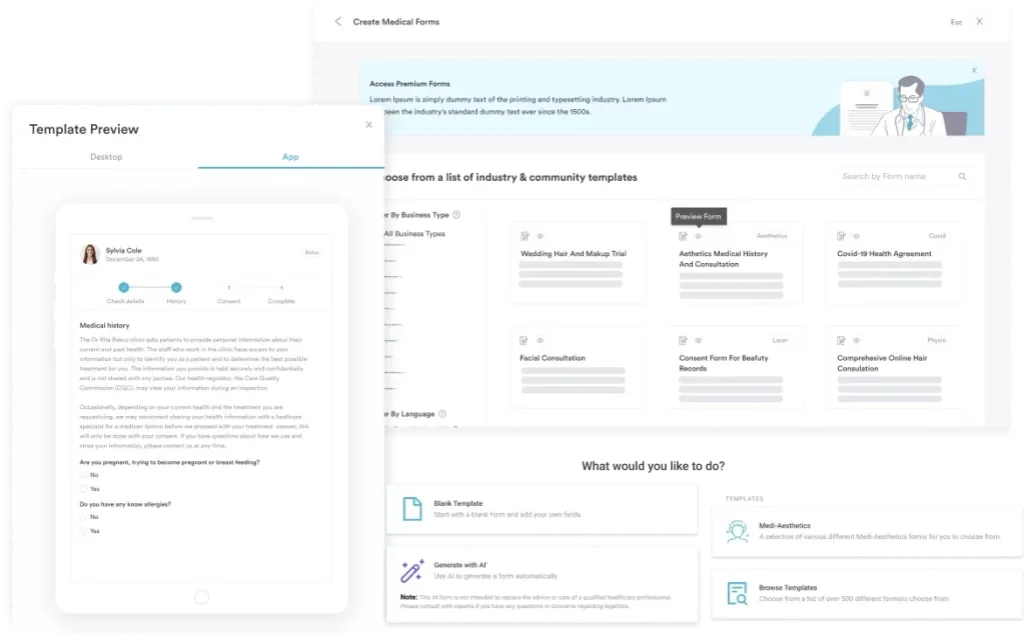
Maintain HIPAA-compliant records for all T2038 documentation. Medicaid post-payment audits can reach back several years, so retention matters as much as the paperwork itself.
Most states that use T2038 require approval before the money is spent. The approval process varies, and Michigan, for example, requires prior authorization once a service goes above $250.
Track authorization dates as closely as you track claim deadlines. A purchase made after the approval lapses is treated the same as one made with no approval at all.
T2038 is often confused with codes for ongoing community support. It pays for one-time set-up costs, while the codes below pay for services delivered over time.
Use the AAPC HCPCS code lookup to review current descriptors before you choose. Where two codes seem to fit, your state waiver billing appendix decides which one the state accepts. Help managing a self-directed budget points to T2041, and ongoing behavioral health support to H2015.
Denials on T2038 claims come from a short list of root causes. Each one is preventable with checks before the claim goes out.
Structured denial management workflows cut rework and protect revenue. Build checks that catch the root causes above before the claim reaches the payer. The sequence below puts those checks in the order a purchase meets them.
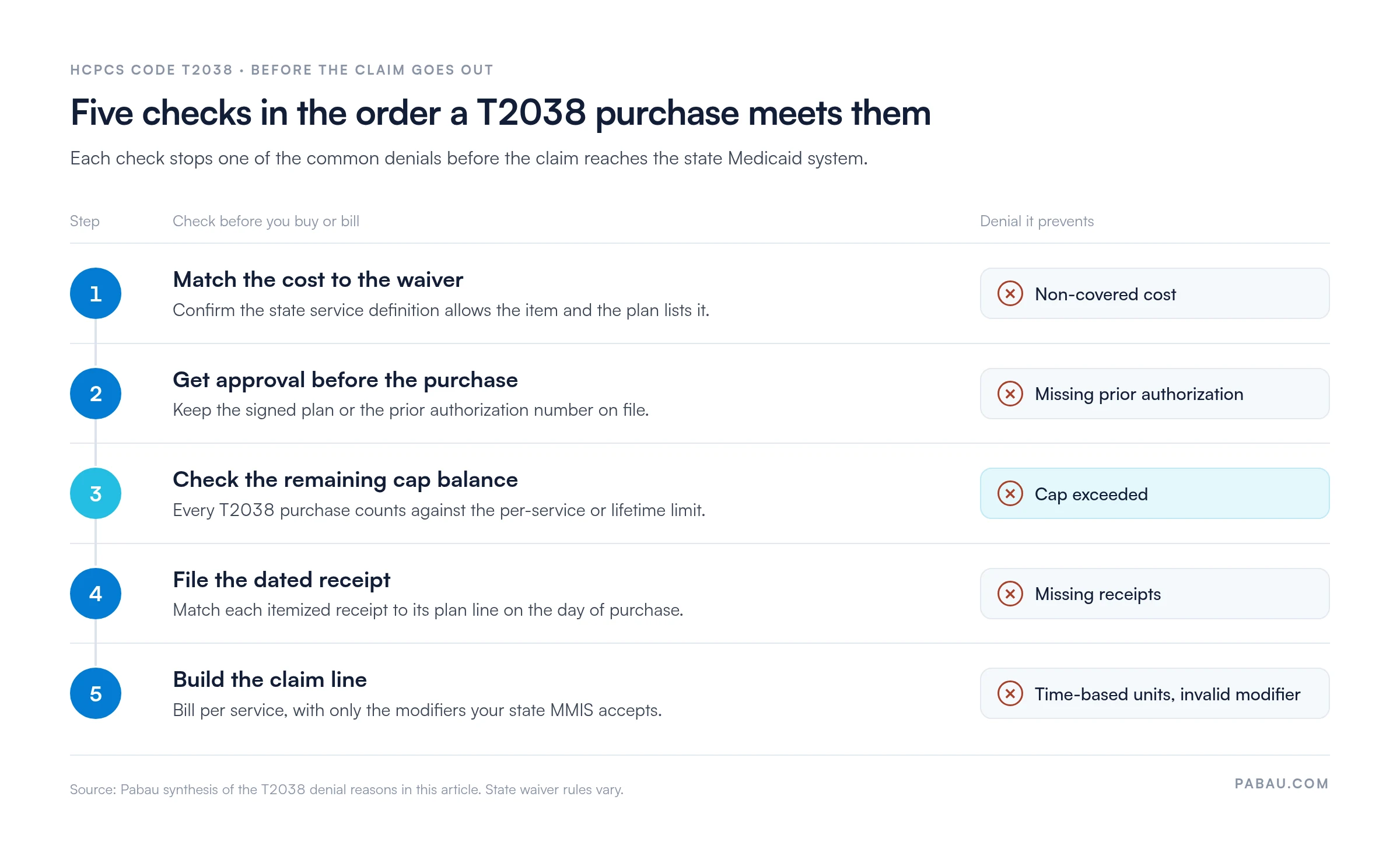
Run a monthly audit of T2038 claims. Pull the prior month’s submissions, sort them by denial reason, and see whether one root cause accounts for more than 20% of denials. That one cause is worth fixing in your process, not case by case.
Transition teams often track approvals in a spreadsheet, receipts in email, and claims in a separate billing portal. When those drift apart, a T2038 claim goes out without its authorization number or after the approval dates have passed.
Pabau keeps that information on the case instead. You record the authorization code, its dates, and the approved sessions against the patient, and Pabau warns you when an authorization is missing. Signed plans and forms sit on the same patient record. Pabau’s claims management software then sends US claims to payers through Claim.MD.
The result is a claim that matches the approval and the paperwork behind it. Every Pabau plan includes the core features, and add-ons enhance the experience, so documentation, authorizations, and billing can stay in one system. Pabau also supports revenue cycle management and medical billing compliance across the rest of your Medicaid work.

Pabau records authorization codes, dates, and sessions on each case and warns you when one is missing. US claims go to payers through Claim.MD, with the supporting documents on the same patient record.

HCPCS code T2038 covers a single kind of cost. It pays to set up a home when a person leaves an institution. Bill it like a support service in 15-minute units and the claim fails, however good the notes are. Practices that bill it cleanly read the state waiver first, check the cap, and match every receipt to an approved line in the plan.
Pabau keeps the authorization, the paperwork, and the claim on the same case, so the approval and the receipts travel together. Book a demo to see how Pabau handles Medicaid waiver codes from approval to claim.

Need a clean claim submission checklist? Clean claim submission covers the elements every Medicaid claim needs to pass automated edits on first submission.
Battling repeated denials? Denial codes in medical billing explains the most common CARC and RARC codes and how to respond to each one.
Want to understand the broader billing ecosystem? Revenue cycle management breaks down each stage from eligibility check through payment posting for Medicaid providers.
HCPCS code T2038 is “Community transition, waiver; per service.” It is a Medicaid-only Level II code for one-time costs when a person moves from an institution into their own home. Medicare does not pay it, and each state decides whether its waivers use it.
T2038 covers transition set-up costs. These include moving expenses, security deposits, utility deposits and installation fees, essential household furnishings, and cleaning or pest eradication before the move. Room and board, recurring services, and any cost the state waiver does not allow are excluded.
No. T2038 is billed per service, and some states define the unit as per occurrence. It is not a time-based code, so minutes or hours are never converted into units. Codes such as T2041 and H2015 are the time-based ones.
Most states that use T2038 require approval before the cost is incurred. Some treat the approved transition plan as the authorization, while others issue a separate number for the claim. Michigan, for example, requires prior authorization once a service goes above $250.
States authorize T2038 in their own home and community-based services waivers, so there is no single national program. Michigan, Iowa, Massachusetts, and Louisiana all list it, each with different rules. Confirm with your state Medicaid agency whether your waiver uses the code.
Each state Medicaid agency sets its own rate and limits, and CMS publishes no national fee schedule. Michigan pays up to $250 per service before prior authorization applies, and Louisiana applies a lifetime cap. Check your state fee schedule or MCO contract for the current figure.
Modifier rules for T2038 are set by each state MMIS. Some states use their own U1 to UD modifiers to identify the waiver program, and others expect the base code alone. Confirm the accepted modifiers in your state waiver billing appendix before you submit.
Common reasons include a missing prior authorization, a cost above the state cap, and an item the waiver does not cover. Units billed in 15-minute increments, unrecognized modifiers, and missing receipts also cause denials. Most of these are preventable with checks before submission.