

CPT Code 98981: RTM Treatment Management Billing Guide
CPT code 98981: Definition and official descriptor CPT code 98981 is an add-on c...

Last Updated: Nov 9, 2026
33207 is the CPT code for insertion of new or replacement of permanent pacemaker with transvenous electrode(s); ventricular. It covers a single-chamber system with one lead in the right ventricle, including pocket creation, lead placement, generator connection and intraoperative testing.
33207 sits between 33206, a single atrial lead, and 33208, atrial and ventricular leads together. The lead count and position in the operative note decide the code, and Medicare coverage follows NCD 20.8.1.
Let Pabau's smart automation suggest the right codes, reduce claim denials, and keep your practice compliant—effortlessly.
Automate repetitive tasks and focus on what matters most—your patients.
Reduce coding errors and ensure compliance with the latest regulations.
Clean claims, fewer denials, and faster reimbursements.
Powerful insights and reporting to help your practice thrive.
HIPAA compliant SOC 2 certified GDPR-compliant Trusted by 4,000+ clinics worldwide

CPT code 33207 covers a new or replacement permanent pacemaker with one transvenous lead in the right ventricle.
Lead position picks the code: 33206 for an atrial lead, 33207 for a ventricular lead and 33208 for both.
Medicare coverage follows NCD 20.8.1, so the diagnosis must document a covered indication such as complete AV block.
The 90-day global period bundles routine post-op visits, but follow-up programming evaluations (93279–93281) are billed separately.
Pabau, the practice management platform we build, sends claims through Claim.MD and matches each ERA back to its claim.
CPT code 33207 is the AMA code for inserting a new or replacement permanent pacemaker with a single transvenous lead in the right ventricle.
Pocket creation, lead placement, generator connection and intraoperative device testing all fall within that one payment.
Coders most often confuse this code with its siblings, 33206 and 33208. Lead placement decides between them, and 33207 applies only when the single electrode sits in the right ventricle. If the physician also places a right atrial lead in the same session, the correct code is 33208, not 33207 with an add-on.
CPT 33207 bundles several components into a single billable procedure. Billing one of those components on its own line is unbundling, and payers deny it under National Correct Coding Initiative (NCCI) edits.
Included in 33207: Pocket formation, lead placement and anchoring, pulse generator connection and fluoroscopic guidance for lead positioning. Intraoperative pacing threshold and sensing measurements and wound closure are bundled too.
Excluded from 33207 (separately billable):
The pacemaker device itself is typically billed separately by the facility using a revenue code or pass-through designation. The physician claim covers the implant procedure only, not the hardware cost.
The three single- and dual-chamber pacemaker insertion codes share the same operative settings and differ on one variable. That variable is the number and location of transvenous leads placed during the session.
The operative report is the deciding document. If fluoroscopy confirms a single ventricular lead and the report states that no atrial lead was placed, 33207 is correct. A two-lead system belongs under 33208 instead.
Ambiguous documentation is likely to draw a records request or an outright denial. The decision path below starts from the new leads the operative note records.
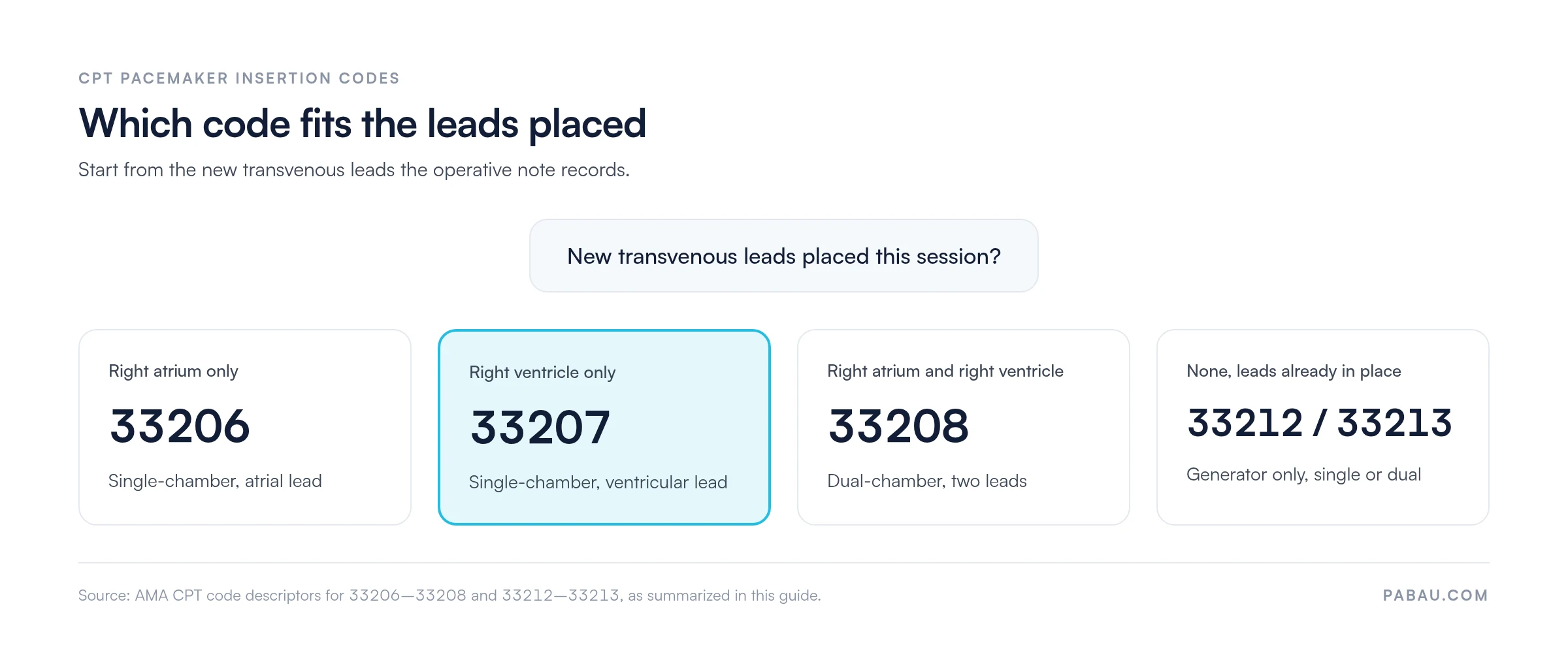
Cardiology billing teams regularly report these codes alongside, or instead of, CPT code 33207. The table below covers the core pacemaker and device management code set.
Payers do not cover CPT code 33207 on the procedure code alone. The claim needs an ICD-10-CM diagnosis that meets the coverage criteria in CMS NCD 20.8.1 (cardiac pacemakers) and the applicable MAC Local Coverage Determination. Submitting with a non-covered diagnosis is a frequent cause of denials for this code family.
Always use the most specific ICD-10-CM code available. I44.2 (complete AV block) meets coverage criteria far more reliably than I45.9 (conduction disorder, unspecified). The diagnosis must match the pre-operative assessment as well as the operative report. Payers compare the two documents during post-payment review.
Before submitting a CPT code 33207 claim, check the ICD-10-CM code against NCD 20.8.1 and your MAC’s coverage policy. CMS revises both periodically, and a MAC billing article can narrow the covered indications further. Run an eligibility check and confirm the diagnosis is on the covered list before the claim goes out.
For CPT code 33207, the operative note must contain the clinical and technical elements that justify both medical necessity and the code selected. A note written as a box-ticking exercise tends to draw more denials and audits. Completing every note before the claim goes out is the foundation of medical billing compliance requirements.
Missing serial numbers or incomplete threshold documentation are the triggers most likely to turn a routine claim into a probe or prepayment audit. Submitting a clean claim for cardiac device procedures starts with the operative note, not the billing screen.
CPT 33207 is a surgical procedure with a 90-day global period, so modifiers affect payment amount, billing order and payer adjudication. A wrong or missing modifier is a common source of avoidable denials in cardiology practices.
Medicare pays CPT code 33207 under the Medicare Physician Fee Schedule (MPFS) relative value unit (RVU) system. The allowed amount multiplies the sum of work, practice expense and malpractice RVUs by a geographic adjustment factor (GPCI) and the annual conversion factor. These values change every January and vary by locality, so treat the figures below as reference benchmarks only.
Use the CMS Physician Fee Schedule lookup tool to retrieve the current rate for your practice’s locality. FastRVU’s 2026 RVU lookup also lists 2026 work and practice expense RVUs.
Traditional Medicare does not require prior authorization for CPT 33207, but Medicare Advantage plans frequently require it for elective implants. Most commercial payers also require pre-authorization for non-emergent procedures. For an emergent implant where prior authorization was not possible, document the clinical urgency clearly in the record. Then submit a retrospective authorization request within the payer’s stated window, which varies by payer.
Many pacemaker implant denials trace back to documentation or diagnosis selection. The table below maps each common denial to its root cause and the corrective action. Effective denial management workflows for CPT 33207 start by tracking these five patterns in every rejected claim.
Reviewing medical billing denial codes alongside these pacemaker patterns helps billing teams build a denial prevention checklist. That checklist catches most of these issues before the claim is submitted.
Run a weekly CPT 33207 denial report filtered by claim adjustment reason code (CARC). CO-11 (diagnosis inconsistent with the procedure) and CO-50 (not deemed a medical necessity) usually point to the diagnosis or its documentation. CO-97 usually means a bundled service was billed on its own line. Sorting denials this way shows which step of the workflow to fix.
CPT code 33207 carries a 90-day global surgery period. During those 90 days, routine post-operative evaluation and management visits are included in the original payment and cannot be billed separately. Device evaluation at a follow-up visit is the exception, because it is not routine post-operative care.
Programming device evaluations are separately billable during the global period: 93279 for a single-lead pacemaker, 93280 for dual-lead and 93281 for multiple-lead. An in-person interrogation without reprogramming uses 93288 instead. Each is a distinct technical service, because the physician is evaluating device performance and not managing the surgical wound.
Many cardiology billing teams build a pacemaker claim from three places: the operative note, a coding worksheet and a separate clearinghouse portal. Each hand-off is a chance to drop a serial number or mismatch a diagnosis.
Pabau, the practice management platform we build, puts streamlined claims management in the same system as the patient record. Claims go out electronically as CMS-1500 submissions through the Claim.MD clearinghouse, which connects to thousands of US payers.
Eligibility checks run as 270/271 transactions before the implant, and each electronic remittance advice (ERA) is matched back to its claim. Pabau also surfaces Claim.MD’s payer enrollment forms, so the billing team can complete enrollment without switching systems.
The result is a pacemaker claim that carries its eligibility check and remittance history in one record. When a 33207 claim comes back denied, the billing team sees the reason against the original claim and can fix the cause before resubmitting.

Send claims through Claim.MD, check eligibility before the implant and match each ERA back to its claim. See how cardiology practices run billing in Pabau.

For CPT code 33207, code selection is the easy part, because the lead count in the operative note settles it. The harder work sits upstream. It needs a diagnosis that meets NCD 20.8.1 and an operative note complete enough to survive an audit.
After the implant, bill the follow-up programming evaluations the global period does not cover. Those visits are paid separately, and skipping them gives up revenue the practice has already earned.
Pabau keeps electronic claims through Claim.MD, eligibility checks and ERA return in one platform, so cardiology billing teams spend less time correcting rejected claims. Book a demo to see how pacemaker billing runs in Pabau.

Need a foundation in medical billing workflows? Medical billing fundamentals explains how claims move from procedure to payment across CPT-coded specialties.
Submitting cardiac device claims through a clearinghouse? Claim.MD clearinghouse guide covers payer enrollment, 837P submission, and ERA processing for high-complexity procedures.
Seeing recurring denials on superbill submissions? Superbill best practices walks through how to structure procedure and diagnosis codes so pacemaker claims clear adjudication on the first pass.
CPT code 33207 covers insertion of a new or replacement permanent pacemaker with a single transvenous ventricular electrode and pulse generator. It includes pocket formation, intraoperative threshold testing and fluoroscopic guidance. Device programming at later visits and lead repositioning procedures are billed separately.
CPT 33207 is for a single ventricular lead only. CPT 33208 is for dual-chamber placement, meaning one lead in the right atrium and one in the right ventricle during the same session. If the operative report documents only a ventricular lead, 33207 is correct.
Medicare reimbursement for CPT code 33207 is calculated from work, practice expense and malpractice RVUs, multiplied by geographic adjustment factors and the annual conversion factor. Rates change each January and vary by MAC locality. Use the CMS Physician Fee Schedule lookup tool for the current figure for your practice location.
Traditional Medicare does not require prior authorization for CPT 33207, but most Medicare Advantage plans and commercial payers require pre-certification for elective implants. For an emergent procedure where authorization cannot be obtained in advance, document the clinical urgency. Then submit a retrospective authorization request within the payer’s stated window, which varies by payer.
No. CPT 33207 describes insertion of a complete new or replacement pacemaker system, including the lead. Lead repositioning or lead insertion codes (33215, 33216, 33217) apply when an existing generator stays in place and a lead is repositioned or added. Billing both 33207 and one of those codes for the same session will trigger an unbundling denial.
The most common denials come from four errors. The first is a non-covered ICD-10 diagnosis, such as I45.9 when I44.2 is documented. The second is billing 33208 when only one lead was placed. The third is an operative report missing serial numbers or threshold values. The fourth is unbundling, such as billing fluoroscopic guidance separately when 33207 already includes it.




