33244 is the CPT code for removal of single or dual chamber implantable defibrillator electrode(s); by transvenous extraction. It covers one or two ICD leads pulled out through a vein, reported once per session.
Coders often confuse it with CPT 33243, which covers removing the same leads through a thoracotomy. Approach mismatches between the two are a common source of denials, so the operative report decides the code.
Related Information
Section
10004-69990 Surgery
Subsection
33016-37799 Cardiovascular system
Code range
33202-33249 Pacemaker or implantable defibrillator procedures
Billable
No
Code also known as
ICD lead removal, defibrillator lead extraction, transvenous electrode removal
Save time. Improve accuracy. Get paid faster.
Automate coding with Pabau
Let Pabau's smart automation suggest the right codes, reduce claim denials, and keep your practice compliant—effortlessly.
Automate repetitive tasks and focus on what matters most—your patients.
Improve accuracy
Reduce coding errors and ensure compliance with the latest regulations.
Get paid faster
Clean claims, fewer denials, and faster reimbursements.
Grow with confidence
Powerful insights and reporting to help your practice thrive.
HIPAA compliant•SOC 2 certified•GDPR-compliant•Trusted by 4,000+ clinics worldwide
Key takeaways
CPT 33244 covers transvenous extraction of one or two ICD leads, and the approach separates it from 33243, not the lead count.
The operative report decides the code: transvenous access is 33244, and open chest access is 33243.
Approach mismatches between 33244 and 33243 are a common source of denials, so confirm the approach wording before the claim drops.
Medicare fee-for-service generally does not require prior authorization for 33244, but coverage still rests on LCD-compliant medical necessity documentation.
Pabau integrates with Claim.MD to handle CPT 33244 claim submission, real-time eligibility checks and ERA processing.
What CPT code 33244 describes
CPT code 33244 describes the removal of single or dual chamber implantable defibrillator electrode(s) by transvenous extraction. It sits in the pacemaker and implantable defibrillator subsection of cardiovascular surgery in the AMA’s CPT code set, which the CPT Editorial Panel maintains.
The phrase that matters is “by transvenous extraction.” It sets the basis for code selection and separates 33244 from every other cardiac lead removal code.
Field
Detail
CPT Code
33244
Official descriptor
Removal of single or dual chamber implantable defibrillator electrode(s); by transvenous extraction
Code category
Cardiovascular surgery, pacemaker or implantable defibrillator
90 days (major surgical procedure; confirm in current MPFS data)
Fluoroscopic guidance
Bundled, not billed separately
One code covers both single and dual chamber removal done through the vein. So when two leads come out in the same session, you still report 33244 once. The descriptor already accounts for the second lead.
How a transvenous extraction runs, step by step
Transvenous lead extraction is a minimally invasive procedure done in a catheterization lab or hybrid OR under fluoroscopic guidance. Knowing the steps helps you check that the operative report supports 33244 rather than the thoracotomy code, 33243.
Patient preparation. The team gives general anesthesia or conscious sedation. The physician then gains vascular access, usually through the subclavian or femoral vein.
Lead engagement. The physician uses a specialized extraction tool. A locking stylet slides into the lead lumen and grips it from inside. A laser or mechanical sheath cuts or dilates the scar tissue holding the lead to the vessel wall.
Counter-traction extraction. The physician applies controlled traction while advancing the sheath along the lead toward the heart. This frees adhesions step by step rather than tearing tissue.
Lead removal. Once the tip is free, the physician withdraws the lead through the vein. In a dual chamber case, the second lead comes out the same way in the same session.
Closure and monitoring. The team closes the access site and watches for cardiac tamponade, hemothorax and venous tear. The clinical record should note these risks.
In short, the route defines the code. If the operative report describes a sternotomy, thoracotomy or any entry through the chest wall, the correct code is 33243, not 33244.
What 33244 bundles, and what it leaves out
CPT code 33244 covers the complete transvenous extraction session. Knowing what sits inside it prevents unbundling denials and double billing.
Included in 33244
Not included (separate codes or not separately billable)
Transvenous removal of two ICD leads (same session)
Open thoracotomy approach (use 33243 instead)
Fluoroscopic guidance integral to the procedure
Pacemaker lead removal (use 33234 or 33235)
Counter-traction and sheath work during extraction
Replacement device implantation (new procedure, new code)
Monitoring during the extraction session
Subcutaneous ICD electrode removal (use 33272); generator-only removal is 33241
Pro Tip
If the pulse generator comes out in the same session, report it with its own code. Check the NCCI edits for that code pair first. If an NCCI edit exists for the pair, modifier 59 (or XS) may be needed on 33244.
CPT 33244 vs 33243: Transvenous vs thoracotomy approach
Both codes describe removing ICD leads, but through different approaches. The operative approach, not the number of leads, drives code selection. In practice, approach mismatches are a common source of denials, and the operative report decides the code.
The risk runs both ways. CPT 33243 is the more complex, higher-paid open procedure, so billing it for a transvenous case is upcoding. On the other hand, billing 33244 after the chest was opened undercodes the work.
Factor
CPT 33244 (Transvenous)
CPT 33243 (Thoracotomy)
Surgical approach
Through the vein (subclavian or femoral)
Through the chest wall (open thoracotomy or sternotomy)
Setting
Catheterization lab or hybrid OR
Operating room (cardiac surgery)
Leads covered
Single or dual chamber
Single or dual chamber
Code selection driver
Operative report confirms transvenous access only
Operative report confirms chest entry
Audit risk
Claiming 33244 when the chest was opened (undercoding)
Claiming 33243 when the transvenous approach was used throughout (upcoding)
What to document
Vascular access site, tools used (locking stylet, laser or mechanical sheath), no chest entry
Sometimes a transvenous case converts to an open approach because of a complication. In that case, review the operative report carefully. The approach completed at the time of lead removal sets the code, and the note should state why the conversion happened.
What trips up 33244 claims
Three patterns cause most of the rework on this code. Each one shows up in the claim before it shows up in a denial.
Approach wording. The note says “leads removed” but never states transvenous access or rules out a thoracotomy. A reviewer cannot confirm 33244 from that.
Generator code pairs. A generator removal or replacement billed on the same date needs its own code. Check the NCCI edit for that pair before adding any modifier.
Prior authorization. Commercial and Medicare Advantage plans often require it for elective extraction. A missing approval is hard to fix after the fact.
Which related code fits instead
Several codes appear alongside 33244 or get confused with it. The table covers the most common decision points.
Code
Description
Use instead of 33244 when…
33243
ICD electrode removal by thoracotomy
Chest was opened (sternotomy or thoracotomy performed)
33241
Removal of implantable defibrillator pulse generator only
Only the generator comes out, including a subcutaneous ICD generator-only removal
33272
Removal of subcutaneous implantable defibrillator electrode
The S-ICD electrode is removed (90-day global)
33264
Removal of implantable defibrillator pulse generator with replacement of pulse generator; multiple lead system
The generator is replaced on a multiple lead system (33263 covers a dual lead system)
33208
Pacemaker insertion, dual chamber
Procedure is pacemaker implantation, not ICD lead extraction
33274
Transcatheter leadless pacemaker implantation
Leadless pacemaker placed after ICD explant (a separate billable service)
Two of these neighbors have their own guides. Use 33241 when only the generator comes out. When a new transvenous ICD system goes in after the extraction, report the insertion separately, typically as 33249.
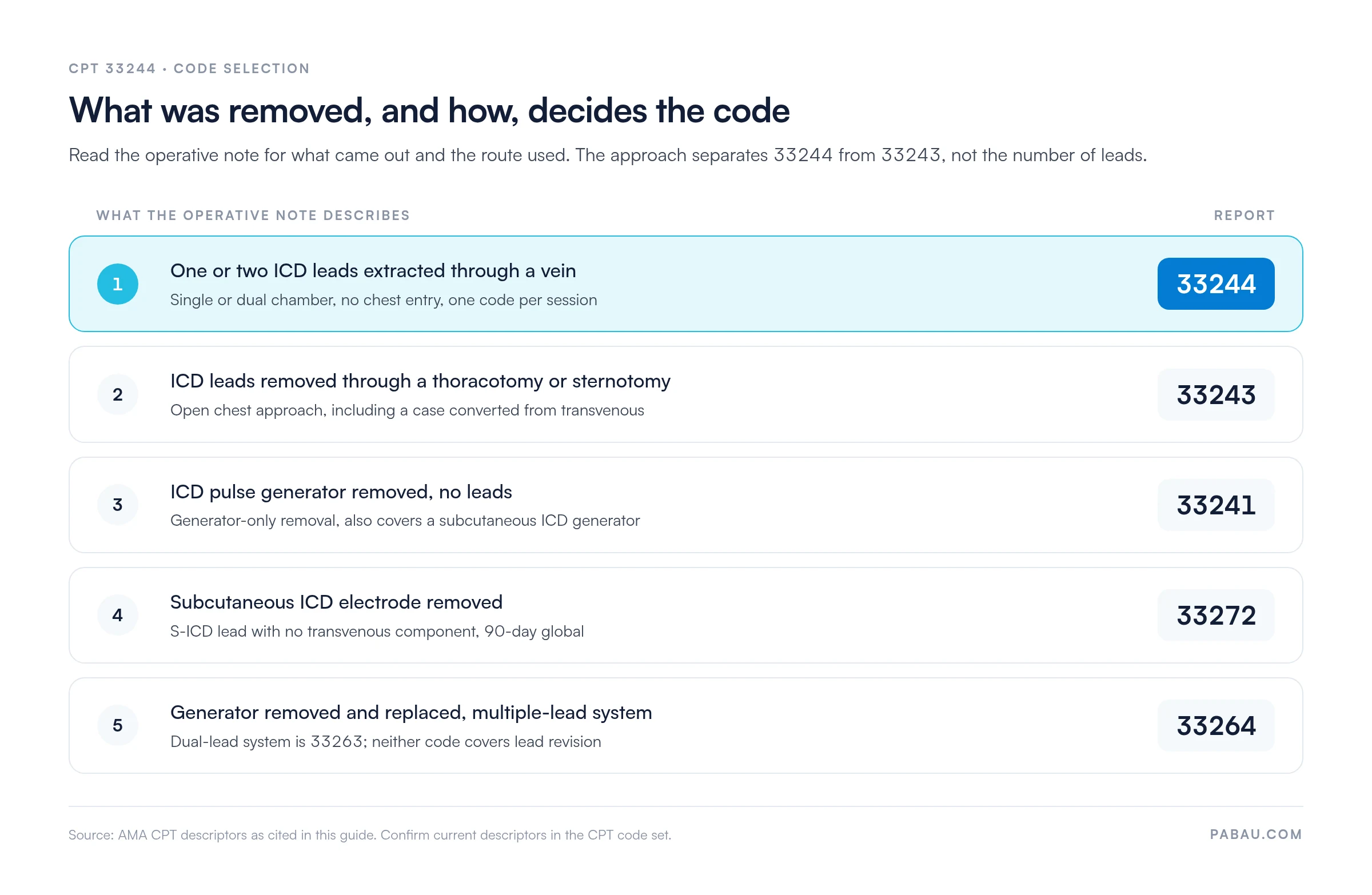
The chart below sorts the five removal scenarios by what the operative note describes.
Only the first row is 33244, and the route in the note moves a case to 33243. Descriptors follow the AMA CPT code set.
Which modifiers CPT code 33244 needs
Modifier choice for 33244 depends on who performed the procedure and what else was billed that day. A wrong or missing modifier is a frequent cause of denials and post-payment audits.
Modifier
When to use
Payer notes
62
Two surgeons each performing distinct portions of the procedure
Each surgeon bills 33244-62, and payment is split. Both operative reports must document the division of work. Confirm 33244’s co-surgeon indicator in the CMS MPFS file before billing.
80
Assistant surgeon providing full assistance throughout
Medicare pays 16% of the allowed amount for 33244-80. Document why an assistant was medically necessary. Confirm 33244’s assistant-surgery indicator in the CMS MPFS file before billing.
AS
Physician assistant, nurse practitioner or clinical nurse specialist as assistant surgeon (Medicare)
Medicare pays 85% of the modifier 80 rate for AS. State scope-of-practice rules apply, so verify with your MAC. Confirm 33244’s assistant-surgery indicator in the CMS MPFS file before billing.
59
Distinct procedural service, applied to 33244 when a pulse generator removal code is billed on the same date
Check the NCCI edit for the specific code pair. If an edit exists for the pair, modifier 59 (or XS) may be needed.
Modifier rules also differ between Medicare and commercial payers. For example, a commercial plan may not recognize modifier AS. Confirm modifier use with each payer before you submit.
How Medicare pays for 33244
Medicare pays CPT code 33244 under the Medicare Physician Fee Schedule (MPFS), with separate facility and non-facility rates. The facility rate applies in a hospital or ambulatory surgery center. The non-facility rate covers office settings, but this procedure almost always happens in a facility because of the equipment it needs.
Facility vs professional billing for 33244
Two entities may bill for the same 33244 session. The hospital or ASC bills the facility fee for the room, staff and equipment. Meanwhile, the physician bills the professional fee at the MPFS facility rate.
The hospital’s claim uses the APC-based Outpatient Prospective Payment System (OPPS) rate instead. A common slip is billing the non-facility rate when only the professional fee is yours to bill.
Billing entity
What they bill
Rate basis
Physician/professional
Work RVU + facility PE RVU + malpractice RVU
MPFS facility rate (lower than non-facility)
Hospital/ASC facility
Room, staff, equipment, supplies
OPPS APC rate (separate from MPFS)
RVU values and payment rates change every January. Use the CMS Physician Fee Schedule search to look up current rates for 33244 by locality. The FastRVU lookup tool shows work, practice expense and malpractice RVUs with geographic adjustments. Never base a current claim on last year’s rate.
Commercial payers negotiate their own rates. Some pay a percentage of MPFS, such as 120% of Medicare, while others use independent fee schedules. Verify the contracted rate with each plan before billing.
What the operative note must say
A 33244 claim pays only when the record establishes medical necessity for the lead extraction. Medicare Administrative Contractors (MACs) apply Local Coverage Determinations (LCDs) that list the qualifying indications. Documentation that does not map to those indications draws a medical necessity denial.
Strong medical billing compliance for high-complexity cardiac procedures starts with the operative record. It should include each item below.
Clinical indication. State the reason for extraction explicitly. Accepted indications include device infection (pocket or systemic), lead malfunction, abandoned or redundant leads that create risk, and lead recall. “Patient requested removal” alone is not a covered indication under most LCDs.
Imaging evidence. Include pre-procedure imaging that supports the indication. Examples are vegetation on the lead in an infection case, or a lead fracture in a malfunction case.
Approach confirmation. The report must state transvenous access and that no thoracotomy or sternotomy was performed. For code selection, this is the most important sentence in the report.
Number of leads removed. State how many leads came out and from which chambers. The code covers both counts, but the count still belongs in the note.
Extraction technique. Name the tool: locking stylet, mechanical sheath or laser sheath. The tool does not change the code, but leaving it out invites questions about the approach.
Complications. Record any intra-procedural complications, how they were managed, and whether the case converted to an open approach.
Physician attestation. The operating physician signs the operative note. In a co-surgeon case (modifier 62), each surgeon submits their own note.
MAC LCDs vary, so check the LCD for your jurisdiction in the CMS Medicare Coverage Database. For a clean claim, attach the operative report to the first submission rather than waiting for a records request.
When 33244 needs prior authorization
Medicare fee-for-service generally does not require prior authorization for CPT code 33244. However, Medicare Advantage plans frequently do, and commercial insurers almost always require it for elective extraction. Urgent cases are different, because most payers allow concurrent or retrospective authorization.
A prior authorization request for 33244 should include:
The clinical indication, matched to the payer’s covered indications list
Proof of failed conservative management where it applies, such as antibiotics tried first in an infection case
Relevant imaging reports or echo findings
Operator credentials showing the physician meets the payer’s lead extraction requirements, since many payers set a volume threshold or require fellowship training
Facility accreditation status, since some payers pay only facilities with cardiac surgery backup
Requirements change often. Verify with the payer before every elective procedure, even when an earlier extraction on the same patient was approved.
How a 33244 claim moves from note to payment
Every 33244 claim passes through the same five stages. Each stage has one job, and skipping one usually means a denial later.
Operative note. The surgeon signs a note that states the approach, the leads and chambers, and the indication.
Coding. The coder picks 33244 or 33243 from the approach, then adds any generator code and modifiers.
Payer check. The biller confirms eligibility, prior authorization, the LCD indication and any NCCI edit.
Submission. The claim goes out with the operative report attached.
ERA. The remittance posts. Any denial code on it tells you whether to appeal or void and rebill.
Before you submit: A 33244 checklist
☐ The note states transvenous access and rules out a thoracotomy or sternotomy.
☐ The lead count and chambers are recorded.
☐ The indication matches an entry in your MAC’s LCD or the payer’s policy.
☐ Modifiers are checked, and any NCCI edit for a same-day generator code is reviewed.
☐ Prior authorization is on file for elective cases with plans that need it.
Why 33244 claims get denied
Denials on CPT code 33244 follow predictable patterns. The same documentation slips and coding errors repeat, and each has a specific fix. Catching the reason before submission works better than appealing afterward.
For practices with high denial volumes, structured denial management turns one-off appeals into steady process improvement.
Denial reason
Root cause
Corrective action and appeal strategy
Medical necessity not established
Operative report does not document an LCD-covered indication
Appeal with the operative note, referring physician’s pre-procedure documentation, and the specific LCD criterion the case meets. Include imaging reports.
Code 33244 billed, approach was thoracotomy
Approach mismatch, where the operative report describes open chest access
Void and rebill with 33243. Do not appeal, because the original code was incorrect. Implement a pre-submission review step that confirms approach language in the operative note before the claim drops.
Unbundling denial, generator removal code on the same date
Modifier 59 missing on 33244 when an NCCI edit exists for the generator removal pair
Appeal with NCCI edit documentation confirming the edit is modifier-billable, attach the modifier 59 rationale, and resubmit. Confirm the edit status for the specific code pair first.
Prior authorization required, not obtained
Elective procedure submitted to a commercial payer without PA
For non-emergency cases, this is typically non-appealable. Submit retrospective authorization with clinical urgency documentation if the procedure was medically time-sensitive. Put a PA check workflow in place for future submissions.
Non-covered indication
Clinical indication documented does not appear in payer’s coverage policy
Appeal with the Heart Rhythm Society (HRS) consensus statement on lead extraction indications as a clinical reference. Request a peer-to-peer review with the payer’s medical director.
Modifier omission
Co-surgeon or assistant surgeon modifier missing from one of the two claims
Resubmit with the correct modifier. Attach both surgeons’ operative notes for modifier 62 cases. Medicare requires both claims to reference the same operative session.
✕ Coding from the procedure name on the schedule. ✓ Code from the approach the operative note describes.
✕ Reporting 33244 twice for a dual chamber case. ✓ Report it once, because the code covers one or two leads.
✕ Appending modifier 59 by habit. ✓ Add it only when an NCCI edit exists for the code pair.
✕ Appealing an approach mismatch. ✓ Void and rebill with the correct code.
✕ Using last year’s fee schedule. ✓ Pull current rates from the CMS lookup each January.
What the 90-day global period covers for 33244
CPT code 33244 carries a 90-day global surgery period under the Medicare Physician Fee Schedule, like other major cardiac procedures. During those 90 days, the operating physician cannot bill bundled services separately. The medical billing basics behind global periods help you avoid accidental overbilling in that window.
What is included in the 90-day global period
These services are bundled into the 33244 global period for the operating physician:
Post-operative office visits related to the extraction
Post-operative complications managed in the office, without a return to the OR
Routine device checks during post-extraction recovery
What can be billed separately during the global period
Modifier 79. Use it for an unrelated procedure within the 90 days. It signals the new procedure is not part of the original global package.
Modifier 78. Use it for a return to the OR for a complication of the original procedure. Expect extra scrutiny on these claims.
Modifier 24. Use it for an unrelated E/M service by the operating physician during the post-operative period.
Services from a different physician fall outside the operating physician’s global period.
Pro Tip
Confirm the global period for CPT 33244 in the current year’s CMS MPFS data before billing post-operative services. CMS updates the MPFS every year, and designations can change. The CMS Physician Fee Schedule lookup shows the current indicator.
How Pabau keeps 33244 claims moving from note to payment
In many cardiology practices, the operative note lives in one system and the claim gets built in another. Billers then retype codes, chase prior authorization numbers and post remittances by hand.
Pabau, a practice management platform with built-in claims management, builds the claim from the patient record instead. The CPT code attached to the service lands on the charge line. The claim can’t go out until required fields, such as authorization numbers, are complete.
For US practices, Pabau’s Claim.MD integration routes claims to thousands of US payers, with real-time eligibility checks before submission. ERAs then post back against the claim. As a result, your team spends its time on the operative note and the coding decision, not on rekeying.
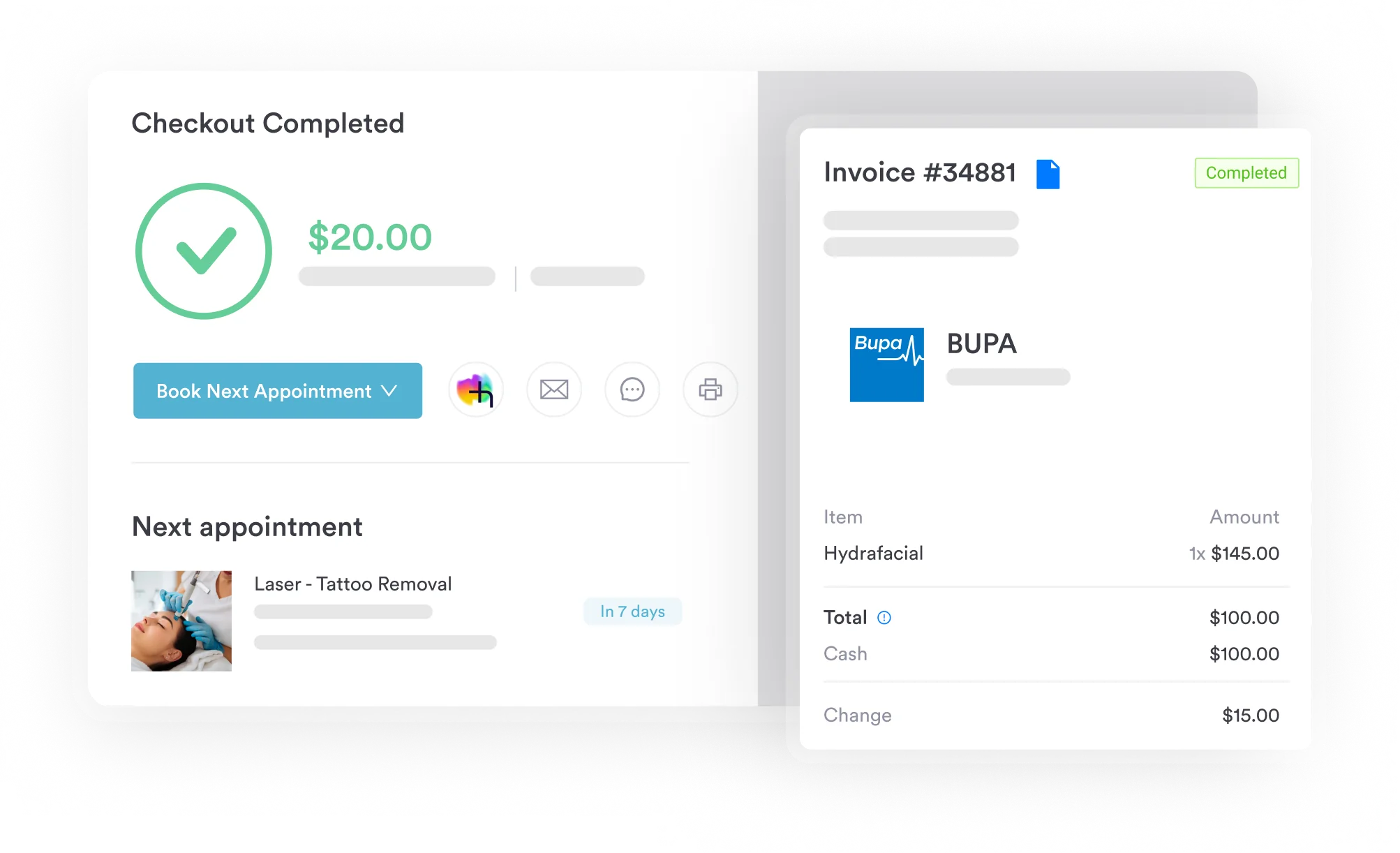
Pabau’s checkout and invoice screen ties each completed visit to its payer, so the 33244 claim starts from the patient record.
Streamline cardiac billing workflows
Pabau integrates with Claim.MD to handle CPT 33244 submissions, real-time eligibility checks and ERA processing, all within one platform built for clinical practices.
Treat the approach sentence in the operative note as the claim. When it says transvenous and rules out chest entry, 33244 holds up. When it is vague, no modifier or appeal letter will rescue the claim.
So put the review step before coding, not after the denial. A two-minute read of the note saves a void, a rebill and weeks of waiting. The trade-off is a small delay on every claim in exchange for far fewer reworked ones.
Book a demo to see how Pabau builds 33244 claims from the patient record and tracks them through to payment.
Continue your research
Need to understand how clearinghouse submission works for complex CPT codes?Medical claims clearinghouse guide explains how claims route from practice to payer and where errors get caught.
Looking for a walkthrough of the 837 transaction format used in cardiac claims?837 file guide covers the HIPAA electronic claim format required for professional and institutional billing.
Want to understand how electronic remittance advice works after a 33244 claim pays?Electronic remittance advice guide explains ERA formats, CARC/RARC codes, and posting workflows.
Removing only the generator?CPT code 33241 guide covers generator-only removal, including subcutaneous ICD generators.
Frequently asked questions
Is 33244 billed per lead or per session?
Per session. CPT 33244 covers single or dual chamber removal, so you report it once whether one lead or two come out through the vein. Record the lead count and chambers in the operative note anyway.
What do you bill when a new ICD goes in?
Report the new device on its own line. A new transvenous ICD system is usually 33249, while a generator-only replacement takes its own generator code. Check NCCI edits for the pair before you add a modifier.
Which ICD-10 codes support medical necessity for 33244?
That depends on the indication. Device infection often maps to T82.7XXA, lead breakdown to T82.110A and lead displacement to T82.120A. Match the code to your MAC’s LCD list before you submit.
How long do you have to file or appeal a 33244 claim?
Medicare allows 12 months from the date of service to file. A redetermination request is due within 120 days of the initial determination. Commercial plans set their own limits, so check each contract.
What makes a 33244 operative note audit-ready?
A clear approach statement comes first. The note should say access was transvenous, with no thoracotomy or sternotomy. It also names the indication, the leads and chambers removed, the extraction tool, any complications and the surgeon’s signature.