

HCPCS Code Q4175: Billing, coverage, and documentation guide
HCPCS Code Q4175: Code Description and Product Identity HCPCS Code Q4175 is the ...

Last Updated: Nov 20, 2026
33999 is the CPT code for unlisted procedure, cardiac surgery. It is reported when a heart surgery is not accurately described by any specific code in the 33016-33999 Heart and Pericardium subsection.
The claim carries the full operative report and a special report naming a comparable code. Payers price it by report, because the code has no national fee schedule value.
Let Pabau's smart automation suggest the right codes, reduce claim denials, and keep your practice compliant—effortlessly.
Automate repetitive tasks and focus on what matters most—your patients.
Reduce coding errors and ensure compliance with the latest regulations.
Clean claims, fewer denials, and faster reimbursements.
Powerful insights and reporting to help your practice thrive.
HIPAA compliant SOC 2 certified GDPR-compliant Trusted by 4,000+ clinics worldwide

CPT Code 33999 covers unlisted cardiac surgery procedures with no matching specific code in the 33016-33999 range.
A complete operative report plus a special report (cover letter) with a comparable crosswalk code are required for every 33999 submission.
Reimbursement is set by report, case by case, because no national fee schedule value exists for this code.
Pabau tracks 33999 claims, prior authorization details and ERA remittances in one place.
CPT Code 33999 is the AMA’s unlisted procedure code for cardiac surgery, used when no code in the 33016-33999 range describes the heart procedure performed.
CMS’s NCCI policy manual says a service not accurately described by any other CPT code shall be reported with an unlisted code.
The same passage rules out a best-fit code unless every component of that code was performed.
Unlisted codes let practices bill for emerging techniques, hybrid procedures and newly approved devices that the annual CPT revision has not yet covered.
The code is a last resort, reported only after a systematic review of every specific code in the Heart and Pericardium subsection. Understanding medical billing fundamentals helps coders see why this distinction matters for clean claim processing.
Procedures that legitimately fall under 33999 include novel robotic-assisted cardiac surgeries not yet assigned a specific code. Hybrid open/transcatheter techniques that span two code descriptors without fitting either qualify too, as do device implantations approved after the latest CPT cycle. The key test is documented evidence that no existing code adequately describes the procedure.
The most common reason a 33999 claim is denied is that a specific code existed and the coder missed it. Before selecting 33999, coders must review the adjacent codes in the Heart and Pericardium subsection. The table below covers the codes most often confused with 33999.
Every 33999 claim requires more supporting documentation than a standard specific-code claim. Payers cannot apply a pre-built fee schedule to this code, so they adjudicate it manually. A complete package on the first pass is the surest way to avoid a denial.
The rules for submitting a clean claim apply here too. Your superbill documentation should capture every required element before the claim leaves the practice. The documentation sits at the center of five checkpoints that a 33999 claim passes on its way to payment.
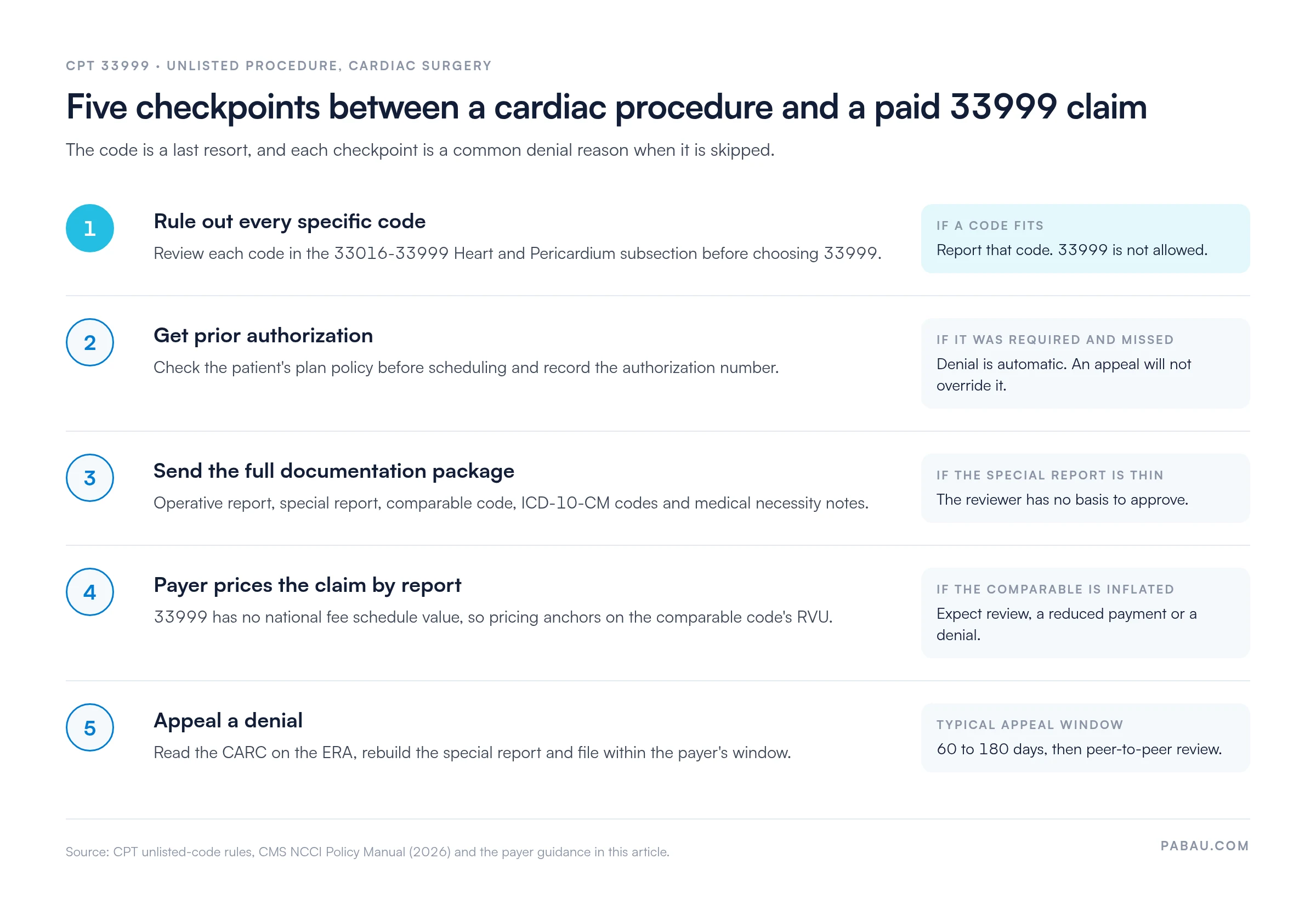
The AMA CPT codebook requires a special report for every unlisted procedure code. CMS echoes this requirement in its Medicare Claims Processing Manual. The operative report and special report together give the payer the clinical and financial basis to price the service.
The AMA specifies that a special report must include the nature, extent, and need for the procedure, plus the time, effort, and equipment required. The five steps below turn those requirements into a report a payer reviewer can price.
Keep the special report to one to two pages. A short, precise report gives the reviewer the comparison they need without burying it in narrative.
Most commercial payers and many Medicare Advantage plans require prior authorization before a procedure billed as CPT Code 33999 is performed. Because the code is unlisted, payers have no pre-built clinical criteria to apply at the claims stage. They want to review the case before the procedure.
Skipping prior authorization when it is required is one of the fastest routes to a non-appealable denial.
Modifiers on a 33999 claim carry extra weight because the payer is already adjudicating manually. An incorrectly appended modifier, or a missing one when documentation supports it, affects the reimbursement calculation and signals inconsistent coding practice. Modifier rules are updated annually with each CPT cycle. Always verify them against the current-year AMA CPT manual.
Run a modifier audit before submitting any 33999 claim: confirm the modifier is listed in your payer’s current policy as applicable to unlisted surgical codes. Some payers do not recognize -22 on unlisted codes without a separate reimbursement appeal letter. Document this check in your billing notes.
CPT Code 33999 reimbursement has no pre-set national fee schedule value. The CMS Physician Fee Schedule does not carry a relative value unit (RVU) assignment for unlisted codes. The payer prices each claim individually based on the comparable code submitted and the clinical documentation provided.
This by-report payment approach means reimbursement rates vary widely, even for the same procedure performed at the same practice.
For Medicare fee-for-service, the MAC prices 33999 by applying the RVU of the comparable code, adjusted for local geographic conversion factors. You can look up comparable code RVUs using the FastRVU 2026 RVU lookup tool to understand the benchmark before submitting.
Commercial payers typically negotiate a rate based on the same comparable code RVU or apply a percentage of the Medicare rate for that analogous code. Never submit a comparable code that overvalues the work. Payers compare the submitted comparable against the operative report, and a mismatch triggers immediate review.
33999 claims are denied more often than specific-code claims because every element of the submission is subject to manual payer review. Understanding denial patterns helps billing teams build a first-pass submission that anticipates the reviewer’s checklist. Good denial management workflows start before the claim is submitted, not after the EOB arrives.
A denial on a 33999 claim is not the end. Most payers allow at least one formal appeal, and peer-to-peer review is frequently available for complex cardiac procedures. Move quickly. Payer appeal windows typically run 60 to 180 days from the denial date.
Medicare processes CPT Code 33999 claims through Medicare Administrative Contractors using a by-report payment methodology. Each MAC adjudicates 33999 independently, which means payment rates and documentation requirements can vary by region even for the same procedure.
The MAC covering the practice’s jurisdiction issues Local Coverage Determinations (LCDs) that may define coverage criteria for specific categories of cardiac procedures. Check the relevant LCD before every 33999 submission.
CMS expects the comparable code submitted with 33999 to match the procedure clinically. A high-value code chosen only as a pricing anchor invites review, and MACs flag submissions where the comparable looks inflated against the operative report. Knowing how the Claim.MD clearinghouse routes claims helps practices send each one to the correct MAC jurisdiction.
AAPC’s Codify CPT range lookup lets coders browse the full Heart and Pericardium subsection and cross-check adjacent codes before finalizing a 33999 submission.
A 33999 claim passes through several hands before it is paid. The coder picks the comparable code, the front desk logs the authorization, and billing chases the remittance. When each step lives in a different spreadsheet, a missing authorization number often surfaces only after the denial.
Pabau, a practice management platform with built-in claims management software, keeps those steps on one patient case. The authorization code, dates and sessions sit on the case, and Pabau warns staff when an authorization is missing.
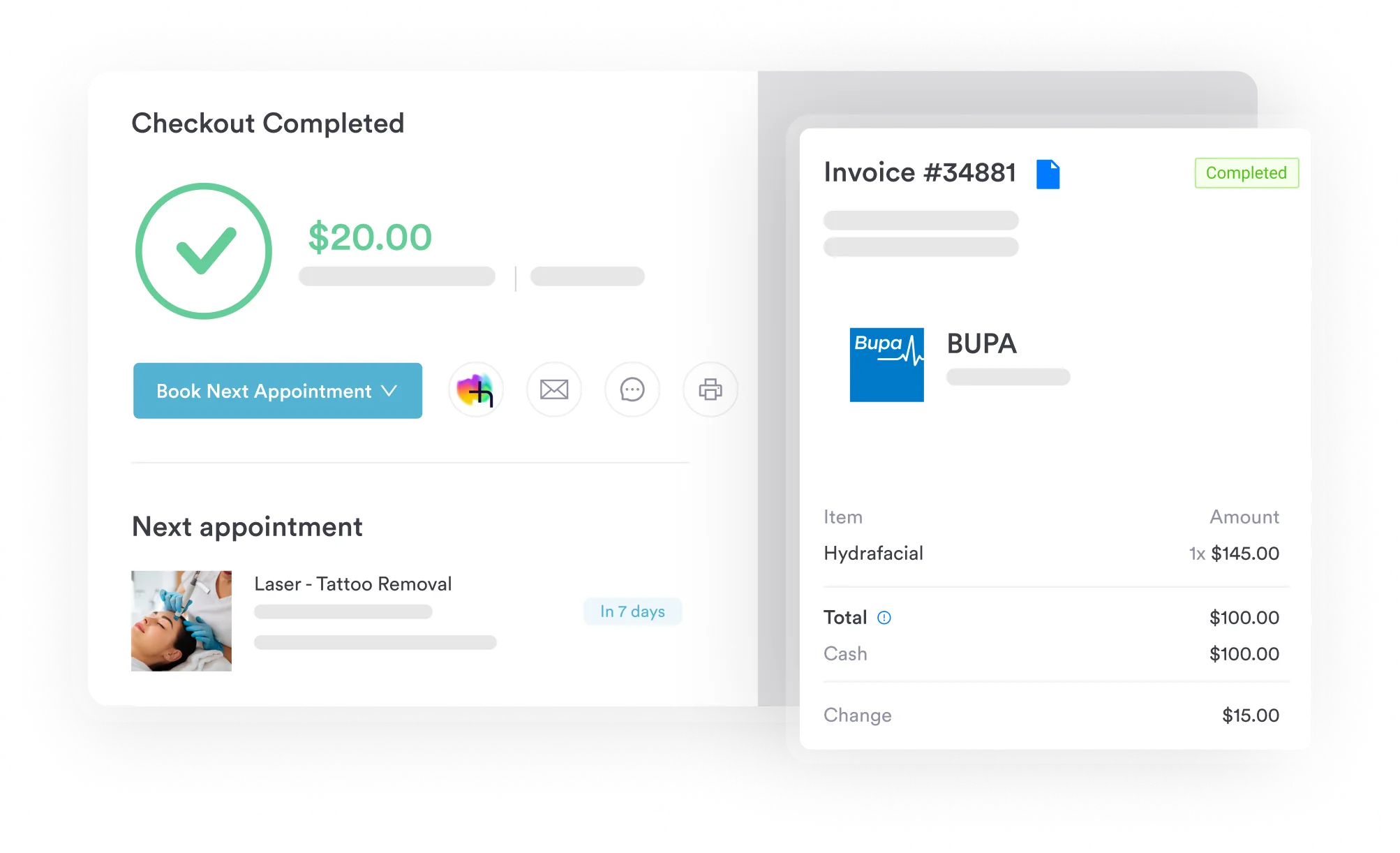
US claims go out electronically through Claim.MD as CMS-1500/837P submissions, with eligibility checks along the way. Pabau then tracks claim status and ERA remittances against each submission, so billing teams know when a 33999 claim needs an appeal.

Pabau’s claims management software sends 33999 claims through Claim.MD and tracks claim status, prior authorization details and ERA remittances in one place.

CPT Code 33999 is a legitimate billing route for cardiac surgery that the annual CPT revision has not yet caught up with. Whether it gets paid depends on the package you send. That means a thorough operative report, a special report with a defensible comparable code, and the authorization number when the plan requires one.
Treat each 33999 claim as a small case file rather than a routine submission, and expect a longer wait for payment. Pabau’s claims management software tracks claims, prior authorization details and ERA remittances in one place. Book a demo to see how Pabau keeps unlisted cardiac surgery claims moving from authorization to payment.

Need a framework for managing claim denials across your practice? Denial management in healthcare covers the end-to-end workflow for tracking, appealing, and preventing claim rejections.
Want to understand how 837 electronic claims work for unlisted codes? 837 file submission explains the electronic claim format MACs and commercial payers use to receive and adjudicate complex claims.
Looking for guidance on electronic remittance and ERA interpretation? Electronic remittance advice breaks down how to read ERA files, identify CARC denial codes, and trigger timely appeals.
CPT Code 33999 is the AMA’s unlisted cardiac surgery procedure code. It is used when no specific code in the 33016-33999 range adequately describes the procedure performed. It requires a special report and comparable code on every claim.
Use CPT Code 33999 only after reviewing every specific code in the 33016-33999 range and confirming none of them adequately describes the procedure. If a specific code exists, it must be used instead, even if the procedure was performed with a novel technique.
Yes, Medicare reimburses CPT Code 33999 on a by-report basis through the relevant MAC. There is no pre-set fee schedule value: the MAC prices the claim using the comparable code’s RVU and geographic conversion factors. Prior authorization may be required depending on the MAC’s local coverage determination for the procedure category.
A comparable code is an existing specific CPT code most analogous in complexity and work to the unlisted procedure performed. Payers use it as a pricing anchor because CPT Code 33999 carries no pre-set RVU. Without a comparable code, the payer has no basis to calculate reimbursement and will typically deny the claim.
Four reasons account for most denials. A specific code existed and was not used, or the special report was missing or incomplete. Prior authorization was not obtained, or the comparable code did not reflect the complexity of the procedure. Check the CARC code on the ERA for the payer’s specific reason.
Yes, CPT Code 33999 can be used for robotic or minimally invasive cardiac procedures. It applies only if no specific code in the subsection adequately describes the technique. Many robotic-assisted procedures now have specific codes. Always verify against the current AMA CPT manual before defaulting to 33999.





