CCSD code XR320: Nasolacrimal duct stenting billing guide
CCSD code XR320 is the UK private insurance code for dilatation or stenting of t...

Last Updated: Nov 24, 2026
33212 is the CPT code for insertion of pacemaker pulse generator only; with existing single lead.
The code fits a session where a new generator is connected to one lead already in place and no new lead is placed. Two existing leads are coded 33213, and three or more are coded 33221. A new generator with new leads is a new pacemaker system, coded 33206, 33207 or 33208.
Let Pabau's smart automation suggest the right codes, reduce claim denials, and keep your practice compliant—effortlessly.
Automate repetitive tasks and focus on what matters most—your patients.
Reduce coding errors and ensure compliance with the latest regulations.
Clean claims, fewer denials, and faster reimbursements.
Powerful insights and reporting to help your practice thrive.
HIPAA compliant SOC 2 certified GDPR-compliant Trusted by 4,000+ clinics worldwide

CPT 33212 covers inserting a pacemaker pulse generator only, connected to one lead already in place. Two existing leads are coded 33213, and three or more are coded 33221.
Medicare coverage follows NCD 20.8.3, which covers non-reversible symptomatic bradycardia due to sinus node dysfunction or second- or third-degree AV block.
Never report 33212 with 33208 for the same session, because 33208 already includes the generator. A new generator with new leads is coded 33206, 33207 or 33208.
Pabau, a practice management platform, sends US claims through Claim.MD as CMS-1500/837P claims, with real-time eligibility checks and ERA remittances in the same record.
CPT code 33212 describes “Insertion of pacemaker pulse generator only; with existing single lead.” That wording comes from the AMA’s CPT code set, which describes procedures performed by physicians and other qualified professionals.
The procedure covers placing an implantable pulse generator (IPG) in a subcutaneous pocket, connecting it to one previously implanted lead, and verifying pacing thresholds. No new lead is placed, and no old generator is removed in the same session.
The lead count is part of the descriptor. Before the CPT 2012 revision, 33212 read “single chamber, atrial or ventricular”, and it has never covered a dual-chamber system. Two existing leads are coded 33213, and three or more existing leads are coded 33221.
The American Medical Association’s CPT code set places 33212 in the Cardiovascular System subsection of the Surgery section, under Pacemaker or Implantable Defibrillator (codes 33202-33275). An electrophysiologist or cardiovascular surgeon typically performs the procedure in an inpatient or outpatient hospital setting. The 90-day global surgery period applies.
CPT code 33212 bundles several services that billers should not report separately on the same claim. The bundled components are pocket creation or revision, connection to the existing lead, threshold and impedance testing, and fluoroscopy to position the generator.
The lead count decides whether 33212 fits at all. The code applies only when exactly one lead is already in place and no new lead goes in. Once the patient has two leads, or the session adds a lead, a different code describes the procedure. A new generator placed with new atrial and ventricular leads, for example, is 33208.
The pacemaker CPT range is dense, and the right code hinges on three questions. Was a new generator placed, was any new lead placed, and was the old generator removed? The decision flow below answers them in order, and the table after it gives each code’s descriptor.
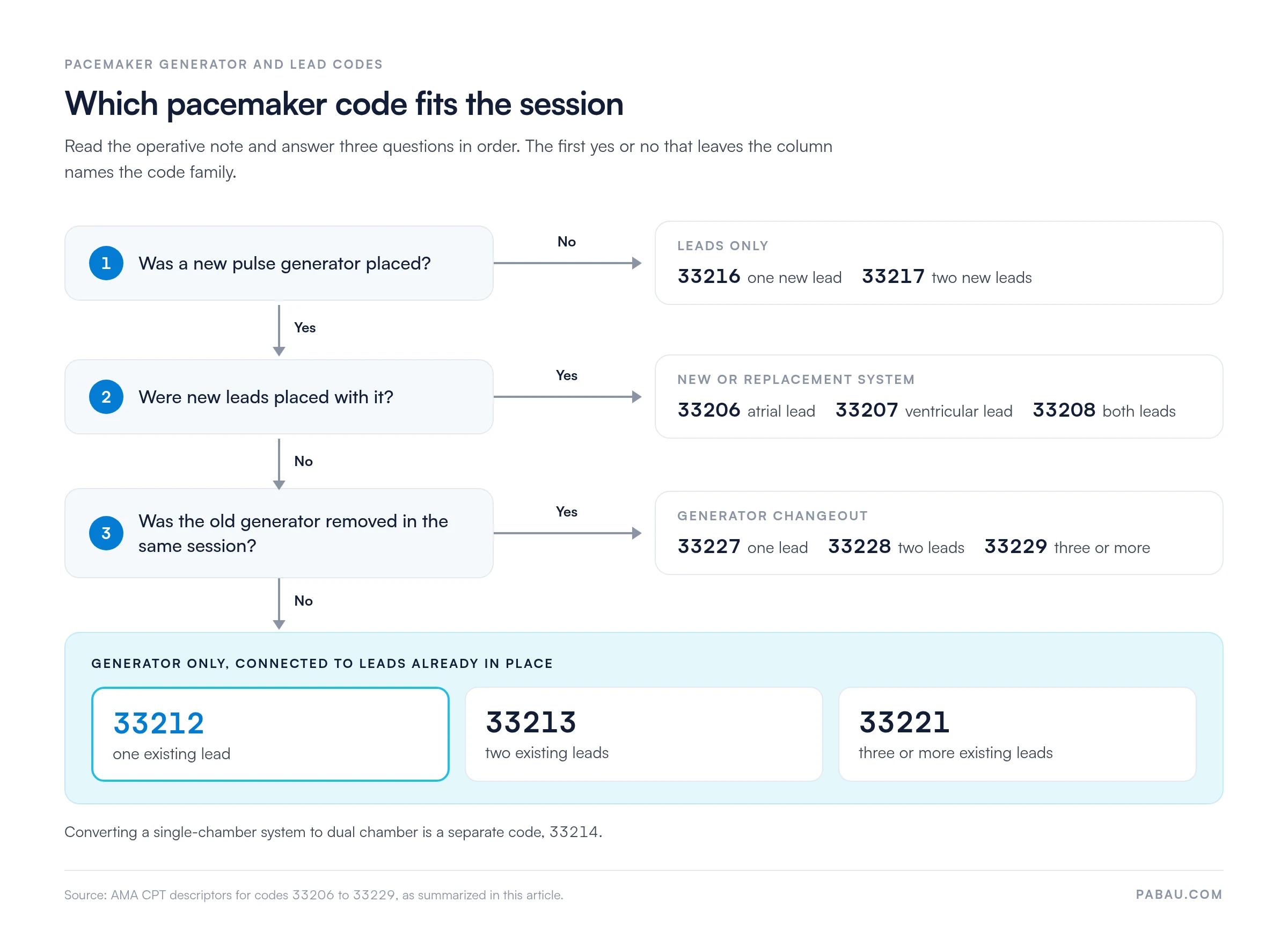
Key decision point: 33212 fits when a new generator is connected to one existing lead and no generator is removed in the same session.
When the old generator comes out and a new one goes in at the same session, report 33227, 33228 or 33229 by lead count. A same-session changeout billed as 33212 misstates the procedure and invites a denial or a recoupment on audit.
Run a pre-claim check on every pacemaker date of service. Count the leads the operative report says were connected, and check whether any new lead went in. One existing lead and no new lead supports 33212. Any other answer points to 33213, 33221, a changeout code or a new-system code.
Payers require a complete operative report to process CPT code 33212 claims. An operative note that leaves out key elements is a common cause of medical necessity denials for this code. The same elements are part of any clean claim submission, so the checklist below serves both jobs.
The operative report must include all of the following to support both medical necessity and accurate coding. Confirm the list with your MAC too, because its local coverage policy may ask for more than the national standard.
CMS National Coverage Determination 20.8.3 sets the Medicare indications for single- and dual-chamber permanent pacemakers. It covers non-reversible symptomatic bradycardia due to sinus node dysfunction or to second- or third-degree AV block.
A Medicare claim for CPT code 33212 should carry an ICD-10-CM code that maps to one of those indications. Any indication the NCD does not address is left to your MAC, and an unsupported one invites a medical necessity denial.
Use the most specific ICD-10-CM code available. Bradycardia codes like R00.1 attract payer scrutiny because they are non-specific, so code the underlying rhythm disorder whenever the chart documents it. Asymptomatic first-degree AV block, coded I44.0, appears on the NCD’s non-covered list and will not support the claim alone.
Three surgical-team modifiers can apply to CPT code 33212, and whether each one pays depends on the code’s MPFS indicators. Using the wrong one, or leaving out a required one, often leads to a denial on pacemaker claims.
Modifiers not applicable: -LT and -RT (left and right laterality) do not apply to pacemaker generator codes because the procedure is not bilateral in nature. Appending a laterality modifier to CPT code 33212 can trigger a claim edit.
RVU values for CPT code 33212 change annually under the Medicare Physician Fee Schedule. Verify current figures using the CMS Physician Fee Schedule lookup tool or the FastRVU 2026 RVU lookup before submitting claims or performing practice valuations. The table below shows how each component is built; look up the current figures in the MPFS before billing.
Geographic practice cost indices (GPCI) adjust the final Medicare payment by locality. A cardiology practice in Manhattan receives a materially higher payment for CPT code 33212 than one in rural Mississippi. The rest of the claim can be identical. Use the CMS MPFS lookup with your specific locality code for accurate projections.
Most commercial payers and Medicare Advantage plans require prior authorization before pacemaker implantation procedures, including CPT code 33212. Traditional Medicare (Parts A and B) does not require pre-authorization for the professional component. The claim is still covered only when the NCD 20.8.3 indications are met. Requirements differ by payer and plan, so check each one before scheduling.
Typical prior authorization documentation requirements include:
Submit the prior authorization request well ahead of an elective procedure, since some payers ask for 5-7 business days. For urgent placements, many payers allow retro-authorization within a set window, such as 24-48 hours, so confirm each payer’s window in advance.
A missing authorization is a common reason CPT code 33212 claims are denied. The remittance then names the reason with an adjustment code, and this guide to common denial codes explains each one.
The denial patterns below recur on pacemaker generator claims, and each one is preventable with a pre-claim check. For a broader framework on preventing rejections, see Pabau’s guide to denial management workflows in healthcare billing.
Because 33212 is a generator-only code for one existing lead, most same-day pairings with other pacemaker codes describe a different procedure. Code the session once from the operative report, then check any remaining pair against the current CMS NCCI tables. A session that places two new leads and no generator is 33217 on its own.
Facility vs professional billing split: The facility reports the device, supplies, and room charges on the UB-04. The physician reports CPT code 33212 on the CMS-1500. Both claims are filed separately, but the diagnosis codes and procedure date must match. A mismatch between the facility and professional claims draws audit attention to both.
Cross-reference the facility claim to the professional claim before submission on every pacemaker date of service. Confirm that the diagnosis codes match, the procedure date is identical, and the facility’s device charges show a generator only, with no new lead. A short cross-check costs less than reworking a denied claim.
In many practices a pacemaker claim passes through three tools. The coder reads the operative note, keys the code into a separate clearinghouse portal, and posts the payment by hand when the remittance arrives. Each handoff is a chance to drop the lead count, the modifier or the authorization number.
Pabau keeps those steps on the patient record, with built-in claims software for practices. US claims go out through Claim.MD as CMS-1500/837P claims, and Claim.MD connects to thousands of US payers for real-time eligibility checks and ERA processing. The prior authorization code, dates and sessions sit on the case, with a warning when one is missing.
The result is a 33212 claim built from the same record as the note behind it. Eligibility is confirmed before the procedure, and the ERA lands against the claim it pays, so denials surface sooner.

Pabau sends US claims through Claim.MD, checks patient eligibility in real time, and posts ERA remittances. A 33212 claim and its payment stay on the same patient record.

Code 33212 from the lead count in the operative note, never from the device order or the schedule. One existing lead, no new lead and no generator removed is 33212. Any other combination is a different code, and the note has to show which one.
The trade-off is a few minutes before submission against weeks after a denial. Checking the lead count, the removal status and the NCD 20.8.3 indication up front is cheaper than reworking a denied or recouped claim.
Book a demo to see how Pabau carries a pacemaker claim from the operative note to the ERA on one patient record.

Need to understand the claims lifecycle behind pacemaker codes? Claim.MD clearinghouse guide explains how electronic claims move from submission to ERA for cardiology practices.
Seeing high denial rates across your CPT claims? Revenue cycle management overview covers the end-to-end workflow from charge capture to payment posting.
Need a checklist for clean claim submission? Denial codes in medical billing maps common CARC codes to their root causes and fixes.
Billing a new single-chamber system instead? CPT code 33207 covers a new or replacement pacemaker with a ventricular lead.
CPT code 33212 covers inserting a pacemaker pulse generator only and connecting it to one lead that is already in place. No new lead is placed. Two existing leads are coded 33213, and three or more are coded 33221.
CPT 33212 is a generator-only code for a patient with one existing lead. CPT 33208 is a new pacemaker system, with the generator plus new atrial and ventricular leads placed in the same session. Because 33208 already includes the generator, the two codes are not reported together for one session.
Yes, for most commercial payers and Medicare Advantage plans. Traditional Medicare does not require pre-authorization for the professional component, but the claim must still meet NCD 20.8.3 coverage criteria. Requirements vary by payer, so verify them before the procedure date.
The surgical-team modifiers are -62 (two surgeons, each performing a distinct part) and -80 (assistant surgeon). Payment for each depends on the MPFS indicators for 33212. Modifier -AS covers a physician assistant at surgery, billed under the assistant’s NPI. Laterality modifiers -LT and -RT do not apply to 33212 and cause claim edits when appended.
Common denial causes are missing prior authorization and a diagnosis code outside the NCD 20.8.3 indications. Others are a lead count that does not match the descriptor, 33212 reported alongside 33208, and place-of-service errors (POS 11 instead of 21 or 22). Incomplete operative reports round out the list, and a pre-claim checklist prevents each one.
In most cases, no. A new generator with one new lead is a new pacemaker system, coded 33206 (atrial) or 33207 (ventricular). CPT 33216 is for inserting a lead only, when no new generator is placed. Check the current CMS NCCI tables for the exact pair status before submission.